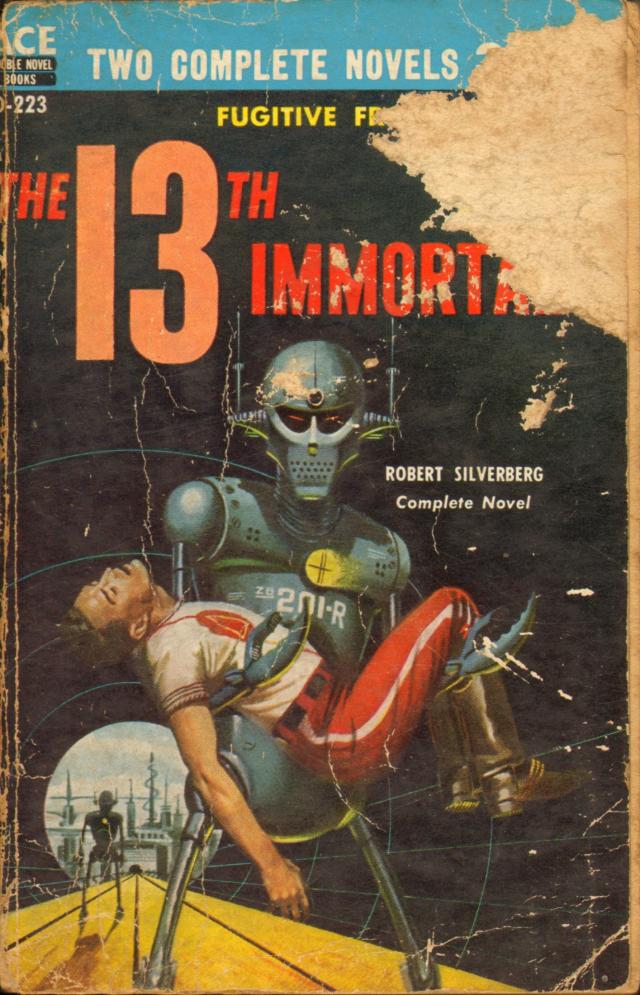
The 13th immortal, p.7
The 13th Immortal,
p.7


“I'm looking for. ... I don't know his name. He's tall, very tall, and—" He broke off, overwhelmed by self-conscious guilt, unable to recite the catalogue of one mutant's alienness to another.
“Go ahead," the mutant said with surprising warmth. “Tell me what he looks like and I'll see if I can find him. I'm not offended."
Kesley licked his lips and proceeded to describe the man he sought as vividly as possible. When he was through, the mutant nodded.
“You look for Lomark Dawnspear, friend. Has he wronged you?”
“No,” Kesley said hastily, beginning to wish he had never come. “I just want to talk to him.”
“Wait here. Ill try to bring him to you.”
Kesley waited. The mutant vanished in the confusing tangle of closely-packed shacks.
In the midst of this poverty and genetic horror, Kesley held himself perfectly still, hoping not to call to himself the attention of some unfortunate who might be jealous of his fine clothes or unscrambled chromosomes. But no one approached him. The mutants held their distance, eyeing him with unashamed curiosity from the cramped porches of their huts.
It was a panorama of total ghastliness. Kesley could see now where the horror with which men regarded the Old Days had arisen: the people here were living reminders of the crime of the Old World—a crime, Kesley thought, whose consequences were visited upon the tenth and the twentieth generations.
“You seek me?” a harsh voice said.
Kesley snapped to attention and saw the hoarse-voiced Jeremiah of the streets approaching him, escorted by the dewlapped one. Kesley nodded; this was the man. In such profusion of mutation, there would hardly be two so marked.
“Do you remember who I am?” Kesley asked.
The mutant chuckled. “Could I forget? You’re the young killer from the southlands, up here to do away with—but hush! I must not give it away!”
Kesley gripped the mutant by the baggy folds of flesh that hung loosely on one spidery arm.“ How do you know anything of who I am?”
The mutant shrugged. “How could I keep from knowing?” His voice was mild and apologetic now, with little of its earlier raucous quality. “I can no more keep from knowing, than you—than you can keep from needing food, or seeing when your eyes are open. I . . . know”
“How much do you know?”
“Why you are here, and where you are from . . . and where you will go, and what you will become.” Lorn ark Dawnspear’s voice had modulated into a dull, almost ritualistic drone. “I see these things, and I do not speak. I speak, but you do not see. Blind, I know you. Eyes open, you march into treachery.”
Kesley released the mutant and stepped back. He was shaking with inward horror; his empty stomach seemed to be squirming. “What are you talking about?”
The mutant smiled feebly. “Counter-question: who is your father, handsome blond man?”
“My father? I—”
“You do not know?”
“All right—I don’t know. Do you?”
“How could I not know? Can the maggot restrain its hunger? Can the Earth forget its orbit?”
“You know, but you’re not talking. Is that it?”
Dawnspear shrugged again. “You would not want me to tell you,” he said softly. “I see that, too.”
“All right,” Kesley said, irritated. “Forget all about that. Give me some other answers.”
“If I can.”
“The man named van Alen—is he dead?”
“No.”
“Where is he?”
“In his home. Antarctica.”
“It was true, then,” Kesley said. He stared into the mutant’s dead eyes. “Who is he?”
“A noble of the Antarctican land,” Lomark Dawnspear said. “Forget van Alen. Watch Miguel . . . and Winslow. Watch everyone, youngster. Watch Santana, the greasy prelate. Watch me. Watch the fool stealing up behind you this very minute.”
“The oldest trick in the world,” Kesley said skeptically. But he felt a sudden cold sensation between his shoulder-blades, and whirled quickly. Another mutant stood there, a wide, slablike thing with four arms pivoting off jointed shoulders. One of its thick-fingered hands clutched a rock, jagged and heavy.
Moving instinctively Kesley grasped the arm holding the
rock and yanked it down, smashing a fist into the broad creature’s stomach at the same time. The rock thudded to the ground; the four arms windmilled aimlessly for a moment or two, and then the mutant backed off mumbling stertorous, incomprehensible curses.
“You’d better leave,” Lomark Dawnspear said. “Some of the slower ones are beginning to realize you’re here. They're likely to make things dangerous for you.”
“But you haven't told me a thing,” Kesley said.
“The answers lie ahead of you . . . the answers and the questions. Now go.”
Scowling, Kesley drew his robe tighter around his sweating
body and remounted his horse. The mutant ghetto seemed like a nightmare world, shifting in and out of reality almost at random, blurring into dream and then focusing sharply on hideous actuality. Without looking back, he spurred his animal and rode hastily out of the valley.
Somehow, the long week passed, and somehow Kesley endured it. Each day brought him closer to the audience with Winslow, when he would be called upon to act as assassin.
And he still had not a shred of plan.
Kesley's imagination had throbbed in constant feverish play all week, picturing and re-picturing the scene. Winslow —what did he look like? Suave and bearded, with dark tired eyes like Miguel's? Thin, pallid? Bloated?
It didn't matter. There was a Winslow on the throne, faceless and personality less, and surrounding him were blurred shadows of courtiers: a priest perhaps, a few generals in formal armor, men like that. Kesley saw himself kneeling in the Duke’s long hall, rising to advance on nerveless legs to the throne—
Plunging a knife into the Ducal bosom.
Firing an echoing pistol shot as he rose from obeisance.
Leaping forward and throttling Winslow on the throne.
Actually, he knew, it would not be that way. A Duke had an eternity to lose at an assassin's hands, and would be expected to surround himself with protection. No one, not even Miguel, would place himself at the mercy of anyone begging audience simply for the sake of “amusement.” There were too many years to be lost.
Yet Kesley's active mind continued to develop a multitude of alternative methods for the killing, and always the picture ended with the moment of death. He found himself unable to project the action past the actual assassination; the sequel escaped his mind completely.
Seven days passed and, on the eighth, Kesley and Duke Winslow were to come face to face.
On the morning of the final day, Kesley rose early. Sleep had been intermittent during the just-ended night, and he left his quarters wearily shortly after dawn. On foot, he wandered through the awakening city, in full regalia.
By now it was generally known that ambassadors from Miguel's court had been in Chicago for the past week, and he drew uneasy stares from the curious early risers. He walked on, down one cobbled street after another, smelling the early morning smells of fresh air and the fresh food offered in the stalls.
The bright sunlight was glinting off Winslow's palace, sending down showers of scattered light. Winslow is awakening now, Kesley thought. For his last morning. After four centuries he*s come to his final day.
Suddenly hungry, Kesley turned into a food shop that appeared a few feet away.
“Good morning,'' the proprietor said unctuously.
Kesley swung himself down into a booth without replying. After a moment, he looked up. “Coffee,” he said.
“Certainly, senor."
The white-uniformed counterman seemed delighted to be serving one of the South Americans. He bustled out officiously from behind the counter and put the cup before Kesley.
He tasted the coffee. The synthetic beverage was tepid, slightly oily. Nevertheless, he forced himself to finish it, then sat broodingly in the booth staring at the gray film of dinginess that overlay the empty cup.
“Something else maybe, senor?”
“No—nothing,” Kesley said. “I'm not very hungry.”
“Too bad, senor. Has the trip north disturbed your appetite? The food you’re accustomed to—”
Damned chatterbox, Kesley thought, irritated.
“My appetite is fine.” He dropped a coin ringingly on the counter and walked out, into the warm, stale morning air.
Glancing around tensely, he let his hand slip to the hilt of his dagger. He caressed it absently for a moment, scowling. The minutes were crawling by like snails; the audience with Winslow would never come.
Dispiritedly, he turned his steps back toward the hotel. The desk-clerk looked up idly as he entered.
“Senor?”
“What is it?” Kesley snapped.
“The man from Duke Miguel—have you seen him?” “What man?” Kesley asked, puzzled.
“He arrived while you were out—a small man with a heavy mustache. His horse was nearly dead; he must have come in a great hurry.”
Kesley frowned. He was expecting no one from Miguel. Hope flashed brightly: perhaps it was a last-minute reprieve for Winslow, and thus for Kesley. Perhaps, he thought, it was a cancellation of the assassination order!
“Where is he?” Kesley asked hurriedly.
The desk-clerk jerked his head upward. “He went upstairs. Oh, about ten minutes ago. I guess he’s still there.”
“Gracias” Kesley said. With sudden excitement he dashed up the stairs, threw open the door, and looked around.
No one was in the outer room of the suite. From within came no sound—not even the usual boisterous horseplay of his men. Cautiously, Kesley opened the inner door. Within, he saw Santana huddling over his breviary in his usual chair.
“Santana?”
There was no reply.
“Padre?”
The priest appeared to be totally absorbed in his reading. Annoyed, Kesley crossed the room and grabbed Santana roughly by the shoulder. The plump Archbishop spun limply, sagging backward as Kesley touched him, and dropped heavily from the chair.
Kesley paled. The red velvet of the Archbishop’s robes was stained with a deeper red, already turning a crumbling brown. A knife had been thrust through the folds of fat that covered the priest’s heart, and had found its mark. Santana had attained the martyrdom he coveted.
“Feliz! Domingo!” Kesley shouted. His voice sounded harsh, dry. “Luis! Where are you?”
He strode to the adjoining door and threw it open—and his men, as if they had been held back by a spillway, came pouring forth.
All six rushed out and, Kesley saw, there was a seventh with them, a small dark man who was apparently the courier from Miguel’s court. Kesley leaped back and had his pistol and knife out almost before his mind was aware that he was under attack.
The gun barked. One man fell. The courier leaped forward, knife-blade high; Kesley sidestepped and ripped through the flesh of the man’s back with a fierce downstroke. Turning quickly, he kicked a third man in the stomach, and backed toward the door.
They had no guns, but they outnumbered him six to one. Tossing his mantle to one side for greater freedom, Kesley chopped downward with the knife and drew blood again, while one of the grooms sidled toward him and slit his arm shallowly with a rapid lick of his blade. Kesley fired again, and the man fell.
Then he managed to bull out the door and down the stairs, with the five remaining South Americans thundering after him. At the first landing he paused to fire; a body tumbled toward him, and he caught the small man and wedged him crossways in the stairwell just as the other four approached. Kesley ducked as a thrown knife whizzed past his ear, and kept running.
He dashed out past the astounded clerk and into the courtyard. The hotel’s ostler, a tall, bony old man with walrus mustaches, was puttering around Kesley’s horse, rubbing it down with the tenderness a skilled groom would devote to a choice animal.
“Get out of the way, you idiot!” Kesley yelled as he entered the court. Bewildered, the old man looked up, smiling mildly.
“Your horse is not yet curried, sir, and—”
“Out of the way!"
Kesley shoved the oldster to one side just as the four swarthy assassins swept into the courtyard and swarmed toward him. The old man tottered and took a couple of staggering steps that led him straight into the path of the South Americans; Kesley, mounting the horse, winced sympathetically as they collided with him and threw him roughly to the ground.
But the delay allowed Kesley to mount his animal and, even without spurs, he was able to bring the horse under quick control. He wheeled it toward the onrushing assassins. The magnificent beast whinnied and plunged forward.
Surprised, the South Americans yielded before this frontal attack; one aimed a knife blow at the horse’s flank, but Kesley’s boot caught the man’s face and sent him reeling away. Kesley charged through the straggling, disarrayed South Americans and out of the courtyard into the main thoroughfare.
He rode three or four blocks, then pulled up, gasping for breath, and guided the horse into a side-street for a moment.
For the first time in the last six minutes, he had a chance to evaluate the situation:
Point: Santana was dead.
Point: his six men had turned against him, and only their stupidity and his agility had kept Kesley from sharing the Archbishop’s fate.
Point: someone had arrived from Miguel’s court shortly before.
Therefore, Miguel had changed his mind and had ordered the assassinations of Santana and Kesley. Or had Miguel changed his mind? Perhaps this entire expedition had been a complicated way of wiping out a troublesome Archbishop?
Kesley’s fingers quivered. Anything was possible—anything —when dealing with immortals.
“Betrayal and betrayal again" the mutant Lomark Dawn-spear had prophesied. And the mutant had been right.
For one reason or another—or perhaps none at all, Kesley thought coldly—Miguel had betrayed him.
And the counter-betrayal? Kesley smiled. Fifteen minutes ago he had been steeling himself for the work of assassinating Duke Winslow. Now he would, rather, swear allegiance to him. The decision was made quickly, for Kesley saw it was the only path open to him.
He rode out of the shadows and onto the main stem again, moving cautiously as if expecting to see the four small Argentinians charging madly out of nowhere toward him. But they were not to be seen; the street was crowded with Chicagoans going about their morning business, and a sickly aura of heat was starting to descend as the August day edged toward noon.
Clamping together his tattered sleeve over his flesh-wound, Kesley rode out and toward a mounted policeman who sat stiff and proud in his green-and-gold uniform, looking down on the pedestrians.
“Officer?”
“Yes, senor?”
The title pleased Kesley; that meant he had been recognized. “There's been a disturbance down at my inn. My men were drinking, apparently. They’ve assassinated His Holiness, and attempted to kill me when I returned from my morning walk.”
“How many are there?”
“I killed three in escaping. There are four left still at large down there.”
The policeman drew a whistle and uttered a brief, subsonic blast. Almost instantly, a second mounted man rode up, and at his request Kesley repeated the story word for word.
I'll go down there,” the first officer said.
Kesley turned to the other. “Would you conduct me to the Palace? I feel I should seek sanctuary with the Duke until affairs are more stable.”
“Of course.”
Together they rode down the winding road that led to Winslow's Palace. The policeman was a man of few words; once, he asked if Kesley had any idea why he had been attacked. Kesley shrugged without replying.
For the first time, Winslow's rosy palace seemed to Kesley a place of refuge rather than the place where he undoubtedly would meet his death. He smiled grimly. Assassins had become assassins' victims; the wheels had turned, and the positions on the board had altered. For Santana, it had been check and mate; Kesley had escaped, through no fault of Miguel's.
But what if Miguel's messenger had come too late? Suppose Kesley had already seen and killed Winslow? Kesley frowned; it was impossible to divine just what Miguel's real motive was. But now there would be no more dealings with Don Miguel.
A phantom thought struck him, and his lips curled upward. What if Winslow were to engage him in similar service and send him back to assassinate Miguel?
It was possible. Anything was possible, Kesley thought dismally. Anything was possible at all, in this chess game with all moves masked.
They drew near the palace. As usual, the guard at the gate inquired what business Kesley had within.
“I have an audience with the Duke,” Kesley told him.
With great punctiliousness, the gateman disappeared into his tower and returned clutching a lengthy appointment sheet.
“The audience is at two,” Kesley said impatiently, as the gateman’s eyes wandered all over the sheet.
“Indeed so,” the guard replied after a moment. “And I believe it's no more than ten now. Duke Winslow will see you in four hours, no sooner, senor.”
Kesley wiped away sweat and fought down an impulse to cut the guardsman down with an impatient blow of his dagger. “It's an emergency. Tell the Duke that. Tell him that the
Archbishop’s been assassinated, and that I must see the Duke now!”
A flicker of interest crossed the guard’s eyes. "Ill tell him that. Wait here.”
Ten minutes later the guard returned. "Go in,” he said
laconically.
"You need me any more?” asked the policeman at Kesley’s side.
“No—thanks, you’ve been very helpful.” He handed the man a coin; as an afterthought, he gave one to the gatekeeper as well, and entered.
A dejavu emotion filtered through him at the sight of the interior of Winslow’s Palace grounds. There was the same broad courtyard as at Miguel’s, the same distant entrance. This time, though, a cold-faced man in Imperial uniform was waiting for him.