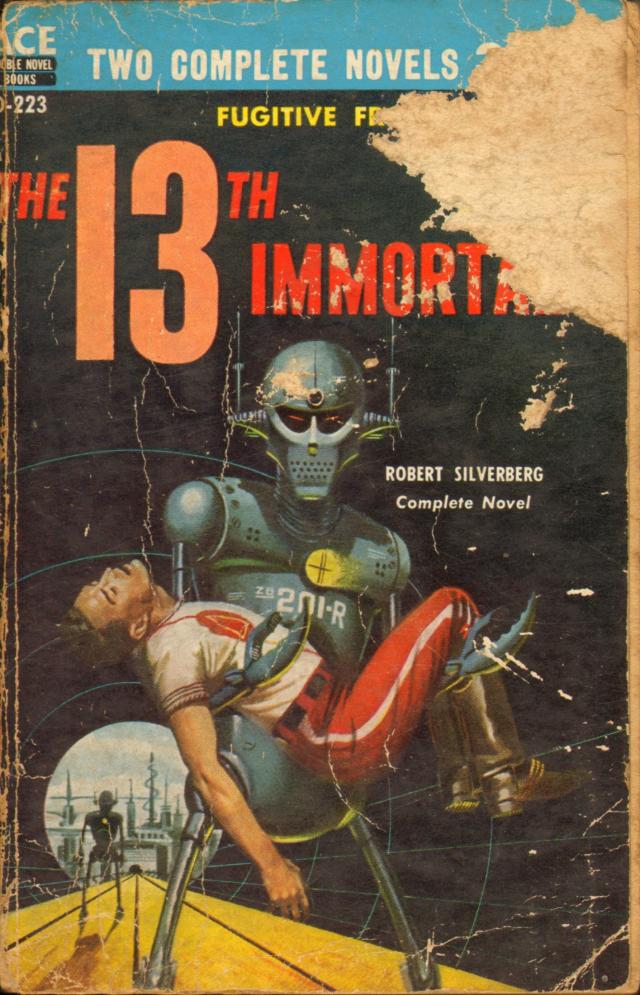
The 13th immortal, p.9
The 13th Immortal,
p.9


In the morning, the elaborate, half-mythical tracking devices would be brought into play: the needle-snouted, mechanized bloodhounds of legendary dread, the whirling radar parabolas, the ingenious screens and devices inherited from a culture long dead. It wasn’t much of a secret that the Dukes maintained many of the taboo devices of the Old World, and used them for their private ends. Miguel’s closed-circuit TV, Kesley thought, was an example.
But the bloodhounds wouldn’t be called out till later. Right now the reaction was one of simple hysteria; heads would be rolling at the Palace if Kesley were not found at once. And, he thought, riding atop a Ducal horse, clad in Ducal uniform, it wasn’t too likely that they were going to find him.
He glanced ahead. The guards were riding together, forming an anxious little circle. Evidently someone had called a halt and was about to organize a systematic search.
Further ahead, the towers set in the wall ringing the city were lit; the guards there had been roused as well, it seemed. Kesley surreptitiously cantered out of line and cut off down a dark side-alley, taking care that none of the guards were following him.
A few minutes later he reached the West Gate—smaller than the other three, and lightly guarded. Drawing his horse up before the guard-tower, he shouted: “Open the gate, you idiots! The assassin’s escaped, and he’s heading west.”
“What are you saying?”
“I said open the gate. I’m Duke’s guard. You’re holding things up. The assassin’s out there at large someplace!”
The door swung back.
“Thanks,” Kesley yelled. He kicked the mutant’s scaly hide to make the beast spurt ahead. He raced through the open gate and out of Chicago. The confused shouts of the guards echoed faintly in the distance as he urged the horse on.
Breaking out into the flat country that ran westward, he rode hard without any direction or destination in mind. Once he looked around and saw three riders about two and a half miles back, pelting steadily after him.
They were on to him then. He hadn’t fooled them completely. But it had worked well enough to get him clear of the city and, if he could put more space between himself and Chicago before they turned the hounds on him, he’d be all right.
The road veered suddenly and split into a network of forks. Almost without thinking, he grabbed the south fork and urged the horse on. He didn’t know the country at all down there, but there were cities-Peoria, St. Louis, Springfield, Cairo way down on the river. Somewhere between those empty names, he had heard there was a Mutie City— a regular refuge for mutants, a walled city of some sort where not even Duke Winslow’s hand could reach.
He bent low over his horse’s stringy mane and urged the gasping beast on. Glancing back, he saw his pursuers— and dim in the night was something dull and metallic grinding toward him down the flat road.
Bloodhound.
They had the hounds out after him already. Winslow wasn’t going to let him escape lightly.
Shortly after sunup, his exhausted horse stumbled and fell, pitching him to the ground. Kesley rolled to his feet, glanced once at the animal’s splintered leg doubled beneath its body, and looked back. No sign of his pursuers now.
He destroyed the horse with a single bullet and started moving, on foot, through the underbrush. He had no idea where he might be, except that he was somewhere south of Chicago.
Through the rest of the morning he hacked his way through the wild vegetation that had sprung up in this uncultivated area. Exhausted finally, he stopped near noon to rinse some of the sweat from his face at a clear blue brook.
Wearily, he scuttled away from the brook and started to get to his feet, without success. He remained kneeling, staring at the quivering tips of his fingers, smelling the warm morning air and listening to the singing of the untroubled birds, and finally slumped forward, face down in the fertile soil, and slept. He had been awake almost fifty hours.
Later, Kesley felt gentle hands slide under his body and scoop him up. Foggily, he opened one eye and fought to focus it. Deep in his mind, he was struggling toward wakefulness, acutely aware he should flee but unable to make his exhausted body respond.
“Let go of me,” he murmured, clawing fitfully at the hands that held him. He blinked. “Where are the hounds? Don't let the hounds near me."
“There are no hounds," a purring voice told him. “Winslow's men turned back hours ago."
Some of the cobwebs cleared from his brain. “No hounds? You’re not from Winslow?"
“Look at me and see."
The hands released him and slowly Kesley turned. Standing behind him, arms extended uneasily in case Kesley should topple, was a graceful, seal-like creature with glistening, golden-brown skin. A slit-like mouth was bent into a clumsy smile; narrow yellow eyes gazed warmly at him.
“I'm . . . very tired,'' Kesley said.
The mutant nodded gently. “You should be," he said. He took a step forward, and caught the exhausted Kesley just as he began to fall.
IX
Sanctuary—for a while.
“So I'm not to be allowed any rest,” Kesley said bitterly. “Three days here and you're tossing me out, is that it?”
He glared sourly at the little group of mutants facing him. “Well?”
“You've been here three days,” Spahl pointed out. The seal-like mutant shrugged sadly. “That's three days longer than any non-mutant's ever spent in this city, Kesley. We can't keep you here much longer.”
“Why do you want to stay here?” asked Foursmith, an angular, knobby-looking mutant with a row of inch-long red nubbins protruding through the flesh of his back. “You've got to get going, you know. Daveen's not here.”
“I don't know where Daveen is!” Kesley said. “Can't you let me catch my breath?”
“You'll have to leave tomorrow,” Spahl said. “We'll give you a horse.”
“Thanks.” ,
This was the third day since Spahl had rescued him in the forest and brought him to Mutie City; they had fed him and rested him, but now they insisted that he leave.
He couldn't blame them; the city was a refuge for harried mutants, not a harbor for escaped turncoats. They ran the risk of incurring Winslow's displeasure by giving him sanctuary. Yet, he thought, as long as they'd admitted him they might as well have let him stay long enough to get his bearings, to have some of the furor over him die down. .
Well, at least they'd taken him in. A small blessing, but a real one.
“I'm sorry,” he said humbly, walking to the window of the room they had given him. He looked out over the variegated city below—strange and motley compared with the neat regularity of all Empire-built cities.
“I'm imposing myself, and I'm acting like a fool.” He wet his lips. “I'll go whenever you want me to.”
“Don’t misunderstand,” Foursmith warned. The mutant with the extended vertebrae was the current head of the mutie enclave. “We’re not throwing you out. We think you should leave, that’s all. For your good and ours.”
“Agreed,” Kesley said. In the street below, a two-headed woman was making slow progress pushing a perambulator in which squirmed a many-armed monster-baby. He shuddered. He still was not used to such sights.
This was the world’s genetic refuse heap, the city where the alien race in mankind’s midst could live in peace and security. Gradually, Mutie City was enfolding in itself the mutants of the Ducal cities; here, the grim souvenirs of the time-shadowed great war could walk unmolested.
He could see the logic behind the agreement of the Dukes granting Mutie City total independence. The mutants came here and, gradually, the contamination of their genes would be localized, the cancer of mutation penned into one tiny area. Kesley wondered whether, on the day when the last mutant had left the Twelve Empires and entered Mutie City, the Dukes would bomb the city to shreds and thus restore mankind’s genetic homogeneity. It was a terrible thought.
He turned. There they were, Spahl and Foursmith and Ricketts and Huygens and Devree, each one looking as if he had come down from a different world. They ruled the city.
“Why did you take me in?” he asked.
“There were reasons,” Huygens, the double-header, said resonantly.
Always reasons, Kesley thought. And everyone knows them but me.
“This Daveen—he’s not a mutant, is he?” Kesley asked.
“No,” Foursmith said. “I saw him once, in the court of Duke Winslow. He is very tall, without hair, and blind. He’s not one of us.”
“And you don’t know where I could find him?”
“You might try the Colony,” Foursmith suggested. “He might be in hiding there, among the other artists. At any event, the Colony is safe from Winslow, too. Perhaps you could stay there for a while.”
“Good enough,” Kesley said.
The Colony sprang from the blue-green grass of Kentucky like a sprawling, segmented worm. Its architecture bore no resemblance to that of any city Kesley had ever seen; broad, rambling, almost ramshackle, it presented an even more disorderly appearance than had Mutie City.
He wheeled the exhausted, six-legged horse the mutants had given him up the final stretches of the roadway, looking around cautiously as he rode. It had been a tense but, happily, uneventful journey down from Illinois.
The Colony, like all other cities, was walled. But it was as if a different architect had planned each segment of the wall. Here, it was high and carved from blocks of pink granite; there, it was a lazy stile of limestone. Towers of black basalt capped the wall at irregular intervals.
He rode toward the gate—an open gate. Pulling his mount to a halt as he approached, he turned toward the guard.
“Who are you?” questioned the guard, looking up from a notebook. Kesley saw a series of interlocking doodles scrawled on the man’s page.
“My name is Kesley. I’m here seeking sanctuary from Duke Winslow. I’m also looking for a blind poet named Daveen. Is he here?”
“He has been,” the guard answered. “You armed?”
“Pistol and truncheon,” Kesley said.
“Leave ’em out here. You can pick them up when you’re leaving.”
Kesley didn’t like the idea of parting with his weapons, but he seemed to have little choice. Reluctantly, he surrendered them and rode inside, into what seemed to be a park.
A fantastic array of houses was visible beyond the park. For a moment, Kesley thought he had wandered into a lunatic’s asylum. Then he remembered it was simply an artists’ refuge.
A nude girl stood unashamedly in the center of a lawn not far away, and clustered about her, sketching furiously, was a group of painters. Beneath a live-oak tree behind her, a fat, balding man squatted on the ground, playing a wooden flute. Elsewhere, other members of the colony seemed to be busying themselves at their various interests.
Kesley tethered his horse at a hitching-post just inside the main wall, and looked around for someone who might be in authority.
After a moment, a girl in a brief halter and shorts approached him. “Hello, friend. My name is Lisa. Where from?” Her voice was clear and firm. Somewhat hesitantly, Kesley said, “Chicago, mostly.”
“Oh? What do you do?”
“I don’t understand,” Kesley said.
“Paint, sing, write? Light-sculpture? Architecture? Come on,” she said impatiently.
“I see. No, I’m not an artist. I’m . . . just here visiting. Looking for someone.”
“That’s nice. Who?”
“A poet. Daveen the Singer, they call him. Is he here?” The girl frowned. “Daveen? I recall the name—but I don’t think he’s living here now. You’ll have to ask Colin about that. He remembers everything.”
“Where can I find this Colin,” Kesley asked.
“Over there.” She pointed to the group surrounding the nude girl. “The old lecher’s busy sketching Marla. He doesn’t know any more about sketching than I do, but he loves to look at a pretty body. He’s the bald one, right down in front. You’d better not bother him now.”
“I’ll wait,” Kesley said. He could hold his own among assassins, but he could see that he was going to be sadly out of his depth here in the Colony.
The Colony was even more grotesque and wonderful a place than Kesley had imagined, in that first dazzling introduction in the park. After the darkness of the world of the Twelve Dukes, and the different darkness of Mutie City, the Colony stood forth as a land of beacon.
Total anarchy prevailed, for one thing. People lived where they liked, ate as they pleased, worked or did not work.
There was always enough food. The Colony was self-sufficient, insular, smug in its seclusion. And inscribed in deep-cut letters over the inside of the main gate were four words:
DO WHAT THOU WILT
“The guiding motto of the Abbey of Theleme,” Lisa explained, when Kesley commented.
“Theleme?”
“A reference to Rabelais,” she said. “Oh, I see you don’t know that either. It’s a book—I mean, he was a writer. You don’t read much, do you?”
“No,” Kesley said distantly, staring at the huge letters in the stone. Do What Thou Wilt. They were shattering words; he wondered what Duke Winslow’s reaction would be if he ever had an opportunity to see them.
But there wasn’t much chance of that. The Colony was even older than the Twelve Empires, having been established back in the days of the chaos by a group of artists and poets determined to preserve their way of life while the rest of the world crumbled about them. They had succeeded; and now, the outside world did without them. They had no part in Empire doings, and the Empire kept its distance from them. It was, Kesley was told, all part of the uneasy balance in which the world was held. No one dared tip the scales.
He was welcomed to the Colony warmly, even though he was quick to make clear that he himself was no artist and that he was here solely in quest of Daveen. The night of his arrival they held an immense party, supposedly in his honor.
He recognized a few faces. The girl named Lisa had appointed herself his guardian; she stayed close by his side. Somewhere else in the huge roomful of milling people, he spotted the man named Colin, looking like an aging Silenus with his baggy eyes and fuzzy crown of graying hair. He was engaged in animated conversation with the girl Marla, who had modeled nude that afternoon. Now, she wore a transparent plastic blouse and tights; it was an even more startling costume.
Finally, Kesley got to speak to Colin.
The balding man was very fat and very drunk, he noticed. He stared curiously at Kesley for a few minutes, then said, “You're the newcomer, aren't you? The one we're all here to honor?”
“I'm looking for a man named Daveen. You know him?” “No,” Colin said loudly. “Never heard of him. Want a
drink?”
Kesley shook his head. He flicked a glance warily at Lisa, who was smiling enigmatically. “He's a poet," Kesley
said. "A blind man. Lisa thinks she remembers him.
“Lisa will say anything. I don't remember any Daveen."
“Daveen? Who's talking about Daveen?” a deep voice asked. Kesley glanced to his left and saw a tall, burly, blond man with long curling hair. The big youth was smiling sweetly.
"I am," Kesley said. “I'm looking for him."
From somewhere in the background came the discordant shrill of a strange musical instrument. Kesley winced.
“What do you want Daveen for?” the blond boy asked. “You from the court?”
"I'm running from the court. Winslow wants to kill me. I have to find Daveen."
The tall youngster chuckled raucously. “Daveen hasn’t been here in years. You'll never find him!”
An atonal blast of the weird music blended oddly with the harsh laughter that suddenly surrounded him. Defeated, confused, Kesley looked at the alien faces of the men and women in the room. It was as if they wore masks of desperate gaiety, hiding a deep inward brooding.
He realized it had been a mistake to come here. In the middle of the room, a lithe girl of about nineteen was taking off her clothes to the accompaniment of an ecstatic chant from a ring of onlookers; a spindly man of about forty was intoning what was probably poetry, and the blond boy had gone into a frenzied solo dance.
Distortion upon distortion, darkness within darkness.
Kesley felt cold and alone. At his side, Lisa clung tightly to him, sliding her hands playfully over the flat, hard muscles of his chest, giggling and whispering. The party was reaching a peak of wild license now.
This was what happened when walls closed around people, he thought. The mutants in their city; the poets in theirs. The Dukes in their Empires. And somewhere, far to the frozen south, the Antarcticans behind their blockade. They all interlocked, meshed in a tightly-geared procession to nowhere. Grimly, Kesley watched the blond boy dance himself into exhaustion, watched the girl in the middle of the room whip off her one remaining garment and stand totally naked.
Lisa was chanting, “This is the way the world ends, this is the way the world ends ” It was probably a line from some poem. But it was more than poetry, thought Kesley. It was truth.
Truth.
X
When morning finally came, Kesley had long since decided to leave the Colony.
As the first rays of dawn broke, he rose and made his way over the huddling sleepers in the room. Lisa stirred; the poetess had slumped over yawningly more than an hour before. On the floor, between the sleepers, lay remnants of artistic achievement—strewn manuscripts, curious statuettes, musical scores, musical instruments and such things. Kesley carefully avoided stepping on them. He wanted no contact here.
“Where are you going?” Lisa asked, looking up. Her eyes were red and raw looking; the copper mesh of her blouse was stained with the thick amber fluid of the drink she had laughingly poured between her breasts at some wild moment of the night before.