The 13th immortal, p.4
The 13th Immortal,
p.4
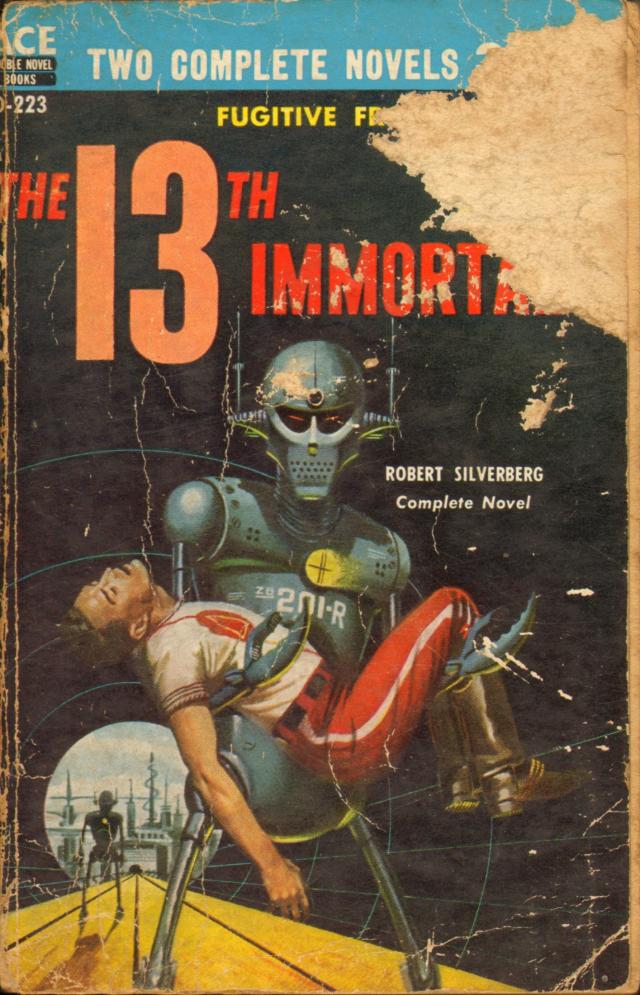


Kesley wondered about van Alen. The Antarctican had run away, and presumably had been shot by a bandit. Was he dead, his corpse lying rotting on the plain? It didn’t matter, now. Kesley was in the hands of Duke Miguel. His destiny was no longer bound to that of Dryle van Alen.
“Get along, now,” a voice drawled. The line moved up. Slowly, the long queue was passing through the great double doors and into the city. Kesley’s six captors surrounded him, three before and three aft. Their conversation during the long trip north to the capital had been limited to occasional rapid-fire bursts of incomprehensible Spanish, and Kesley still had no idea of the fate that awaited him.
“We go to the Duke,” the taciturn bandit leader said as they reached the gatekeeper. He gestured at Kesley. “We bring him a prize.”
“Norteamericano?”
"Sí."
The gatekeeper flicked a thumb over his shoulder. “Go in.”
Kesley’s horse moved forward, and they entered the Ducal capital of Buenos Aires.
Cities look pretty much alike, Kesley thought, as they entered. His short acquaintance with van Alen had made him
more observant, more analytical. And, looking around, he framed the generalization. He might just as well have been in Galveston, or St. Louis.
There were differences, of course, but they were not fundamental ones. The dirt was a constant, the litter and the smell, and the undercurrent of noise. The crowds, too. And also the houses: squat, two- or three-story affairs, in the universally accepted architectural design, with gray whorls of greasy smoke spiralling up from their hearth fires.
Kesley wondered what cities had looked like in the Old Days, before the rain of bombs had leveled the world. New York had had millions of people in it. Buildings had towered to the skies. Kesley remembered how old Lester described a visit he had made to New York forty years earlier. The blistered hulks of the great towers still stood, jagged shells clawing at the sky. Forty, fifty, eighty stories high—it was unbelievable.
Cities were different now. The Twelve Dukes had laid down the unvarying pattern for the cities during the Time of Rebuilding, four hundred years before. The old names had been kept, and the old locations. But a city of the Twelve Empires now had a certain prescribed shape, and a city in Argentina Province looked much like one in Illinois Province, or Capetown Province. There was the wall, first of all, high and thick and protective. Within the wall, the radial spokes of streets, and the circling network of avenues, lined with low houses. At the heart of the city, the Building of Government or, as in Buenos Aires and eleven other cities in the world, the Ducal Palace.
Markets, shops, houses, schools, meeting-halls—these were all provided for, all according to plan.
“Why are you taking me to the Duke?” Kesley asked, as they trotted toward the towering palace.
The bandit chief shrugged. “The Duke wants norteamericanos. He pay us to bring them; he tell us where you and your friend are. We bring. See?”
Kesley nodded. It was the truth, he saw; the bandit had merely been following instructions.
Everyone follows instructions, he thought suddenly. He had followed van Alen's orders; the bandits were puppets of Don Miguel. And Miguel?
Who, he wondered, pulled the Duke's strings?
Kesley smiled. Van Alen had tainted him with philosophy. Life would undoubtedly have been much simpler if he'd remained in Iowa Province, on the farm.
The contradiction followed at once: he hadn't been happy there, he realized. Life had never been simple—not even in a world where the benevolent Dukes tried manfully to avoid the fatal complexity of the Old Days.
They reached the approaches to the Palace, now. It was an imposing, almost breathtaking building. In seeing to it that the short-lived peoples of the world remained properly close to the ground, the Dukes had stressed their own grandeur. The milk-colored Palace swept upward like a bright fang piercing the sky. It was perhaps three blocks square at its base, and rushed upward for more than a hundred feet before its firm lines were broken by as much as a window.
The building's facade was frosty white and immaculate, a solid wall of irradiated polyethylene. Spotlights—even now, in the daytime—played against its shining bulk. The building was awesome, magnificent, a monolithic monument to a fortuitous mutation affecting but twelve men—and, thought Kesley, its very grandeur was faintly ridiculous.
A row of blue-clad guards was arrayed before the main entrance. Kesley's captors rode to the approach, and the bandit chief engaged in a brief colloquy, at the end of which one of the guards vanished within.
He returned a few moments later, bearing with him a small brown leather pouch. The bandit accepted the pouch eagerly, and tossed it to one of his men.
My price, Kesley guessed in wry amusement.
He was right. The bandit undid him and hauled him down from his mount. As Kesley gratefully flexed his numbed arms, the bandit shoved him toward the waiting guard.
“Adios, norteamericano!" The six bandits grinned cheerfully, pocketing their bounty. They remounted, and rode away.
"Come with me,” the guard said stiffly. He drew a pistol, but Kesley shook his head.
“I won’t make trouble. You can put that thing away.”
The great door swung open and Kesley was conducted into a vast courtyard lined with flowering shrubbery. At the . far end of the yard, Kesley saw a small group of men standing in irregular formation.
“We go there,” the guard said. He pointed, and Kesley started off in the direction indicated.
There were about ten men waiting there, under the surveillance of one of the Duke’s guards, who watched them with drawn gun. As Kesley drew near, he saw that the men were, like himself, North Americans.
“Where are you from?” a white-haired man called. “Up north ?”
“Iowa Province,” Kesley said, joining the group. “You?”
“Illinois.” The other’s voice was bitter. “I’m from the court of Duke Winslow. He’ll hear of this; he’ll—”
The guard yelled: “Quiet down there!”
“What is all this?” Kesley whispered.
“I don’t know. Miguel’s evidently rounding up all the North Americans in his territory. It’s illegal! It’s—”
The guard whirled suddenly and struck the Illinois man across the face with his pistol. “Silence!”
Kesley felt a surge of anger, but restrained it. He bent and lifted the older man to his feet. Dazed, the courtier wiped blood from his tunic and dabbed gently at his gashed cheek. “Damn him,” he muttered. He groped at his hip for a sword that wasn’t there.
“Hush,” Kesley said. “They’ll only knock you down again. Fall in line and keep quiet. We’ll find out what's going on later.”
It was the only way to stay alive, he told himself. Fall in line; ask questions later.
Another door opened, and they entered the palace of the Duke.
“This way,” the guard called. “After me.” Shepherding them with his drawn pistol, he led the way, while three other guards closed in at each side of the group. Kesley looked
around. They were in a long corridor which headed toward a descending staircase. The dungeons, obviously.
They kept walking. Fall in line; ask questions later. Kesley repeated it to himself.
Suddenly he stiffened. He had fallen obediently in line •when van Alen had appeared from nowhere—and the questions that arose had never been answered. Now, perhaps, he was marching unquestioningly to his death. I won't do it, he thought defiantly, and stepped out of line.
He yanked the pistol from the astonished guard near him and slid his hand around the thick butt. The gun had an unfamiliar feel to it; it was heavy and clumsy. But he raised it quickly to shoulder-level and fired.
The guard at the front of the line yawped and clutched his shoulder. Kesley fired again. A second guard dropped. The other men in the line caught on, now, and charged the remaining pair of surprised guards. Kesley heard a pistol crack, and saw that it was in the hands of a North American.
This was the way. Act, instead of being acted upon.
Guards were coming down the corridor now, waving pistols. “Over here,” Kesley yelled. He started to run back the way he had come. Turning the corridor, he collided with a surprised-looking fat man in reddish velvet robes, who had been moving forward in stately fashion, oblivious to the conflict ahead of him.
Kesley knocked the fat man off his legs and kept running. Behind him came the sounds of pistol shots echoing down the halls, and the clatter of feet. Guards were coming from all over. He turned, fired three more times, and threw the useless gun away.
Four guards dashed toward him and, quickly, he backed into a dark alcove. There was a door. Impulsively, he threw it open and stepped inside.
A fist rocked him almost before he had crossed the threshold. Dizzily, Kesley wobbled backward to get a view of his assailant.
He was a big, broad-shouldered, black-bearded man wearing embroidered robes and a shimmering gold tiara. A noble, Kesley decided. He packs a mean punch.
The big man reached upward and yanked on a bell. Almost instantly, the room was full of guards. Determined to do as much damage as he could before being retaken, Kesley sprang forward. He clawed at the embroidered gold robes, feeling gold inlay ripping away under his fingernails. Then the noble hit him again, sending him staggering up against the wall. Two guards seized him.
“One of the escaped prisoners, senora guard babbled. “How he got in here we do not know. He-”
“Enough, payaso. Take him away. Kill him.”
A tired frown crossed the big man’s forehead. “No. Forget that. Tie him to a chair, and leave him alone here with me.
The guard looked up doubtfully, but quickly concealed his misgivings. “Of course, sire.”
“Send in my clothier also. This idiot has ruined my robes.” Kesley allowed himself to be tied to a chair.
“You're a bold fool,” the big man said, coming over to glower down at Kesley. He knotted his fingers in his thick, tangled dark beard, and smiled, baring stained yellow teeth. Kesley met the noble's gaze evenly.
The deep eyes were set in a network of fine wrinkles. They were not the eyes of an ordinary man. They were heavy with the shadow of a hundred thousand days gone by, and infinities of days to come. Kesley realized that the man before him was no mere noble. He could only be Don Miguel, Duke of South America.
An Immortal.
IV
Kesley watched Miguel pace uneasily back and forth. The room he had blundered into was evidently one of the Ducal offices; a broad desk at the back was littered with a great many official-looking papers, and on one wall hung a glossy shield bearing Miguel's coat of arms.
Suddenly Miguel turned. “Where are you from?” he asked. His voice was deep, resonant, commanding.
“Iowa Province. I was a farmer."
“Oh? Then what might you be doing in my lands?"
Kesley saw that he had blundered. Farmers, normally, did not take pleasure jaunts to South America. He tried to repair the damage. “I was on a buying tour. I was down here for cattle, and grain, and—”
Miguel chuckled. “Enough, please. One does not have to be an Immortal to see through your lies.” He pulled out a chair and sprawled his big form down. Smiling strangely, he said, “You can speak the truth. Why are you here?”
“I—I—” Kesley's face reddened. He realized that he had no rational answer to give. He was here only because van Alen had led him here—and van Alen was dead or wounded now, far to the south.
Miguel sighed. “You assassins are all alike. At the moment of capture, you lose the sacred fire.” Swiftly he leaned over and undid Kesley's bonds.
“There. You are free. Kill me, now. We're alone; this is your chance!”
Miguel slipped an ornamented stiletto from his sash and handed it to Kesley. Opening his cloak, the Duke fumbled with buttons and pulled the cloth aside, baring a broad, muscular chest covered with graying hair. “Here! Plunge the dagger in—now!”
Kesley weighed the stiletto in his hand, balancing the haft on his palm, fingering the weapon's keen point and well-honed blade. Miguel waited patiently. One comer of the Duke's wide mouth was drawn up in a cold smile; the other sagged almost uncontrollably into a drooping sneer.
“Well?”
Kesley feinted with the stiletto and flicked it through the air past Miguel's head and into the center of the arms-bearing shield on the wall. The Duke, who had not so much as blinked, laughed heartily.
“A good man with a knife! A good man indeed.” Serious again, he said, “But you could have killed me. Why didn’t you?”
“Kill an Immortal?” Kesley replied listlessly. "I’d sooner try to harness a whirlwind. How could I possibly kill you?”
“By plunging the knife into my heart,” Miguel said. “You obviously fail to understand the true nature of our immortality.”
"Which is?”
“Cell regeneration. Gradual rebuilding and replacement of decayed cells. We remain as we are because the decays of age are counteracted as rapidly as they occur. There are no organic defects to plague us. This process, however, does not guard against a knife in the heart, or a slit throat, or a bullet in the back.”
"And yet you gave the knife to me. Why?”
“I knew you wouldn’t use it,” Miguel said. "You shortlived ones are so terribly easy to understand. Only . . .”
The Duke’s voice trailed off. "Only what?** Kesley prodded after a moment.
“Only nothing,” Miguel said. He rose. "Come upstairs with me, young one, to my office. I am a slave to my duties . . . more thoroughly enslaved than the basest serf on my lands.”
Miguel touched a panel in the wall and it slid back, revealing what looked to Kesley like an adjoining room.
"My private elevator,” Miguel explained. “Come.”
The elevator rose silently. When it stopped, the door slid open and Kesley found himself in an even vaster room, almost completely lined with books on one wall from floor to ceiling. Another wall was bright with paintings; on a third, strange lights flickered on a wide board, and glowing above their multicolored glitter were eight rectangular gray screens.
Seeming to forget Kesley, Miguel strode across the room and seated himself in an imposing chair facing the screens. He covered the flashing red light with his palm. The uppermost of the screens became illuminated. Kesley gasped as the face of a man grew visible.
The man in the screen gesticulated humbly. "Your blessing, sire. Mendoza of Quito reporting, Don Miguel”
“Speak, Mendoza/' Miguel's tone was regally impatient. “It has not rained here for sixteen days, sire," Mendoza said anxiously. "‘The people are discontented. Crops are dying, and—"
“Enough." Miguel flipped a switch and a second screen ’ came to life. “Luis, take care of this fool from Quito, and explain to him that we have no control over the weather. Then transfer all these other calls to your own line. I’ll be busy for the next fifteen minutes."
The screen went blank; the flickering lights died away.
“What is that thing?" Kesley asked.
“Closed-screen television. I use it to keep in contact with my governors in the various provinces."
Miguel took a seat behind a desk; this one, like the other downstairs, heaped high with papers. He lowered his great, bearlike head between his hands and stared at Kesley for what must have been more than a minute. Finally he said, “I offered you a chance to kill me. You declined it.”
“Perhaps if I got the chance again, I’d act differently,” Kesley said.
“Perhaps. But the chance comes but once. I am not yet tired of life ... I think." The Duke’s eyes drooped wearily. They seemed to be staring backward into yesterday—and ahead at the burden of an endless tomorrow. “Four hundred years is many years, though. Are you married, young man?”
Startled, Kesley said: “Huh—no. No, not yet.”
“I have been married thirty-six—no, forty-one times. The longest was the first: twenty-six years. We were both thirty when we met. When she died, she was fifty-six; I was still thirty. I was just finding out, then."
Miguel toyed with a sparkling, many-faceted gem on his desk. “Most of the other marriages were short ones. ... I couldn’t bear to watch them grow old. Now I do not marry at all."
“Do you have children?” Kesley asked.
Miguel flinched as if struck. His wide lips tightened in anger; then his face softened again. “The gene is recessive,” he said quietly. “And lethal in early childhood, if not immediately after birth. My dynasties have been short-lived.
I have had eight children; seven lived less than a year. The eighth reached the age of nine.”
He laughed hollowly. “Out of eternal life, nothing but death. No, I have no children, young one.”
“I—see,” Kesley said. He peered closely at the Immortal, feeling a strange flow of pity for the timeless man. Immortality was a costly gift, he saw. Suddenly, Kesley wondered how many other Immortals there had been beside the Twelve—Immortals who, once they realized the terrible nature of their breed, had taken their own lives. More than one, he thought.
And how often did Miguel himself consider suicide? Had he had some hidden protection against Kesley's knife, moments ago downstairs, or had the Duke been half-hoping the blade would strike true?
Perhaps.
“Why do you keep me here?” Kesley asked.
Miguel looked up slowly. His eyes, deep and piercing, bored into Kesley’s. “You amuse me,” Miguel said. “When one is more than four centuries old, one is hard put to find amusement. I am amused by the possibility that you might strike me dead at any moment.”
“It’s really very funny,” Kesley said.
“I'm amused by the fact that you're not afraid of me. Awed, yes, but not servile. How many times a day do you think I hear that hateful word ‘Sire? Sire! Me, who has sired eight dead babes and nothing more.”