The dangerous dozen, p.1
The Dangerous Dozen,
p.1


S. Hussain Zaidi is a veteran investigative, crime and terror reporter with a career spanning decades. His previous books include Mafia Queens of Bombay, Dongri to Dubai, Byculla to Bangkok, Mumbai Avengers and R.A.W. Hitman, some of which have been adapted into popular Bollywood films. Hussain Zaidi lives with his family in Mumbai.
THE DANGEROUS DOZEN
THE DANGEROUS DOZEN
Hitmen of the Mumbai Underworld
S. HUSSAIN ZAIDI
For Dr Sharat Kolke
My friend of 30 years and a benefactor
Gabriel Khan was an esoteric byline that was created to partner with my name. The idea was that Gabriel Khan would have the freedom to talk about facets of journalism which under my personal byline might not sound right. Gabriel Khan was my alter ego.
Much later, when I presented the book to my friend Dr Sharat Kolke, whom I have dedicated the book to, he pointed out the existence of real Gabriel Khans, one a British photographer and the other a German cardiologist. We had a good laugh over it.
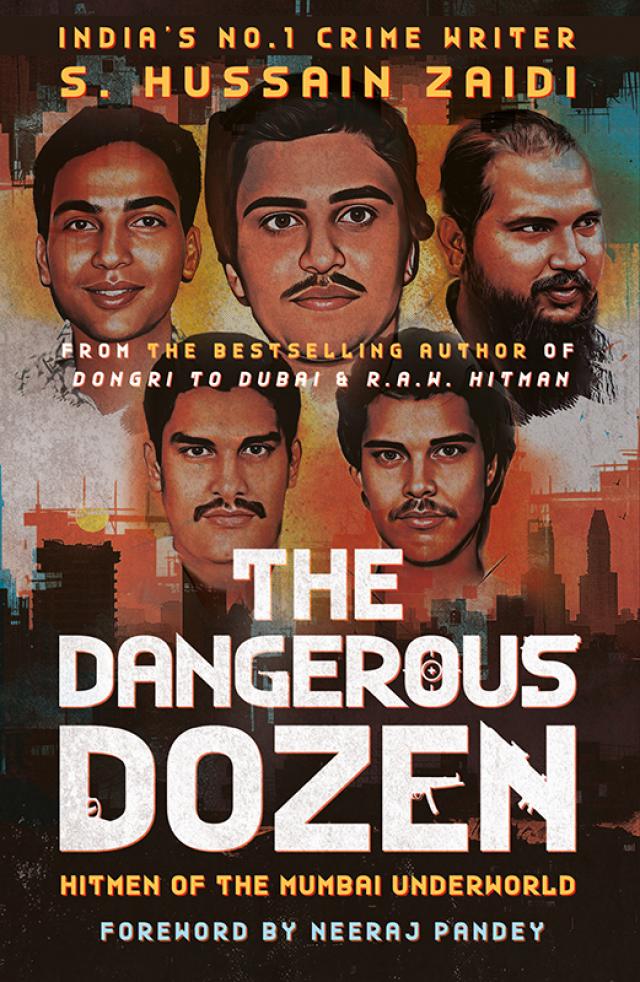
I must thank filmmaker and storyteller Neeraj Pandey who agreed to write a foreword at short notice, and a special thanks to Mohsin Rizvi whose brilliant visualization got us a knockout cover for this book.
S. Hussain Zaidi
INTRODUCTION
I started my career in journalism at a time when typewriters were treasured and when newsrooms were not cold, clinical, impersonal cabins with corporate trappings. The newsrooms of my time were huge with an open plan area. There were tennis table-size wooden desks, one for the reporting team and another for the editing team. A long row of benches was where the reporters sat and typed away their copies on Godrej typewriters. There was a place for the teleprinter, from where we got the wires, PTI, UNI, Reuters. And yes, we also had a tribe called proof-readers, who were the last in the news food chain. No gaffe escaped their sharp eyes. The features desk were lucky fellas who generally got cabins and lived life kingsize with only weekly Sunday pages to fill. They didn’t have to produce two stories a day, or so we thought.
The newsrooms were always messy, with lots of papers, notebooks, and printouts. The journalists hung their jhola bags from their plastic woven wooden chairs or metal chairs woven with plastic. Typewriters were at a premium and there was a mad scramble for non-defective ones with all their keys intact. If you were lucky to start your career at the training ground, The Free Press Journal or Indian Express, the sea view was a bonus. When the muse didn’t work, one could always find inspiration in the angry turbid Arabian Sea that was pushed into a corner at the end of Free Press Journal Marg in Nariman Point.
There were a couple of black rotary dial phones in the room, but you could make a call only if the telephone operator—seated in her lofty cabin near the entrance—deigned to connect your number. You had to keep the telephone operator very happy. Direct phone lines were only for the editor and, sometimes, the chief reporter. You could chain-smoke in the newsroom and both male and female journalists puffed away to glory. The chaiwallah was always being summoned for endless cups of tea punctuated with bhajjis and sandwiches. And the chaiwallah was always asking for money and the journalists were always broke.
Some journalists wore long kurtas and jeans, while others wore shirts that were never tucked into their pants. Most male journalists had a moustache and a beard or a stubble. You would find only a handful of clean-shaven ones. They looked like poets and spoke with the air of one having to carry the burden of mankind on their shoulders. The female journalists cut their hair into a very short crop and were strong-willed. They, too, loved khadi and were always informally dressed. And yes, they wore sarees too.
Newsrooms transitioned to computers within two years of my new career in journalism, and the now defunct Indian Post was the first paper to get Atex computers which, in the late ’80s, had military applications. Reporters could send messages to each other on their computers, the first version of Gmail chats. And yes, it was the era of newspaper clippings and libraries for background research. Sans Google, journalism was none the poorer.
It was an era when journalists were not discriminatory in what they read. It was an eclectic choice of reading material: Aleksandr Solzhenitsyn, Graham Greene, Jane Austen, Roald Dahl, Agatha Christie and Jeffrey Archer.
I loved the feel and pulse of journalism and I never thought beyond it. There was something magical about it. The feeling that we were instruments of social change and that we had a responsibility to society and mankind. That we were not mere chroniclers of our times, but shaped opinions and changed perceptions and that our pen was actually mightier than the sword. (The disillusionment came much later, with age and wisdom.)
In the late ’80s, when I started my career in journalism, journalists were an intrepid lot. They wrote stories that could bring down governments. Arun Shourie had ripped apart A. R. Antulay in the cement scam, and Maneck Davar exposed the link between Dhirubhai Ambani’s Reliance Industries and the Central Bureau of Investigation director Mohan Katre. (Davar posed as a small scale detergent manufacturer and entrapped Katre’s son Umesh into revealing his business dealings with Reliance.) It was an era when journalists wrote in shorthand but were not stenographers. It was when movies reflected the times we lived in, like Saaransh and Ardh Satya. There was no political censure and no censor.
It was a time when journalists were sceptical about politicians and their intent. For journalists, the establishment was always to be questioned. The politicians were always the snake in the grass. Pakistan was a country that got separated at birth. We watched Tamas with pain in our hearts. We were not at war with Pakistan every day, as television channels now are. And that was because we focused on the here and now. We had local issues and starvation, poverty, bad infrastructure, poor governance, corruption, tribal issues, zilla parishad scams, farmers’ problems, communal riots, the Bhopal gas tragedy, a burning Punjab, Kalahandi and Bhagalpur. It was a time when the Page 3 social scene idea was just incubating in some party-hopper’s mind.
It was a time when the great Vinod Mehta turned the definition of investigative and interesting journalism on its head. The Sunday Observer was a trail-blazing newspaper. It shook the behemoth, especially the Old Lady of Boribunder.
I started writing on crime occasionally, while covering other beats. Crime reporting was challenging because getting contacts was not easy unless one wanted to report only the police version. When I met S. Hussain Zaidi, he was a promising young man, all of twenty-seven, shy and reserved. He was heavily into reading paperbacks and was very promising. His narrative skills were in place even at that formative stage in his life. I thought he should be taken under my wing. Over several bun maskas at Yazdani Bakery in Fort, and gallons of carrot juice, Hussain’s destiny and future was shaped as the top crime journalist of Mumbai.
When I moved to television for a year, Hussain established himself as a crime reporter of much merit at the Indian Express, which had just launched its city supplement under Sai Suresh Sivaswamy. It was called the Express Newsline. Hussain’s stories were creating waves and the Rotary Club had already invited him as a guest. He spoke on ‘How not to fear the dreaded extortion call’.
Since we were never in competition we became buddies and in him I discovered a hungry protégé. With experience and subsequent success, he built better contacts and collected more scoops. In the early days, he was very humble and did not think it beneath him to touch my feet even in public on Guru Purnima. He once bent and touched my feet in a public square at Matunga Circle.
My crime contacts were virtual encyclopaedias and had more archived facts in the recesses of their brains than the Mumbai police had in their dog-eared dossiers. Sadly, most of them have been felled by death. A few I can name. The late chief of the Anti Terror Squad (ATS) Hemant Karkare, Customs Inspector Farooq Batatawala, Deputy Commissioner of Police Deepak Jog, ganglord Hussain Shaikh alias Ustara, Dilawar Khan, killed at twenty-eight, and Badshah, who I think is still alive. I introduced Hussain to my sources back then, and he was an instant hit with them.
Though Hussain and I held divergent points of view on most topics, we were bound together by our shared common destiny—crime reporting.
In his journalistic career, Hussain unravelled the Mumbai mafia like no other journalist has ever done. He also shattered many myths. He belied the celluloid notion of the archetypal gunman as a heroic, dauntless fellow with reckless audacity. He gave the gunman a name, a face and painted them in real colours, a far cry from their virtual persona. He told us that in real life they were not at all heroic. That some of them were feckless, while others could not even shoot straight. That the ones who killed recklessly were also psychos. And the ones who aimed straight with their guns were not necessarily brave but bolstered by the weapon in their hand. Hussain’s story, ‘Gangster’s Shame Cannot Cock a Gun’, which was carried as a lead story in the Express Newsline, is a case in point. It was the first article on crime that took a derisive line and denigrated mafia hitmen. The mafia across the board were not at all amused by that story.
Like some Mantralaya journalists, crime reporters tend to take sides. Some become spokespersons for certain mafia groups. Both the police and mafia informers become very wary of such reporters. Once when we went to Peon Chawl at Byculla to meet Arun Gawli’s shooter, Raju Phillips, he was astonished to learn that we do not take money. Raju ratted out several names of journalists, especially from the regional press, who were on their steady payroll. On the other hand, Hussain’s credo was ‘Roti sirf reporting
se’.
The mafia gangs, therefore, held him in high esteem, even when he wrote adversely about them and exposed them! He was never labelled as ‘us gang ka aadmi’. They came after him for various reasons (like exposing a ganglord’s affair with his lieutenant’s wife), but never for his sympathies and affiliations with other gangs. It was for this reason that he could step into Kolhapur jail (to meet Gawli) with as much aplomb as he could walk into a Karachi hideaway (to meet Dawood’s acolytes). Hussain managed to have contacts in most of the top gangs, including Dawood, Chhota Shakeel, Abu Salem, Chhota Rajan and even Arun Gawli. Then there was the P gang. The Mumbai police force.
Despite his seething resentment of the Mumbai police force and its wicked ways, Hussain has often put them on a pedestal and elevated the men in uniform to a heroic stature. In all his books, right from Black Friday, Dongri to Dubai and Byculla to Bangkok, his books showcase the exploits of the Mumbai police, at times a bit exaggerated in my opinion.
Since Hussain is very prolific, he has almost written on all shades of crime. While reading his books, I felt I could write about the men who wielded the gun for the dons. The hitmen might seem lowly in their stature as they are more of a tool to be used and thrown or killed by the police or rivals, but some of them have gone on to shape a gang’s trajectory. The profiles included in this book are of some of these bloodthirsty and violent men; a few of them were drawn by the lure of the lucre, while others were drawn by a belief in their invincibility. Those who pitched in were Gautam Mengele, Nazia Sayed and Jyoti Shelar. While Nazia is already a published author, Gautam is prepping himself to be one.
We also took the help of a bright, young student of St. Xavier’s called Raina Bhagat. All of twenty, Raina showed tremendous promise, professionalism and dedication to the work assigned to her.
Jyoti Shelar gave much of her time while she was in the midst of her own maiden book, The Bhais of Bengaluru. And she never batted an eyelid when I asked her to finish my task first before flying off to various cities in Karnataka for her research work.
Through these young professionals, I would also like to extend my thanks to their sources and friends who were of tremendous help in fleshing out the characters in the book.
I would like to thank retired assistant commissioner of police Jaywant Hargude and ACP Sunil Deshmukh of Dadar division.
Gabriel Khan
PROLOGUE
A Gangster’s Lair
I was overcome with obsessive interest in my subject for months. And yet, when I first saw him, it was a shocking disappointment. Looks can be deceptive they say, but the man standing in the room across from me looked nothing like a sharpshooter of his reputation. He was short and stout; the makings of a potbelly and stooping shoulders gave him an awkward hunch. He was wearing the all-white look one tends to see in the underworld. Tailored white shirt, white pants and white shoes, I couldn’t check his socks, but I bet they were white too.
He had a decent haircut and a direct stare. I didn’t like his eyes though. His eyes were those of an arrogant and boastful man. His stance was firm but his diminutive personality failed to arouse any terror in me. He reminded me of the famous Bollywood singer Udit Narayan minus the pahadi voice and the skin colour. But this Udit Narayan of the underworld was a man known more for his skills with the gun and proficiency with a blade. The blade runner.
There was a bank of closed circuit television screens behind the man, hitched to several hidden cameras. Obviously he had watched me come up the street. Since I had already set foot in his lair, I resolved to make the meeting count. He rose to greet me with proper Islamic customs and mannerisms. In a husky yet powerful voice, he said, ‘My name is Mohammed Hussain Shaikh, but they call me Ustara.’ He spoke in colloquial Urdu.
My curious eyes scanned him head to toe, and stopped at the sight of two guns holstered in his pants. The guns peeked out of their holsters, and induced a slight intimidation in me. My glance immediately shifted away from Ustara to the table that separated us. I spotted three mobile phones carelessly lying next to a pile of papers. In those days, apart from BPL, Max Touch was the most prominent service provider, and cell phone technology had just been introduced in Mumbai. A call from a mobile phone was priced at nothing less than Rs. 36 per minute; the same charges applied to incoming calls as well. At a time when most citizens like me could barely afford one phone, Ustara was flaunting three. ‘One is for my jaan, one for my family, and the third one for the business,’ he quipped. His ‘jaan’—a euphemism for his current love interest.
It was Farooq Batatawala, inspector from the Marine and Preventive Wing of the Customs department who introduced me to Hussain Ustara. Ustara was a gangster who hated Dawood’s Man Friday, Chhota Shakeel. He didn’t like their remote control method of extortion. ‘You can’t sit in Dubai and make threatening calls to people from there and then send your boys to do the dirty job. We do the same thing but we sit in Mumbai and face the pressures,’ he would say.
He was also the first hitman I met in the mafia, and perhaps that was why I was fascinated by him. Ustara was the ring leader of a small group of gunmen who were operating from Pydhonie in south Mumbai. His hideout was a rundown building on Bapu Khote Street. The entire building belonged to Ustara. He also had a close-knit group of five to six people who worked for him and kept Ustara informed about the affairs of the area.
I almost missed the entrance to Ustara’s rundown building twice. There are shops on the ground floor and as you make your way to the first floor via a narrow flight of stairs, there is a huge empty room that seems like an abandoned warehouse on the left—or is it a Fire Refuge floor, I wondered. It was pitch dark and cavernous as I proceeded upstairs.
Though he eventually became well known for his guns, his clever use of razor blades in his formative teenage years had earned him the title of Ustara. He was adept at flashing the ustara, barber’s knife, at the right moment and at the right target. Ustara narrated the story to me. In his teens, he was part of a gang of pickpockets and was hauled up by his ringleader for not depositing the entire day’s earnings. The man, who was a bully, was heavily-built and broad-shouldered like a giant, clearly an oversized opponent for the sixteen-year-old Ustara. There was a skirmish and Ustara was cornered by the ringleader’s minions. In desperation and armed with nothing but a blade and unmatched valour, he attacked the man, slashing his neck and drawing the blade down to his navel and below. The doctor at the hospital who treated the injured man remarked that the person who cut him had done so with surgical precision.
The man survived, but Ustara became famous in the inner circles of the Mumbai underworld as the boy who could use an ustara to settle arguments. From that time, the weapon had become synonymous with him, and hence the name. He showed me the razor he was carrying in his sleeve. Whenever trouble approached, or if circumstances pushed Ustara into a fistfight, he would merely dig into his sleeve and then the penetrative slash would follow. Some really deft criminals in jails can hide blades in their mouths.
Ustara also took great pride in his skills with all kinds of weapons. He boasted of being able to assemble and shoot a gun in less than three seconds flat. A feat otherwise only portrayed in mafia movies. I particularly remember one scene in The New Police Story, where the ageing and washed-out cop, played by Jackie Chan, would lose to a nimble-fingered younger gunman who was always faster and quicker. Ustara was agile like no gunmen ever heard of, and at the same time he could use his trademark weapon to bring death upon his opponents. But he admitted that he loved guns more, his favourite being the Mauser pistol (1914 model)—the authentic German model, not the Chinese one, which is actually a cheaper imitation of the original.
Ustara said he managed to stay out of trouble with the cops, as he was an informer and gave a lot of valuable information on the underworld in exchange for his freedom. He rattled off some names of top cops, but I could never independently verify his claims. He mentioned that he had a very special knack of judging and employing people, which others lacked. Ustara’s close group of trusted men had six members, each suffering from some deformity. Ustara believed that when a man was disabled in any manner, god would compensate him by blessing him with an alternative, sharpened sense. Ustara signalled, and his sidekicks emerged out of the woodwork, literally—the walls seemed to have no doors. The gang members were all in their late thirties. They seemed to have lived a tough life. Their faces were scarred and they all looked like they had been thoroughly whiplashed by life. He introduced me to all his gang members and I noticed that all of them sported a deformity or an unusual feature. Some had an extra appendage, one had different coloured eyes, another had one big ear. Even the resident cat had one grey and one amber eye, both holding a malevolent glare. ‘People with deformities have other acute senses. They are very good in my line of work,’ he reiterated.