

Out of earth, p.1
Out of Earth,
p.1
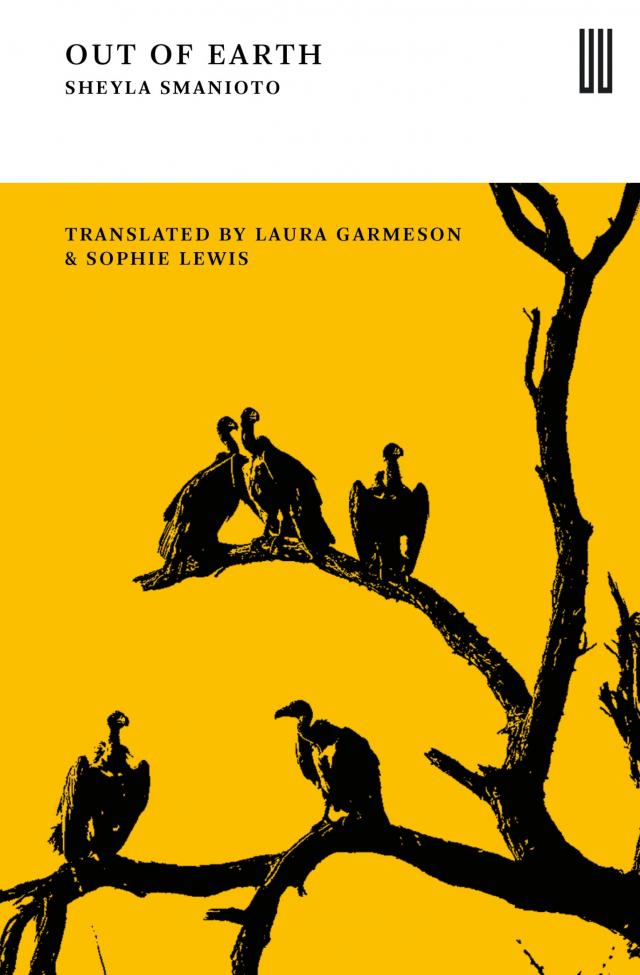


‘In Out of Earth, to see is to incur risk. To look away and not see the truth is a rejection of living.’
—Tice Cin
‘Full of originality and lyricism … it’s a punch to the stomach, in the best sense. At times dark, at times vibrating with hope in every line.’
—Larissa Bezerra, O Diário de Maringá
‘The situation, the characters and the reality depicted in Out of Earth flow at one remove from the usual run of literature in our times. Her writing shows a rare audacity.’
—Rodrigo Casarin, Suplemento Pernambuco
Sheyla Smanioto was born in 1990 into a working-class family in Diadema, São Paulo state, which was then the most violent town in Brazil. In 2017 she was selected by Forbes magazine as one of the people under 30 making a difference in Brazil. With her two published novels, Desesterro (2015, appearing here in English as Out of Earth) and Meu corpo ainda quente (2020), she won the SESC, Biblioteca Nacional and Jabutí prizes, as well as being shortlisted for the São Paulo literature prize. She has twice received grants from Itaú Cultural fund to assist her writing.
Laura Garmeson is a writer and translator from Portuguese and French. Her work has been published in the Financial Times, the Times Literary Supplement, Asymptote Journal and The Economist, among other publications.
Sophie Lewis is a translator and an editor. Working from Portuguese and French, she has translated numerous authors and she co-founded the Shadow Heroes translation workshops enterprise. Sophie’s translations have been shortlisted for the Scott Moncrieff and Republic of Consciousness prizes, and longlisted for the International Booker Prize.
Kathleen McCaul Moura’s writing has appeared in the London Review of Books, Granta and The Guardian, among other places. Desesterro is a foundational text in her PhD on literature and urbanism in São Paulo, and her latest novel is set in São Paulo.
Tice Cin is a poet and dj. Her novel Keeping the House was shortlisted for the Jhalak and Desmond Elliott prizes in 2022.
Out of Earth
Out of Earth
by Sheyla Smanioto
Translated by Laura Garmeson
& Sophie Lewis
boiler house press
table of contents
Introduction by Kathleen McCaul Moura
Out of Earth
Afterword by Tice Cin
Author Acknowledgements
Translators’ Acknowledgements
Glossary
introduction
by Kathleen McCaul Moura
I met my husband in London. He told me he was from São Paulo. I had only the vaguest idea where the city was, despite the fact I worked in international news. When I arrived in Brazil myself and visited the local BBC bureau in the hope of some work, I realised why this was. Expecting something similar to the enormous newsroom I had experienced in India – teams of editors, reporters, cameramen and stringers in every cranny of every region – what I actually found was a dark cubby-hole and one quite harried man who told me he was desperate for help. Like India, Brazil is among the ten largest countries in the world, a former European colony with huge economic, political and cultural heft. However, unlike India, Brazil was part of the Portuguese not the British empire. This is a legacy which has left English readers today, just like that poor reporter, woefully under-resourced in relation to this enormous country’s literature and history. This is a particular shame for a great Brazilian novel such as Sheyla Smanioto’s Out of Earth, which plays so viscerally with some of the nation’s perennial problems. Aside from the theme of domestic abuse against women, the novel grapples in significant ways with migration, inequality, cycles of violence and multi-generational trauma caused by a colonial slaving history.
The story of Fátima’s escape to São Paulo takes as its template the classic Brazilian migration from the poor, arid rural North to the city – the same legendary journey that President Lula himself made as a child in an open truck. It was the arrival of Northern musicians in São Paulo that kicked off the famous Tropicália movement, and the countryside kid’s confusion in the city became the subject of some of Brazil’s most beloved pop songs. Caetano Veloso’s ‘Sampa’, for example, is sung along to at almost every opportunity. Smanioto’s treatment of this migration is noteworthy for a couple of reasons. First, unlike Veloso, Fátima never visits São Paulo’s central sights but stays in the poor, marginal neighbourhood of Vila Marta. This is perhaps a more accurate portrait of poor Brazilian migrants, who mostly swapped a ruthlessly feudal countryside for marginalised life in dangerous and illegal peripheral developments, without access to civic benefits such as good medical care, schools, cultural institutions and transport links. Second, unlike most chronological descriptions of this migration, Out of Earth jumps episodically between the countryside and the city, such that the two begin to merge in the ‘fantastical metamorphosis of Vila Marta Vilaboinha’. This says something important about the Brazilian migration experience. Despite travelling hundreds of thousands of kilometres, Fátima never escapes her origins or the crimes that haunt her.
What are these crimes? One of Out of Earth’s great strengths is to show how the country’s brutal past continues to affect everyday citizens. In 1500, explorer Pedro Cabral claimed the country we now call Brazil for the Portuguese crown. The land was cut up into enormous farms on which laboured legions of African slaves, ruled over by colonial lords often known for inhumane cruelty. In 1888, Brazil became the last country in the world to abolish transatlantic slave trading, but the violence continued, encapsulated for many in the book Rebellion in the Backlands by Euclides da Cunha, which describes the savage government massacre of a small religious town known as Canudos. Smanioto’s grim backwater Vilaboinha has the same extreme violence at its heart. Gory, maimed bodies, fluids and entrails are everywhere, sickeningly dissected into meat, flesh, animals. Perhaps Smanioto’s graphic imagination is her own method of fighting the apathy not only of Brazilian readers inured to the violence by the sheer numbers of nameless victims – indigenous people, slaves, women – but also of the novel’s characters themselves, as they repeat, normalise and sanction abuse in what Smanioto has called ‘an historical repetition of tragedies’.
When I first arrived in Brazil, my husband worked hard at giving me a good impression of his beloved homeland. He focused on the beaches, the great São Paulo nightlife, the fantastic football, and the unique and wonderful music, never mentioning the country’s traumatic and violent foundations. This inclination to sweep bad things under the rug has been recognised as a Brazilian trait. The famously mixed-race population is routinely celebrated but rarely with proper acknowledgement of the abuses on which this was at least partly established. The 20th century was marked by two military dictatorships in which thousands were brutally tortured and disappeared. However, unlike other Latin American countries with similar histories, for decades Brazil chose not to investigate these crimes. The former guerrilla fighter Dilma Rouseff finally initiated a national truth commission in 2014, when she was president. Subsequent president Jair Bolsonaro closed it down, and critics still argue that Brazil is held back by its refusal to confront its history. One of Out of Earth’s great achievements is to embody what the narrator calls the crime of forgetting. The rural violence of the past is, horrifyingly, and literally, unearthed in the heart of the modern city. Bodies revolt: they won’t be buried, won’t accept their trauma, their history. They run through the streets, frightening their abusers, and forcing the contemporary reader to examine the community’s brutality in the merciless glare of the sun of the Northern regions, where the country was first settled.
This may all sound rather grim. Well, it is. Yet these terrible stories are told with humour and in a fantastical, compulsive style which keeps you hanging on till the very end. Smanioto says it was a paperback copy of One Hundred Years of Solitude that first showed her what literature could do, and García Márquez’s influence is there in Out of Earth’s dark brand of magic realism, as well as in its playful modernist neologisms. This novel is confident its readers are equal to it, that they will stay the course through fragmented pieces of history, conversations, ghost stories, poetry, fantasy and horror until the whole finally makes profound sense. Smanioto’s voracious talent is to turn remembering her country’s vicious past into literature is so meaty, so sensuous, so fleshy.
Out of Earth
by Sheyla Smanioto
Translated by Laura Garmeson
& Sophie Lewis
Circus: everything that is monstrous on show.
Monster: everything I cannot even imagine.
Three Eyes
In Vilaboinha, out in the northern regions, there are hardly any dogs, except for Grandma Penha’s. There’s no law against it, but Tonho doesn’t like the noise they make when they’re all barking when someone’s coming. Tonho doesn’t like the barking, goddamnit, no one needs to know he’s coming, that’s why he beats anything doglike to death.
He whistles, Tonho does. Calls the dog over right up close. The dog hesitates, tail lowered. The dog hesitates, then comes. It wants to know why the calling. Then he strikes the animal on the flank, yelping softly. The dog, not Tonho. The dog lies dying, slowly slowly. Not Tonho, he likes listening to the faltering barks of the dog on the ground guts blood bone breath. Tonho’s, not the dog’s. But right before the dog dies, in that very moment, you wouldn’t be able to tell which was the dog and
which was Antônio.
Fátima knows:
‘Devil, that dog.’
It’s no coincidence that in Vilaboinha only Penha has a dog. It barks softly, rises with the earth, only howls in the midst of the wind. Penha knows what Vilaboinha can do, that’s why she taught her granddaughters to lead quiet, quiet little lives, sheltered and shrouded in silence. Cover yourself up, Maria de Fátima, lower those eyes, girl. Don’t lie, or you’ll end up scaring life away. That’s why she taught her granddaughters. What happened to her needn’t happen to them.
Penha knows what Vilaboinha can do, she’s lived in the town so long, my God, it’s been far too long. Penha knows, that’s why she doesn’t take chances, no, the dog’s time will come, Penha won’t take chances, no, her granddaughters have got to learn. They don’t call Penha crazy for nothing, not for nothing. She’s spent so long in Vilaboinha, since the beginning, too long seeing this bitch of a city devouring all its useless puppies. Too long, my God. Too long.
‘What happened, Fátima? You came on your own?’
‘Tonho’s on his way, Granny.’
‘So this is how you show up for the photograph? No shoes?’
‘I borrowed some the day of the christening.’
‘Was your hair like this, a tangled mess?’
‘You told me to put it in plaits, remember?’
‘Run your fingers through it some more, come on. It was only a gust of wind.’
‘Granny you’re so hell-bent on having everything how it was.’
‘What’s worth remembering about today, Fátima? The missing dog?’
‘I don’t know, Granny, but the christening’s long gone, there’s no photograph to bring it back.’
‘Be quiet, leper-girl. Don’t mess with my memory.’
In Vilaboinha there were no dogs at all except for Penha’s, not while Fátima still lived there. Twenty years isn’t all that long, if you think about it, but a dog is a kind of plant that can root in any soil. Her grandma’s guarded everything around it, a female, and so skinny my God she was skin and bones, she used to gnaw the bones in her own paws and bury herself whole so the wind wouldn’t carry her away. She only stayed by her owner when Penha’s other granddaughter — the girl hasn’t even a name, poor thing — used to soothe the earth with her feet outside, and wouldn’t let anyone dig at all.
Grandma Penha spent her days with her stomach propped against the kitchen sink, scraping a spoon around the bottom of the pot to make sure no doubts or sugar crystals were left. Enveloped in dreams of her own, the dog objected to the iron’s whining. Envious. Penha watched the girl, her youngest granddaughter, sweeping the earth over the ground outside. The dog would moan softly, dreaming of terrible bones, her tail restless. Penha’s granddaughter was watching the outline traced on the swept ground, she was watching the wind, watching the wind, and Lord Almighty the girl saw a lot more than just the wind.
Dona Penha drops the pot, the noise wakes the dog and the dog jumps up, lies down, now with her head between her paws, eyes unearthed. The girl, her granddaughter, a strange fixation, she stares at the earth, the horizon, the dust seeing people who aren’t there. Goddamn obsessive, couldn’t she hide it at least. What if the photographer arrives early and sees the girl in this state? Shameful. Since she was little her gaze has stretched far and full of people, boundless, she saw a group, convoy, herd, her finger feeling out what wasn’t there, mind that finger, come on, girl. Since she was a little girl… what is it she can’t stop staring at?
Dona Penha kicks the pot, the noise wakes the dog — it’s not there any more, goddamnit, where did it go? Penha picks the pot off the floor, shaking her head to dislodge her thoughts from the bottom. Those stubborn grains of sugar, so that’s where they decide to fall.
‘Did you tell Tonho to come straight here?’
‘I left him the clothes from the christening.’
‘Did you tell him it’s a family portrait?’
‘I said we all had to do what you wanted.’
‘If your sister could hear me, look at her, just like a worm.’
‘Quit squirming so much, girl, come on, or you won’t fit in — ’
‘Look towards the photographer, leper-girl. Don’t you embarrass me.’
‘She gets like this whenever the dog goes missing.’
‘Goddamnit, didn’t I say it’d find its own way back?’
‘I know, Granny, she just won’t learn.’
‘Tonho will be here soon, what if she’s not learned to be ready by then?’
When the madwoman’s youngest granddaughter was born, everyone in Vilaboinha was convinced she was blind. She’s blind, look, her eye’s empty, don’t you see? Looks like it hasn’t hatched, it’s just an egg, poor thing, next to another egg. But a travelling doctor opened their eyes: the girl’s sight is fine, maybe a bit too good, he repeated, and mad Penha pretends she can’t see, because deep down she and everyone else knows that her granddaughter sees everything, every little thing. Even things she shouldn’t.
Each time she catches her granddaughter looking into the distance, Penha loses her temper — didn’t I tell her not to show it? Her youngest granddaughter acting like an animal, the devil, she’s grown up now and still this problem in her guts. Didn’t I tell her hide it at least? Dona Penha’s squinting trying to glimpse what her granddaughter sees, she feels dizzy, goddamn, the girl is all she can discover. It can’t be that she sees more than us, that she perceives another world, can’t be pregnant by her own eyes, no it can’t be.
Penha tries harder, eyes straining, it’s no good, in those eyes everything dies. She tenses, hips against the sink, feet splayed, but the only figure she sees returning from the raised earth is her eldest granddaughter, Fátima, holding the newborn in her arms. The little one wears clothing from the christening, ready for the photograph. She fits in the crook of her arm, in the fold of her bosom, when Fátima stretches she’s born all over again. Penha likes the name Fátima, Maria de Fátima, she likes it so much that if she could she’d take it from one generation and give it to the next.
‘She’s the prettiest little thing in that christening dress.’
‘Lord forgive me for christening her twice, Granny.’
‘Don’t talk bullshit. The bad thing is not to be christened.’
‘But what if the blessing turns, Granny?’
‘Don’t be stupid.’
‘We can’t know how it works.’
‘Course we can. Be grateful for the little angel you have there.’
‘All she does is sleep, she hardly cries, she hardly eats.’
‘Did you want her to be starving all the time, like the girl?’
‘The girl weren’t even christened. Scarlett took after you.’
‘Yes. Because you, Fátima, you cry over anything.’
The photographer holds his camera in the rolls of his belly. It’s my third eye, he says. The black box on its three legs can hardly stand straight. Nothing escapes the eye of a good photographer, consider that a warning, he boasts, quivering. He quivers even more as he screws the final piece of the machine into place. He’s a plant turning towards the sun, all huddled over his box. Bending vertebra by vertebra until his eyes are level with the three-legged creature, the weight of the landscapes on his shoulders, the desire to photograph dreams, family portraits, until his eyes are two weights on the narrow box. These days they’re useless.
Tonho should be arriving soon, the woman holding the child assures him. That’s why the older woman, the elderly lady, has gathered them all together, her and the other one, they must be her daughters, no, granddaughters, she’s getting both of them and the child out of the house, they jump at the sound of the shout until they arrive, windswept, before the camera’s eyes. Before all the eyes. Tonho could arrive any minute, so let’s not waste time, let’s wait right here, ready in position, right here what’s the matter, move further to the side, Fátima, come on, Tonho could arrive any minute. The photographer, propped on his two three four five legs, waits. The camera, a dog ready and waiting, barks.


