Expatriates of no countr.., p.1
Expatriates of No Country,
p.1



Expatriates of No Country
Expatriates of No Country
The Letters of Shirley Hazzard and Donald Keene
Edited by
Brigitta Olubas
Columbia University Press New York
Columbia University Press
Publishers Since 1893
New York Chichester, West Sussex
cup.columbia.edu
Copyright © 2024 the Trustees of the New York Society Library, the Estate of Donald Keene, and Brigitta Olubas
All rights reserved
E-ISBN 978-0-231-56034-4
Library of Congress Cataloging-in-Publication Data
Names: Hazzard, Shirley, 1931–2016, author. | Keene, Donald, author. | Olubas, Brigitta, editor.
Title: Expatriates of no country : the letters of Shirley Hazzard and Donald Keene / Shirley Hazzard and Donald Keene; edited by Brigitta Olubas.
Description: New York : Columbia University Press, 2024. | Includes bibliographic references and index.
Identifiers: LCCN 2024022410 | ISBN 9780231214445 (hardback) | ISBN 9780231214452 (trade paperback) | ISBN 9780231560344 (ebook)
Subjects: LCSH: Hazzard, Shirley, 1931–2016—Correspondence. | Keene, Donald—Correspondence. | LCGFT: Personal correspondence.
Classification: LCC PR9619.3.H369 Z48 2024 | DDC 823/.914—dc23/eng/20240626
LC record available at https://lccn.loc.gov/2024022410
A Columbia University Press E-book.
CUP would be pleased to hear about your reading experience with this e-book at cup-ebook@columbia.edu.
Cover design: Julia Kushnirsky
Contents
Introduction
1 1977–1986
2 1987–1996
3 1997–2008
Acknowledgments
Notes
Index
Introduction
This book tells the story of a friendship between two extraordinary writers, Shirley Hazzard and Donald Keene, through their correspondence. They were brought together by the death of a mutual friend. Ivan Morris was, like Keene, a scholar of Japanese literature. He died suddenly and prematurely in 1977; a memorial for him provided the occasion for their meeting and for the thirty-year correspondence that followed. With his first letter, Keene sent Hazzard one of the obituaries he had written for Morris, a beautiful admixture of affection and professional admiration, offering praise for Morris’s eccentricity and his erudition alongside his own sense of personal loss. The qualities Keene singles out for remembrance offer a window onto values he shared also with Hazzard. They give a sense of what brought them together in a friendship of mutual admiration and unashamed embrace of learning and high culture, beauty, arcana, accomplishment. He wrote:
[Morris’s] English was that of a virtuoso: the translation, into an idiom reminiscent of Defoe, of Saikaku’s The Life of an Amorous Woman is nothing short of dazzling. He told me once that he had verified the usage by the eighteenth century of every word in that translation. No doubt it was tedious looking up all the words, but it was typical of him not to spare the effort, and it made the translation uniquely effective.1
A few years later, Keene sent Hazzard a copy of Meeting with Japan, a collection of articles he had been commissioned to write for the newspaper Tōkyō Shimbun on the subject of “what Japan has meant to me.”2 In her reply, she drew on his understanding of his complex location in Japan to express her own relation to Italy, where she lived for part of each year:
I remember your saying—writing—in your “Meeting with Japan” that you came to depend on Japan for your happiness and thus to be sure that Japan could console you also for unhappiness. There are many for whom such a place does not exist even in fancy, and part of my own conscious joy in merely being in “my” chosen land is the sense of luck that Flaubert describes on the Nile: of gratitude that one is able to realise all this and look on with that awareness. I think that you, like me, came to this after you were quite grown up, and having enjoyed other places meantime, though not with this particular calm exultation. In my case, the sense of place was scarcely existent in childhood, and was perhaps saved up for the intensified adult pleasure later on.3
Both spoke of their “chosen land” in terms of great devotion: “The only way to describe my relationship to the city of Kyoto is to say it was love at first sight.”4 “When I entered [Naples] I knew that it was a coup de foudre. I knew that this was where I wanted to be. I became joyful . . . really for the first time I knew what joy was. It became a part of my life, I understood at last what that was.”5 Their friendship traced the tenuous lines of expatriate connection; serendipitous, passionate, often solitary. Both had made substantial lives away from their country of birth. Keene had spent the war learning Japanese in the U.S. Navy and was stationed for a time in Japan. His postwar years were taken up with further study of the language at Columbia, Harvard, and Cambridge and in Japan. From the 1970s, he taught the spring term at Columbia University and spent much of the rest of the year in Tokyo. He was an inveterate traveler, adding destinations to lecture tours late into his life and giving talks on ocean cruises. Hazzard left her native Australia very young and made only a handful of short return visits. From the 1970s, she divided her time between Italy and New York. This displacement, as much as their intellectual and literary engagements and accomplishments, defined the life and career of both.
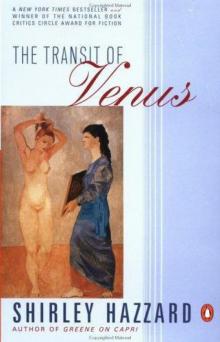
Shirley Hazzard died in 2016, aged eighty-five, an acclaimed novelist, winner of the National Book Award and of Australia’s most prestigious literary prize, the Miles Franklin Award, for her final novel, The Great Fire (2003), and of the National Book Critics’ Circle Award for her masterpiece, The Transit of Venus (1980); The Bay of Noon was a finalist for the 1970 Lost Man Booker Prize. Her writing is admired for its self-reflective delicacy of phrasing, its wit and irony, its intensely personal resonance, and its finely realized sense of place. She is one of the great writers of movement, passage, and transit. Her novels delineate a writerly sensibility that finds its location, as well as its most receptive audience, unconfined by national borders and paradigms. They trace the fates of young expatriate women within the geographical and emotional worlds opening up after World War II but before the social upheavals of feminism, and take her readers into moral territory that is at once utterly sure and breached at every turn, where the certainties of romance forms are tested by human vulnerability and the often brutal social and political canvas of modern life.
In all her writing, Hazzard crafted a wholeheartedly cosmopolitan perspective, insisting that “my temperament is not a very national one,”6 that “it is a privilege—to be at home in more than one place,” and refuting the designation “expatriate”: “I’m not even sure which country I’d be an expatriate of.”7 In place of the nation, Hazzard directs readers to the broad web of humanist inheritance. In her understanding of the work of culture and its place in the world, humanism provides an intellectual and imaginative bedrock. It signals the larger interconnections that make meaning of individual endeavors. It marks the work both of reading and writing, of attending to occluded as well as vaunted moments and objects, and it provides for unexpected points of recognition and understanding: “Humanism set the dignity and singularity of a man or woman above abstractions and inventions. Through generations of the world’s fratricidal convulsions, it supplied the fragile continuity of individual civilization. It offered hospitality to thought and art.”8 In her novels, she invokes humanism’s principles through the dense morality that underscores their intricate plotting, and in her striking use of literary allusion or oblique quotation. These qualities combine to create novels of great stylistic elegance and narrative density through which deeply familiar narratives of love, loss, and aspiration play out.
The writer Jay Parini drew attention to what he called the “sweep” of Hazzard’s fiction, the “global view” that it provides of the world of its readers and protagonists and its traversal of “the entire world,” a narrative passage that “manages to alight everywhere.”9 Within this global reach, Hazzard’s fictional worlds are those of the postwar, carved out in the wake, above all, of Hiroshima, which she had visited, aged sixteen, in 1947. The ramifications of the cataclysm are found through her work; they define the moral scope of her protagonists’ lives. Michael Hofmann observed that she would have “desired, as a novelist and as a woman, to make amends, to heal the atom by recombining her particulate characters in the right way . . . to find some better future for the species,” adding, “You could say the whole purpose of Hazzard’s enterprise, in life and fiction, was to put the world together again, and do it properly (and by the rules of art and love and goodness).” Further, “[i]n some fairly real way, the protagonists of her books are the continents of this blasted planet, and what she is doing is hauling Australia . . . up to Asia.”10
Hazzard’s four novels are set in the decades through which she lived and are marked by the great cadences of the twentieth century. She wrote to a friend, “What has attracted me—even, perhaps pleased me—is to look at, live, trace this strange caper of modern life in the constant presence and awareness of poverty and war . . . the endless ‘music’ of the two world wars and the Depression that haunts a life-span like mine.”11 She had left Sydney aged sixteen; had lived with her family in Hong Kong and Wellington, New Zealand; then in 1952, still with her family, traveled to New York, where she worked as a stenographer at the United Nations. Fiercely intelligent and instinctively intellectual,
she embarked on a project of self-education through extensive and passionate reading and through friendships with the literary elite of New York.
Her marriage to the translator and biographer Francis Steegmuller was marked throughout by the couple’s commitment to literary amateurism and belles lettres, traditions marked, as Timothy Duffy has observed, by idiosyncrasy and individuality.12 Steegmuller was a private scholar; his research and writing were supported in part by writing commissions, publishing advances, and the like, but primarily by the income bequeathed to him by his wealthy first wife, Beatrice Stein Steegmuller, a talented amateur painter and philanthropist. Hazzard, too, had been living off her writing for a year or two when she met Steegmuller in 1963, thanks to the generous (absurdly so, from the perspective of the present day) First Writing Agreement offered by The New Yorker magazine. She had also begun spending time regularly in Italy as well as New York after having been posted for a year to Naples in 1956. Her marriage consolidated this pattern: writing, reading and traveling, and spending time in stimulating conversation with the literary elites around them. The Steegmullers rented apartments in Naples, Capri, and the Upper East Side of Manhattan and moved between them through the year in well-trodden patterns: spring and autumn in Italy, August and December in New York. They read and reread, above all, the European canon; by way of example, Hazzard gave this list of works they read aloud together in the last decade of Steegmuller’s life: “Shakespeare, Gibbon, Byron’s ‘Don Juan,’ Clough’s ‘Amours de Voyage,’ Thucydides, Seneca, Auden, Delacroix’s journals, Leopardi’s ‘Canti.’ ”13 If such a writerly habitus is today no longer really imaginable, it was already unusual, even remarkable, in the immediate postwar decades.
While Steegmuller’s erudition and scholarship were grounded in his prewar years at Columbia, Hazzard had not even completed high school. There was a certain anachronism, and an unlocatedness, in her intellectual bearing; an autodidact who had made her way into the cultural life of New York from the far reaches of the colonial netherworld, pursuing intellectual modes that were already being relegated to the past. She had always operated to a degree outside the circuits of contemporary cultural life. To describe Hazzard and Steegmuller as amateur writers is to highlight not a lesser achievement or, as Roland Barthes has it, “a lesser knowledge, an imperfect technique,” but rather to assert the centrality of devotion in their pursuit of a life of letters. Amateurism is found, Barthes writes, “simultaneously at the highest and the lowest level: as Arcanum of enjoyment and as a modest hobby not to be exhibited,” a domain of pleasure not defined by a paying public. The amateur seeks “to produce only his own enjoyment”; he is “the one who does not make himself heard.”14
Donald Keene died in 2019 at age ninety-six, an acclaimed scholar of Japanese literature who had published more than twenty books in English and another thirty or so in Japanese, translations, literary histories, or monographs on individual authors, covering all major periods, from the eighth to the twentieth centuries. Keene was revered in Japan for his scholarship and his devotion to Japanese language and culture. His fellow Japanologist Carol Gluck observed that he was “almost the most famous man in Japan . . . You can’t go anywhere in Japan and utter the words ‘Donald Keene’ and not have everybody know him.”15 One of his former students, the Japanese American journalist Fred Katayama, observed that in Japan, Keene was seen as the foreigner who best knew and understood the country and the people.16 Keene received many of the most prestigious Japanese literary awards, including the Kikuchi Kan Prize (1962), the Yamagata Bantō Prize (1983), the Japan Foundation Prize (1982), the Asahi Prize (1990), and the Inoue Yasushi Prize (1994), and was the first non-Japanese to receive the Yomiuri Prize for Hyakudai no Kakyaku, the Japanese original later published in English as Travelers of a Hundred Ages (1989). He was also awarded the National Book Critics Circle Ivan Sandorf Award (1991) in the United States. Further Japanese honors included the Order of the Rising Sun in 1975 and 1993, and he was the first non-Japanese to receive the Order of Culture, conferred by the emperor in 2008.
Notwithstanding Keene’s extraordinary productivity and his employment at Cambridge and Columbia universities, there was a dimension of Barthes’s amateur in his career as a scholar from the start, above all in his devotion to Japanese language and literature but also in the extraordinary range and scope of his writing and teaching, for instance, the “unattainable” goal he had set himself of “learning everything about Japan”17 and the fact that he had been, as he wrote, for many years “the only person to teach Japanese literature at Columbia” and so had had to “cover all periods.”18 This capacious approach was evident from the start in his prodigious enthusiasm both for learning the language and for disseminating that knowledge to the widest possible audience. On his first military posting to Honolulu in 1943, he arranged for his one day off each week to be spent studying Japanese literature at the University of Hawaii. “The first term we read a modern novel each week, and wrote a report in Japanese. I had never before read anything in Japanese as long as a novel, and it was exhilarating to discover I could do it.”19 He reflected on his 1955 Anthology of Japanese Literature—which quickly sold out its first printing of two thousand copies and has remained in print ever since: “Its success brought home to me again . . . that I was really not cut out to be a scholar who produces one perfect research article every decade and that my greatest strength lay in communicating to other people the excitement I felt on reading works of Japanese literature.”20
Keene’s study of Japanese language and literature had its roots in his passionate opposition to war. At the age of eighteen, troubled by the progress of the war in Europe, he had come across a translation of the eleventh-century Japanese novel The Tale of Genji. He returned often in interviews and in memoirs to the importance of this moment. During the German bombing of Britain, he had been overcome with despair, and the novel offered “a kind of deliverance” to him in the world it conjured:
The translation (by Arthur Waley) was magical, evoking a distant and beautiful world. I could not stop reading, sometimes going back to savor the details again. I contrasted the world of The Tale of Genji with my own. In the book, antagonism never degenerated into violence, and there were no wars. The hero, Genji, unlike the heroes of European epics, was not described as a man of muscle, capable of lifting a boulder that not ten men could lift, or as a warrior who could single-handedly slay masses of the enemy. Nor, though he had many love affairs, was Genji interested (like Don Juan) merely in adding names to the list of women he had conquered. He knew grief, not because he had failed to seize the government, but because he was a human being and life in this world is inevitably sad.21
So Keene, a pacifist, enrolled in the U.S. Navy in order to learn Japanese. His first assignment, in 1943, was to interrogate Japanese prisoners of war at Pearl Harbor and to translate related documents. Uninspired by the inconsequential nature of the translations he worked on, he happened upon “a box filled with malodorous little books” seized during the campaign on Guadalcanal, in the Solomon Islands, that turned out to be “diaries taken from the bodies of dead Japanese soldiers and sailors. The odor was caused by the dried blood with which many of these diaries were stained.” The diaries, which became his “special field of competence” during his time in the navy, were difficult to read because they were handwritten and because “the diary, unlike the printed or mimeographed documents I previously had translated, was at times almost unbearably moving, recording the suffering of a soldier in his last days.”22
He was repeatedly struck by the distance he felt between himself and some of his fellow Americans, who seemed to have only one wish, “to return to their former lives,”23 in contrast to the sense of friendship that developed with some of the Japanese (“I discovered these people had read the same books that I had”24). This contrast “haunted” him, he wrote, adding nuance to his thinking about war, defeat, and victory: “the consecration of the Japanese to their cause,” on the one hand, and “the total indifference of most Americans to anything except returning home.” He added, “Although I did not in the least accept the ideals of the Japanese militarists, I could not help but feel admiration for the ordinary Japanese soldiers, and in the end I came to believe that the Japanese really deserved to win the war.”25 He wrote movingly, in an essay in 1946, of his friendship with one prisoner, the naval officer Sato, with whom he discussed “the great books of the West as well as the East. He was ready to discuss Greek tragedy or philosophy, but equally the works of Proust and Joyce.”26 He decided one evening to bring his phonograph to the camp to play a recording of Beethoven’s Third symphony because he knew this would bring pleasure to Sato. His account of the evening, playing the records in the shower room (for the acoustics), details the responses of one after another of the prisoners: one a former taxi driver, another a former news reporter, another a former doctor. “Nothing stood between us. If on no other ground, we could meet on that of music. The music was as true for them as for me, in spite of our different backgrounds, in spite of the cement and concrete shower room.”27