Expatriates of no countr.., p.5
Expatriates of No Country,
p.5
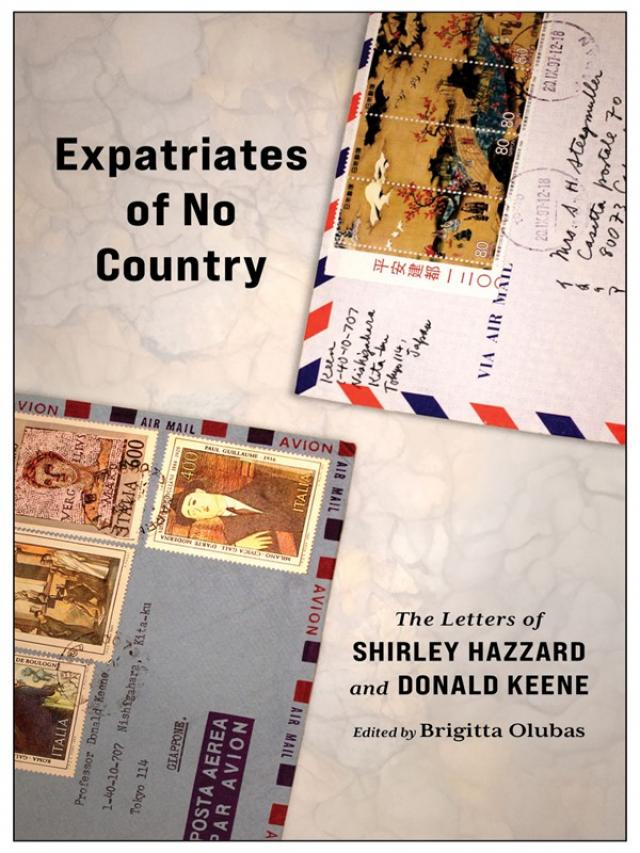


Much affection, and we do hope to see you sometime during 1983. [. . .] We wonder when your publication date is? I wish I knew the appropriate Japanese expression for trois fois merde, or Auguri—as ever—Shirley
New York, January 20, 1983
Dear Shirley,
[. . .]
Today I emerged unscathed from what the Japanese call ningen dokku, which means literally a “human dock”. This neologism refers to the practice of having a complete medical examination that requires one to spend at least two days in the hospital while every conceivable test is performed, and it owes its peculiar name to the analogy between the services performed at the hospital and the rather similar services performed on a ship in dry dock. This is not a bad example of how the Japanese have expanded our poor old English language in a manner that would surprise Dr Johnson. Anyway, the worst feature of my present physical condition is a tendency to stooped shoulders, an occupational hazard with writers, I am told. I was particularly pleased that there are no conspicuous signs of old age creeping over me. There is still much work for me to do—or at least I think so.
I had a three week vacation in India and Thailand, returning to Japan on the 10th of this month. I enjoyed the sunshine and the heat. Unlike my previous visits to that part of the world, I was not bothered by the oppressive humidity. In fact, I was there during the one month or possibly six weeks of the year when the weather is hot but comfortable. In Bangkok I met a friend who was in New York last year, and to my surprise I received the enclosed photographs of Francis, taken at the annual festivities of the American Academy. Somehow, if one put that scene into a novel, no one would believe it: I just happened to meet someone in Bangkok who just happened to be carrying around some colored photographs of Francis Steegmuller.
Shortly after my return to Tokyo I had a telephone call from Kazuo Nakajima, the friend of Bill Weaver. He was to return to Italy in a couple of days, but we arranged a meeting and spent a most agreeable two or three hours in conversation. Just imagine teaching Japanese in Venice! Why didn’t I think of that? I have visited Venice several times, briefly each time, but it just becomes more and more beautiful in my memory. It occurs to me that this is just the opposite of Proust’s experience; his Venice was above all the Venice he could not visit, and the impossibility of going there made it seem so incomparably beautiful. But my Venice is one above all of silence, broken only by the occasional vaporetto, a city of human beings rather than of means of transportation.
Speaking of Proust, I have slowly been making my way through the new translation by Terrence Kilmartin. I find it quite wonderful, much better than my recollections of Scott Moncrieff, and really not very different from my recollections of reading the original. But, naturally, even more than the ease and grace of the translation it is the book itself that overwhelms me. Each page brings a new discovery—and I thought I knew Proust well.
On the plane going to India, believe it or not, I read Villette, which you once recommended. I thought that with the exception of one chapter which baffled me, the book was remarkably good, perhaps the most effective portrayal of desperate loneliness that I have ever read. The one chapter is towards the end, a dreamlike sequence in which Lucy creeps out of the house at night and makes her way to the center of the city where she sees almost everyone she knows, overhears their conversations, is even waved to from a carriage. It reads exactly like delirium, but the next chapter makes it clear that everything actually happened as described. And the mystery of the ghostly nun seems curiously unworthy of the book. Having said what no doubt many others have also said, I must add that I am most grateful to you for having called my attention to a book that moved me more than any novel of that period. It baffles me now why no one before you ever mentioned it to me.
[. . .]
All good wishes for what is still a relatively new year!
Yours, Donald
New York, January 25, 1983
Dear Donald—
A postscript to my letter of last week, in response to your delightful one just received. I’m taking it over to the hospital in a little while so that Francis can enjoy it and also for the pleasure of seeing his face (in the flesh) when he sees his face (in the photographs). As I’ve said, in a novel, one would never dare put the real coincidences of life into a novel. He—Francis—is fine, and in a few days can come home and, as the doctors say, forget all about his recent adventures. He will be glad to learn the expression ningen dokku, and still more glad to hear that your only defect is stooped shoulders. We had not even noticed this let alone imagined any other.
Yes, how fine to have been in India and SE Asia in these weeks. I remember, in my first autumn in Hong Kong, how suddenly one day I realised it was cool, it was dry or at least drier. The era before air conditioning too. Having met Kazuo any number of times, I learn only from you that his name is Nakajima—yes, he is a genius to be teaching Japanese in Venice. Your words about Venice, most a proposito, as—having shirked the tremendous expense of Venice hotels, even fairly ordinary ones, for some years—we are promising ourselves at least a week there soon. I’m interested in yr observations about the new Proust. First, for me, it is the fact that it has important passages not hitherto available in translation. But I don’t agree with Richard Howard’s review in the New York Times savaging Scott Moncrieff in favour of this new one. For one thing, the new translators clearly state that they have based their work on SM’s. Then—I spent some weeks with my evening game of setting out the three and comparing; and for my own taste SM still sometimes wins out—although indeed I found passages in the new translation also at times simplified and improved. However, look at this (from my “favourite” passage, Albertine’s letter of farewell): The French—from memory, I think correct—is “Croyez que, de mon côté, je n’oublierai jamais cette promenade deux fois crépusculaire, parce que la nuit venait et nous allions nous quitter,” which Scott Moncrieff translates: (again from my memory) “Please believe that I shall never forget that drive in a twilight that was twofold because night was coming and we were about to part,” and (new translation—from the book): “You may be sure that for my part I shall never forget that doubly crepuscular drive (since night was falling and we were about to part) and that it will be effaced from my memory etc.” “Doubly crepuscular”? Brackets? Perhaps it is really, as Guizot said of Gibbon, that once someone has hewn out so great a work (in this case of translation) it is then possible to make objections to it since it now exists to object to, whereas was previously unimaginable, a labour one cld scarcely conceive.
So glad you like Villette—nice to think of it being read by you in Japan. We’ll talk of it when we meet again. Please don’t come when we are in Italy if you make your New York trip in the spring, as we greatly hope you will. We’ll be in NYC again from mid-April to mid-May (then from late July to Labour Day). After this exceptionally mild winter we have a few cold days now, but already some thoughts of spring come to the imagination and 5:00 o’clock is no longer nightfall (although “doubly crepuscular”) . . .
How good that your work is going on. I’m trying to remain on my own during this absence of F’s in hospital, and get a good stretch of difficult stuff completed. As soon as one can get to it, a tremendous relief descends, don’t you find?
Thank you so much for your coals-of-fire letter. All affectionate greetings from us both—yours—Shirley.
Tokyo, March 28, 1983
Dear Shirley,
[. . .]
I’m spending my time in Japan quite happily. Progress on my book, the last of the four volumes of my history of Japanese literature, have been delayed pleasantly by the arrival of the first batch of galleys. I now believe that they will actually publish the book, though it has been almost two years since I turned over the manuscript. Galleys are in good condition, but at some point, after I last saw the manuscript, a kind and helpful editor made her way through the foot notes hacking them to pieces. Although she knows no Japanese, she has been instinctively aware, she thinks, of which words in a Japanese title are important, and she has deleted the rest. Or she has cut off the second half of a title, deciding it was too long, but because she has no idea of what the title means, they tend to end up in the form of The Transit Of. She shortened the title of my book Modern Japanese Literature to Japanese Literature, saving six letters; however this might prove confusing to some readers since I have another, quite distinct book called Japanese Literature. [. . .]
You asked in a previous letter if I had read Montale. Unfortunately I haven’t. My Italian is entirely self-taught, mainly from opera libretti, and although I can read newspapers and the like, my knowledge of Italian is inadequate for poetry.
[. . .]
As ever, Donald
Tokyo, August 24, 1983
Dear Shirley,
I know what a long time it has been since I last wrote, and I apologize. The thought of writing you has been much in my mind, if only because I would like to have a letter in return, but my time has been divided up into such peculiar segments that there never seemed to be the right moment for resuming our correspondence.
[. . .]
My chief occupation has been writing a newspaper serial. This sounds rather like Dickens, but my serial has been devoted not to a novel, but to a study of Japanese diaries over the centuries. It is extremely difficult for me to write a manuscript of an absolutely prescribed length, and this means that I generally have to go over each instalment with an editor in order to fit it into the Procrustean space allotted to me. It has taken up far more time than I expected, but the time has not been wasted because I will be able to use my new knowledge when writing the first (concluding) volume of my history of Japanese literature. The greatest pleasure, predictably, has been discovering diaries I had never previously read. One, for example, was written by a woman in her eighties, and consists almost entirely of expressions of bitterness over the decision of her son, an eminent Buddhist priest in his sixties, to go to China in order to study at the fountainhead of his particular sect of Buddhism. She writes as if she has been completely deserted, though another son, also a Buddhist priest, is nearby. She curses her son and finally even Buddha for allowing so terrible, so unprecedented a calamity to happen to her. Then she curses herself for having lived so long. If only she had died earlier—she was sickly as a child—she would have been spared this anguish. The son, who seems like a monster, was probably a very pious man who was sure that he would see his mother in paradise, provided he did everything while in this world to ensure salvation for both of them. It is an amazing document (twelfth century), but it also made me realize for the first time, at least in words, how extremely important the relationship is between mothers and sons in Japan, and how extremely unimportant, certainly when compared to the west, the relationship is between fathers and daughters. Some Japanese soldiers died in 1945 with the cry “Long live the emperor!” on the lips, but many, many more died with the cry of “Mother!” or some diminutive instead. This made me realize, by a leap of association, how few operatic duets there are for mother and son as opposed to father and daughter. The only one I can think of is Azucena and Manrico in Trovatore, and they are really not even related. But how many Verdi operas are built around the father-daughter relationship. I haven’t thought of any explanation for this difference between Japan and the West, and perhaps there isn’t any, but this is the kind of reward I receive for battling my way through some almost forgotten diary.
The other day the enclosed review appeared in the Asahi evening news. I thought it might interest you, because I know your views are quite different. The reviewer, James Kirkup, has lived in Japan for many years, teaching English. I met him once, about 25 years ago. Very briefly, but I have had indirect contacts with him from time to time. He can be very nasty in his reviews, and he is in fact a kind of menace because of his conviction that he is the only person who can translate Japanese poetry. (I don’t think he knows any Japanese, but he works with translations made by students.)
I hope that you and Francis have been well and enjoying Italy. I am looking forward very much to my return to New York in January. I really miss my friends in New York.
As ever,
Donald
New York, September 10, 1983
Dear Donald—
Your letter was received with so much pleasure. I too have been intending as ever to write—do you think if we didn’t “write” in our professional lives we’d take up the private pen more often? I think I said to you before this that I feel I am drowning in unanswered letters that—although pleasant to receive—mean little to me; while the friends I truly would like to write to go to the wall. Francis and I between us certainly write a thousand letters or more a year, nearly all of necessity. Elizabeth H and I have the expression “sending telexes” (or teleces . . .) for the messages we write in our heads to each other, which comparatively seldom get onto letter paper.
[. . .]
Next Thursday I leave for Italy. Francis follows ten days later. I should have been on Capri two weeks ago. But this year we had a misadventure as we were leaving Naples to come here for our August stay. When I tell you that for a lifetime we have told all our visitors to Naples that nothing can happen to them if only they will not carry anything snatchable, you will wonder why we had a bag in hand on our last evening in the city in late July. (In fact, we had been delivering books to a binder; and were being careful, staying near the wall etc.) However, when we crossed an open space to a taxi, to return home, two youths on a Vespa who must have been stalking us flashed past, grabbed the bag; Francis held onto it for a second—enough to get flung to the ground and dragged. Terrible moments. (The drama quickly improves, I should say at once.) Street people were indescribably good. Police came. Two (quite other) young men told me not to wait for the ambulance but to put F in their car, and thus we sped to a nearby hospital. Disintegrating premises, excellent & efficient, humane care. X rays, etc. I phoned to a Neapolitan friend who, before I could finish speaking, said “I’m coming at once” and hung up. Stayed with us throughout the night—at a second hospital where we were sent to a specialist in head injuries. (It was Saturday night in July, and this specialist was at his country place on the sea. When called he too started at once; took an hour and a half to arrive; came at midnight, spent two hours with Francis.) Pronounced the injuries as restricted to a broken nose & contusions, possibly a cracked cheekbone. The other serious injury was a broken—right—shoulder. The contusions, blood, etc made everything look more appalling, of course. Upshot of all was that we made our plane to NY two days later, with superhuman help & comfort from friends, the airline, the doctors etc. (The Naples hospitals would not accept a penny from us—for X rays, ambulance, hours of doctors.) Once restored to the medical Mecca of NYC, all hell broke loose. I suppose this is a good place if you have—god forbid—a complex complaint; and a lot of money. But the neglect of a broken shoulder and nose was formidable, and resulted in terrifying haemorrhages from the nose, and a dawn admission to NY Hospital ten days after our return. A week in hospt fixed most things, except for patience with the shoulder which is now restored except for continuing exercises for mobility etc. F lost weight—it has been mercilessly and infernally hot. He also had a week of depression, presumably a delayed reaction—throughout the episode itself he was completely composed and even humorous.
So—long story, which explains our presence in NYC at this moment. F sees the shoulder doctor last time before joining me later this month; then we hope to remain in Italy until about 12 Nov. To think that when we return here you will be within a few weeks of your own re-entry. I confess I find the city awful in a variety of ways. However, there are great compensations—of friends, liveliness, music, pictures, and other assets (yesterday, a Metrop Museum friend let us in, in advance, to the Manet exhibition; a strangely variable painter in quality, to my mind, but of course with many astonishing talents). Since your departure, an appalling edifice has opened at 57th and Fifth, the Trump Tower, a temple to crass materialism. It carries with it an implication of—Dallas, perhaps; or some brash, indistinct but organised arrangement for flaunting wealth. Trumpery Tower. [. . .]
I was baffled—completely—by James Kirkup’s view of P. White’s autobiography. It is inconceivable to me that such an impression can be gained from a work of so much vindictiveness, such untransmuted egotism and revenge. Of course there are good things in it—the pieces about Greece, episodes in the war, in England, in the Middle East; youth in the Australian countryside. But wherever a direct personal comment enters, there is the danger—usually consummated—of an attack on something or someone. At one stage he says that Manoly (his long companion) says “I even hate him too”. If not, Manoly seems the lucky exception. The attack on the painter Sidney Nolan, PW’s greatest nonsexual friend for thirty years, is pretty insane. (Derives from Nolan’s having remarried after his wife Cynthia’s death—she was a suicide.) PW says “What I cannot forgive is his laying his head on another woman’s breast”—Does not this strike you as unhinged? Who is he to “forgive”, what is there to forgive, why proclaim this to the world? This is the man who gives, as his “recreation” in Who’s Who: “Friendship” . . .
Disheartening, this also.
Time to go to Italy.
Your “serial” sounds utterly fascinating. I find it surprising that, at such an era, a Japanese woman would feel herself in a strong enough position to resent a son’s defection (even if in the cause of Buddhism). I must think about opera. It is strange that more examples of Mother-Son do not come to mind, as one cannot stay in Italy even a matter of days without discovering how immensely important the mother-son relation is. Now of course subject to some erosion; but, for an older generation, sacred. “La Mamma” is not only the Madonna and Cybele, but a natural force, something that throbs through Italian life. Yes, of course, Trovatore, and the dread line: “Ero già figlio prima d’amarti”. Turiddu and Mama Lucia. Well, we have to work on this.