Expatriates of no countr.., p.15
Expatriates of No Country,
p.15


[. . .]
There is not much to report. I have been extremely busy, but almost always at the same thing, looking for materials concerning the Emperor Meiji and writing about what I find. I have also written a small number of miscellaneous pieces for newspapers and magazines, but (mercifully!) I have not had to deliver any lectures. This summer promises to be rainy. I prefer rain to heat, but there is somewhere in the back of my head a remembrance of golden summer days, such as I have rarely experienced, and this makes me less appreciative than I should be for the gloomy skies.
There doesn’t seem to be much likelihood of returning to Italy this year. I have been asked if I would give a paper on shoes in Japanese literature at a conference sponsored by Ferragamo, but Japanese literature is notoriously deficient in descriptions of shoes. I’m afraid I lack the courage (effrontery?) to give an hour’s address on the subject, though I would like to visit Italy again.
[. . .]
All my best wishes.
As ever, Donald
Sydney, August 16, 1997
Dear Donald—
As you see, I’m a few miles closer (or so I think?) to you. I can’t thank you enough for your two letters, and for being so thoughtful as to write to me the second time on not hearing. Your first letter reached me with some delay—NOT because of your having sent it to Italy, but because the main post office at Naples (a huge bombé fascist affair that is now admired for its modern architecture . . . such is our contemporary desperation) was being painted, inside, and no mail was being sorted or delivered. A Neapolitan detail. The letter reached me shortly before I left for NY, where I intended to answer it right away—then I was swallowed up in writing my speech for Australia, which I gave here three evenings ago. The speech terrorised me—I couldn’t get close to my theme, rewrote continually, felt desperate towards the institute that was bringing me so expensively to Sydney . . . That continued to the evening before my departure, when I stayed up most of the night to recast the talk, which only then seemed to me fairly tolerable. Then—the long, long flight in the dark, wondering why I had ever got into it all. Arrived at Sydney at dawn, a beautiful day coming up, to be met by Ann Lewis, whose house and boat you’ll remember—so kind. Since then, a week ago, every “midwinter” day has been like early summer, and with an inexpressibly beautiful clear light. People have been immensely kind. Many things have got better at Sydney (and some things, of course, worse). The great relief: the “speech” went very well (a dinner for 600 people—politics, corporations, the arts), such an accessible, responsive audience. To my astonishment, I had a lovely evening.
[. . .]
Your description of your changed situation in Japan—with the infirmity and death of friends—is so real to me. It is what Francis experienced with Paris, after a lifetime attachment to the city and to his friends there. When he finished his book on Cocteau, in 1970, we had been living in Paris part of the year for five years. We knew many people, had also met many people through the Cocteau connection—fascinating, every one of them—yet Francis decided that we wd pursue our Italian life, and make sporadic visits to France. Because his friends in Paris from the 1930s, all older than he, were disappearing one by one; and the new friends made through Cocteau were also for the most part elderly and starting to drop away. He felt that the city for him wd be a haunted place; and the modern changes dismayed him—skyscrapers, a new hardness . . . Of course we re-visited the city, but never lived there again. I don’t think, of course, that your “case” is just like that. But the cruel feeling of a chapter closing, of the evaporation of visible evidence of one’s memories seems something analogous. As you say, we’ve been so fortunate—but how to settle, now, for less in these beloved and familiar places? Again fortunately, we don’t yet have to make definite decisions. Of course, selfishly, I’ll be very pleased if you decide to spend more time in New York. But how good if “things” could go on for us without those sad mutations. And how grateful one is to have one’s work, what one has chosen, and wished, to do.
Sydney is full of memories for me while I’m here. I think little about these things while I’m in New York or Italy. The light here is itself poignant and evocative to me, recalling childhood mornings and afternoons (at that age, evenings didn’t play such a role). Huge changes—and then some salient things utterly unaltered.
[. . .]
Coriolanus—how glad I am not to have seen what you describe. It is a marvellous play. Francis and I would read it aloud with excitement. Uncompromising. When I first came to NY—with my parents, at the beginning of the 1950s—a friend invited me to go to a production of Coriolanus at the Phoenix theatre, then down on First Ave about 20th St. The actor was Robert Ryan, whom I’d seen in films. It was splendid—the simple, faithful production and the wonderful acting. (I don’t suppose his mother’s name really was Volumina—a stroke of Shakespeare’s genius. However, I’ll look in Petrarch.) Ryan was a very tall craggy man, highly trained stage actor originally—and the performance was unforgettable. Many years later Francis and I were at Marya Mannes’ apt in the Dakota, and Ryan, a neighbour in the building, came in for a drink—v civil and pleasant person. I asked him about the 1952 Coriolanus and he said it was one of the best experiences of his acting life.
I beg your pardon for this rambling letter, which I now confide to the Pacific posts. We’ll be in touch—and I so look forward to Oct-Nov days in New York. Also, something to tell you about “my” Villa dei Papiri at Herculaneum—Good news there.
With all affection, and with apologies for delay—Shirley.
Tokyo, September 19, 1997
Dear Shirley,
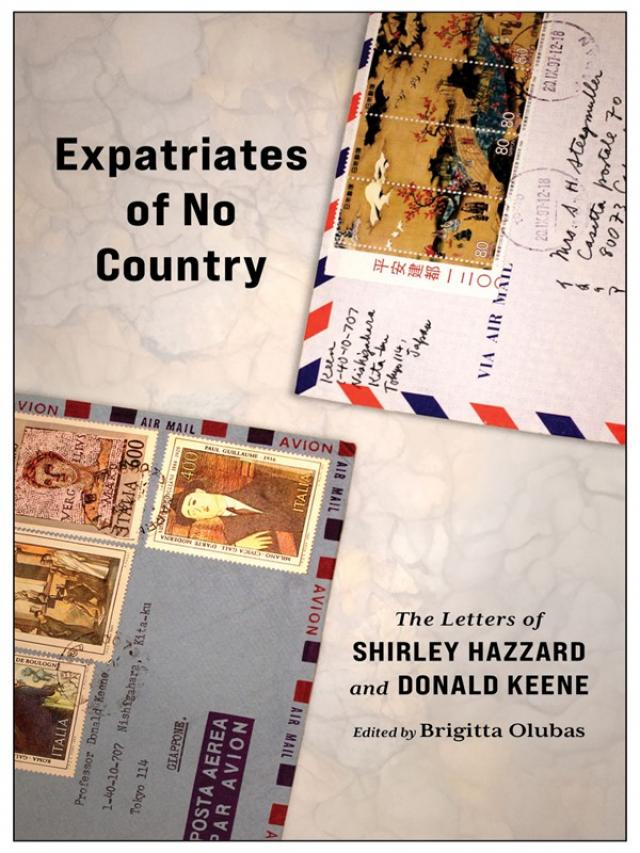
I was very happy to receive your letter from Sydney. The envelope festooned with rare and curious denizens of land and sea. I think you will be glad to know that when two English princes, sons of Edward VII, visited the Japanese court in 1881 they gave the Empress two wallabies they had acquired in Australia, assuring her that the animals would make the palace just as cheery as their ship. The younger Prince, then only 16, had dragons tattooed on both arms. Does that sound like George V to you?
I never really expect a letter to Naples will reach its destination without delay. I remember well the huge, ugly post office. During my last visit to Naples I stayed at the Hotel Oriente (appropriately!) which is just across the street from the post office, I think, though, that the worst example of fascist architecture is the Milan railway station. No doubt it, too, is admired.
[. . .]
My main work, the biography of the Emperor Meiji, has been proceeding satisfactorily. It may, when finished three or four years from now, be the best biography ever written of a Japanese emperor. But the things I don’t know and should know are maddeningly obvious. I have only a few crumbs of what might be called individuality to offer my readers. I have just found a most remarkable bit of information. In 1883, for no reason I can think of, he refused to see his advisers, did not participate in meetings where his presence was needed, and so on. When Queen Victoria withdrew completely from governmental work, this can be ascribed to grief over Prince Albert’s death. But why did Meiji refuse to see even the ministers he most trusted? Someone must have known, but perhaps out of constraint over revealing royal secrets never wrote anything. I am lucky to have this piece of information about his withdrawal. Although it is not a secret, it has never been used by historians. Probably because it cannot be verified.
[. . .]
I am sure that your talk was wonderful, and hope that you will include it in a volume of talks, including those in Italian. I remember so well that beautiful talk you gave at my retirement party at Columbia. It was the high point of the occasion. You asked me to shoot you if you ever again contemplate making a speech. No, I will not shoot you, but (if you like) I will exclude everyone from the audience except myself.
I shall write again to New York as the date of my return approaches. In the meantime, I hope that the weather in Capri is perfect & that you are enjoying it.
As ever, Donald
Tokyo, December 23, 1997
Dear Shirley,
Yesterday I received your Christmas card. Of course, I was happy to receive it, but I was startled and dismayed to learn that you had spent the autumn in New York having an operation. If we were living in the world of literature, as opposed to the real world, I should certainly have sensed something even without hearing from you; but when I thought of you (which was often) I always imagined you reading a book on a terrace overlooking the scenery at Capri or Naples. I hope you have fully recovered.
I have news which is at once very good but also disappointing. I have been planning to return to New York on January 12, but I had word that I have received the Asahi Prize. This is an important prize awarded not only to persons concerned with literature but to scientists, economists and so on. The announcement is made on New Year’s Day, but I have had word from the newspaper that makes the award. My first thought (apart from joy!) was that I would fly back to New York as planned, then return for the ceremony, which takes place on January 30. But then I began to think of three trans-Pacific flights in two weeks. This is not nearly as long as the flight to Sydney, but it is exhausting. [. . .]
The autumn was truly exhausting. I gave lectures in a dozen or more places, each one entailing not only the actual hour and a half of talking, standard in Japan, but the reception afterwards and—horrors—the innumerable commemorative photographs, each preceded by the command “Cheese!” Naturally, the lecturing interfered with my writing. I now have quite a lot of money, most of it subject to heavy taxes, and memories of the ride from the station or airport to the site of the lecture, normally all I see of any town.
[. . .]
All my warmest greetings, Donald
Tokyo, July 21, 1998
Dear Shirley,
Thank you for your Donizetti card, festooned as always with beautiful Italian postage stamps. I stopped saving stamps at the age of 17 or 18, but I retain affection for them, whether beautiful ones such as those you always put on letters from Italy or old ones showing Franz Joseph, Edward VII, Queen Wilhemina. I feel nostalgia when I see their faces. As a child I was a passionate royalist and could not get interested in American history for this reason. My greatest favorite was Marie Antoinette and I kept reading about her in the hopes that in the next history I read she would escape. It did not occur to me that all histories would tell the same story.
During the last week or so I have made a painful historical discovery. About thirty years ago I wrote a long article about the cultural effects in Japan of the Sino-Japanese War of 1894–5. What I wrote was not mistaken, but I now know how much I did not write. My interest was in the prints, poems, songs, plays and so on that came out of the war, but now that I am writing something closer to a history I have to examine the battles too. The massacre at Port Arthur, which I vaguely knew about, on close look is horrifying. In terms of the number of people killed, it naturally does not rival what one well-placed bomb achieved in World War II, but there is a difference that I cannot easily explain between the action of a man pressing a button releasing a gigantic bomb, and a band of soldiers swooping down on unarmed people and slashing off their heads. This may simply be a failure of the imagination, but perhaps it is something worse. As an intelligent English or American reporter commented in 1894, if a stalwart troop of soldiers from one of the Western democracies broke into a crowd of dusky people and slaughtered them, people reading about this were likely to shrug this off, taking it for granted that savages must be taught they have to obey the rules of civilization; in this case, however, because the sword-wielding soldiers were Japanese, their action was taken as proof that, for all their show of modernity, they were fundamentally barbarians. I shall have to describe the events as I now see them. Perhaps they are not really necessary to a biography of the Emperor Meiji, who was many miles away and probably never learned what had happened. But, knowing the facts, and remembering how cheerfully I wrote about the war thirty years ago, I feel obliged to record them.
Although this kind of research can be depressing (as in the present instance), on the whole I enjoy it extremely. I am bombarded with requests for lectures, articles, interviews, dialogues, roundtable discussions and so on. This attention is highly flattering, and I should probably miss it if it stopped altogether. But I yearn to be back at my musty old books, in the hopes of discovering one tiny germ of new knowledge.
I imagine that you are back in New York now, fleeing the merriment of the August holidays. Oddly for me, I rather wish I were back in New York. It is not exactly the case that the charm of Japan has worn off. There is still much that gives me pleasure. But, having attained a few weeks ago my 76th birthday, I have been thinking of what I want to do most during my remaining years, and the answer is simply: work. I have become a workaholic! Seriously, apart from the great pleasure of being with friends like you, I derive the most satisfaction from reading, perhaps finding a fact that has escaped attention, and trying to make sense of it. This is, I now see, better done in New York than here, where I must fend off friendly, generous people who want me to do something which may not take much trouble but which I don’t really want to do.
[. . .]
As ever, Donald
Tokyo, September 23, 1998
Dear Shirley,
I haven’t heard from you in a few months, and naturally I worry. I hope that you have simply been too busy with your present work to write a letter. Or perhaps my letter never reached you, a possibility that one must take seriously these days. I still look forward each day to the delivery of mail, but even if the box is full of postal matter, it rarely contains any letters. The telephone, fax machines, e-mail and Heavens knows what else have combined to destroy or at least submerge the letter as a means of communication. Can you imagine Clarissa writing an e-mail missive as she is being carried off by that dreadful Mr. Lovelace?
I believe that you mentioned you would return to New York in order to be present at the celebration of Bill Maxwell’s ninetieth birthday. I wish I could be there too. I have just finished reading his novel A Folded Leaf. I found it almost unbearably moving. He writes so beautifully and with such truth. And also with the humor which, I suppose, is a necessary part of any work in the English language. Please send him my warm regards when you see him.
I have been slowly but steadily moving ahead with my biography of the Emperor Meiji. I remember someone—I think it was Leon Edel—saying that one must fall in love with the subject of a biography. I am afraid I haven’t managed to fall in love with Meiji, but quite clearly he doesn’t want my love. He never did anything despotic, never ordered the deaths of innocent people. Nor, for that matter, did he allow any statue to be erected of himself on or off a horse, though others of the time were so honored. But except for brief flashes of temper, which he usually regretted the next day, his voice is never heard. If he had not lived in an incredibly interesting period, it would be hard to know what to write about him. I have had little reaction to the three and a half years of the biography, as serialized in a Japanese magazine, but it is too late to turn back now!
I really don’t know where to send this letter, but I suppose (on the basis of my experience with Mussolini’s post office in Naples) that New York is safer. New York safe? Well, not really! Best wishes as always,
Yours, Donald
Tokyo, July 22, 1999
Dear Shirley,
Just typing the figure 1999 seems somehow ominous, doesn’t it? Today I saw a BBC television program about people who think that the world will end next year. One man warned solemnly that this is our last chance to flee from the doomed planet earth. He didn’t say where he advised us to go instead; perhaps he doesn’t want his extra-terrestrial haven becoming overcrowded!
Last night I had a dream which ended with you urging me to go to Reggio Emilia. Of course, I’m always ready to go anywhere you recommend, but before I could find out why I should go there, I woke up. My plans are still not definite; perhaps I shall investigate Reggio Emilia. Unfortunately, I don’t even know what I should be looking for—buildings, landscapes, gardens, food, wine, music???
I arrived in Japan on June 6th after a voyage from San Francisco. An airplane journey of two days, as you know, can be excruciating, but on the sea I found myself wishing the journey were longer. Nothing special happened, and apart from a one-day stop in Honolulu there were not any variations in the scenery, but it was wonderful being completely in control of my time. No, that was not really true. There were prescribed meal times, and I had two lectures to give. But these were insignificant interruptions to the hours when I read or, for exercise, strolled along the deserted decks. Since arriving in Japan I have been following my usual routine, a mixture of serious study, lectures on topics that don’t interest me anymore but seem to interest audiences, and a small amount of seeing friends. So many friends have either died or are no longer what they were. That is the price one pays for living to be 77. There is a chance I may visit Italy for a week or so in November. There is to be another conference in Venice on Hokusai. I am not being modest when I say that I have nothing new to contribute on the subject of Hokusai, but I have been invited, and I think I may go, for Venice if not the conference.
I hope that your books have been coming along well. How exciting to have received that offer from the English publisher! Just when I was about to conclude that it is the fate of all good books to be neglected, I heard of this deserved recognition!
As ever, Donald
Naples, October 17, 1999
Dear Donald—
I don’t know why I shd take up the first half of this letter enumerating for you the thousand impediments that prevented my writing it long ago. They are all the usual things that New Yorkers, and travellers, are accustomed to, compounded by my dilatoriness—well, not really that, but it must look like dilatoriness to my wronged, and illustrious, correspondents. I loved having your letter, and the impression of your sea voyage, which roused strong memories. I’ve probably told you that, the first time I left Australia, just after the war, to go with my parents and sister to the east, the little ship, the Taiping (very comfortable, with at least two Chinese servants to every passenger) went from Sydney to Kure in five weeks, with only one stop—of a single afternoon, in New Guinea to take on water—and it didn’t seem in the least long and the thrill of arriving, in a Red Dawn, at the top of the world, having started from the bottom . . . There had been no other way for Australians (or almost anyone) to travel outside their own country other than by ship, before the war; and during the war only combatants were travelling by air. Sea travel went on well into the 1950s as an unchallenged means of moving around the world. Jet planes put an end to it, of course. One of the marvellous aspects is, or was, being free from interruptions: “they can’t get at me”. But I suppose all that is changed, and your fellow passengers were often babbling into cellular phones? Spirits can cross water, these days. Having said that, I realise that we are entering, here, the season when Capri is cut off from the mainland quite regularly by high seas, sometimes for a couple of days: a pleasant and exclusive feeling.