

Sisters of tomorrow, p.2
Sisters of Tomorrow,
p.2
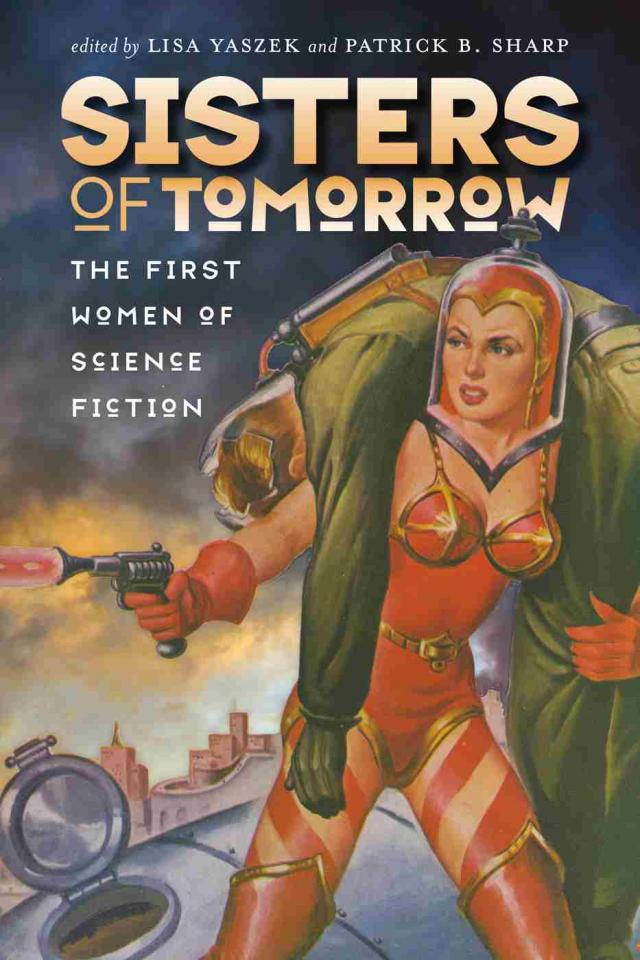


So where did these women work in the SF community? Our survey of the forty-three specialist, multi-genre, and amateur magazines that featured SF in the 1920s, 1930s, and 1940s indicates that while women published in almost every one of these magazines, their work appeared most prominently in three key venues. Authors who specialized in scientific extrapolation gravitated toward magazines founded by Hugo Gernsback, including Amazing Stories, Amazing Stories Quarterly, and Wonder Stories. In 1927, just one year after he founded Amazing, Gernsback regretfully noted that women rarely made good SF authors, because their science education was all too often “limited” by social convention (“Headnote to ‘The Fate’” 245). Yet he was quick to publish those women who did write SF, and by 1931 his successor, T. O’Conor Sloane, could claim women such as Leslie F. Stone as “staff writers” without undue comment.3 In many ways, women’s rapid assimilation into the Amazing fold was inevitable. Gernsback featured women writers in the scientific magazines he published prior to the founding of Amazing Stories and continued this practice in his genre magazines. Moreover, he encouraged authors to draw on literary traditions that had long been popular with women writers, including utopian and Gothic fiction, and women easily adapted his conception of SF as a vehicle for scientific inspiration in order to explore how the genre might also serve as a vehicle for social change.4 Gernsback’s successors at Amazing, Sloane and Ray Palmer, expanded the mandate of their magazine to include the work of women poets such as the critically acclaimed Julia Boynton Green and science journalists such as the provocative L. Taylor Hansen, who used her monthly column to challenge scientific racism. Meanwhile, the managing editor of Wonder Stories, David Lasser, cultivated the progressive political visions of women writers, including Stone and Lilith Lorraine.5
Women were also significant contributors to the multi-genre magazine Weird Tales. In direct contrast to their counterparts at Amazing, the editors Edwin Baird, Farnsworth Wright, and Dorothy McIlwraith never directly commented upon this trend. Indeed, the relatively high proportion of women contributors might not have seemed significant to them because the first generation of pulp magazines that appeared in the 1890s, including All-Story Weekly and the Black Cat, were also multi-genre magazines targeting and featuring women writers.6 Moreover, Wright and his fellow editors were even more committed than Gernsback to showcasing speculative fiction written in literary traditions forged by earlier generations of women writers, including Gothic romances and fantastic poetry as well as newer ones in which women were just beginning to make their mark, such as the laboratory monster and bizarre SF adventure tale. Indeed, Harris—an early woman writer of carefully extrapolated SF usually associated with Amazing Stories—was actually a Weird Tales discovery (Ashley, History 28). Additionally, Weird Tales was home to Margaret Brundage, whose sexually and racially charged cover illustrations made her one of the most-talked-about artists in the early SF community, regardless of race or gender. It was also home to the editor Dorothy McIlwraith, who was tied with Mary Gnaedinger of Famous Fantastic Mysteries for the honor of being named the first female lead editor in SF and who successfully oversaw her magazine’s transition from pulp magazine to midcentury slick.
Amateur and semi-pro publications offered many women a third way to engage their chosen genre. Lilith Lorraine was a true pioneer in this respect, appearing in the May 1930 debut issue of SF’s first recognized fanzine, the Comet, and contributing regularly to the Hugo-nominated fantasy fanzine the Acolyte. Between 1943 and her death in 1967 Lorraine founded more than half a dozen of her own amateur press publications, including Challenge, the first magazine dedicated to SF poetry. While Lorraine moved from commercial SF to semi-pro publishing to better enact her own vision of SF, other women launched professional careers based on their involvement with fanzine culture. Virginia Kidd, an active member of fandom, published her first poem in the Fantasy Fan in 1933, when she was just twelve years old. Kidd cofounded the Vanguard Amateur Press Association in 1945 and published many of her own fanzines, including Heeling Error, Snarl, and Quarterly, through that organization before trying her hand at professional writing and establishing herself as a literary agent. In a fascinating variation on the same theme, Tigrina wrote weird poetry for the Acolyte, served as an associate editor for the Detroit-based fanzine the Mutant, and edited Hymn to Satan, the first SF and fantasy music publication. Inspired by her positive experiences with genre fandom, in 1946 Tigrina launched Vice Versa, the first publication in the world devoted to lesbian issues, and embarked on what would become a decades-long career in gay journalism.
So what exactly attracted women to SF? The women featured in this anthology addressed this subject in a wide range of interviews, guest lectures, and essays, offering four main reasons for their interest in this genre. First and perhaps foremost, women were drawn to SF because they had an affinity for science. Clare Winger Harris connected her lifelong love of SF to the “love of science” that she developed at Smith College, a single-sex institution that was the first of its kind to create a dedicated science building for its students (Harris, Away 11). The SF author and science journalist L. Taylor Hansen claimed that the impetus for her work was the desire “to capture something of the thrill” of scientific discovery while overcoming the limitations of traditional scientific perspectives: “Most laymen who live within the limited horizon of a daily job can never experience the personal thrill of a scientific discovery which is the near look of science; while by the same token many scientists … through lack of multidimensional concept, [have] lost contact with the advanced horizon which is, in essence, scientific far vision” (Ancient Atlantic 7). Hansen’s stated desire to re-create the thrill of science for laypeople and encourage a “scientific far vision” was very much in line with Gernsback’s influential definition of SF as a “charming romance intermingled with scientific fact and prophetic vision,” and so it is perhaps no surprise that she published most of her early work in Amazing Stories (Gernsback, “New” 3). SF also offered women a way to engage science when there seemed to be no other option. As Batya Weinbaum’s interviews with the author’s family reveal, Leslie F. Stone turned to genre writing in large part because while she was interested in science, her family saw it as “a male pursuit” and so did not provide her with “any encouragement” to study it (35). In an era when increasing opportunities for women in education and the professions competed with patriarchal assumptions about the proper sphere of women’s work and the masculinization of science, SF provided women with opportunities to engage science in both critical and creative ways.
Women also chose careers in SF because they loved the genre. Clare Winger Harris “grew up reading the stories of Jules Verne and H. G. Wells” (Harris, Away 11). Leslie F. Stone grew up loving the John Carter stories of Edgar Rice Burroughs and said that she wrote SF as “a creative outlet for my rather vivid imagination” and “for the sheer pleasure of it” (“Day” 101–102). C. L. Moore, too, said that she was “weaned on the Mars books” of Burroughs and loved the fun of reading SF, which “was a grand, glorious experience, a new way of looking at the world and sharing in exciting new adventures” (qtd. in Elliot 46). Moore recounted the moment she rediscovered SF: it was “at a local newsstand across the street from the bank where I was working at the time. On my way to lunch one day, I spied this copy of Amazing, which stood out like a sore thumb…. I just loved the stories, the fact that they took me out of myself and my narrow little world” (qtd. in Elliot 45–46). As a thirteen-year-old, the future SF poet and literary agent Virginia Kidd related a similar story in the readers’ forum of Wonder Stories: “Many years ago, I saw a magazine … on the drug store mag-racks, and investigated its presence … one of stories was Part One … of Taine’s The Time Stream. I’ve been reading [SF] ever since” (“From” 628). Whether they grew up reading the classics of Wells and Burroughs or the new pulp magazines, girls fell in love with SF just like their boy counterparts and were inspired to contribute to the ongoing development of this new genre on their own terms.
For some women, SF was an ideal way to contribute to the creation of new and better political sensibilities as well. The most direct advocate of SF as a form of political expression was Lilith Lorraine, who argued that genre fiction was “not an escape literature,” but a powerful mode of storytelling that “holds out a challenge” for humanity through its propensity for “constructive dreaming” and “by cutting the imaginative patterns for better social conditions, more mature systems of government, more advanced biological research … and more daring encroachments upon the secret of life itself” (“Not” 13–14). Even “prophet of doom” SF had a progressive political function for Lorraine because it could be used to show readers “the picture of a world charred and atomized,” thereby prompting them to “wonder what we can do to prevent it” (13–14). Although she was less direct in her discussion of it, Leslie F. Stone appreciated the political possibilities of her chosen genre, too. As she rather gleefully recalled, even when “women’s Lib was just a gleam in feminine eyes,” she was able to provoke controversy among readers with stories about adventurous women, skilled African Americans, and less-than-all-powerful white men (“Day” 101). For authors such as Lorraine and Stone, the future-forward orientation of SF provided an ideal way to explore widespread cultural hopes and fears regarding the politics of nations and the politics of everyday life.
Finally, women were attracted to SF because it offered the opportunity for meaningful paid labor in a relatively egalitarian environment. Margaret Brundage sought employment at Weird Tales because she was “trying to break away from fashion” illustration to better support her family during the Great Depression and the magazine paid her a handsome “$90 a cover” (Everts 28, 31). Authors generally received less monetary compensation than artists such as Brundage—Leslie F. Stone calculated that she received a “not-so-very-grand total of $1872” for the twenty stories she published over the course of her career—but appreciated that for the most part they were welcomed as equal partners in the creation of a new popular genre (“Day” 103). As Stone put it, “On his discovery of my gender, Hugo Gernsback accepted it quite amiably. In fact, I’m sure he liked the idea of a woman invading the field he had opened. Nor did T. O’Conor Sloane … have any qualms about women writers” (101). Amelia Reynolds Long had similarly fond memories of her time in the early SF magazine community, noting that “being a woman [did not hold] me back with any of the science fiction magazines” (qtd. in Williamson). Similarly, C. L. Moore recalled that “I’ve never felt the least bit downed because I was a woman” (qtd. in Elliott 47). For women such as Stone, Long, and Moore, the opportunity to be treated as equals in the workplace seems to have been even more important than the fact of a paycheck itself.
Sisters of Tomorrow is part of the ongoing project to recover the history of women’s contributions to SF in all their forms. For the past four decades, feminist scholars have successfully challenged the notion that early SF was simply about “boys and their toys,” pointing to the work of SF luminaries such as Leigh Brackett and C. L. Moore as well as more recently rediscovered authors such as Clare Winger Harris and Leslie F. Stone as evidence of women’s long-standing interest in SF. In a related vein, feminist anthologies of SF—beginning with Pamela Sargent’s groundbreaking Women of Wonder (1974) and extending through Justine Larbalestier’s more recent Daughters of Earth (2006)—provide readers with direct access to stories written by these authors.
Sisters of Tomorrow weaves these traditions together and extends them in two ways. Previous scholars and anthologists have focused primarily on the fiction that women published with professional, SF specialist magazines of the type inaugurated by Hugo Gernsback with Amazing Stories. By way of contrast, this collection presents women’s contributions to SF in the genre’s formative years across specialist, multi-genre, and amateur press publications. Additionally, Sisters of Tomorrow features not just stories written by women in the early SF community, but also the poems, editorials, science columns, and artwork they published in professional and amateur magazines alike. By considering the ecology of SF across publishing venues and across the various features included in genre magazines, we demonstrate how women shaped historic understandings of science, society, and SF in different arenas of SF production.7
Apropos of our goal to explore the ecology of women’s work in all kinds of SF, we devote each chapter to a different aspect of genre magazine production. Chapter 1, “Authors,” examines the largest group of female contributors to the early-twentieth-century SF community: fiction writers. While Clare Winger Harris, Leslie F. Stone, Lilith Lorraine, and L. Taylor Hansen all wrote action-packed, dramatic tales designed to educate readers and even inspire scientific and social change, C. L. Moore and Dorothy Quick crafted spine-chilling tales that disrupt readers’ most cherished beliefs about human dominion over the universe. In a related vein, Amelia Reynolds Long, Leslie Perri, and Dorothy Les Tina drew upon the social sciences to tell tales about the hopes and fears of modern technocultural people. Even as these authors produced fiction that embodied the different visions of SF offered by different magazine editors, many drew inspiration from women’s traditions of utopian, Gothic, and domestic fiction to critically assess the patriarchal impulses of science and to imagine how new and more egalitarian technocultural arrangements might produce new spaces for female adventure and new men to accompany women on their adventures.
Chapter 2, “Poets,” explores the types of verse that women wrote for genre magazines. Women who wrote such verse drew from well-established traditions of nineteenth-century fantastic poetry by women that make the private sphere a gateway to fantastic worlds populated by female heroes. This is particularly evident in the weird poems of Leah Bodine Drake and Tigrina, which revolve around the adventures of women who gladly exchange the restrictive world of human men for the more exhilarating company of demons. It also informs the light verse of Julia Boynton Green, who used domestic settings to introduce scientific ideas and feminine sensibility as a way of confirming scientific theory. Meanwhile, Cosmic poet Lilith Lorraine employed both light and weird verse on a grand, galaxy-spanning scale to celebrate the possibility of human expansion throughout space and to warn readers of the elemental forces that, if left unchecked, might destroy all of humanity. Taken together, these women created a body of speculative verse that connected the themes and techniques of their nineteenth-century predecessors to the issues of gendered perspective and gendered authority that are still central to feminist SF poetry.
In chapter 3, “Journalists,” we examine the science journalism that women wrote for SF magazines. Most of the women who worked as science journalists in the SF community, including Henrietta Brown, Ellen Reed, Fran Miles, and Laura Moore Wright, wrote in the new journalistic style developed at E. W. Scripps’s Science Service in the 1920s, using eye-catching headings and the drama of human discovery to interest readers in what might otherwise seem to be dry factual material. But Moore, Lynn Standish, and L. Taylor Hansen also strategically redefined science journalism to better suit the needs of a boisterous fan community confident of its intellectual abilities. Standish and Hansen were particularly adept at producing science columns that scrambled the hierarchical model of reporting made fashionable by Scripps, questioning the authority of the professional scientific community, celebrating the insights of laypeople, and inviting readers to challenge the relations of fact and fiction as they inform science writing as a whole.
Chapter 4, “Editors,” connects the work of women as SF editors with the practices of their counterparts in commercial and noncommercial magazine production. Like the pioneering female editors of the wildly popular and profitable women’s magazines that flourished throughout the late nineteenth and early twentieth centuries, Mary Gnaedinger of Famous Fantastic Mysteries and Dorothy McIlwraith of Weird Tales were seasoned professionals brought in from outside their respective magazines’ communities to enact preestablished publishing agendas. To ensure the success of their publications, Gnaedinger and McIlwraith adopted the persona of the editor as facilitator, using written editorial comments to assure readers that the creation of genre fiction was a joint endeavor by the editor and her audience, while quietly shaping those audiences’ ideas about good SF through story selection and layout design. By way of contrast, Lilith Lorraine, the editor and publisher of half a dozen semiprofessional SF magazines, including Different, followed the example of women editors associated with the modernist “little-magazine” movement. As such, she took on the role of the editor as impresario, using her publications to speak directly about the relations of aesthetics and politics. While they were a true minority in their own time, Gnaedinger, McIlwraith, and Lorraine paved the way for the scores of award-winning female editors who are active in speculative fiction today.
Our fifth chapter, “Artists,” considers the critical role that visual art by women played in the economic and aesthetic success of early-twentieth-century genre magazines. Like much SF fiction and poetry, SF art tended toward either technophilic celebrations of science and technology or Gothic depictions of a terrifying universe that directly challenged the Enlightenment dream of human dominion over nature. While artists such as Dolly Donnell and Dorothy Les Tina worked primarily in the technophilic vein, others—most notably Margaret Brundage of Weird Tales—perfected its Gothic counterpart. Whichever mode they adopted, women working as visual artists for the genre magazines of this period used their training in commercial art to quite literally paint women into the story of SF. By making the figure of the modern, active young woman (complete with bobbed hair and fashionably sporty or seductive clothing) central to the fantastic landscapes of SF art, Donnell, Les Tina, and Brundage established a legacy that still resonates in the work of contemporary female SF artists.


