

Sisters of tomorrow, p.24
Sisters of Tomorrow,
p.24
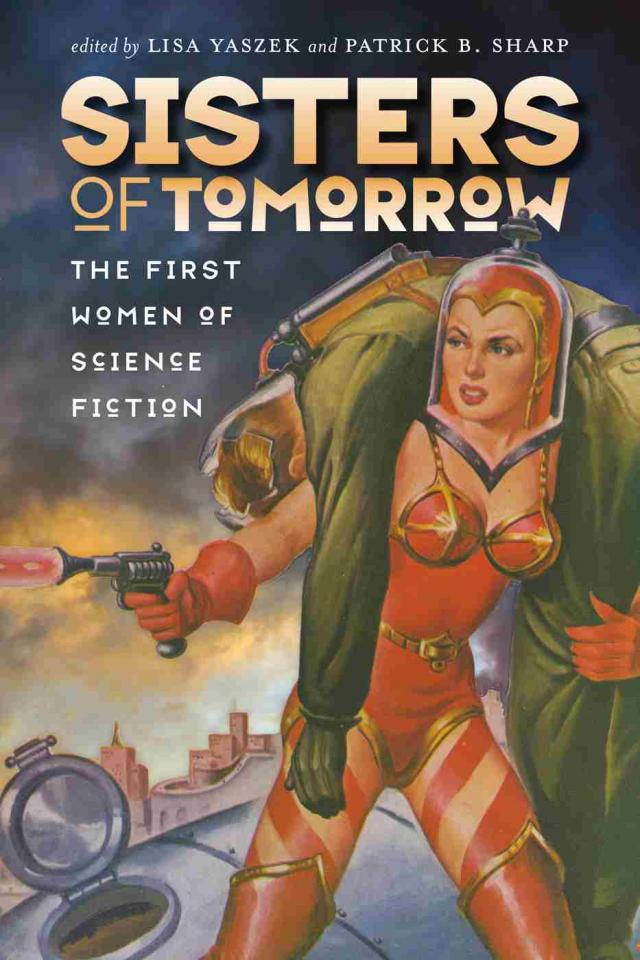


The sensitive finger curled up from the chart and the white head was raised slightly as if listening … Then suddenly I noticed a strange silvery light that seemed to shine on the wall above the desk, over the shaded portion of the student lamp.
“Slowly … turn slowly!” Kepling warned me as I started to whirl around in response to that instinct which made one search immediately for the cause of an unexplained fact. “Remember, it must not be frightened away again.”
I checked my startled movement with an effort, and turned slowly only to gasp in amazement. For the thing that glowed just beyond the circle of light rays from the lamp was one of the most grotesque creatures that one could conceive. It stood perhaps seven feet high—or rather, I should say floated, because apparently it had no method of support, but moved as if our atmosphere had been so much heavy liquid. Like one of those beautiful self-luminous denizens of the deep seas, it glinted with a faint silvery light, its nine tentacles hanging down like a drooping flower whose long, faintly waving petals faded out into shadow. At the same moment, I was aware of a strange, heavy perfume that seemed to suddenly fill the air of the little room and engulf me like a tidal wave from the sea. I put out a hand to touch Jim’s sleeve to warn him about that peculiar odor, but my arm seemed to become unbearably heavy. It dropped limply back to my side, Jim leaning forward in his chair, the white head of Kepling lit by the streaming rays of the student lamp, and the silvery thing which floated just beyond the circle of light, all became fixed like figures of wax or the sketches of a madman on an illumined canvas and then suddenly swam together in a crazy whirl, as I fell forward into the dark pit of unconsciousness.
It must have been days before I again came to. Perhaps because of my unexpected movement, I received more of the mysterious drug than either of my two companions. At any rate, when I next opened my eyes, their anxious faces were bending over me. I glanced at them and smiled, when suddenly I caught sight of our strange surroundings, and the smile faded into an expression of wonder.
“Yes, we looked the same way when we first glanced around,” Jim grinned.
“But …”
“See, Doc, he is getting interested. I said he would come around all right.”
“The coming around isn’t the point in question!” I answered, sitting up and staring at the glass palace surrounding us—my eyes roving from the lustrous, silver mattress-like rug upon whose tufted fibers of moonlit cobwebs I had been resting, to the glowing draperies above our heads that twined backwards like so much gossamer-thin spun glass, glistening as they moved in an unfelt breeze.
“Doc thinks that the machinery which propels her is up there, but we can’t find any way of getting up,” Jim volunteered.
My eye dropped back down the sheer glass-like walls that glowed with the same weird silvery light that our visitor had emitted in the office of Dr. Kepling.
“But how in …”
“We know nothing more than you do,” the cultured voice of the old professor assured me. “We were also drugged in the office. We both saw you fall but were already powerless ourselves. During our state of unconsciousness we were evidently kidnapped.”
“He might have invited us to go,” I grunted resentfully. “I have a notion to smear him up.”
“That would be most unwise,” Kepling said quickly. “In the first place, he has not harmed us, and in the second place, even if you should succeed in overpowering him with his strange drugs, we have not the remotest chance of getting back to Earth.”
“You mean that we are in space right now—off the Earth?”
“Exactly.”
“And this is a spaceship?”
“Nothing else but!” Jim grinned gleefully.
“But where did he have it when he was hanging around the Science Building?”
“Undoubtedly he had it stationed in the upper atmosphere, and he conveyed us to it in some mysterious manner.”
“Suppose we ask him?”
“I have tried to communicate with him but my efforts have been unsuccessful. However, I believe I can enlighten you both on one point. My observations tend to the prophecy that we are speeding toward the constellation of Perseus or Andromeda at a terrific rate.”
“Well, that is the best news I have heard since the calculus questions were stolen,” Jim grinned.
“But what about our Earth?” I asked. “Is it still visible?”
“No, the Earth dwindled away some time ago and now even our sun has shrunk to a star of the first magnitude.”
“That ought to be an interesting sight,” I said, starting to rise.
“Take it easy, Mr. Hunt. The sensation of weightlessness may not make you any too steady on your feet for awhile.”
I arose awkwardly. Outside of being slightly dizzy, which I laid to the lack of gravity, I managed to follow the white-haired figure of Kepling without any mishaps, although my eyes were busily roving over the fantastic building, which Jim later told that he had nicknamed “the Temple of the Stars.” It was formed of a type of composition that at first glance resembled glass, but although it was transparent, yet it glowed with a silver luminosity, giving the effect of diffused moonlight.
As soon as Kepling reached the edge of this strange palace and pointed back to a bright yellow star below us, the luminosity of the floor and walls, which I will continue to call glass for the want of a better name, faded out, and the stars glowed through the black abysses of space at us from all sides like millions of varicolored lights. How aptly Jim had named the ship! I was so awestruck at the gorgeous spectacle they presented that I failed to note the puzzled frown that had crept over the placid features of the white-haired scientist.
“Something is the matter with the sun—I mean our sun,” he announced, his usually quiet voice vibrating with a note of alarm.
“I expected as much,” I heard myself saying.
“What?”
“Well, I mean it’s a hunch that came to me yesterday, or day before, or last week—or whenever it was that you gave your lecture on Nova Persei.” “Then why didn’t you mention it in the office?”
“Forgot it, I suppose. So much was happening. Then, too, Jim had kidded me. He had suggested … oh, certain disagreeable possibilities.”
But Kepling was no longer listening to me.
“Look!” he cried, his voice trembling with excitement.
My eyes turned unwillingly—almost fearfully—back to that little yellow star. It was ablaze. Its dazzling glory seemed to expand—eclipsing the more feeble lights of its nearest neighbors.
Then again I felt that strange presence near me, and turning around, I saw the flower-like being floating near us in all its ghostly, silver beauty. One long, radiant tentacle slowly separated itself from the others and pointed to a great opaque globe that began to glow with a ruby light.
“Look, a new type of telescope, I suppose,” I said as Kepling’s horror-stricken eyes followed my pointing finger.
Slowly the ruby light began to shrink, turning to a glaring white as it concentrated in a spot of terrific brilliance.
“He is showing us the sun—our sun …” The old astronomer’s voice ended in a groan.
Then suddenly I saw it—that wave of fire—spreading … on every side … spreading. Jim covered his eyes as if to shut out the horror of it. Beside me the flower-thing floated silently, his phosphorescence touching the scene with a detached, unearthly shimmer. Perhaps he lingered there with unexpressed and inexpressible sympathy!
The wave of flame spread on and succeeding waves followed it, until the glare of the flaming disc became unbearable. But the globe followed the first wave of fire, and slowly the gleaming nucleus drifted to the edge and out of sight.
Jim uncovered his eyes again and stared as a hypnotized man might stare at the globe.
Flashing in a trillion sparkles, the wave of white-hot gas was reaching for its first planet …
“Mercury!” Kepling gasped, even as the wave engulfed it and turned it into a tiny torch.
The light of the conflagration seemed to intensify as it spread, and again the globe followed its expanding edge. I felt my throat tighten as Venus swept into view. But almost immediately it was caught up in the veil of fire, seemed to actually explode in hissing steam and slowly swung toward the edge of the globe as the third planet accompanied by its tiny silver bubble of a moon came into the path of the fiery death.
Kepling groaned, while Jim stared like one turned to stone. In that moment of horror, as we watched in helpless misery the luminescent wave creeping upon our little world, I seemed to be able to see with my mind’s eye the streets of the cities with their floods of terror-stricken faces turned skyward—some groping with blind stares from which sight had been forever blasted, and others glaring with pupils from which the light of reason had vanished …
But the wave of death swept on—engulfing the planet and causing it to gleam suddenly like a large diamond thrown into a strong light.
Kepling slumped limply to the floor. That movement startled Jim from his frozen state, and he bent over the old gentleman with white, drawn features. But I staggered back away from the globe, closing my hands over my face as if to shut out its terrible message. My foot struck a bench and on this I sank, dropping my head into my hands.
Infinite moments went by. Finally I felt a hand on my shoulder and heard Kepling’s voice murmuring, “I know, my boy, that it is easier to face the most horrible death oneself than to realize that everything one has loved and lived for has been swept away in one moment of unspeakable terror, but the past is past while we are still alive and must go on.”
“As wanderers of space.”
“Yes, as wanderers of space,” he nodded, gripping my shoulder harder with his slender fingers. “For without the need of words it has been revealed to us why we were kidnapped.”
“Perhaps he too … he seemed sort of helplessly sympathetic when it happened,” I murmured, noting that the globe had turned black and that the silver luminosity had come back into the floor and the walls.
“Perhaps,” the white head nodded. “It is a cruel, unbelievable fact to face but we must realize that not only our friends, but also all art, all history and literature, all the sciences—everything which we call our civilization—has been swept like a gnat into nothingness. For when we three die, our race will be no more.”
“Don’t!” Jim begged in a whisper, instinctively using the hushed tones that one falls into in the presence of death.
So it was that our great adventure was begun upon the ashes of tragedy, and this was why the bitterness of that tragedy never entirely forsook our minds. For though in the days which followed, we did much to regain our zest for life, yet behind it always loomed that terrible knowledge that the past was blotted out—making the future but a hopeless blank, even as those dark apertures torn in the star-clouds of the heavens are a blank, through which we seem to look into endless nothingness …
And now time slipped by, almost without the realization that it was passing. Kepling worked almost unceasingly upon copying what he could remember of scientific books, while Jim and I spent hours at the glass wall looking out at the stars that gleamed around us like endless swarms of fireflies.
We saw our host but seldom, although he seemed to anticipate our wishes in a most extraordinary manner, the objects we had desired always appearing to materialize from nowhere. He himself, however, kept out of sight—either preferring to stay invisible or else remaining in the upper part of the palace-ship that we had never seen. We often commented upon him, wondering where he had come from, where he was going and, again, if he, too, was the victim of one of those catastrophes that astronomers have called novae—an exile without a parent civilization—a wanderer through space.
This feeling was intensified when, passing near to Algol, he distracted our attention from the “Demon Sun” by pointing one gleaming tentacle to the nebulous rotating ring of Nova Persei, which was looming up like a strange Saturn among the stars and then slowly fading away again into darkness. Jim was the first to voice his opinion.
“You were right, Doc. This man from space is certainly interested in Nova Persei.”
Kepling nodded thoughtfully.
“Wanted: one Sherlock Holmes,” I grinned.
“Well, I don’t know why it should, but it gives me the creeps to think that he might have come from Nova Persei,” Jim murmured with a shrug.
“And the way he has of fading away into nothingness gives me the creeps,” I added.
“It is equally possible that our methods of locomotion give him the creeps,” Kepling smiled. “Personally, I am of the opinion that his method has innumerable advantages.”
Jim laughed.
“Especially in some of the exploring expeditions that we probably have in store for us!”
“Look!” Kepling interrupted. “The nebula around Nova Persei is pretty plain now because of our nearness—but the condensations—they are easily distinguished.”
“You know, Doc,” Jim said thoughtfully, “they do look like the remains of planets. Not that I’m upholding the theory that they were run down by a dark star, but merely overtaken by the wave of fire.”
Kepling’s eyes sparkled suddenly as the idea took hold of him.
“Possibly they are. I wish I could turn the globe back to our sun and observe what has happened,” he said earnestly, the scientist in him fully aroused over the conception of a new theory.
He had no sooner uttered the wish than the globe clouded with showers of stars and comets, until at an immeasurably further distance than we had viewed it before, a flaming sun flashed upon the screen. Surrounding it was a very faint nebulous haze and dimly marked were four tiny condensations—somewhat brighter than the luminescent veil that surrounded them.
“Why only four?” I asked in surprise.
“We are evidently too far away to see the four minor planets and those are the major four.”
“Good reasoning, Jim,” Kepling smiled affectionately.
“But it does have an uncanny resemblance to Nova Persei,” I put in.
“Except the positions are about reversed,” Jim added.
“Of course, there is no need of forming theories any more, but the habits of a lifetime are hard to break.” The white-haired figure smiled wistfully as I turned away from the globe. Somehow, the sight of that gloriously beautiful funeral pyre hurt me more than the lash of a whip. Disconsolately I turned away, walking toward the opposite wall and looking off through the myriad swarms of stars that glowed in through the darkened sides of the ship. Then suddenly I stopped and stared. For out of the tail of my eye I had caught sight of an enormous colored light ahead of us that loomed up like a vast comet. I looked up quickly. The new object, which seemed to have appeared from behind the hidden prow of our spaceship as if we had been steering toward it and now were swerving to one side, was a brilliant blue sun, the lower third of which was covered by its reddish-yellow companion. I had often viewed binary or double stars back in the old university telescope, so the sight was not unusual, but the nearness of this pair made me gasp at the splendor of the spectacle they presented.
“Come quickly!” I called out with excitement.
Jim was the first one to reach my side, but the white-haired astronomer was not far behind him.
“Look at the blue sun up there with its companion that looks like a huge luminous orange.”
“Must be Almack,” Kepling said thoughtfully.
“Almack?” I asked, trying to place the familiar name.
“Yes. You will remember that in my lecture on multiple suns, I mentioned this group of three.”
“Three?” I said quizzically, taking another look at the apparent double.
“Yes, three. Behind the orange sun, you will see the thin green outline of the third. Like all multiple suns, you will remember that they revolve around their common center of gravity.”
“Did you say the third sun was green?” I asked, trying to separate it from the red corona of the orange.
“Don’t you remember our discussion of that very group?” Jim grinned at me. “You were trying to figure out the sunset effects.”
“Sounds more like your ideas. You were the interplanetary bug of our group.”
“Perhaps so. But, oh, how I would like to take a peek at a world lit by this trio of colored suns!”
“That is a wish that I have secretly nursed all of my life,” Kepling admitted softly.
Hardly had the words left his lips than the three jewel-like suns swung back toward the prow, becoming eclipsed at last by the forepart of the ship.
“He is going to take us there,” I laughed. “How’s that for thought-reading?”
“Well, the wish was double,” Kepling smiled, “and therefore doubly strong.”
“Triple,” I corrected.
Jim laughed as the silver luminosity came back into the walls. It was the first real laugh I had heard from him since the days on Earth.
“I am only hoping that our entertaining host has adequate means of breaking the speed of the ship,” the old professor murmured with a worried frown.
“But if we really wanted to worry, Doc, we wouldn’t have to go very far. A whole host of funny ideas would come trooping in,” Jim grinned. “For instance, we might begin to wonder about the air and if its content would agree with our lungs, or we might wonder if the planet is too small and the atmospheric pressure would burst us, as the deep-sea fish burst when they come into the air; or we might wonder if the planet is so large and the atmosphere so dense that we would be crushed … or …”
“That will do for the present,” I put in.
“Besides, we haven’t any weapons …” he continued.
“Young gentlemen, I for one have full confidence in the good judgment of our host.”
“So have I. Even if I did start out wanting to kill him off.”
“I tell you—he’s a great animated flower,” Jim agreed.
“But the most practical thing,” I interrupted, “would be to get some sleep before we get too close, because we will be too interested in the landing of the ship to even think about such a thing later on, while we do not know what dangers or hardships may await us on the new world.”


