

Sisters of tomorrow, p.51
Sisters of Tomorrow,
p.51
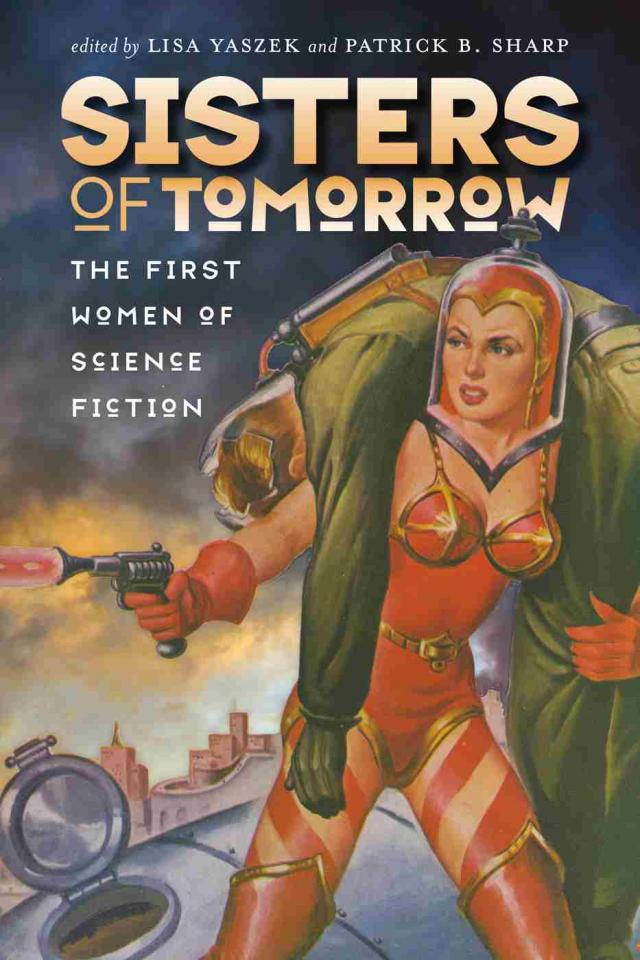


The cover art of the January 2013 issue of the SFWA Bulletin—its 200th issue—painted by professional illustrator Jeff Easely, was an image of a powerful, chain-mail-bikini-clad woman straddling a giant she has just killed with her bloody, upraised sword. WorldCon art shows are chock-full of such images, as are the covers of old pulp magazines and current products such as Dungeons and Dragons. However, many members of SFWA were not pleased with this retro cover, which, perhaps, is a good example of why women who read general fiction cringe at the thought of reading SFF. It seems reasonable that cover art might refer specifically to book content, but in this field cover art is often just a marker. Rocket ships are sometimes on the covers of books with nothing of the sort inside.
SFWA members voiced complaints about what they thought of as an inappropriate and sexist cover on the grounds that it did not represent the organization’s mission or aspirations. Moreover, it might cause writers to reconsider their present membership and cause those who had been considering joining to change their mind.
I identify with this image about as much as I identify with the grown white male protagonists in most 1960s SF paperbacks. Later, I learned that the image refers to the classic high-fantasy heroine Red Sonja, and I can definitely identify with her backstory—that of a barbarian seeking revenge for terrible crimes. But I can’t help but wonder: would it be possible to be Red Sonja without taking steroids? Her body is as unbelievable as Barbie’s—and that is a strange comparison to make in the world of SF.1
Having fun yet? This is just the beginning.
As if the cover of SFWA Bulletin 200 wasn’t enough, in that same issue Mike Resnick and Barry Malzberg, two seasoned SF professionals, engage in their monthly chat, which, over the years, has covered writing craft, the business of writing, and such topics as “The State of the Field” (issue 157), “Agents” (issue 144), and “Pseudonyms” (issue 153). These conversations are usually quite informative. This particular chat, titled “Literary Ladies (part 2),” was something quite different.
I’ve always been interested in the history of women in SF so I began to read what they had to say. I read that Bea Mahaffey, a longtime SF fan and pioneering SF magazine editor from the 1950s, “was competent, unpretentious, and beauty pageant gorgeous … as photographs make quite clear…. She was a knockout as a young woman” and “according to [another fan], during its first few years of existence CFG [the Cincinnati Fantasy Group] was populated exclusively by men. Then Bea joined. Then the members’ wives got a look at Bea in her swimsuit at the 1950 MidwestCon. Then the club’s makeup changed to the 50% men and 50% women that has existed ever since.” I didn’t finish reading the column. I put it down, discouraged. But I also realized that Resnick and Malzberg were seeing, thinking, and writing from a male point of view. Furthermore, like other SF authors past and present, male and female, they wrote what might be called racy sex stories during lean times. Resnick, in particular, has historically anthologized women on the basis of the quality of their work; I have never found him to be sexist in person, and he has the reputation of being an honest and generous anthology editor. But in their male bubble, Resnick and Malzberg mused according to their own past (and presumably SF’s past, since that is the column’s slant) and their own attitudes, including that of giving equal or more weight to the way a woman looks when mentioning her skills and abilities. They were not taking their task, or the women mentioned, seriously enough for their audience. I was not surprised, just disappointed at how little things have changed, and at someone’s bad editorial judgment in using my SFWA dues to put this in front of me. Perhaps I was not surprised because over the years I have become numb to this kind of thing. Which is not good.
Others, women and men alike, did get angry. Very angry. In a later Bulletin Resnick and Malzburg defended their conversation, seemingly blind to why it irritated so many. Instead of asking themselves why their dialogue might have offended some readers, they complained of censorship and the abridgement of First Amendment rights, and called those who had objected to their characterization of female editors in the column “liberal fascists” (“Talk Radio Redux” 50).
The kind of epic blowup for which SFWA is famous erupted. In the past, these fights had been semiprivate, contained within the organizational boundaries of long-ago member-only print or bulletin board online forums. This time, the firestorm engulfed the blogosphere. If you are interested in all the gruesome details, you can read about them here: http://www.slhuang.com/blog/2013/07/02/a-timeline-of-the-2013-sfwa-controversies/.
Heads rolled.
Things changed.
We actually should thank Resnick and Malzberg for bringing these galvanizing attitudes to our attention. These particular columns made many SF writers aware of iniquities and pervasive sexist attitudes in the field and encouraged them to participate in a process of change. The influence of activist women has increased tremendously in the past decade as younger women have entered the field, voiced their dismay, and used their strength and sense of community to raise awareness of subtle and overt sexism in all spheres of SF. These women responded swiftly to the SFWA blowup.
In September 2013, Lightspeed magazine announced its all-women-edited and -written “Women Destroy Science Fiction” project, which would include a double issue for online subscribers, a stand-alone e-book, and a print edition. On January 15, 2014, the magazine opened its Kickstarter campaign and by February 16 closed with 2,801 backers and $53,136.
In May 2014 SFWA announced the 2014 Nebula Award winners. For the first time in history, every winner was a woman. Jubilation ensued among female fans: http://www.themarysue.com/the-2014-nebula-awards/.
In June 2014 Lightspeed published Women Destroy Science Fiction! (issue 49), which highlights the history of women in SF and features marvelous essays, new and reprint SF, and illustrations by female artists. It has garnered a lot of attention. As Tempest Bradford notes in a review of this special issue for NPR, the authors and artists featured in it “are less focused on technological changes and more on the relations between people, or between people and society, or changing cultural and gender roles. That’s true across the issue.” This echoes the ways women have treated technoculture in SF since the inception of the genre in the 1920s.
There is a concerted call for writers to become more aware of how they portray women, as in Kameron Hurley’s Hugo Award–winning essay “We Have Always Fought: Challenging the Women, Cattle, and Slaves Narrative.” Hurley writes that “populating a world with men, with male heroes, male people, and their ‘women, cattle, and slaves’ is a political act. You are making a conscious choice to erase half the world. As storytellers, there are more interesting choices we can make.”
Of course, young authors are not alone in their call for more interesting choices in SFF. Short fiction editors have considerable power in the field, and two experienced women editors are particularly influential today.
Ellen Datlow first became visible as the fiction editor of Omni from 1981 to 1998. Omni was conceived as a slick newsstand magazine “that explored all realms of science and the paranormal, that delved into all corners of the unknown and projected some of those discoveries into fiction” (Ashley, Gateways 367–68). While at Omni, Datlow showcased the early short fiction of William Gibson (“Burning Chrome,” “The New Rose Hotel,” and “Johnny Mnemonic”) and published original SF by Connie Willis, Karen Joy Fowler, Ursula K. Le Guin, Elizabeth Hand, Suzy McKee Charnas, and many other women.
Datlow, presently an anthologist and an acquiring editor at Tor.com, has won a prodigious number of editing awards. She has structured her career so that she is able to invite writers to participate in her anthologies and in her online venues; thus, although she always looks for the best stories, she does not depend on submissions from the relatively small number of women who write SF but is able to invite and include a much larger percentage of women in her collections than do magazine editors. Daring in her wide-ranging publishing choices and deeply respected for her editorial acumen by writers and readers alike, Datlow showcases the writing of women in a vast range of fiction that includes SF, horror, fantasy, and mainstream stories. As such, she is very much the editorial heir to early SFF editors such as Mary Gnaedinger, Dorothy McIlwraith, and Lilith Lorraine, all of whom demanded the highest quality of work from writers and all of whom were eager to showcase the offerings of both men and women.
In a similar vein, Sheila Williams, the managing editor of Asimov’s from 1982 to 2004, when she became executive editor, has since won two Hugo Awards for best professional editor and has, over the course of her career, enlarged upon the vision of editorial predecessors. Williams’s informative, entertaining, and personally slanted editorial columns strengthen the links between science, technology, society, and SF readers, much as did earlier editorial columns of important women SF magazine editors. They encourage readers to think about space exploration, the history of science fiction, the excitement of new scientific discoveries, and how SF is related to and manifests in our daily lives with terrific range, verve, and insight. The Annual Reader’s Award, begun under the editorship of Gardner Dozois, encourages readers’ feedback, and Williams began the practice of including readers’ comments in her editorial column. This is very much in the tradition of community-building characteristic of all early SF editors, but especially those women who wanted to capitalize on readers’ passions and interests to improve the genre as a whole.
Like McIlwraith and Lorraine in particular, Williams also actively encourages young SF writers. In 1992, Williams and Rick Wilber, a professor of mass media at the University of South Florida, established the Dell Magazines Award for Undergraduate Excellence in Science Fiction and Fantasy Writing (http://www.dellaward.com/), which confers on the recipient a five-hundred-dollar prize and a paid trip to Orlando, Florida, to receive the first prize at the International Conference for the Fantastic in the Arts.
Of her editing style, Williams says:
We still publish things that get us in trouble all the time. We don’t know what’s going to get us in trouble, or who with. That’s the whole nature of magazine publishing. It’s very exciting to be a magazine editor, because you know someone’s going to get mad at you sometime. You don’t know when or who or whether it will be someone on the left or the right—but someone’s going to be mad. I find that kind of exhilarating, and a little bit nerve-wracking. I don’t set out to upset anyone, but we want to break ground. The magazine is my magazine. It’s stories I like. We’re out to explore new directions. I don’t think that any editor at Asimov’s was afraid of publishing women or anyone from any particular background that wasn’t the traditional angle. But there’s been a fantastic wonderful explosion of talent from diverse backgrounds recently. Fiction in general can only benefit from that.” (“Sheila Williams”)
“WE HAVE ALWAYS FOUGHT”
Since Mary Shelly published Frankenstein in 1818, there has probably never been a time when women have not written about, edited, and envisioned the future through art. Sisters of Tomorrow shows that women have indeed always fought—and that, in the opening decades of the modern SF community, at least some women fought by dreaming of worlds where women were not cattle or slaves but were, instead, creative and compassionate people who used every scientific and social device available to build better futures for all.
In this endeavor, they were part of the community of women contributing to the work of becoming fully active members of society using their own particular talents, whether those talents were political, educational, artistic, scientific, or completely idiosyncratic syntheses of ambitions and skills, as they forged a new kind of literature. Women did not just participate in the accelerated, exhilarating, mad rush of change that has marked the rise of technosociety—women were the change. Women stormed barricades, rioted, and starved themselves for the right to vote, and then ran for office. At the same time, and using that same energy, women invented telescopes through which they saw previously unknown stars and undertook the voyage to reach them. Women imagined human-friendly societies that gave us ways to think about how to build better futures. Women, knowing what it was to live as aliens, created aliens with depth and uncanny powers. In early SF, women went to space, used ray guns with alacrity, and explored wild planets. They also applied their energies to their own planet, imagining alternative Earths where women fought off evil scientists, perfected new modes of political governance, and transformed both the home and the men with whom they shared it in startling ways. Women invented, shaped, and inhabited this unruly, hard-to-define art form that now infuses and sometimes drives society and invention. Women are quite fully this nova, this power, these shining, strange new worlds that we call science fiction.
Women thrilled, astonished, and startled as they wrote, edited, and illustrated wondrous, marvelous, amazing, and astounding tales. They had fun. They made money. They were independent. They fought for that independence and fought to maintain it.
And women, it is clear, must and will continue to fight to define themselves, the world they live in, and the worlds that they invent.
But must we always fight? Science fiction writers, whose vocation and profession is to imagine the future, are perfectly situated to think of ways to better communicate, and to imagine how we will use our own potential and that of our planet and of infinite space not only to understand and mediate our problems, but also to become a wiser species, able to celebrate all visions of our shared future through the complex, deeply human art of nuanced, finely wrought science fictional storytelling. If publishers and the public do yet not realize the nobility and potential of this calling, it is only because we, as writers from backgrounds as diverse and myriad as the worlds we invent, whose tales tap and unfurl the strength of dreams, have not yet fully grasped our power. Welcoming all voices, understanding that we are all on the same side, is the first step toward using that strength to point our universe toward unlimited future.
NOTES
INTRODUCTION
1. Figures cited in this book regarding the number of women working in SF between 1926 and 1945 are derived from our count of those listed in Stephen T. Miller and William G. Contento, The Locus Science Fiction, Fantasy, and Weird Magazine Index (1890–2001). We began by asking our research assistant, Amelia Shackleford, to compile lists of all known women and men who published or otherwise worked in SF during the period under question, including those who contributed to both professional and amateur SF publications as well as multi-genre magazines with substantial SF offerings. Lisa Yaszek then confirmed these numbers in an independent review of the Index, cross-referencing each author to make sure we were not double-counting known pen names or counting house pseudonyms. Our estimates are conservative in that we did not count authors with gender-neutral names whose sex we could not verify.
2. As Justine Larbalestier and Helen Merrick have shown elsewhere, a significant number of women fans helped shape SF as a modern popular genre through their letters to professional magazines. While we consider women’s work as contributors to amateur SF publications throughout this anthology, we recommend that readers interested in women’s work as fan correspondents see Larbalestier’s The Battle of the Sexes in Science Fiction and Merrick’s The Secret Feminist Cabal.
3. Indeed, as Jane Donawerth points out, by 1931 Gernsback also considered women regular contributors to SF, noting, in his introduction to Lilith Lorraine’s 1930 short story, “Into the 28th Century,” that “it speaks well of the times in which we are living when women authors such as Lilith Lorraine have the vision to take science fiction seriously” (qtd. in Donawerth, “Lilith Lorraine” 252).
4. For further discussion of Gernsback’s positive reception of women contributors, see the introduction to Jean Stine, Janrae Frank, and Forrest J Ackerman’s New Eves.
5. For an overview of David Lasser’s role in supporting politically progressive SF and recommendations for further reading on this subject, see Eric Leif Davin’s “Gernsback, His Editors, and Women Writers” and Pioneers of Wonder.
6. For a discussion of gender in the marketing of early magazines, see the introduction to Robert Weinberg’s Biographical Dictionary of Science Fiction and Fantasy Artists. For a discussion of the early days of the Black Cat, see the first chapter of Mike Ashley’s The Time Machines.
7. Of course, other scholars have noted that SF production occurs outside fiction writing as well. Both Robin Roberts’s A New Species and Brian Attebery’s Decoding Gender in Science Fiction briefly address representations of sex and gender in SF art and advertising, while Robin Anne Reid’s Women in Science Fiction and Fantasy contains entries on women poets and editors. As such, we see Sisters of Tomorrow as extending the lines of inquiry begun by these fellow critics. Furthermore, it is important to note that Justine Larbalestier’s The Battle of the Sexes in Science Fiction and Helen Merrick’s Secret Feminist Cabal both explore the one area of women’s engagement with magazine SF that we do not address in this anthology: fan letters. Indeed, we decided not to include such writing precisely because Larbalestier and Merrick have done such thorough work on this subject that it seemed best to focus on other types of SF production that have not been addressed elsewhere in a sustained manner and to simply refer readers to those outstanding publications.
1. AUTHORS
1. For further discussion of Gernsback’s vision for SF and its influence on other genre editors of the early twentieth century, see Gary Westfahl’s The Mechanics of Wonder, the introduction to Michael Ashley’s The History of the Science Fiction Magazine, Vol. 1: 1926–1935, and Paul A. Carter’s “Extravagant Fiction Today—Cold Fact Tomorrow.”


