

Sisters of tomorrow, p.50
Sisters of Tomorrow,
p.50
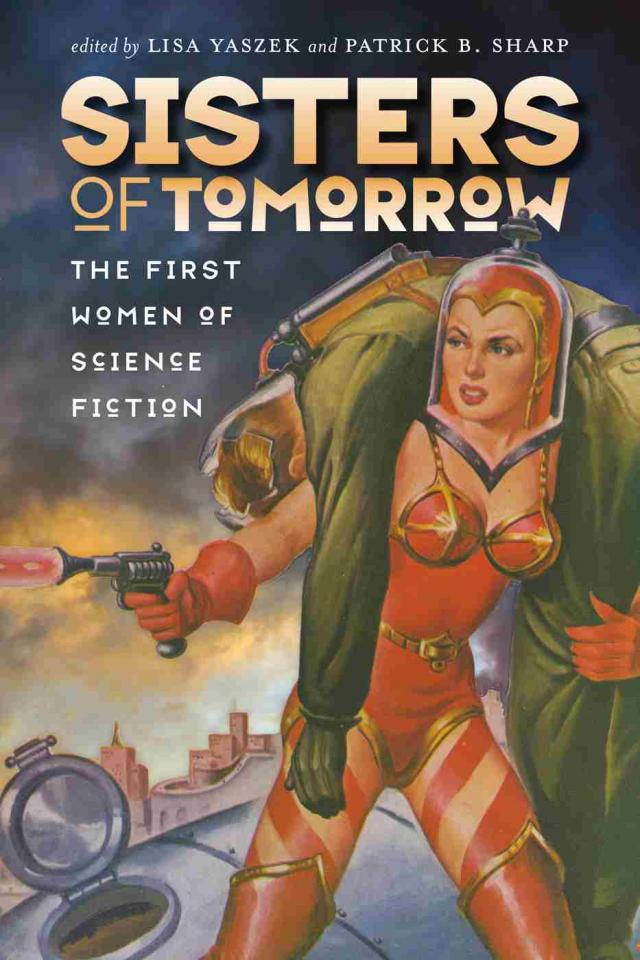


These are still strange times.
Who reads SF?
SF has been a predominantly closed system since the 1920s. The writers, the literature, and the fans form a feedback loop upon which publishers depend. It is common to hear someone outside SF culture declare, “I don’t read science fiction,” without any qualifiers. SF rarely makes inroads in this demographic, and most people who say this are women. Markers warning of SF content splash book covers, and the literature is segregated in bookstores. Reviews are ghettoized—SF is not “literature,” but reviewed in special “science fiction” sections—a practice that allows potential readers to avoid being caught by surprise when a review sounds intriguing.
Because fiction readers are not a large segment of the population and because SF is a very small slice of that demographic, the SF literature market is small. Moreover, many publishers, editors, and even writers claim that SF is a literature for males written by males and imply that women should stay out of the clubhouse, or enter at their peril. This attitude creates a dearth of realistically portrayed girls and women in the literature; instead, stories, books, and covers are overwhelmingly filled with sexual stereotypes of females, if there are any females at all. Most protagonists have been, and still are, grown-up white males—aliens, as far as young girls are concerned, and so these young girls avoid SF in droves. Somewhat ironically, however, in order to read much of anything at all, many learn early on to see through the eyes of a male protagonist anyway. After all, we are all “men,” right?
That is, we are all men until some of us are reminded by the world that we are female and “can’t”—can’t understand mathematics, can’t explore the Yucatan, can’t earn a PhD in a scientific field or, thereafter, find a job that promises fair promotions, can’t shoot wild animals, can’t work for the CIA, or can’t do much of anything that Alice Sheldon spoke of as having done in letters to colleagues including Ursula K. Le Guin, Robert Silverberg, and Joanna Russ when writing under the pseudonym and playing the part of James Tiptree, Jr. When Tiptree began winning Hugo and Nebula Awards, the SF community realized that no one had ever seen Tiptree, despite his voluminous correspondence, in which Sheldon described her alter ego as being a painfully shy recluse. Alice Sheldon, a PhD biochemist, big game hunter, explorer, and CIA agent, had easily infused her letters with male-seeming verisimilitude. Still, people speculated as to whether the mysterious James Tiptree, Jr., might be a woman. In response to this rumor, Robert Silverberg, in his introduction to Tiptree’s first short story collection, Warm Worlds and Otherwise, famously wrote: “It has been suggested that Tiptree is female, a theory that I find absurd, for there is to me something ineluctably masculine about Tiptree’s writing. I don’t think the novels of Jane Austen could have been written by a man nor the stories of Earnest Hemingway by a woman, and in the same way I believe the author of the James Tiptree stories is male” (xii). And the world machine conspired to keep it that way. Although the reasons are personal and complicated, Alice Sheldon did not do nearly as well as a writer as did the multiple-award-winning author James Tiptree, Jr. once her secret identity was revealed.
Women are often described as being invisible in early SF because they used their initials, or took male pseudonyms, or wrote in partnership with a man. That is, “they didn’t write it.” However, writing under pseudonyms—even multiple pseudonyms—both was and is common for men and women alike. Because SF checks do not provide much food for the children, a writer might have several stories running in the same magazine under different bylines. Sometimes, women—and men, for that matter—have pseudonyms thrust upon them. When Ursula K. Le Guin became the first woman to sell a short story (“Nine Lives”) to Playboy magazine, the editors asked her to use only initials because “their readers would be frightened by a female byline on the story” (Le Guin 77). Le Guin complied—and used the Playboy check to buy a Volkswagen bus. When asked for a bio, she wrote, “It is commonly suspected that the writings of U. K. Le Guin are not actually written by U. K. Le Guin, but by another person of the same name” (77). Thus Le Guin—much like those early-twentieth-century SFF authors who used initials or androgynous names but provided editors with decidedly feminine portraits and biographies of themselves—both did and did not accept the identity thrust upon her by her chosen genre.
Are men really frightened of SF written by women? Or do male writers of SF grumble because women take up space in magazines, in bookstores, and on award ballots that used to be filled by men?
Or are editors and publishers just supplying the kinds of stories that the SF readership wants? Who does read SF? After conducting an extremely detailed statistical survey, hard SF author Mark Niemann-Ross came up with a number: 57 percent of those who read science fiction are men.
This means that 43 percent of all SF readers are women. This isn’t a bad number, but it could be better. As Sheila Williams, the executive editor of Asimov’s, says, “I’m frustrated by the gender imbalance among science fiction readers. Girls need to know from an early age that science and technology are cool. Advances in both will shape much of our future, and they should be encouraged to be fifty percent of these industries. Good science fiction with strong and exciting female protagonists can give teens a framework for their dreams and aspirations” (qtd. in Wilde).
So how might women writers bring about a situation in which girls and women are better represented in SF? Pat Murphy points to the challenge of changing the situation: “Consider a 2012 study, in which science faculty from a number of universities considered the application of a student for a laboratory manager position. The student was randomly assigned a male or female name. Otherwise, the application was identical. Yet men and women both judged John to be more competent than Jennifer—more valuable to the tune of $4000 a year in salary, more worthy of mentorship, and generally more likely to be hired.” If it is this difficult for scientists—who are supposed to embrace value-free modes of analysis and decision making—to put aside their cultural biases when evaluating who should or should not be allowed into their community, then little wonder that similar difficulties persist in SF.
SF magazines may also have a difficult time increasing their female audiences because they publish much more SF written by men than by women. As Susan E. Connolly notes, “The actual, editorial market for science fiction written by women is small. Of five short-fiction markets that publish SF only, the gender gap is huge—71.9% of stories are written by men; 28.1%, by women.” Why might this be the case? Apparently, women are not as motivated to write SF as are men. Magazines depend upon submissions; they cannot publish what they are not sent. Williams says that less than 30 percent of her submissions are from women and that 30 to 33 percent of Asimov’s stories are written by women (Wilde).
Short-fiction editors who solicit stories from writers have more control over gender balance. One such editor is Ellen Datlow, who mainly publishes original and reprint anthologies as well as stories for Tor.com, but who, like Williams, reads for quality, not to achieve gender balance. As she explains, “I’m glad to see that more young female writers and writers of color are entering the fantastic field…. But when it comes down to what I or any editor buys it’s always going to be the story itself, not who wrote it” (qtd. in Newitz).
Similarly, Julie Crisp, a novel editor at Tor UK, says, “I’m a woman. Yes, a female editor commissioning and actively looking for good genre—male AND female…. The sad fact is, we can’t publish what we’re not submitted.” After analyzing 503 submissions between January and July 2013, she produced a graph showing that “when it comes to science fiction only 22% of the submissions we received were from female writers” (Crisp).
There is a strong correlation between statistics regarding women in SF and women in STEM professions (science, technology, engineering, and mathematics). As a paper recently released by the White House Office of Science and Technology Policy notes, only 24 percent of scientists and engineers in the United States are women (“Women and Girls”). Gender imbalance is a cultural phenomenon. Interestingly, Joanna Russ’s bullet points in “How to Suppress Women’s Writing” apply equally to women in science. Consider, for instance, this report on women in science written by Eileen Pollack for the New York Times (I insert Russ’s laws in bracketed italics):
As Nancy Hopkins, one of the professors who initiated the disparity between men and women study (a mid-1990’s MIT investigation into marginality experienced by female scientists at MIT), put it in an online forum: “I have found that even when women win the Nobel Prize, someone is bound to tell me they did not deserve it or the discovery was really made by a man [She didn’t write it] or the important result was made by a man [She wrote it, but she had help], or the woman really isn’t that smart [She wrote it, but she isn’t really an artist, and it really isn’t art]. This is what discrimination looks like in 2011.”
Similar attitudes that marginalize the perceived abilities of girls and women are mouthed by the former president of Harvard, one’s grumpy uncle, and, often, by women themselves.
The previously cited Programme for International Student Assessment results suggest that excellence in STEM-related skills depends on that delicate dance each of us, male and female, does, from birth, with our environment in order to understand and become a member of the society into which we are born. When young and powerless, we must keenly absorb clues regarding how to act in order to please others and, thus, survive.
Ben Barres, a neuroscientist who underwent a female-to-male sex change operation, has firsthand experience with sexual discrimination in the sciences. As he wrote in a 2006 article for Nature:
If innate intellectual abilities are not to blame for women’s slow advance in science careers, then what is? The foremost factor, I believe, is the societal assumption that women are innately less able than men. Many studies, summarized in Virginia Valian’s excellent book Why So Slow?, have demonstrated a substantial degree of bias against women—more than is sufficient to block women’s advancement in many professions. Here are a few examples of bias from my own life as a young woman. As an undergrad at the Massachusetts Institute of Technology (MIT), I was the only person in a large class of nearly all men to solve a hard maths problem, only to be told by the professor that my boyfriend must have solved it for me. I was not given any credit. I am still disappointed about the prestigious fellowship competition I later lost to a male contemporary when I was a PhD student, even though the Harvard dean who had read both applications assured me that my application was much stronger (I had published six high-impact papers whereas my male competitor had published only one). Shortly after I changed sex, a faculty member was heard to say, “Ben Barres gave a great seminar today, but then his work is much better than his sister’s.” (134)
Barres’s experience backs up the claim of unconscious bias that Murphy notes in relation to SF, a bias that is prevalent in all spheres of our culture.
But the problem doesn’t stop with science—it is part of our larger cultural fabric. Mitch McConnell, Senate minority leader, says, “We’ve come a long way in pay equity, and there are a ton of women CEOS now running major companies…. I don’t grant the assumption that we need to sort of give preferential treatment to the majority of our population, which is, in my view, leading and performing.” Joan Walsh, the author of the Salon piece that includes this quote, goes on to dryly remark: “McConnell is a little shaky on the facts, unless he considers 5 percent of Fortune 500 CEOs to be ‘a ton of women.’”
When women participate in predominantly male cultures, they are accorded fewer resources than men. In February 2012, the American Institute of Physics published a survey of 15,000 male and female physicists in 130 countries. In almost all cultures, the female scientists received less financing, lab space, office support, and grants for equipment and travel, even after the researchers controlled for differences other than sex. “In fact,” the researchers concluded, “women physicists could be the majority in some hypothetical future yet still find their careers experience problems that stem from often unconscious bias” (Ivie and Tesfaye).
I suggest that a parallel process of unconscious bias affects the success of female SF writers. There are processes in publishing that authors are usually not privileged to know or participate in. Consider the very visible issue of cover art. Cover art is perhaps the most powerful marketing tool that publishers have at their disposal. They commission cover art that they think will attract the target audience. Authors usually have no power over this process. As Kat Goodwin notes in her response to Julie Crisp’s assertion that there is no gender bias in publishing:
Women authors trying to break in, who would mostly love to be published by Tor or Tor UK, know it’s not that simple. They have eyes. And what they see is SFFH publishers not publishing as many women, not promoting them as much as male authors, giving them feminized book covers or scantily clad ladies in leather, describing and marketing urban mysteries as paranormal romance, and so forth…. It’s that female authors tend to more often be given covers like Evans did, or the twisty, half-naked women, no matter what sort of story they are writing. They are marketed as women authors first, fantasy or science fiction or sometimes horror authors second, and their books are so frequently marketed as for women only. And that means that their ability to reach the widest possible audience is curtailed.
But cover art is just the beginning. The decisions of editors, marketers, and publicists regarding market placement strategies for any novel (which are, again, closely held ones usually available only in-house rather than for public statistical analysis) play a major part in how well a book sells. Books are marketed to different audiences by means of cover art, blurbs, book placement, budgets for author tours, advertisement, and publicity plans for media appearances. Often, in SF, books have a minuscule promotional budget. Even when there is a decent budget, if an editor or marketing team decides to market to only a small slice of potential readers, book sales suffer. As Nancy Kress put it in her 1993 guest of honor speech at the Michigan-based SF convention ConFuse:
I’d like to read you a quote from a popular history of science fiction written by a respected editor in the field, in fact he was my editor, a man who’s been involved in science fiction in myriad capacities for over thirty years. He says: “It matters little that most of the women writing science fiction command popularity with only a minority of the total science fiction community. The source of the power of these new women writers in the field at present is that within their own core audience of (for the most part) adolescent and young women, they are transcendently heroic.” I don’t know whom this editor thinks it “matters little” to if women science fiction writers have only a minority readership, but I can assure you that it doesn’t matter only little to me. It matters a lot to me whether I have a minority readership or a large readership. It matters a lot to me, to my royalty checks, to my reputation. How many people are interested in reading me and how many people are not interested in reading me not because they think I am a lousy writer which is their choice but simply because they have decided that they don’t want to read female science fiction. I think this editor has completely missed the boat and what is depressing is that if I told you he was, he is, one of the most respected and actually one of the most competent editors in the field.
Even as women gain power in our culture as a whole and SF in particular, they are faced with myriad challenges stemming from editors who continue—consciously or not—to promote female writers to the general public differently than they promote male writers.
Then, there are events that we have seen, read about, or heard of. I personally saw this one. In 2000, Connie Willis (one of the four women who has been named a Grand Master of Science Fiction) was toastmaster at the Hugo Awards ceremony. Connie is delightful, witty, funny—a true professional when it comes to public speaking. At the podium, Harlan Ellison flanked her. As they engaged in the amusing repartee that characterizes award ceremonies, Harlan took it in his mind to grab Connie’s breast. She did not appear to lose her professional pace, but in that split second, perhaps she wanted to haul off and punch him in the face. But … maybe it was an accident?
No. He did it again. You can watch it here: https://www.youtube.com/watch?v=Zxd1jFDXzsU.
This rude, sexist, demeaning, and insulting act of harassment was a tremendous surprise to everyone in the audience. It also seemed a surprise to Harlan that people were upset and that he was expected to apologize to Connie. When she did not answer his repeated calls, he accused her of being unsportsmanlike. What was the message? No one knows what Ellison was thinking, but the message I got from his behavior was “You think you’re something, you woman writer on the stage. I’m a Grand Master too. In fact, I am grander than you because I can humiliate you sexually with this public grope, by using your gender against you.”
My reaction, as a woman, was anger.
Perhaps it raised the question in the minds of women thinking about writing science fiction: Is this the true face of the genre? If one of the most lauded women in SF history can be publicly harassed in this manner, what might be taking place in less public venues? (In fact, sexual harassment at conventions is a constant problem.) Do I want to be a part of this community? Would it not be better to write something other than science fiction?
The SFWA Bulletin, SFWA’S trade magazine and public face, is on newsstands and available to non-members. Since I joined the SFWA in 1990, the magazine has become slick and professional looking, and it usually features articles about writing and publishing useful to both beginning writers and the seasoned professionals who author the contents. But that doesn’t mean its contributors don’t occasionally still fall into bad old habits of bias—again, conscious or unconscious—against women.


