

Studio of screams, p.13
Studio of Screams,
p.13
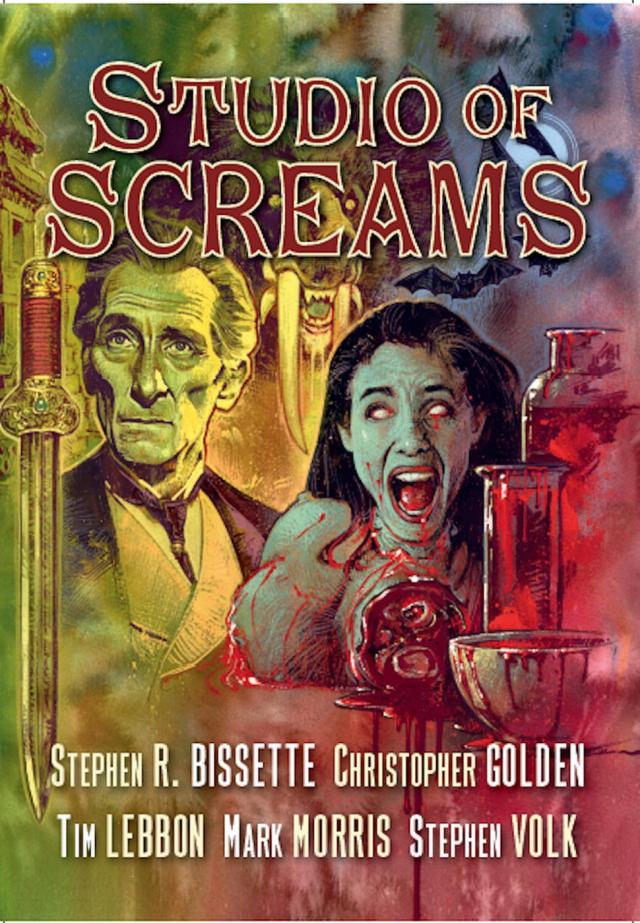


Faking the 1890s London, fog, the British Museum: fine, that we could pull off. But China? What to do? We were counting coins, trying to make do with glue and sticks, the cost of studio rentals and sets seemed completely out of reach, but it was such a good script.
Brother Louis had the ticket. Louis tapped his archeological circles and his travel circles—he’d been all around the world by then, digs and such, all over England, off to Mongolia to Turkey and back—and he formed a sort of coalition, a cabal of fellow travelers who thought it would be fun. Some steered clear, but those who were game were a great help. The Queen’s award going to Carreras and Hammer a couple of years after, that helped later on.10 Legitimacy, Queen’s award for horrors, made it respectable in ways it wouldn’t have been if we’d tried it earlier. Louis and his digger’s cabal, they came up with all manner of suggestions, and we made a go of it.
The Tian Shan mountain footage—Tengri Tagh, Tengir-Too, “Mountains of Heaven”—was purchased from an amateur climbing enthusiast, a wiry dentist and his two sons who had cleared permission to go over there around 1960 with a 35mm camera for some reason, came back with all this spectacular silent color footage, their home movies. Some of it wasn’t useable, handheld, shaky at times, but there were exquisite shots and passages; one son had a remarkably steady hand with the camera, some lovely panoramic stuff, just spectacular. So we made the best of it, and I traded them two free weeks for their family in a seaside place I still had on the market and £100 cash for the footage. They were tickled, never a problem, invited them to the premiere as well. The two sons loved it, only wished we’d made it splashier with the gore, one of them said after.
Once the dentist’s wife got word around to their friends and family, we had all manner of Asian travel footage, more than we’d possibly need, some 17.5mm, most of it 16mm color, at our disposal for a song or three. So all the travelogue footage in SWORD OF THE DEMON was new, you see, never seen before outside of select dens and lounges, but I had to spring for the blow-up from home movie format. Still, the studios did that sort of thing, had done since the silent era, yes? All those jungle movies and India movies. It looked sharp once it was polished up and edited into place, it looked good enough, looked like we’d spent a fortune we didn’t ever have, proper exotic, because it was genuine.
Louis found us translators who stuck with the production, got us into two or three museum displays for second-unit shots—atmosphere at no cost—but we couldn’t get into the British Museum, so we faked that in part with the others as best we could, and a couple sets.
I’d have loved to have had Peter Cushing and Stanley Baker in the cast, but that wasn’t going to happen, was it? Well, through some miracle, we scored and won Peter in the end— Peter as Sir Winston Tremayne—by cutting back on Tremayne’s onscreen presence from the original script, to fit Peter’s schedule. Again, it’s THE MUMMY, in’t it? Had to have Peter.
Went with some performers that had worked with the Danzigers, including Laurence Payne and Adrienne Corri as our leads—they’d done that Poe film a couple few years before for Harry and Ed11 —and they were really quite good. She had a look, perfect for our kind of film. We did get Michael Ripper for one day, a character bit, and Darren Nesbitt. Good villain material, Nesbitt, I’m glad we got him, he had a look: very odd, with that brow, his thick lower lip. Always reminded me of the puppets in Gerry and Sylvia’s TV puppet telly programs.12
The Chinese actors? Well, we worked with a theatrical troupe of Chinese refugees who were in country. Stranded, they were. Puppeteers, some of them were, but also actors, they were expert in shadow play or some such. They’d had bad luck, coming off a revival of what they were expert in, some kind of opera shadow theater or “sung drama,”13 I’m not sure what. They’d come off a government-sponsored revival at home back in the 1950s and early ’60s, but fled their homeland when all that was banned in China in the mid-60s amid the Cultural Revolution. One decade, they were bankrolled by their government, the next, they were in trouble, Mao14 banned it all, and they’d fled. We caught them through sheer luck, all thanks to Louis’s connections. Had to use fake names on the credits, they were terrified of being identified by name, so the credits—those aren’t their actual names.
It was ideal, because they had costumes, makeup, all sorts of theater stuff apart from the shadow puppets, and since their theater is traditional, very old, their costumes looked suitably 19th century, not that our audiences would have cared, but Louis cared. Helped them out, funded their travel for a full month of their jaunt through our part of the UK in exchange for appearing—in their own costumes—for the week or so we needed them. We had to keep toning down their performances for the picture, but Peter Cushing stepped in and he was a Godsend. Peter had such a kind way about him, he was such a gentleman and gentle man. He helped the troupe scale back their theatrical excesses and made them conscious of the camera as audience, so that they got over the initial day or two of struggle and found it a lark. It shouldn’t have worked at all, our actors hated it at first, but Peter made the difference, in the end it worked out well enough. Peter adored the troupe, they adored him, and everyone on the set loved Peter, so our people ended up quite liking them. I have very fond memories of Peter with his watercolors and sketchbook on the third day he was on set, whenever he was off-camera he was drawing with two of the artists, the puppeteers, doing these exquisite petite watercolor drawings. We were all sorry to see them go, having no idea what lay in store for them, adrift as they were. Never found out what became of them, sad to say.
So, right, the yaoguai. Look, we’d cobbled something together from Louis’s photo reference, but it was—well, it was silly, is what it was.
Two of the puppeteers were so thankful for what we’d done for the troupe that they took it upon themselves to work up three mockups, as stick puppet, shadow puppets, except with features and sculpted faces. They were all based on a similar design, like an outsized demon bear or boar, with those teeth and tusks and all, but also with canine attributes, and they were marvelous once we properly lit them. In exchange for some extra travel money, they stayed on an extra week and worked with our crew and did all the puppet work. Since there were three demon puppets in all, we started with the most stylized of them, and saved the most elaborate and hideous of the trio for that last sequence with Richard and Florence, when the yaoguai materializes one last time. The puppeteers were terrific, really; staged the attacks with our stuntman and cast, expertly staged all that shadowy creepy stuff in the smoke, the semi-darkness, they were absolutely genius with the smoke and mirrors. They worked up that weird little dance the yaoguai did while Florence sort of hypnotized the damned thing. That’s my favorite thing in the whole movie. Brilliant, really, only you can occasionally see the rods, the sticks, in some shots, some of the murders. Still. Much, much better than we’d have ever cooked up on our lonesome.
But the real breakthrough, what changed everything forever more, was my realizing I had all I needed with my buying and selling property.
The Blythewood secret of production: own nothing. No studio. Minimal overhead. “Make do or mend,” as the government told everyone in the War.
Well, Blythewood made do, made a movie, then mended.
Why envy Carreras and Bray? I had all I needed with the sideline I’d gotten into when the first films still weren’t returning anything: I was an estate agent, what you’d call a realtor. Bought and sold land, homes, houses, old farms, barns, businesses, warehouses, properties.
I had all these properties, peppered all over the place. I could simply do whatever we needed on one or more of the properties, and sat down with my accounting—well, see, if I was clever, it was legal enough. I could do whatever inside the properties, and to some extent outdoors, what wasn’t visible to the public. Tear out whatever, build up whatever, it all fell in the budget of the production—including any demolition, tear-down, remodeling, what have you—and tack on an extra week off-budget of contractor work to see to the cleanup, repairs, rebuilds, whatever, then turn the property around afterwards. Pull up anything we wanted, knock up anything we wanted, put up anything we needed, bury anything we wished anywhere we wished afterwards, as long as it was on company property, and didn’t interfere with gas or water lines or any architecture or underground complications.
We could hack the sword through walls, through furniture, send the severed hands and heads flying, toss anything we wanted out high windows and French doors, crash dummies into a flagstone driveway, fling the fake blood anywhere we wished, it was our cleanup, wasn’t it? We didn’t use Kensington Gore as much as expected, we used paint, house paint, since it was easier to deal with cleanup or just painting over afterwards, and looked suitably scarlet on film. Trevelyan and the Board required a few cuts, nothing like the troubles we later had. Ah, but to the budget and boon of all this—all in all, minimal overhead.
We rented all the tech kit we needed, it was the same as shooting on location on the cheap, no studio costs. Needed to break open or down a wall for a lighting setup, tear a floor up to accommodate electrical right into the fusebox? No problem, as long as the structural integrity was still sound.
Why hadn’t anyone thought of it before? That was all I could wonder, really. I still wonder.
And we started it with SWORD OF THE DEMON, oddly enough. Recreated parts of the British Museum in an empty warehouse outside of London, tombs in two dire but dry cellars in a place outside of Northampton, the Limehouse scene was set up in a place that I turned over two months later to become a supermarket. Sir Winston’s home room-by-room in two different upscale places I had on the market. Pulled them off market for a month, did the deed, then kitted them up for sale with the improvements we’d made after filming was done. Worked a treat.
The tombs were supposed to be in China, of course, but we also based them in part on a dig Louis was on in England, in the south-west. The West Kennet Long Barrow, some call it South Long Barrow. One large stone chamber, about 100 metres long, 20 metres across, ditched either side, Louis said there were smaller chambers, what’s left of them, too. Louis was there as part of archeologist Stuart Piggott’s excavations, in 1956 and again in 1958, before he really got involved much with the war movie productions I was on with already. The Barrow is on a field across from Silbury Hill, which is weirder still, an ancient chalk mound. This is all near Avebury in Wiltshire. All sorts of weird old sites around Avebury, Neolithic stuff.
Why make the tomb resemble the South Long Barrow at all? Um, later. Remind me. Later on, that.
The carriages, the coach and such, that was difficult, but we found what we needed.
The artefacts, though, those were all Louis. The sword, Zheng’s jade pendant, everything in Zheng’s tomb, everything except the robes and costumes, all Louis. What he pulled together—astonishing, really. Presumably artefacts that weren’t supposed to be in private hands, much less his own collection, but there they were, on set as needed. Looked better than anything we could have cobbled up, even at Shepperton or Pinewood, truly.
Cushing, of course, loved all the artefacts Louis brought on set. He’d watch Louis closely, how Louis worked with his hands. It was really quite remarkable, not so much imitating Louis’s manner as trying to absorb how Louis interacted with the artefacts, with that realm of things. Peter would work up little bits of business with them, first asking Louis how best to handle them—“how would you touch this?” he’d ask, imitating Louis, in part to ensure he was being careful, but then making the gestures his own—which I understand was the sort of thing he’d always do on a set, but in this case he was also fascinated with Louis being an archeologist.
Peter’s presence really pulled the entire film together. I just wish we could have afforded more than five days with him, but he made the most of those days—for all of us. We were lucky to have him at all, and of course his name was absolutely boxoffice for us.
“And the box,” I ventured. “That couldn’t be the same box as in—”
“And oh—you noticed,” Blythewood purred. “That box? Yes, it’s the same one in MOLLY’S MOGGY later on. That box.”
I hesitated, thought for a moment, then asked, “And inside? There’s that shot when Peter Cushing holds the box open, and it looks like something’s alive inside, looking out.”
“Yes, well, those weren’t eyes, really, but we lit and shot it to suggest they were,” Blythewood replied, “and that worked with the orange eyes being reflected in the sword blade and such. A lot of double-exposures and post-production work to accomplish that, but the box, those were in there, they were part of it.”
“What were they?” I asked.
Again, that unnerving Cheshire Cat grin from Blythewood. He looked at me for a full 30 seconds before leaning back and folding his hands over his belly.
“When the box is being held open that first time,” he calmly asked, “how many ‘eyes’ did you see inside, looking out?”
I pondered, closed my eyes to recall the image as clearly as I could, and held up seven fingers.
“Yes, that’s right.”
Blythewood leaned forward.
“Remember that box. Remember those...eyes.”
He gestured to the appetizer spread before us.
“Have something to nibble on, Professor,” he said, “You’ll need a walk, too, stretch your legs, toddle around. The grounds are quite lovely out here. Then—
“—ready for the next offering?”
5THE FACE OF FU MANCHU, a British/West German production from producer Harry Alan Towers and director Don Sharp, from the Sax Rohmer novel. The film was an international success, followed by a procession of sequels.
6Special effects expert Les Bowie, veteran special effects artist on countless British films, including work for Hammer Films.
7Blythewood is referring to James Carreras, his partner Anthony Hinds, and James’s son Michael Carreras and Hammer Film Productions, citing the back-to-back shooting of THE TERROR OF THE TONGS (directed by Anthony Bushell) and the TV pilot VISA TO CANTON (directed by Michael Carreras), filmed at Hammer’s Bray Studio April through July, 1960, on faux-China sets designed by Bernard Robinson and art director Thomas Goswell.
8 Michael Powell—Micky—and Emeric Pressburger, the creative dynamos who produced and co-directed BLACK NARCISSUS (1947), and a remarkable procession of feature films.
9Born in Warrington, Lancashire, England in July 1930, raised in Shanghai, and completing his education in America, British-Chinese actor 郭弼 / Burt Kwouk was a staple of any and almost all British films from the late 1950s to the 21st century featuring Asian characters. Kwouk was most familiar to American audiences for playing Cato Fong in the Pink Panther films starring Peter Sellers; when Sellers (as Fu Manchu) crossed paths with a character played by Kwouk in THE FIENDISH PLOT OF DR. FU MANCHU (1980), Seller/Fu Manchu said, “your face is familiar”—and audiences laughed. That’s how familiar Kwouk/Cato was to even casual filmgoers at that time.
10On May 29, 1968, Hammer was awarded the Queen’s Award to Industry, just three years after the award was established by Royal Warrant to acknowledge those British firms demonstrating extraordinary innovation and international success.
11Harry Lee Danziger and Edward J. Danziger, producers of THE TELL-TALE HEART, 1960, which indeed co-starred Payne, Corri, and Dermot Walsh.
12Gerry and Sylvia Anderson, whose “Supermarionation” puppet sf TV series included Supercar (1961), Fireball XL5 (1962), Stingray (1964), and Thunderbirds and Thunderbirds Are Go (1965 and 1966), among others. Nesbitt later appeared in the Anderson’s live-action series UFO.
13Xiqu or “sungdrama,” “sungopera,” a traditional style of Chinese shadow theatre, banned in China between 1966 and 1976.
14Mao Zedong, aka Chairman Mao, chairman of the Communist Party of China from 1949 until Mao’s death in September, 1976.
THE DEVIL’S CIRCUS
CHRISTOPHER GOLDEN
1
THE SOUND OF BREAKING GLASS followed Yvette up from the safety of dreams. She lay in her too-soft bed, beneath the heavy blanket her grandmother had made for her, and she listened to the breeze slink across the vineyard outside her window, rustling leaves and whispering nighttime secrets. Yvette felt warm despite the coolness of the night, and her thoughts were still cloaked in the fog of sleep. She closed her eyes, having forgotten the sound of breaking glass along with her dream.
She hadn’t yet drifted off completely when she heard the clink of empty bottles coming together, and her eyes shot wide. Yvette lay stiff beneath the covers and interrogated her thoughts and fears. Had she heard it, really? The sound of breaking glass came back to her as if she heard it now for the first time. That hadn’t been a dream sound after all, had it? As much as she wanted to deny it, she thought that no, the sound had been born in the real world, in the darkness outside her window.
Then the bottles had clinked together.
Her papa—Jean-Marc Comtois—had grown tired of suffering the predations of the thieves who roamed the countryside in the aftermath of the wine crisis. A tiny insect, barely visible to the human eye, had made its way across the Atlantic from the Americas and had destroyed so many vineyards that multitudes in her part of the world had become destitute. Laborers had lost their jobs, owners had lost their property, people had been driven far afield in search of work. Others, however, had stayed closer to home and had turned in desperation to theft and fraud in order to feed themselves and their families.
Papa had put stakes in the ground of the vineyard, strung connections between them, and hung empty bottles from the string. They had been robbed twice in recent months by burglars who had made their way into the house and snuck off with whatever they could lay hands on. And there were other thieves, simpler and stealthier, who came into the rows at night and stole grapes, or who snuck into the barn and took whatever hadn’t been nailed down.


