

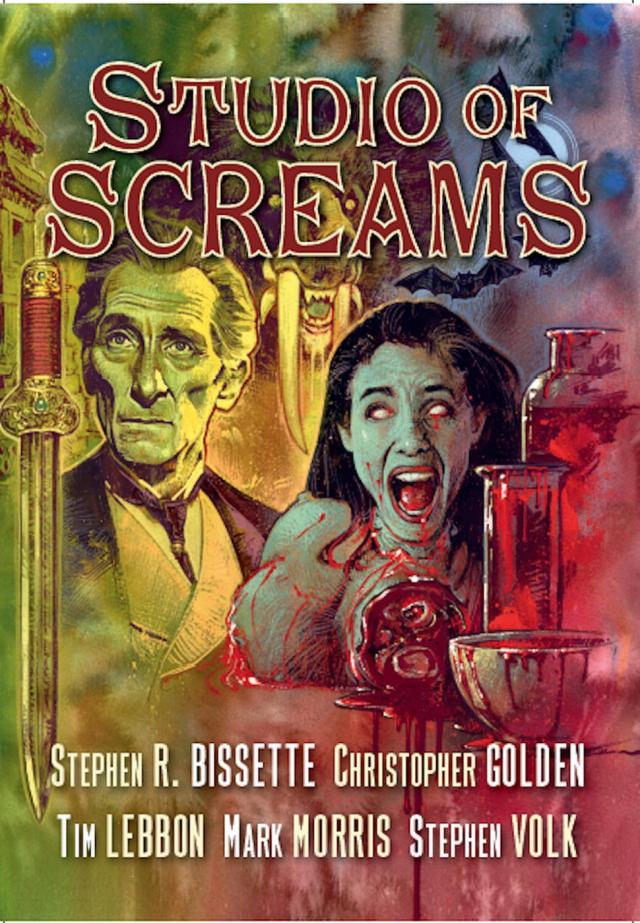
Studio of screams, p.21
Studio of Screams,
p.21


“Claude,” she said, twisting his grasp. He yanked her hair back but she pulled in return, struggling to get a look at his eyes. “This isn’t you. I understand how the allure might draw you in, might have manipulated all of you, but I’m here with you, and I am all you have left. Not this, not—”
A flicker of doubt touched his eyes. His brow creased. “This is my family.”
“I’m your only family. Father’s dead. It’s just you and me in this world. Whatever this demon is, it’s taken enough from you, leeched enough of the goodness from—”
The demon inside Oskar hissed loudly, cringing as if in pain. He tossed his older brother aside as if Hugo weighed nothing.
“Bring her here,” the demon said.
Yvette saw reluctance in Claude’s eyes, but that did not stop him from obeying. He tugged her hair more tightly, twisted an arm behind her back, and marched her toward the boy. Up close, she could see the air wavering around and above Oskar, see the heat rising from his flesh and the smoke coming from his eyes. His skin began to tighten, withering from the inside out. The demon wore people, inhabited their bodies, but human flesh had not been made to contain the infernal. She could see it now, right before her eyes, and she watched what would happen if the demon slithered its way inside her as it had done with Oskar.
“God in Heaven,” Hugo said, rising again to his knees. “It’s too late for him, isn’t it?”
She could hear his heart break.
Yvette dug her heels into the dirt and grass, pressed backward against her brother. “Claude, please?” she said, but only weakly now. There were too many people in the demon’s thrall, too much strength, too much hunger.
Oskar grinned at Hugo. The left side of his mouth ripped so badly the split went all the way to his ear. Tears streamed down Hugo’s face as the truth struck home—he had lost his brother forever.
But when he sprang from the ground and lunged, it was not at Oskar.
Instead, Hugo hurled himself at Yvette and Claude. He angled his body at the last second, lowered his shoulder, and slammed into Claude with enough force that her brother cried out and released his hold. The two men crashed to the ground, plowed through several performers, and then scuffled in the dirt with the sword-swallower shouting and kicking at Hugo, trying to tear him off Claude. The whiteface clown and the strong man waded toward them, even as Oskar’s voice changed. His words seemed thinner somehow, deeper, echoing as if he spoke from some distant place.
“The girl!” Oskar screeched.
The whiteface whipped around, eyes fixed on her. One of the beautiful acrobats rose from her worship and reached for her. This strange, lithe, agile woman had such hungry eyes, such naked, pitiful desire in her gaze, that it snapped Yvette out of the paralysis that had seized her. Claude no longer gripped her, but she’d been frozen.
Now she moved. The acrobat snagged the back of her blouse. Yvette did half a pirouette and slammed her elbow into the woman’s chest. The acrobat’s left hand faltered...lowering the torch she’d been holding, and Yvette wrested it from her grip. As she turned to brandish the torch at the others, she shouted to Hugo and Claude.
“Stop it! Stop fighting or we’ll all die here!”
Both men glanced at her—her brother and her friend—but when Hugo tried to rise to help her, the human cannonball kicked him in the ribs and Yvette heard a snap. Claude grabbed Hugo around the throat and drove him to the ground again, and that was when the flicker of hope she’d been feeling snuffed itself out.
The whiteface clown reached for her and Yvette shoved the torch into his chest. His grin promised darkness and pain and his eyes turned that sickly orange again, but when his costume ignited, his eyes became dark confusion. The costume went up like it had been soaked in kerosene, and she saw the moment his greasepaint caught fire. Flames spread across his cheeks and forehead and filled his eyes as if it had a hunger all its own.
One of the other clowns tackled the whiteface to the ground and tried to bat at the flames to put them out, succeeding only in catching fire himself. Flames leapt across the dry grass inside the tent. The human cannonball stepped into a patch of flame that caught in his costume and he ran to the inside wall of the tent, trying to find a way out, pulling at the hem, and fire raced up the fabric, heading for the air at the center of the roof, where the vents shot heat and sparks into the night air.
The strong man grabbed Yvette. He had a twisted sneer and eyes that said the darkness in him had not been born with the arrival of this demon, that he had always been exactly the kind of man such an evil could mold in its image. She fought against him, clawed bloody furrows in his face as the fire spread and people began to scream. He turned toward his lord, the demon inside young Oskar, and hoisted her like a barn cat that had dragged in a mouse and wanted to show its master.
Oskar raged, lifting from the ground, shrieking in shrill, desperate tones as patches of grass ignited around him. His eyes were on her, sinking into his rapidly withering flesh. Soon he would be nothing more than a husk.
The monkey came racing through the flames, chittering and screaming, a torch with a tail. It leaped for the strong man, eyes wide with terror, as if it thought somehow perhaps the man could save it from this pain. The strong man reacted, holding up his hands to ward off the fiery, clawing, screaming thing that shot toward him.
Most of those who weren’t already burning were running, trying to escape. Half a dozen remained on their knees, pleading with the demon to save them. Yvette ripped a torch from the hand of the elephant wrangler, then kicked the kneeling man onto his side as fire reached to embrace him.
Hugo shouted her name. Yvette turned toward him in time to see a torch in his hand...and her beloved brother Claude on fire. His costume had become a curtain of fire that surrounded him, and as she watched, the smeared mime makeup on his face ignited. His flesh melted like candle wax, like the greasepaint had been all that remained of him after the demon had taken his kindness, his decency, his humanity.
Screaming, Claude ran to Oskar, his sister forgotten. But he did not fall to his knees before his master. Instead he wrapped his arms around the legs of the young boy who had floated above the flames. As fire spread from Claude to Oskar, the husk of the boy’s flesh burning faster, brighter than even the clown’s greasepaint, she saw the demon’s eyes staring hatred at her from out of the withered, blackening mask of Oskar’s face. Then it collapsed in upon itself. A black mass swirled inside and then burst free, a small swarm of wasps that flew from inside the burning shell and toward the statue of the demon that loomed in firelight at the back of the tent—that winged, humanoid serpent of stone.
The wasps caught fire, popping like cinders, puffs of smoke rising as the swarm flew toward the statue.
Someone charged into Yvette. She screamed, tried to burn them with her torch, but then she heard a familiar voice, desperate and frightened, rasping in her ear and she knew it was Hugo. He threw her over his shoulder and charged through several terrified worshippers, through flame and a choking fog of black smoke that had filled the tent.
Then they were outside and she felt the searing in her lungs as she greedily sucked in breaths of fresh, cool air. Hugo crumbled to his knees and they stayed there together for a minute or so, just coughing and shaking on the grass while the circus people tried to save one another, or rushed off into the night, terrified of discovery now that it had all fallen apart. The demon’s tent had been completely engulfed in flames by now, and Yvette stared at the fire blazing along the edges of the gap, the burning entrance.
She’d had one last look at the demon through a veil of smoke. Claude had been on the ground, his burning, blackening limbs wrapped around the flimsy, charred scraps that were all that remained of Oskar. Grief carved her up inside, but a single, clear question kept pulsing in her head, overriding all of it. She wondered if any of the wasps had made it back to the statue.
“Come on,” she said, and forced Hugo to join her as she struggled to stand.
She felt the lure of temptation, the desire to wait until the fire burned out and the statue stood revealed, if only to see what would happen then. If only to know the answer to her question about the wasps.
Instead, leaning on one another, Yvette and Hugo stumbled into the night, ignoring the villagers who came running, drawn back to the circus by the screams and the fire. The blaze had spread to other tents and to wagons. Animals yowled to be set free, and their cages were thrown open. Then the main tent caught fire and true chaos erupted.
People shouted, wanted to help, went to the aid of the injured and the terrified. The blaze threw its hideous light quite a distance, but it wasn’t very long before Yvette and Hugo reached a place where cool darkness at last embraced them. From here they could find their way to the river, and after that...well, it didn’t matter, really. Not to Yvette. She had no family now, no one left in the world. Hugo still had his mother, but she had no expectations of him. Perhaps they would travel together and perhaps they would not.
She was alone. Hungry. Penniless. Bereft.
But somehow joy kindled a spark inside her, because at least she was here in the cool darkness. At least she was alive, and the demon would never have her, never touch her. She wanted to weep and to scream with relief and laughter, all at once, and wondered if this must be shock.
“Yvette,” Hugo said, his voice quiet with dread.
Only then did she realize that they had paused. Hugo had looked back over his shoulder, staring into the sky. Yvette tried to fight the urge to look, but somehow she felt compelled to follow the path of his gaze.
The smoke billowing above the bright, raging fire churned and swayed. It might have been the wind, but it seemed to Yvette that the smoke moved like a swarm of wasps.
The fire burned brighter. The wind picked up, carrying away the smoke and the screams.
Yvette took Hugo’s hand. His grip felt firm, assured, and though they grieved in silence, they made their way to the river together in the starlight.
Alive.
The rest would come later.
INTERVIEW THE SECOND:
THE DEVIL’S CIRCUS
AS MAYER ESCORTED ME OUT OF THE SCREENING room, The Devil’s Circus movie tie-in paperback in my hand (“Step Right Up for the Three-Ring Nightmare—NOW a Major Motion Picture!”), I worked the stiffness out of my neck and back. Step by step as I made my way between the buildings, I turned my head back and forth, a twist or two but not too much, until a satisfying “crack” eased the lingering discomfort of the last half-hour of the feature, caught up in Hugo and Yvette’s ordeal.
Then I heard it, like a beacon: the received pronunciation of BBC news voices, drawing me into the dining room.
A proper dinner awaited me this time—an abundant spread. The aroma was intoxicating.
I should have asked what Blythewood was so attuned to on the BBC, but I was still in that delicious post-movie daze, stepping out of one non-reality into day-to-day—well, no, that’s not quite it. There was nothing day-to-day about this time with Lawrence Blythewood.
Again, his attentive body language, eyes closed, listening intently to the newscast; again, without so much as opening an eye or a glance my way, a deft tap at the laptop’s keyboard, the broadcast was cut off, and he folded and tucked his computer away. Out of sight, out of mind.
And then, to me:
“What was that old Punch line about English wines?” Blythewood asked. “English wine necessitates four people to drink: one victim, two mates to hold him down, and another to pour the wine down his gullet. It’s not as bad as all that now, of course. Very different from how it was when we made DEVIL’S CIRCUS, I assure you.”
Blythewood waved his hand over the feast.
“It’s early for dinner, I know, but here you are. Your choice of duck confit or trout filet, with twice-cooked crispy potato medallions. There’s also a vegetable—asparagus—or you can go with your choice of a green salad with mesclun, or locally-grown greens and an herbe vinaigrette with maple balsamic. Québec cheeses to follow, then coffee and some maple or fruit dessert. Will this do?”
“Oh, God,” I stuttered, “why, yes. Very much so.”
“In any case, we’ll have a nice Italian vintage this evening, now that you’ve had a fleeting look at the fate of the unfortunate heirs of movie vineyards.”
I raised my glass; “A toast, to Yvette and Hugo, wherever they wandered off to together.”
“Yes, it was at least still possible for a happy ending to a horror,” Blythewood said. “You could still lose everything, then find all you needed: Yvette lost everything, but gained Hugo. Hugo lost everything, gained Yvette. A happy ending with the source of all sorrows going up in smoke behind them. You could still carve out a future for yourself, and hang onto the hope it might actually be possible. But that would all change after 1968, like so many other things changed. It’s only got worse, so much worse, since then. Enough to make one wish for a proper end, a comeuppance, to all the nonsense.”
Blythewood looked off in the distance, troubled; the first indication of something amiss I’d seen in his face, something troubling to Blythewood.
“The box,” I began. “That’s the box again, isn’t it, in Yvette’s room, on a shelf with her mother’s things, before the fire in the prologue—”
“Yes, indeed. You spotted it.” He nodded.
“I could see a bit more of the box itself this time, though there isn’t a full shot of it. Appeared to be golden in color to me, with some Celtic knot work incised into the surfaces, perhaps a Celtic dragon?”
“Catch any glimpse of what was inside this time?”
“I wanted to pause it, I asked Mayer to—but, anyway, I counted five—stones, I think. Not eyes, this time. They look like gems, or polished stones, but it was too quick to really make out.”
“Spot on,” Blythewood smiled, beaming now. “Five. And, yes. Gemstones they are.”
“Why five?”
“We’d done another film between SWORD and CIRCUS, snuck a cameo for the box into that one with six visible.”
“Why six?” I ventured.
“After SWORD OF THE DEMON we’d rolled out HIM, another horror, about a resurrected warlock out to revive ‘the old ways’ and create an army composed of fallen 5th century British invaders, Jutes, Angles, and Saxons. Louis supervised a lot of that production’s concept and planning, but our ‘army’ was pretty modest, about a dozen dung-colored warriors, in keeping with our budget. We went with HIM as a title because Hammer had done so spectacularly with SHE—then Herbie Leder popped up with IT, his silly Golem movie15 —but no matter, our title was changed in every market outside of the UK. Anyway, seven visible in the box for SWORD’s cameo, six for HIM, and five for DEVIL’S CIRCUS. You see what we were up to, yes?”
Looking Blythewood in the eyes—he wouldn’t look away or blink—I tried to coax, dragging out the word without sarcasm, “Because...”
“In due time. Keep your eye on the box.”
An awkward pause, then, out of the blue:
“You ever see any films credited to one Michael Reeves?” Blythewood asked, looking askance again, wistful. “Very young fellow, very talented.”
“Yes,” I replied, “WITCHFINDER GENERAL, I’ve played it for my students.”
“Study it now, do they?” Blythewood asked, suddenly looking less glum. “Well, if any of the horrors deserve it, that one does. Yes, that’s him. No telling what he might have done, God willing—but God wasn’t. Struck down in his prime, barely cut his teeth. And oh, what teeth they’d have been.”
“Did you—?”
“No, but he worked with peers I knew well: Tony, and he had contracted with Tony for another five pictures, starting with one about Ireland.16 No, I only met him once, but he had it, Reeves did, make no mistake.”
“Why ask?”
“Met him on our set, only one evening, for DEVIL’S CIRCUS,” Blythewood said. “He was just a kid, but he watched what we were doing intently, eventually recommended a change that we made during one of the night shoots. Very sharp fellow. He also recommended we cast an Italian character actor, Antonio De Martino, who Mike had met and worked with while assisting on an Italian horror movie for Paul Maslansky.17 I followed up and he was right, we brought him in and Antonio was excellent. We’d already cast Skip Martin as a ‘little person’ clown, and Antonio was also a dwar—uh, ‘little person,’ and the two of them got along famously. For my money, they were most alarming of the clowns, the bald twins. They were a delight in real life, and performed a sort of antic act after hours a couple of times for the cast and crew, all their idea.”
“What was that slow-motion sequence, with the two—with Skip and Antonio dancing together, on that hill?” I asked. “That seemed to come out of nowhere and lead nowhere, but it really is haunting.”
“Ah, that,” Blythewood whispered. “They both were fascinated by Louis and his expertise in archeology, all the places he’d been. Louis and Antonio would sit and chat in Italian, and they put together a jaunt with Skip and one of the assistant cameramen to one of the sites Louis had spent time at, the one I mentioned earlier—Silbury Hill, that Neolithic chalk mound. Creepy spot, especially by night. Don’t know how Louis got permission, if he needed it, for all that. They went there, and to another old dig site whose name I can’t recollect, came back with all this strange footage. Louis insisted we use some of it. Odd fit, but we slipped it in as if Yvette or Hugo were dreaming it during their nod-off in the barn.”
“Ah, I can sort of see it as that,” I said.
Blythewood paused to sip his tea, then laughed as if to himself more than to me.
“Skip and Antonio both insisted on being credited onscreen as Trix and Truciolo—‘introducing Trix and Truciolo,’ with the two cartoon theater masks, comedy and drama, that’s what they wanted, that’s what we did. A lot of misinformation out there claiming they’re one and the same fellow, but that’s not the case. Antonio went back to Italy, but stayed in touch with Louis, who went to visit Antonio more than once. Skip went on to do all sorts of roles on telly and big screen, you know, including VAMPIRE CIRCUS. Lifted a bit from our circus horror, almost the same role for Skip.”


