

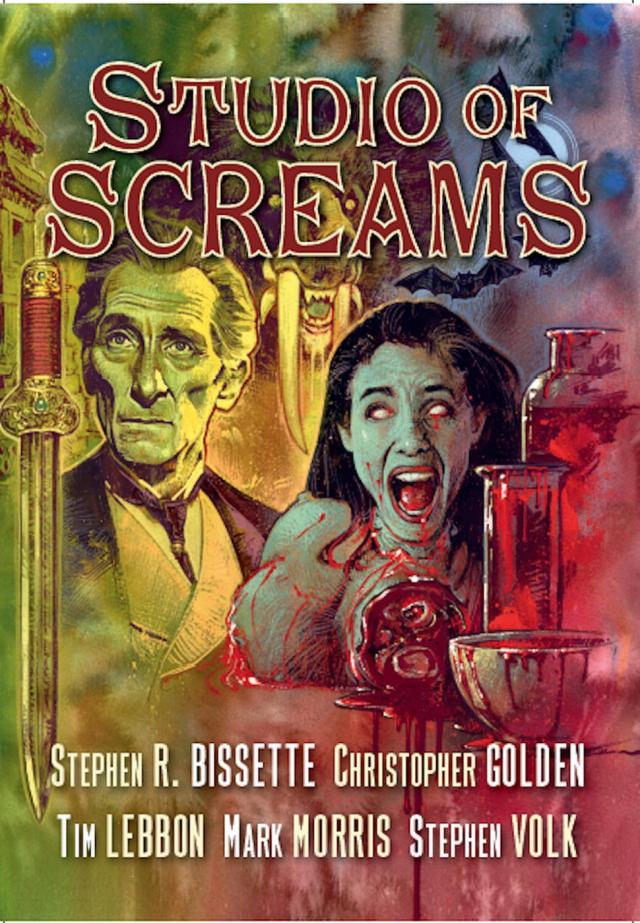
Studio of screams, p.29
Studio of Screams,
p.29


“No,” Jack breathed. He sensed someone behind him and he glanced back at his mother, standing in the doorway and leaning against the jamb. She was twitching, and though her toothless smile remained, it seemed hollow.
The equipment brought up from the downside came to noisy, sparking life. Gears ground. Pistons pumped. Abertha took one of the glass containers and plugged it into the frame, and a weak light shone through his wife’s blood, bathing the secret garden and its occupants a deep, luscious red.
“Peggy says the boy’s cute too,” his sister said. “His blood’s still too innocent and pure for our use, but...” She smiled. “He’ll do for a snack.”
Jack could not even cry, or shout, or scream. He ran forward and thrust the spear before him, piercing his sister just below her right collarbone. She jerked back but remained upright, and as he tugged the spear out and struck again, she started to laugh.
She raised the knife in her hand.
Jack struck again, popping her eye and shoving the spear deep into her brain.
Her laughter changed tone, but did not stop.
His father closed in, a glimmering blade in his hand. He sensed his mother behind him, reaching for his shoulders. He could smell only death—his beautiful Lucy’s, rich, meaty and raw; his family’s, old and musty and because of their dark art, never quite final; and his own.
They let him jab with the spear one last time before they held his arms and pushed him down.
INTERVIEW THE THIRD:
CASTLE OF THE LOST
WHATEVER IT WAS BLYTHEWOOD was paying attention to while I was screening the films, it seemed to have lightened his mood considerably.
He closed his laptop up with some reluctance this time, setting it carefully aside but well within reach. If he was at all displeased with the interruption, he didn’t show it.
“Sit down, my boy, sit down,” he enthused. “I quite liked the poster we had for CASTLE OF THE LOST. Our tagline was, ‘This will be a good happy place,’ with the stonework of the castle filled with agonized, screaming faces, the twin towers becoming reaching hands with bloodied fingers. It was a line from the film, Jack’s line, and we used it in all the trailers and radio ads, too. The radio adverts were even better than the poster.”
Checking my scribbled notes, I asked, “I recognized James Villiers in the cast, and of course Michael Gough in his role as the patriarch, but can you tell me anything about the young leads?”
“I’d seen them in something Milton and Max28 were shooting at Shepperton,” Blythewood replied, “Christopher Matthews and Judy Huxtable, we thought they looked compatible with one another, and turned out they were. Not names, per se, but attractive enough, good chemistry, the camera liked them. I’d hoped they might register well enough in their film for Max and Milton to score for us. Once their hair and clothes were done up suitably, they looked and sounded their parts, enough to pass for a troubled 1940s couple in the wake of the War. I thought he in particular was quite good as Jack, very effective. We almost went with a different couple, but Judy and Chris were suitably British and very professional, arrived prepared at all times, seemed to take it all in stride.”
According to Blythewood, CASTLE OF THE LOST’s Roger-Corman-by-way-of-Pier-Paolo-Pasolini staging of the orgiastic sex scenes sparked a procession of troubles with the American, British, Canadian Provinces (particularly Ontario), and Aussie censor boards.
“The Germans and Asian markets loved it, though,” Blythewood chuckled, rubbing his hands together. “They got the uncut version, as they call it these days. Lots of nudity and writhing flesh, as much as was permitted by 1970. Money in the bank.”
“Trevelyan’s staff was up in arms at different points,” he continued, “as you might well imagine, particularly that same bloody woman who’d insisted upon the DEVIL’S CIRCUS trims. Here we were endangering children again—poor, put-upon little Georgie—with sex under the floorboards, and with rats, no less. She was outraged. I’ll tell you what was funny. That bit in the film, early on, when Jack and Lucy find the rat in their baby’s room?”
“Yes?” I said, rising to his cue.
“Very LADY AND THE TRAMP, that, don’t you think?” he laughed. “She wanted that gone. I pointed LADY AND THE TRAMP out at the time, I think that got us through by a whisker. Disney put one in the baby’s crib, built his whole cartoon feature around it, but I’m the one got all the heat decades later. Cursed woman! Well, we got our way in the end.”
I smiled along with Blythewood, nervously replaying in my mind’s eye the still-fresh image of the rat perched on the rail of baby George’s nursery bassinet, grooming itself. Brrrrrr.
“And,” Blythewood winked, “we got back at her, as you’ll see shortly.”
“The joke was the couple leave London because of the rats, to move to the family castle,” he continued. “But I tell you, the first location we scouted to stand in as Grayland Castle was swarming with rodents. There was one rat so fat that we called him Churchill. I almost saluted the damned thing. We’d have gotten more than our money’s worth in rats alone, there, but cast and crew wouldn’t have stood for it, so we moved on and kept searching.”
Allow me to once more consolidate my notes, while staying true to what Blythewood shared about the film.
The World War II scenes didn’t require much screen time, but they were crucial to Jack’s character and to the script, so we had to see clear to do them correctly. Could have cost us a pretty penny, what with the uniforms and firearms and sniper shenanigans, but it was me that suggested we go all IT HAPPENED HERE with it, saved us a bloody fortune.29 We easily faked the war scenery, easy to find stand-ins for Juno Beach, the Cherbourg rubble, Jack drunk in Normandy. It was the same frugality we’d managed with the first couple of war films a decade earlier. The flashback of Jack cutting down that trio of SS, repeated throughout the film in a few fleeting frames—it didn’t have to look expensive, it had to look painful, bam, blood and mud, twitching limbs, an unhappy memory. It all worked fine.
As we started talking about, we had quite a dance with Trevelyan and the censors on this one. Now that you’ve seen it yourself, you know why.
Mind you, I’d developed a fresh strategy: always had to keep ahead of the censors. Since I wasn’t beholden to others for the most part, doing quite well with the real estate, I would occasionally purchase properties for screenplays I had no intention of ever filming. Pound-wise, penny-foolish, you might say, but foolish like a fox.
How do I mean? OK, so, to get the CASTLE OF THE LOST script through Trevelyan’s readers, I’d submit it along with two or three screenplays I’d purchased story or novel adaptation rights for, and paid a writer to adapt into the most appallingly lurid sensationalism possible. Package ’em up and submit them to the BBFC all at the same time. I was fond of Charlie Birkin’s short stories, really nasty pieces of work, but I knew the subject matter alone of the Birkin tales would have Trevelyan and his readers squirming. So I bought the rights to a couple of those and worked ’em up as scripts. I’d mentioned I had associations with NEL, the publisher, and they specialized in pretty sordid fare—vice rackets, biker gangs, junkies, potheads, skinheads, soccer hooligans, whatever violent lowlife activity would prompt paperback sales over the years—and I had connections in Australia, where Sydney’s Kings Cross was a sort of cue word for prostitution and various depravities. So, The King Cross Racket and The Spungers from Scripts30 in Australia, a couple of Birkin’s stories— “Green Fingers,” a Nazi officer wooing a woman for nefarious reasons I won’t reveal, and “The Serum of Dr. White,” a daft scientist messing about with a disfigured lass—stuff I knew Trevelyan and the BBFC would never countenance, not for a moment.
CASTLE OF THE LOST seemed a proper traditional Gothic and tasteful by compare, and that’s how I worked it through the censors. After all, all the elements were in place: a castle, family man soldier with wife and son returning to the home he’d fled, a dark family secret, and those marvelous oversized painted family portraits, which had been a staple of those Vincent Price Poe movies from HOUSE OF USHER on. We had to take some special pains with those, since the likenesses had to match the faces of the family members so precisely that you’d recognize those characters when we needed you to, setting up the revelations to come. Contracted with not one but three portrait artists, two women and an elderly gent, so they looked like they were from different generations. We had the actors posed for the portraits—took photos, of course, couldn’t be paying actors to sit for portraits, but the artists themselves approved the costuming and were there for the photo shoot—and made sure they were suitably representational in nature, very lifelike.
We had to make some changes to the script, and struggle with the final cut, had to tone down some of the sex whenever breasts-and-blood was involved, but wasn’t nearly as difficult as it could have been. As you’ll see, the novelization is completely over the top, includes elements we knew they wouldn’t permit us to keep.
Later years, as the ’70s wore on, it was the NEL skinhead novels that helped me grease the wheels. After A CLOCKWORK ORANGE, the last thing the BBFC wanted were those Richard Allen or Leo Bruce31 novels on the big screen. It was easy to slide a horror title or our big-screen adaptations of the odd TV series like The Brothers and Softly Softly Task Force through certification without too much monkey business. As long as I accompanied those submissions with scripts that had them really thinking I was out to bring NEL East End bovver books like Skinhead, Death of a Bovver Boy, Boot Boys or Skinhead Girls into theaters, I’d land the fish I was really after. I should also mention that with every submission of those NEL-based screenplays, we’d beef ’em up instead of tone ’em down—more beatings, more rapes, more racist rants—and that never failed. I’d argue, “the times are changing!” They’d double-down on me, made me look like a prat, but then they’d let the horrors and cop TV features roll, though we had to avoid including skinheads as villains.
Those bovver boys paperbacks were so popular that they really thought we were eager to film them, but it was all a shell game for me. Always paid NEL and the authors for the rights, so no one was the wiser. It looked legit. Saved money and hassles in the long run, actually, since it cost every time you had to resubmit a film for approval or more cuts. What’s a couple hundred pounds, here and there? Writers are cheaper than actually making the movies, and ultimately less expensive then BBFC submissions and resubmissions. Flip some real estate, it was all gravy.
The flash-frames really bothered the BBFC. It was one thing in EASY RIDER, quite another when we were intercutting frames of the SS being shot down with “the final party,” the puddles of blood and limbs on a stone floor. Our editor wanted to add frames from the orgy footage, but I knew that would push Trevelyan’s buttons: a frame too far, you might say. This was a year before Ken Russell and THE DEVILS, Pasolini and THE DECAMERON, three years before THE EXORCIST. We could only push so much and only so far.
Brother Louis had a hand in deciding where we were to film CASTLE OF THE LOST. His initial plans weren’t feasible, for reasons I’ll get into.
In the end, we used a combination of locations. A mansion in Somerset, for the posh interiors, and an actual castle in Wiltshire for exteriors and grounds. We needed a spot of miniature and matte painting work to make it look as overgrown as it needed to, and to add the lightning-split old oak. It worked out nicely, those looked convincing enough. The owners weren’t going to allow us to dress it accordingly, so a little trickery was necessary.
Of course, all the mayhem, the subterranean basement orgies and tortures and such, we did in the basements of properties I owned, which we reconfigured as needed. Also had a warehouse we used for CASTLE OF THE LOST special interiors, which we recycled and redressed to serve as the cloistered nunnery chambers for our next horror, FEAR NONE NUN. The pub, the King’s Arms, that was the same pub I leased for Ollie to land him for THE SQUEAMISH—but I’m getting ahead of myself.
The Somerset CASTLE OF THE LOST location was Montacute House, which at that time hadn’t appeared in films or telly much, if at all. Not until later, much later. We had to work around a couple of local school class trips at the place, as I recall. Another Wiltshire location, Longleat House, was suggested to us, but it wasn’t quite right. It wasn’t a castle, was it? Look at our title—we had to have a castle, didn’t we? Still, Longleat House was quite majestic and palatial, but I’m glad we passed on that one, as it soon became overly familiar, to my way of thinking. There’s no denying it would have been a grand location. Very odd fellow, the owner, one Alexander Thynne, the Marquess of Bath. You should look him up. Dodged a bullet with that one, I think, but one never knows until you’re in it. He was a character, and a novelist, among other things, and Ollie Reed subsequently starred in a movie based on one of the Marquess’s books that they shot there, at Longleat House, even mentioned it by name in the advertising.32 Reed regaled us with some riotous stories about the Marquess and his “wifelets” while we were together shooting THE SQUEAMISH. But look, never you mind, we didn’t use that location.
I lucked into a deal on parts of Devizes Castle, a Victorian era castle, in Wiltshire, which had everything just as we needed it though it sat on precious few acres. The original castle dated way back, 9th century, but that was long gone. What’s there now was built in the 19th century, had a very distinctive look. A lot of people told me we’d never be permitted to film there. The owners weren’t at all interested initially, as local village folk hadn’t many fond memories of FAR FROM THE MADDING CROWD having been shot in part thereabouts in the province in the mid-1960s.
The castle itself was a divided property: a North Tower and the main section of the castle, that was the largest property, and a South Tower. It had been divvied up in the early 1950s, with the South Tower going through multiple owners in a relatively short period of time. Not sure how that all worked, but I wish I’d had a hand in it, must have meant a few quid for the middle-men. Complicated things enormously, all that, but we got in and out before the portion we filmed in and around was added to the National Heritage List.33
Took some gentle persuasion. Money only goes so far. Fame and likely infamy—as this was to be a horror movie, hence a source of potential shame—usually closes doors in real estate. So, sweet-talk, patience, persistence, and sugar. Had to work out terms with both owners, since we wanted the ability to include the entire structure in some shots. All in secret, as well. No “thank you” in the credits, nothing in publicity. In exchange, I had my contractors see to two renovations—room interiors only, nothing extravagant—for one proprietor, and I found a holiday home and funded a family holiday for the other owners and their son and daughter-in-law, with certain restrictions and guarantees to both parties, on my part, that we’d not shoot in any interior living spaces. Hallways and specified interiors only, and absolutely not to do any damage. Still: those turrets, parapets, towers on both ends of the structure, the crumbling steps and stonework partially grown over in a rear grounds area, a marvelous archway with a triangular stonework top leading out to a considerable length of stone steps stretching down to the gardens, these glorious ceilings, even a suit of armor. Just perfect, really, despite all the bother to access it and limitations we labored under. Days, not even a week. We measured our opportunities there by the hours, really.
Brother Louis was particularly intent on our being there, however short our window of opportunity. It was the crown’s property in earlier centuries, Henry II and Henry III used it as a prison, Henry VIII gifted it to his wife Catherine at some point—I don’t recall which of his three Catherines, though Louis knew, of course. Lots of history, you can perhaps imagine Louis going on and on and on about it, as well as how it impacted our own...families. No water under the bridge. We hold on to our old grudges. “Why let a bad thing go?” Louis would say.
Castrum ad divisas, he called it, “the castle at the boundaries,” said that’s what it was once called in an earlier incarnation, centuries before, which burned to ruins and had to be rebuilt upon.
Louis would drive back and forth, to Devizes from Glastonbury and back, as his schedule permitted. He was doing some sort of long-standing research involving Glastonbury Tor. It was about an hour or so each way on the A361. He did some kind of late-night, early-morning ritual on the castle grounds before we were done, burying those carved skeletal animal figures with antlers, the “charms” our art department made and hung over the windows. Among other things.
I stopped Blythewood here. “What other things?”
He simply grinned at me, as if in contemplation.
Eager to keep him talking, I said, “I couldn’t help but notice the box again.”
“And what did you see this time?” he leaned in to ask.
“Couldn’t make out much of the box itself this time, it wasn’t onscreen long enough. But inside this time, there were—four stones, just four. We were shown the box, twice, and there were four stones visible.”
“And we were down to three when we opened the box anew in FEAR NUN,” Blythewood noted, citing the subsequent Blythewood horror, FEAR NONE NUN. “This was all according to a scheme Louis had devised, you understand. I merely—facilitated.”
“And since you’re speaking of your brother, may I ask—”
Blythewood sat back and folded his hands together over his belly.
“At long last,” he sighed. “It’s taken you long enough.”
“What,” I stammered, “what is it? The box? From where?”
“What do you know of the Glastonbury Tor, oh learned professor?”
I hesitated. I didn’t have much to offer by way of an answer: “A hill, isn’t it? I’ve read references to it in Arthurian texts, a clay hill, with an ancient tower on top of it—”
Blythewood smiled, benevolently this time, “indeed, professor, well done. A hill, a crumbling tower without a roof perched upon it—St. Michael’s Tower, by name, apparently all that’s left of a 14th century church. An ancient site, predating any church in England, yielding artefacts dating back to the Iron Age, the time of the Romans, the Saxons, dark time. It’s revered, managed by the National Trust, still quite mysterious. It rises from the Somerset Levels.”


