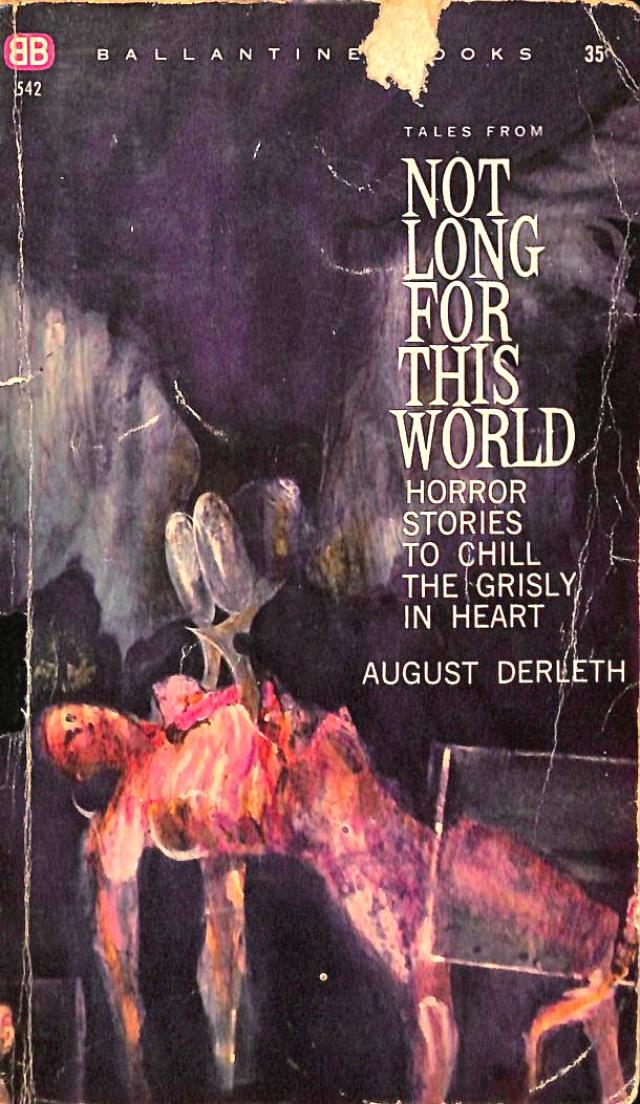
Not ong for this worls.., p.14
Not Ong for This Worls - August Derleth,
p.14


Camberveigh shaved and had breakfast, preoccupied. If indeed he had slept through Friday, he ought certainly to be hungrier than he was. But he was not hungrier than usual. Moreover, if he had not shaved on Friday, he ought to have had a greater growth of beard. Furthermore, there were curious misplacements of objects in his house which led him to the unavoidable conclusion that he had not slept through Friday. Obviously, then, he had been up and about at something. But search it as he might, his memory told him nothing, his memory presented an absolute blank.
And yet not quite absolute: there was deep within him an urgent conviction that there was something strange and terrible he ought to know.
Camberveigh, however, had an habitual dislike for fantasy, and he refused to entertain vague fears, premonitions, hunches, and the like. Granting the fact that somehow his doings on Friday the sixteenth eluded his memory, he had today to do the things he should have done on Friday. That book Anima had loaned him must be returned to the old bookseller. And he must have a visit with his physician to ascertain whether this sudden lack of memory about the previous day might be a sympton of some serious physiological disorder. A stitch in time, he thought.
Accordingly, still troubled about his flawed memory, Camberveigh sat down and had a look at the book. Anima had pressed it upon him, saying it was full of antiquities, and, indeed, so it was. He examined the binding and had an unpleasant conviction that it was bound in human skin. The book itself was written in Latin and was quite difficult to read, for the print had faded in many places. It was obviously, however, one of those curious items on demonology and allied occult matters, and he was a little puzzled to know why Anima should have insisted that he take it along, when Anima knew very well his interests lay primarily in the field of entomology and ornithology, both of which were quite distinctly removed from the occult.
He read a passage here and there, translating as he read. “To summon from the Pit Him Who Will Serve you can be done in this wise…” here followed an elaborate formula. He turned a few pages. “It is possible at the midnight hour to call up the spirits of the dead and hold communion with them in regard to events of the future…” He turned a few more pages. “Thus it can be that through the medium of the accursed object, it is possible to send forth one’s spirit self, the astral body, and dispossess another for a brief time, but only for so long as the object remain in his possession.” He dipped into the book farther along. “Quentus had with him continually a large black dog, commonly held to be his familiar, a certain evil demon summoned from the Pit and put into his service…”
Certainly it was interesting, Camberveigh thought, in a detached way; but it was not in his field, and he must regretfully return it and spend no further time on it. He had little enough time to devote to his studies as it was. He wrapped the book carefully, got dressed, took his umbrella—though it was an exceedingly mild day outside—and set out for his doctor’s office, which was within walking distance of his home.
There was nothing whatever wrong with him.
“Perfectly fit,” said his physician. “Your experience is certainly odd—but not at all unique. Such things have happened before and will happen again. Forget about it.”
“But I have the feeling that there is something about yesterday I ought to know.”
“So would I, in the circumstances.”
Somewhat reassured, Camberveigh went on his way. He descended to the Underground, and, while waiting for his train, bought a copy of the News of the World. British bombings, threats of German reprisals, Spanish toadying to the Axis, America toadying to Spain—disgusting! He turned to an inner page and saw that one of his acquaintances had come to his end in a violent manner. “Murder of Rochard Craig!” read the headline. “No further clue has thus been discovered in the search for the murderer who entered Rochard Craig’s home sometime yesterday and killed Craig when discovered in the act of rifling Craig’s bookshelves of rare old volumes which constituted the heart of the Craig collection. Craig was stabbed to death. Search is being made for the missing volumes but there is little hope…Horrible! thought Camberveigh perfunctorily, and went on to read the usual column on birds in the country written by a retired bee-keeper in Sussex.
His train came and he took it to Soho, taking pleasure in the accounting of what the linnets and the cuckoos and a rare peregrine had been up to during the past week in Sussex. He caught the correspondent in what he was convinced was a minor error, and made a mental reservation to write and challenge him on the point, however trivial it was. The scientific amenities must be observed, fancy must not be confused with fact, the truth must be adhered to with exactitude. That alone was the proper attitude.
He. arrived at Anima’s hole-in-a-corner book shop some time after the lunch hour, but, since he was habitually a lackadaisical luncher, he did not mind. The shop was, as usual, quite dark; it was set into a little alley, and even with the brightest sunlight, not too much light ever reached inside. So much Camberveigh had observed on his first visit to Anima’s shop, which had been made only a little over a fortnight ago, and had been brought about by a chance meeting with the bookseller himself in an air-raid shelter. Anima seemed to prefer it that way.
He stood for some time waiting; perhaps the bookseller was at his luncheon, perhaps he had not heard the little bell tinkle. After waiting a few moments in vain, Camberveigh walked back among stacks of books and touched the bell with his umbrella. This time it brought Anima out of the back room.
A small, wizened man, not very strong, who came obsequiously and with narrowed eyes. “Ah, it is you,” he said with an almost offensive familiarity. “You have brought my book back, eh?” His eyes fell upon the package Camberveigh carried, and—could it be?—lit up with a strange, eager sense of possession.
Abruptly Camberveigh heard himself saying, “Why, no, I’m sorry, Mr. Anima. I found it so interesting to read that I wanted to look it over a little longer. I thought you would not care if I kept it at least over Sunday.”
Anima was disappointed. He shot a sharp, inquisitive look at Camberveigh, but was apparently satisfied by what he saw in Camberveigh’s face. He nodded curtly and said very well, Camberveigh might read it if he liked. “But not over Monday, mind! I must have the book back Monday. I need it. I am—studying in it.”
Camberveigh left the shop in perplexity. What inexplicable motive had impelled him to keep the book. Why had he suddenly thought there was something shudderingly familiar about the old man whom he had viewed with the most aloof unconcern at every previous meeting? It was extraordinary—and yet, was it, indeed?
It came to him with a feeling of chilling shock that he had seen Anima’s face since his last visit to the shop. The feeling became conviction, free of all doubt.
Fleeting as it had been, it was Anima’s face which had looked at him out of his own mirror that morning! On his way back to his rooms, he tried to rationalize his actions. But they were incapable of rationalization. Of a sudden there in that dark shop, when confronted by Anima’s eagerness to repossess his curious book Camberveigh had been assaulted by an eerie determination to retain possession of it.
He had acted on impulse, something he had never done before. But now, as he sat there in the underground train, he was conscious of a great turmoil inside him, of a conflict of emotions rooted in some facet through to which he could not reach; once again it was wound up with what he ought to know about the previous day, but there was the conviction that he was close to knowing, that indeed he knew, if only he could understand. It was extraordinary, and it was extremely upsetting to a man as methodical as Camberveigh.
Really, he did not want to see any more of Anima’s book. What imp of perversity was responsible for his action? He had had ample time to examine the volume, for which he began now to feel a faint distaste, an aversion which, like his sudden impulse of but a short while ago, he could not explain.
He took the book home with him and unwrapped it again.
The binding was certainly of human skin. There was no telling how old it was, but it was not so much a genuine book as a compilation of various printed things gathered up by some long-dead collector, and bound in this hideous fashion. Camberveigh thought it might conceivably date back to the time when Black Masses and devil worship were flagrant in London, but he was a little hazy on his dates.
He turned from the book and set about answering morning^ post. But he could not keep his attention to the mail; he kept thinking about the book, about Anima and his strange eagerness—first, to press it upon him; then to take it back. He thought about the incredible fascination the volume seemed to have for him at the same time that he was conscious of its repellence.
Finally, he got up, because he could no longer continue to struggle within himself, and went over to the book and opened it, determined that he might as well be methodical about it and read in it until he was thoroughly tired of it. This he did. He read all about demons, witches, warlocks, caballistic rites, certain strange practices of Druids, ancient religions, spectres, astrals, hauntings; he read until nightfall, and then put the book aside.
At that hour, it was his custom, being a neat man, to clean his apartment. He set about doing this, and so came upon his grey suit dropped behind an overstuffed chair. One of his best suits, too! How did that come to be there? He picked it up, indignant. Surely he could not have done that even in a state of trance, if he had been in one on Friday! To add to his indignation, he saw when he had rescued it, that not only was the suit badly wrinkled, but it was very dirty and dusty, as if he had carried something heavy against it; and finally, he saw that it was stained rather messily with something that had dried brown into the fabric and looked rusty.
He brushed his coat, and finally carried it tentatively to the washbowl in the bathroom, where he wet one of the stains gingerly and scrubbed at it. The water came away a kind of odd brown-red—the water in the bowl began to look the way it did when he had washed out a bloodstained handkerchief after a bad cut a month ago. Camberveigh stood and looked down into the water. What was it he saw there? What depths of darkness and horror looked up at him from this curiously colored water. He looked at his suit and abruptly thrust it from him. Then he took it up again and gazed at it more intently. If the stains were bloodstains—what made those serried marks of dust and dirt? As if books had been carried there, pressed close to his body!
His mouth and throat went dry, and he began to tremble a little.
What went through his mind was surely impossible! But now, inexorably, his very method began to make itself felt He went back in memory to the visit he had paid Anima on Thursday; he reconstructed, word for word, their conversation.
“Do you know Rochard Craig?” Anima had asked.
“Yes.”
“Ever been in his house?”
“Oh, yes.”
“Know your way around then, eh? Seen his collection?”
“Yes, though I don’t go in much for books.”
“No, you bugs and bird people don’t appreciate inanimate things.”
So much of it came back with striking clarity. Anima had mentioned Rochard Craig; Anima’s envy at mention of certain of Craig’s books was unmistakable. What were they? His methodical mind presently gave him a title or two, whereupon he went at once to the papers and looked up those titles among the books listed as missing from Craig’s collection. There were there, duly listed.
Camberveigh mixed himself a Scotch and soda and drank it fast.
Then he went back to that horror of a book still lying on the table where he had left it.
After some while of searching, he found the passage that had recurred to memory. Thus it can be that through the medium oj the accursed object, it is possible to send forth onefs spirit self, the astral body, and dispossess another for a brief time, but only for so long as the object remain in his possession. He read on in growing amazement. What was set down there was inconceivable, incredible, and yet…
Yet there were those bloodstains on his suit; there were marks as if he had carried away books; there were so many curious facts that they went beyond mere coincidence.
And the accursed object—surely the book!
Given him by Anima, who had somehow then taken possession of him. That was where his lost day had gone. Unbelievable as it might be, against all reason—yet it offered the only comprehensive explanation of what had happened to his Friday.
He read on, struggling to keep his natural scientific prejudice from getting in the way. Apparently there was but one risk run by the projector; until his “object” was returned to him, there existed by its very possession in the hands of another a bond between them; that would surely account for Anima’s eagerness to regain his book. Yes, it was undeniable, it made a precise pattern, with every facet fitting neatly into place.
Camberveigh sat back, little beads of cold perspiration on his forehead. He lit a cigarette. He must think.
He knew enough about the laws of evidence to know that if the investigation of Rochard Craig’s death—he, how foul! he revolted against himself at the thought that his hand might have brought it about—ever got to him, he would not have a Chinaman’s chance. There was the condition of his suit, the blood could be analyzed easily; there were the books—no doubt whatever that Anima had them; he would certainly testify that Camberveigh had brought them in Friday, on the infamous lost day. And perhaps even the weapon—! He got up on the instant and began an intensive search.
In less than half an hour he discovered it: a little stiletto he had picked up long ago at a sale in Petrie’s. It was awkwardly hidden behind a shelf of books. What evidence!
He took it out and washed it thoroughly.
The hour was now quite late; darkness had fallen. He paced his rooms for a while in deep thought, but eventually he returned to the book.
What was it he must do to do as Anima had done?
Still incredible he took the book, stretched out on his bed and began to follow the instructions put down in that labored Latin.
It seemed to him after a while that he slept…and that he dreamed. Of foggy streets, and the voice of London muted in the night, a London where nothing was material; and he passed through walls as if they were air, swiftly, swiftly, recognizing streets, lanes, buildings; and he was in Soho, going down that little alley, passing into that hole-in-a-comer shop with its musty books. And it seemed to him that he entered into the wizened, crabbed figure lying asleep there and took his body and destroyed it. And then again the fog and the night and London asleep, save for those dark-eyed, sleepless creatures who walked its streets by night, pitied by darkness, the forgotten and homeless…After a long while he struggled awake, tired as if he had not slept at all.
But he had. He had awakened at promptly seven o’clock on Sunday morning.
Ah, what a dream he had had! But—was it a dream? He was still fully clothed. He leaped from his bed and knocked down that book of Max Anima’s. With a shudder of revulsion, he picked it up and carried it back out to the table.
It was not a dream. There was his suit, still, with those ghastly, incriminating stains. There was the stiletto, too. Worst of all, there was the book bound in human skin. Who could doubt that it was accursed?
Anger and frustrated rage and bitterness rose in him. It took him some time to quell these emotions, to bring to bear upon his problem the fundamental meticulousness of habitual method. He reviewed his situation; it was not good. Surely it was beyond the bounds of possibility that no one had seen him in the vicinity of Craig’s house; Anima in his physical self need not have feared being seen. Even if he, Camberveigh, had guessed, could he tell the police? He could picture the reception such a fantastic rigmarole would receive!
He snatched up the book again, took his suit, and descended to the basement, where he lit a fire in the furnace and carefully destroyed both objects. After he had completed this task, he removed the ashes, cooled the furnace, and ran the ashes down the drain. Then he took the stiletto, walked out, and dropped it into the Thames, which flowed past not far away.
After this he returned home, shaved methodically, and got himself some breakfast, thinking.
If anyone had seen him on that lost Friday, by all the laws of average the police would soon be at his door. At least, the evidence was gone now. He had more than a fighting chance. He began instinctively to gird himself for battle. Actually, he was not guilty, but there was no way in which he could involve Anima, none whatever. In any case, he was beginning to have grave doubts about the whole matter. That damnable book had actually suggested that no psychic force could compel anyone to do something against his own nature, and the implications of that were monstrous!
He turned on the radio and dialed for the news. He was a little late. He missed the war bulletins and got the late London news. “Max Anima, eccentric bookseller famed for his skill in obtaining rare and unique out-of-print books, was found dead this morning in the rooms behind his bookshop. He had apparently committed suicide. The door of his rooms was locked on the inside…”
So that, he thought, was that!
At that moment there was a ponderous and authoritative knock on his door.
Now then, he thought, and went confidently forward to open the door.
An Inspector from Scotland Yard stood on the stoop. With a polite “Good morning,” he walked in, quite sure of himself.
A Collector of Stones