Not ong for this worls.., p.15
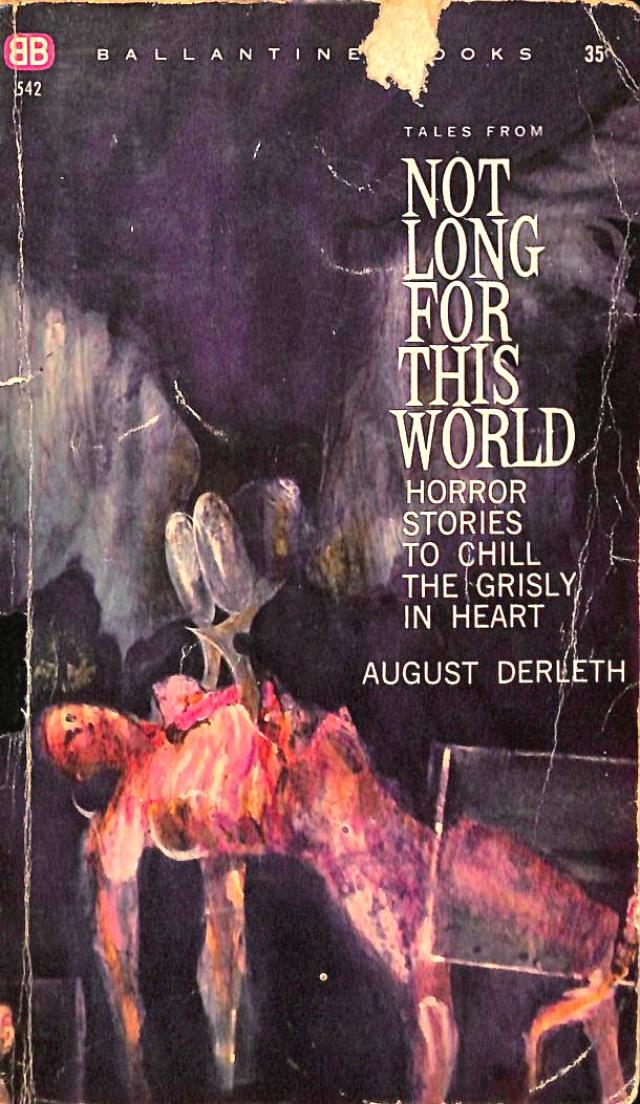
Not Ong for This Worls - August Derleth,
p.15


Mr. Elisha Merrihew, a fat man with money and a pink complexion, was a collector of stones, and, like many collectors, he was not too ethical about the ways in which stones came into his possession. One might have conceived some faint, if unethical, sympathy for Mr. Merrihew if he had collected precious stones, but -no, he was interested in the most common kind of garden variety, ranging all the way from field rocks to discarded paving blocks. He built things with them, one hobby leading to another; he had built a dwelling for himself—commodious, too—, a summerhouse, a tea-house, and no less than four hundred and fifty-seven feet of path around his estate, which was well off the country away from too inquisitive neighbors.
He was still at building paths—this time a rambling byway leading to his boathouse on the nearby lake—when he stopped his car one afternoon beside a wood and made a delightful discovery. Not very far from the road, just over a broken-down old fence, there lay four sizable, stones, smooth, too, apart from the weather-wear they showed, and just exactly right for his walk. Since there was no one, and not a house within sight, Mr. Merrihew crossed the fence and appropriated them, lugging them one after the other to the back seat of his car—the trunk was not good enough for them—and driving off with them.
It was not until he had got all the way home in the summer dusk that he discovered that the stones had some sort of lettering on them. The light was no longer strong enough to see by; so he brought his flash-light into use, but this did not help much, after all, for the lettering, such as it had been, was very largely worn away. The stones appeared to have borne some kind of dates, but beyond that Mr. Merrihew could make out nothing. Nor could he discern anything further the following day, when he had a very good time all by himself laying the four stones he had discovered so fortuitously in various places, just where they would do the most good, along the path to the lake. They shone faintly gray among the limestone flagging he had got together for most of the walk.
Mr. Merrihew was very proud of his newly-completed walk, and, as always when he was proud, he had to take the occasion to show off his most recent accomplishment by inviting some of his friends out to dinner. Like Mr. Merrihew, his friends were very largely conservative and middle-aged, not as far as birthdays went, but only as far as mental outlook was concerned. Since Mr. Merrihew never failed to put on a lavish meal, his friends never deserted him; they were complacent and duly enthusiastic about the new house, the summerhouse, the tea-house, and the hundreds of feet of walk around the estate, and they were prepared to be fully as complacent and enthusiastic about Mr. Merrihew’s most recent addition.
Their host, however, owing to the necessity of helping his man with dinner, could not himself display his latest achievement, but simply sent his guests sauntering down the walk to the lake and prepared to regale them at dinner with all the figures and facts pertaining ter this most immediate indulgence of his hobby.
But somehow things did not go quite as Mr. Merrihew had a right to expect.
For one thing, instead of the usual paean of praise Merrihew was accustomed to hear from Shane Rodder, who was the first of the little group of three to come in, he was greeted with a casual smile and a remark that, to put it mildly, was certainly uncalled for.
“What was that?” asked Merrihew a little sharply.
“You seem to have got quite a little more help around the place,” said Rodder.
Merrihew stiffened; he interpreted this as a direct reflection upon the newly-completed walk. “I laid all the stones by myself, with no help whatever—quite as usual,” he answered.
“Oh, I didn’t suggest that you had help.”
“Then what did you mean?”
“The people.”
“People?” echoed Merrihew. “As far as I know, Bascomb and I are alone here—apart from my guests for tonight.”
At this moment Mrs. Rivercomb came in, and without pause delivered herself of a hearty opinion. “I must say, Lisha, you have a nice walk there—but why send us out before you’ve got the stones really down? I stubbed my toe twice and almost fell—but Pat caught me.”
“Yes, that’s right,” said Pat, coming in behind her. “Luckily a husband’s still some help these days.”
Merrihew controlled himself with effort. “When I left the walk it was in perfect shape,” he said finally.
“I say someone was digging in some of the stones!" said Mrs. Rivercomb.
“Or out.”
“Oh, nonsense—out!” said Rodder. “The grey ones, wasn’t it?”
“You did notice!” exclaimed Mrs. Rivercomb.
Merrihew tried hard to keep from showing his now profound irritation. He knew very well that his walk had been perfect; even the usual taciturn and noncommittal Bascomb had complimented him on his work. Yet, if his guests were having him, they were doing so with an amazing amount of casual dignity. He wanted to yield to an impulse to give them a piece of his mind, but there was something so guileless in their attitude that he could not.
Without a word, he put down the platter he was carrying and left the room. He went out of the house straight down the walk to the lake. It was a balmy night in August, and the breeze from the lake blew cool and fragrant with the smell of fresh water after a warm day. The lake walk was not in a straight line, but wound in and out among the clumps of lilac and syringa, under the trees and past a tumbledown shed which had once been a boathouse.
As he came round a lilac bush, Merrihew was astonished to see someone bending over his walk, quite as if at work there. He let out a hoarse bellow of anger and charged—only to fall flat on his face, bruising his nose considerably, squarely in the middle of his walk. When he had recovered sufficiently to look around him, he saw that he was quite alone; no one else was near. He saw also that he had fallen over one of his large grey stones, which was certainly not in the position he had left it—not flat and level, but standing upend, crazily.
Merrihew looked at it for a long minute. Then he turned and looked down the walk toward the lake. He saw the other grey stones readily enough; each one of them was out of place. He got up and walked down to the other three stones. Each of them bore evidence of someone’s having dug around in the sand in a patent attempt to either set up or move the stones.
Clearly the work of vandals—perhaps some envious neighbor.
Working furiously, he flattened each stone again; it was not quite level, but he could straighten each one in the morning. And then woe betide anyone who dared to meddle with his walk!
Somewhat disheveled, he went back to the house, where his guests had lent Bascomb a hand, with such good effect that dinner was now on the table, and they waited only for him.
“Dear me!” exclaimed Mrs. Rivercomb at sight of* him. “What in the world happened to you, Lisha?”
“Vandals,” he growled. He marched off to the bathroom to tidy himself up, and, coming back to take his place at table, turned inquisitively to Rodder. “Now, then—what about those people you saw?”
Rodder looked dubious. “I wouldn’t say they looked much like vandals to me. A middle-aged man, a woman I took to be his wife, a young girl, and a young man, I’d say of about twenty or so. Looked like a family. I thought you’d got a new family in to help out.”
“Where were they?”
“Oh, down along that walk. Not together, exactly—sort of lined up. They took off when I came along.”
“Which direction?” barked Merrihew.
Rodder opened his lips to speak, but no words came for a long moment. He looked faintly ridiculous. “Well, now, that’s a stunner,” he said finally. “I don’t believe I can tell you which direction they went. They were just there one moment and next, they had gone—into the bushes, I suppose. Probably felt they were out of place.”
“They certainly were,” said Merrihew. “I saw one of them, too—just for an instant. The young man, I think.”
The conversation grew animated, but no less unclear. That someone had been meddling with Merrihew’s walk was not to be doubted, even though the Rivercombs had seen nothing. Mrs. Rivercomb had twice almost fallen on the walk where the vandals had dug, and that was evidence enough in its own right. The motive for such vandalism was obscure indeed. Rodders description of the little girl, whom he had seen most clearly, suggested no one Merrihew knew, nor did her quaint dress offer him any clue. The old man, said Rodder, had seemed to be wearing an old-fashioned broad-brimmed hat and a frock coat which had the look of being a century old—but of course, it was twilight or deepening dusk, and Rodder could not be too sure of what he had seen. Merrihew was not helped in his attempt to puzzle out the problem, but had to fall back upon the conviction that somehow, somewhere he must have incurred the envy or anger of someone who had chosen this means to avenge himself.
But—a family group? That was incredible. Even in his most aboveboard dealings, Merrihew had been careful to confine his affairs to one or at most two people at a time. The only family, as family, he had ever dealt with was the owner of a limestone quarry, and these people had never had any fault to find with Merrihew’s rates of payment. Moreover, they were a husband, wife, and three sons, and not at all like Rodder’s slim description.
When at last his little party broke up, the subject of the walk to the lake was almost embarrassing. Merrihew was no closer to a solution of his mystery than he had been at the outset. He saw his guests off, and came back into the house, sorely puzzled. The more he thought about the events of the evening, with their faintly ludicrous aspect, the more involved he became.
He had already begun to undress, when he thought of making another inspection of the walk. Forthwith, he put on his bedroom slippers, got into his dressing-gown, and went quickly out of the house to the lake walk. He walked with extreme care and in silence, and when he came to that clump of lilacs beyond which he should catch sight of the first of those fine grey stones, he went along with all the stealth of a second-story man.
Even, so, he was hard put to it to suppress an angry oath at what he saw. There was that young fellow once more, pulling and tugging at the stone, and not far beyond him, a little girl, doing likewise. And now far beyond her, one after the other, a man and a woman—pulling, pushing, moving the stones, little by little. Indeed, the young fellow already had his stone well off the line of the walk, about three feet offside. All four of them worked as if with great effort, not a word passing among them, and, what was more curious still, not a sound.
Dim though the starlight was, it was not so dim that Merrihew had any doubt about their strangeness. He had never, to the best of his knowledge, seen any one of that odd, quaint group—and quaint they certainly were. He had never before happened upon so oddly-dressed a group of vandals. Their costumes clearly belonged to a time decades, almost a century ago. Merrihew had just enough of a smattering of psychiatry to be certain that these people were probably mildly obsessed in some form or other, victims of phobias, or queer compulsions. Moreoever, watching them, he remembered that in the previous night he had once or twice thought he had heard suspicious noises from the direction of the garage, where he had kept the stones overnight.
Well, there was nothing to do but face it. It was certain to be disagreeable—for them. Trumpeting loudly, Merrihew came around the lilac bushes, out of his concealment, and strode toward the vandals who dared tear up his walk.
“There’s no need to run,” he said, raising his voice so that all might hear him, “because I’ve been watching you for some time.” And there he stopped, openmouthed, for though the row of displaced stones clearly attested to vandalism, the perpetrators of this wanton act had nevertheless managed to slip away. For only a moment Merrihew stood there; then his anger got the best of him. He ran this way and that, shouting, growing angrier by the moment, until Bascomb, roused by all the hullaballoo, showed up coming down the walk, carrying a stout poker.
“Look! Just look!” shouted Merrihew, gesticulating at the stones.
Bascomb clucked and shook his head.
“Well, don’t stand there! Get a flashlight and hold it while I put these back into place.”
Merrihew raved incontinently all the while he repaired, as best he could, his walk, and then saw Bascomb back to bed with an ill-tempered peroration in regard to what ought to be done to vandals. Bascomb responded in the only way he thought might be effective; he showed up discreetly with a double whiskey and soda and left it stand significantly at Merrihew’s bedside.
Merrihew, however, was in no mood for sleep. The more he considered this invasion of his rights as a private citizen, the more angry he got. His thoughts rang with sententious variations of the fact that a man’s home is his castle, and so on, and he worked himself up to such a pitch that he finally got out a shotgun he had not used in an age, and spent half an hour oiling and cleaning it. Moreover, he fully intended to use it.
The hour was now approximately two o’clock in the morning. It was hardly likely that the vandals would make another sortie so late, but Merrihew remained uneasy. Nevertheless, he compromised so far with his anger as to get himself into bed, and there he lay fuming still, and trying at odd times to go to sleep. His attempts were not very successful; he kept imagining that he heard the clink of stone on stone; he fancied he heard dragging noises, just as if someone were making off with his treasures. And finally, he got up.
It was now four o’clock, and the dawn would be breaking before very long. He resigned himself to doing without sleep and got dressed. Then he took his shotgun and went outside, gravitating naturally to the lake walk. Just in the remote case that the vandals had returned, he went with great care.
He care on this occasion, was quite unnecessary.
There was no sign of any invader. But Merrihew’s satisfaction at this was considerably ameliorated by what he next saw. He gave a bellow of rage and started forward. There was no need of haste, however; his four grey stones were gone. They had been pried up and lifted out of his walk, and there was no sign of them within range of his sight.
After satisfying himself of this, Merrihew rapidly decided that the vandals could not have got far with his stones. He doubled back across his lawns to his garage, got out his car, and roared out on to the highway. But now—which way to go? He had his choice of two directions—either to the city or away from it. He elected at once to drive away from it, reasoning that such individuals as he had seen were not likely to have come out of any city. Moreover, the direction he chose to drive went into the same remote country out of which he had got the stones in the first place.
He hardly had time to reflect upon the ridiculousness of his impulse before he caught sight of the vandals who had robbed him. There they were—all four of them—man, woman, boy, and girl—going down the middle of the road with the stones on their backs! It was incredible, but there it was; the headlights of his car picked them out plainly enough, though the stones were plainest, seeming to absorb and yet reflect the light, so that it was as if the vandals carrying them were the merest shadows beneath. He did not stop to wonder at all; there were his stones; there were the vandals who had stolen them. With a shout, he stepped on the gas and bore down on them, pounding his horn.
Down came the stones to the asphalt, directly in front of his car. Merrihew slammed on His brakes, reached for his shotgun, and jumped from his car. “And now, you thieves!” he shouted.
But his vehemence was in vain. Once again his vandals had disappeared. Merrihew felt violently frustrated. He wanted to discharge buckshot at some one, preferably the old man who appeared to be the leader of that curious crew. But the road was silent and deserted, save for Merrihew, his car, and his stolen stones, which lay in an uneven row across the asphalt. The lights of his car combined with the first streaks of the dawn to cast an unearthly glow over the scene.
Resigning himself at last to the fact that there was no one at whom he could shoot in vengeance or for the satisfaction of his honor, Merrihew impatiently loaded the stolen stones into the back seat of his car and climbed back in to turn around and take them back.
But at that moment something very untoward took place. Merrihew had just started the car and was prepared to turn, when he felt all around him a fluttering of hands. The car spurted forward, the wheel he had half turned was turned back, and away went the car with Merrihew at the wheel but with Merrihew very much not in control.
He grew chill with unnatural fear. He felt hands like down. He felt bodies pressing against him, light as wind. He felt things probing the dashboard, the brakes, the wheel. In the wan light of earliest dawn he thought he saw faces—an old man’s, a woman’s, a boy’s, a little girl’s. He wanted to shout, but he could not; he sat as a mound of gooseflesh, feeling other hands but his guide the wheel, knowing with the instinct of a long-time driver that the guiding hands were unfamiliar with the wheel, the car. And other pressure but his foot was on the accelerator!
The car increased in speed. It tore down the road, turned an easy corner on two wheels, and leapt into a side road—with Merrihew petrified inside. In the glow of the headlights suddenly Merrihew saw the forlorn woodland spot where he had found the stones.
The car drove straight for it.
The car jumped the ditch, hurdled the fence, and drove directly into a tree with such force that Merrihew went up through the windshield, and the four grey stones flew up out of the car and landed all around him. In the grey light of the dawn, Merrihew saw through his darkening stupor four figures floating out of his car—all four of them light as thistledown, and with the dawn shining right through them; he saw them tugging and pulling at the stones, and, one after the other sinking down into the earth beneath them.
Merrihew’s head had come up against a square stone marker with lettering on it. But it was not until he was some time out of the hospital that he got around to coming back and reading it. What it had to say was succinct and adequately informative.
Dunlap Family Cemetery