Not ong for this worls.., p.5
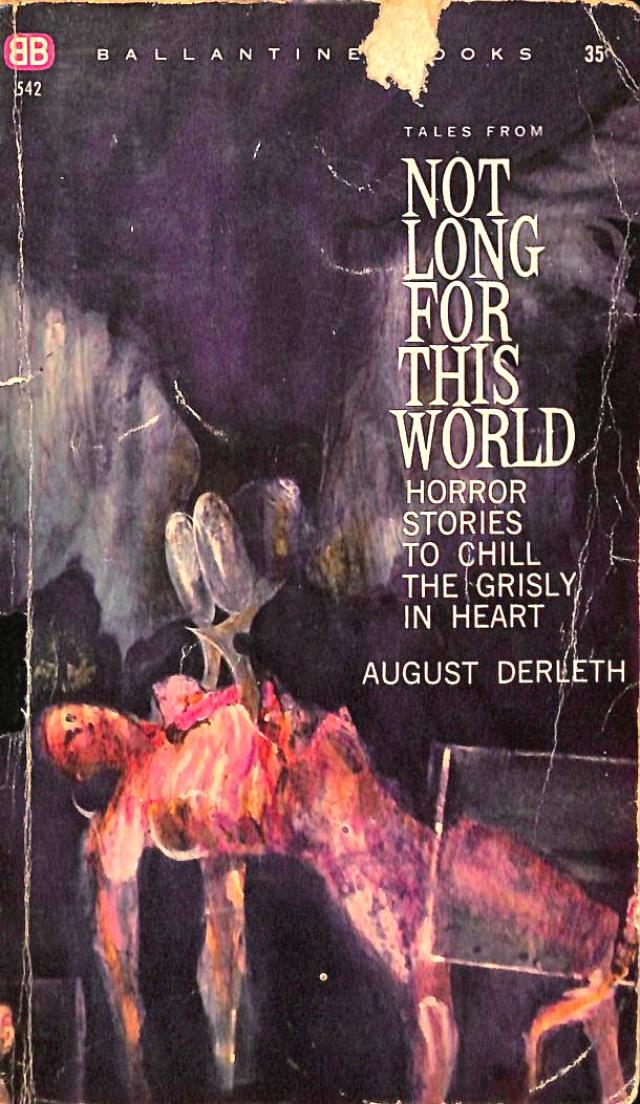
Not Ong for This Worls - August Derleth,
p.5


Then something closed about her neck, jerking upward. She fell, striking her head against the bureau, and descended into blackness.
It was the widow Klopp who found the Feigmans. The doctor who examined them said that Eb had died of heart-failure. He had had trouble with his heart for a long time. But Martha’s death was strange. She had been strangled. He could not understand how it happened. She had been strangled by the bag of silver dollars—somehow the loop of the cord had caught on a clothes-hook near the bureau, she had fallen unconscious, and the leather cord, looped twice about her neck and weighted by the heavy bag, had choked the life from her frail body.
The Drifting Snow
Aunt Mary’s advancing footsteps halted suddenly, short of the table, and Clodetta turned to see what was keeping her. She was standing very rigidly, her eyes fixed upon the French windows just opposite the door through which she had entered, her cane held stiffly before her.
Clodetta shot a quick glance across the table toward her husband, whose attention had also been drawn to his aunt; his face vouchsafed her nothing. She turned again to find that the old lady had transferred her gaze to her, regarding her stonily and in silence. Clodetta felt uncomfortable.
“Who withdrew the curtains from the west windows?”
Clodetta flushed, remembering. “I did, Aunt. I’m sorry. I forgot about your not wanting them drawn away.”
The old lady made an odd, grunting sound, shifting her gaze once again to the French windows. She made a barely perceptible movement, and Lisa ran forward from the shadow of the hall, where she had been regarding the two at table with stern disapproval. The servant went directly to the west windows and drew the curtains.
Aunt Mary came slowly to the table and took her place at its head. She put her cane against the side of her chair, pulled at the chain about her neck so that her lorgnette lay in her lap, and looked from Clodetta to her nephew, Ernest.
Then she fixed her gaze on the empty chair at the foot of the table, and spoke without seeming to see the two beside her.
“I told both of you that none of the curtains over the west windows was to be withdrawn after sundown, and you must have noticed that none of those windows has been for one instant uncovered at night. I took especial care to put you in rooms facing east, and the sitting-room is also in the east.”
““I’m sure Clodetta didn’t mean to go against your wishes, Aunt Mary,” said Ernest abruptly.
“No, of course not, Aunt.”
The old lady raised her eyebrows, and went on impassively. “I didn’t think it wise to explain why I made such a request. I’m not going to explain. But I do want to say that there is a very definite danger in drawing away the curtains. Ernest has heard that before, but you, Clodetta, have not.”
Clodetta shot a startled glance at her husband.
The old lady caught it, and said, “It’s all very well to believe that my mind’s wandering or that “I’m getting eccentric, but I shouldn’t advise you to be satisfied with that.”
A young man came suddenly into the room and made for the seat at the foot of the table, into which he flung himself with an almost inaudible greeting to the other three.
“Late again, Henry,” said the old lady.
Henry mumbled something and began hurriedly to eat. The old lady sighed, and began presently to eat also, whereupon Clodetta and Ernest did likewise. The old servant, who had continued to linger behind Aunt Mary’s chair, now withdrew, not without a scornful glance at Henry.
Clodetta looked up after a while and ventured a speak, “You aren’t as isolated as I thought you might be up here, Aunt Mary.”
“We aren’t, my dear, what with telephones and cars and all. But only twenty years ago it was quite a different thing, I can tell you.” She smiled reminiscently and looked at Ernest. “Your grandfather was living then, and many’s the time he was snowbound with no way to let anybody know.”
“Down in Chicago when they speak of ‘up north’ or the ‘Wisconsin woods’ it seems very far away,” said Clodetta.
“Well, it is far away,” put in Henry abruptly. “And, Aunt, I hope you’ve made some provision in case we’re locked in here for a day or two. It looks like snow outside, and the radio says a blizzard’s coming.”
The old lady grunted and looked at him. “Ha, Henry—you’re overly concerned, it seems to me. I’m afraid you’ve been regretting this trip ever since you set foot in my house. If you’re worrying about a snowstorm, I can have Sam drive you down to Wausau, and you can be in Chicago tomorrow.”
“Of course not.”
Silence fell, and presently the old lady called gently, “Lisa,” and the servant came into the room to help her from her chair, though, as Clodetta had previously said to her husband, “She didn’t need help.”
From the doorway, Aunt Mary bade them all goodnight, looking impressively formidable with her cane in one hand and her unopened lorgnette in the other, and vanished into the dusk of the hall, from which her receding footsteps sounded together with those of the servant, who was seldom seen away from her. These two were alone in the house most of the time, and only very brief periods when the old lady had up her nephew Ernest, “dear John’s boy,” or Henry, of whose father the old lady never spoke, helped to relieve the pleasant somnolence of their quiet lives. Sam, who usually slept in the garage, did not count.
Clodetta looked nervously at her husband, but it was Henry who said what was uppermost in their thoughts.
“I think she’s losing her mind,” he declared matter-of-factly. Cutting off Clodetta’s protest on her lips, he got up and went into the sitting-room, from which came presently the strains of music from the radio.
Clodetta fingered her spoon idly and finally said, “I do think she is a little queer, Ernest.”
Ernest smiled tolerantly. “No, I don’t think so. I’ve an idea why she keeps the west windows covered. My grandfather died out there—he was overcome by the cold one night, and froze on the slope of the hill. I don’t rightly know how it happened—I was away at the time. I suppose she doesn’t like to be reminded of it.”
“But where’s the danger she spoke of, then?”
He shrugged. “Perhaps it lies in her—she might be affected and affect us in turn.” He paused for an instant, and finally added, “I suppose she does seem a little strange to you—but she was like that as long as I can remember; next time you come, you’ll be used to it.”
Clodetta looked at her husband for a moment before replying. At last she said, “I don’t think I like the house, Ernest.”
“Oh, nonsense, darling.” He started to get up, but Clodetta stopped him.
“Listen, Ernest. I remembered perfectly well Aunt Mary’s not wanting those curtains drawn away—but I just felt I had to do it. I didn’t want to but—something made me do it” Her voice was unsteady.
“Why, Clodetta,” he said, faintly alarmed. “Why didn’t you tell me before?”
She shrugged. “Aunt Mary might have thought I’d gone wool-gathering.”
“Well, it’s nothing serious, but you’ve let it bother you a little and that isn’t good for you. Forget it; think of something else. Come and listen to the radio.”
They rose and moved toward the sitting-room together. At the door Henry met them. He stepped aside a little, saying, “I might have known we’d be marooned up here,” and adding, as Clodetta began to protest, “We’re going to be, all right. There’s a wind coming up and it’s beginning to snow, and I know what that means.” He passed them and went into the deserted dining-room, where he stood a moment looking at the too long table. Then he turned aside and went over to the French windows, from which he drew away the curtains and stood there peering out into the darkness. Ernest saw him standing at the window, and protested from the sitting-room.
“Aunt Mary doesn’t like those windows uncovered, Henry.”
Henry half turned and replied, “Well, she may think it’s dangerous, but I can risk it.”
Clodetta, who had been staring beyond Henry into the night through the French windows, said suddenly, “Why, there’s someone out there 1”
Henry looked quickly through the glass and replied, “No, that’s the snow; it’s coming down heavily, and the wind’s drifting it this way and that.” He dropped the curtains and came away from the windows.
Clodetta said uncertainly, “Why, I could have sworn I saw someone out there, walking past the window.”
“I suppose it does look that way from here,” offered Henry, who had come back into the sitting-room. “But personally, I think you’ve let Aunt Mary’s eccentricities impress you too much.”
Ernest made an impatient gesture at this, and Clodetta did not answer. Henry sat down before the radio and began to move the dial slowly. Ernest had found himself a book, and was becoming interested, but Clodetta continued to sit with her eyes fixed upon the still slowly moving curtains cutting off the French windows. Presently she got up and left the room, going down the long hall into the east wing, where she tapped gently upon Aunt Mary’s door.
“Come in,” called the old lady.
Clodetta opened the door and stepped into the room where Aunt Mary sat in her dressing-robe, her dignity, in the shape of her lorgnette and cane, resting respectively on her bureau and in the corner. She looked surprisingly benign, as Clodetta at once confessed.
“Ha, thought I was an ogre in disguise, did you?” said the old lady, smiling in spite of herself. “I’m really not, you see, but I am a sort of bogy about the west windows, as you have seen.”
“I wanted to tell you something about those windows, Aunt Mary,” said Clodetta. She stopped suddenly. The expression on the old lady’s face had given way to a curiously dismaying one. It was not anger, not distaste—it was a lurking suspense. Why, the old lady was afraid 1
“What?” she asked Clodetta shortly.
“I was looking out—just for a moment or so—and I thought I saw someone out there.”
“Of course, you didn’t, Clodetta. Your imagination, perhaps, or the drifting snow.”
“My imagination? Maybe. But there was no wind to drift the snow, though one has come up since.”
“I’ve often been fooled that way, my dear. Sometimes I’ve gone out in the morning to look for footprints—there weren’t any, ever. We’re pretty far away from civilization in a snowstorm, despite our telephones and radios. Our nearest neighbor is at the foot of the long, sloping rise—over three miles away—and all wooded land between. There’s no highway nearer than that.”
“It was so clear. I could have sworn to it.”
“Do you want to go out in the morning and look?” asked the old lady shortly.
“Of course not.”
“Then you didn’t see anything?”
It was half question, half demand. Clodetta said, “Oh, Aunt Mary, you’re making an issue of it now.”
“Did you or didn’t you in your own mind see anything, Clodetta?”
“I guess I didn’t, Aunt Mary.”
“Very well. And now do you think we might talk about something more pleasant?”
“Why, I’m sure—I’m sorry, Aunt. I didn’t know that Ernest’s grandfather had died out there.”
“Ha, he’s told you that, has he? Well?”
“Yes, he said that was why you didn’t like the slope after sunset—that you didn’t like to be reminded of his death.” The old lady looked at Clodetta impassively. “Perhaps he’ll never know how near right he was.”
“What do you mean, Aunt Mary?”
“Nothing for you to know, my dear.” She smiled again, her sternness dropping from her. “And now I think you’d better go, Clodetta; I’m tired.”
Clodetta rose obediently and made for the door, where the old lady stopped her. “How’s the weather?”
“It’s snowing—hard, Henry says—and blowing.”
The old lady’s face showed her distaste at the news. “I don’t like to hear that, not at all. Suppose someone should look down that slope tonight?” She was speaking to herself, having forgotten Clodetta at the door. Seeing her again abruptly, she said, “But you don’t know, Clodetta. Goodnight.”
Clodetta stood with her back against the closed door, wondering what the old lady could have meant. But you don’t know, Clodetta. That was curious. For a moment or two the old lady had completely forgotten her.
She moved away from the door, and came upon Ernest just turning into the east wing.
“Oh, there you are,” he said. “I wondered where you had gone.”
“I was talking a bit with Aunt Mary.”
“Henry’s been at the west windows again—and now he thinks there’s someone out there.”
Clodetta stopped short. “Does he really think so?”
Ernest nodded gravely. “But the snow’s drifting frightfully, and I can imagine how that suggestion of yours worked on his mind.”
Clodetta turned and went back along the hall. “I’m going to tell Aunt Mary.”
He started to protest, but to no avail, for she was already tapping on the old lady’s door, was indeed opening the door and entering the room before he could frame an adequate protest.
“Aunt Mary,” she said, “I didn’t want to disturb you again, but Henry’s been at the French windows in the dining-room, and he says he’s seen someone out there.”
The effect on the old lady was magical. “He’s seen them!” she exclaimed. Then she was on her feet, coming rapidly over to Clodetta. “How long ago?” she demanded, seizing her almost roughly by the arms. “Tell me, quickly. How long ago did he see them?”
Clodetta’s amazement kept her silent for a moment, but at last she spoke, feeling the old lady’s keen eyes staring at her. “It was some time ago, Aunt Mary, after supper.”
The old lady’s hands relaxed, and with it her tension. “Oh,” she said, and turned and went back slowly to her chair, taking her cane from the comer where she had put it for the night.
“Then there is someone out there?” challenged Clodetta, when the old lady had reached her chair.
For a long time, it seemed to Clodetta, there was no answer. Then presently the old lady began to nod gently, and a barely audible “Yes” escaped her lips.
“Then we had better take them in, Aunt Mary.”
The old lady looked at Clodetta earnestly for a moment; then she replied, her voice firm and low, her eyes fixed upon the wall beyond. “We can’t take them in, Clodetta—because they’re not alive.”
At once Henry’s words came flashing into Clodetta’s memory—She’s losing her mind”—and her involuntary start betrayed her thought.
“I’m afraid I’m not mad, my dear—I hoped at first I might be, but I wasn’t. I’m not, now. There was only one of them out there at first—the girl; Father is the other. Quite long ago, when I was young, my father did something which he regretted all his days. He had a too strong temper, and it maddened him. One night he found out that one of my brothers—Henry’s father—had been very familiar with one of the servants, a very pretty girl, older than I was. He thought she was to blame, though she wasn’t, and he didn’t find out until too late. He drove her from the house, then and there. Winter had not yet set in, but it was quite cold, and she had some five miles to go to her home. We begged father not to send her away—though we didn’t know what was wrong then—but he paid no attention to us. The girl had to go.
“Not long after she had gone, a biting wind came up, and close upon it a fierce storm. Father had already repented his hasty action, and sent some of the men to look for the girl. They didn’t find her, but in the morning she was found frozen to death on the long slope of the hill to the west.”
The old lady sighed, paused a moment, and went on. “Years later—she came back. She came in a snowstorm, as she went; but she had became vampiric. We all saw her. We were at supper table, and Father saw her first. The boys had already gone upstairs, and Father and the two of us girls, my sister and I, did not recognize her. She was just a dim shape floundering about in the snow beyond the French windows. Father ran out to her, calling to us to send the boys after him. We never saw him alive again. In the morning we found him in the same spot where years before the girl had been found. He, too, had died of exposure.
“Then, a few years after—she returned with the snow, and she brought him along; he, too, had become vampiric. They stayed until the last snow, always trying to lure someone out there. After that, I knew, and had the windows covered during the winter nights, from sunset to dawn, because they never went beyond the west slope.
“Now you know, Clodetta.”
Whatever Clodetta was going to say was cut short by running footsteps in the hall, a hasty rap, and Ernest’s head appearing suddenly in the open doorway.
“Come on, you two,” he said, almost gayly, “There are people out on the west slope—a girl and an old man—and Henry’s gone out to fetch them in!”
Then, triumphant, he was off. Clodetta came to her feet, but the old lady was before her, passing her and almost running down the hall, calling loudly for Lisa, who presently appeared in nightcap and gown from her room.
“Call Sam, Lisa,” said the old lady, “and send him to me in the dining-room.”
She ran on into the dining-room, Clodetta close on her heels. The French windows were open, and Ernest stood on the snow-covered terrace beyond, calling his cousin. The old lady went directly over to him, even striding into the snow to his side, though the wind drove the snow against her with great force. The wooded western slope was lost in a snow-fog; the nearest trees were barely discernible.
“Where could they have gone?” Ernest said, turning to the old lady, whom he had thought to be Clodetta. Then, seeing that it was the old lady, he said, “Why, Aunt Mary—and so little on, too! You’ll catch your death of cold.”