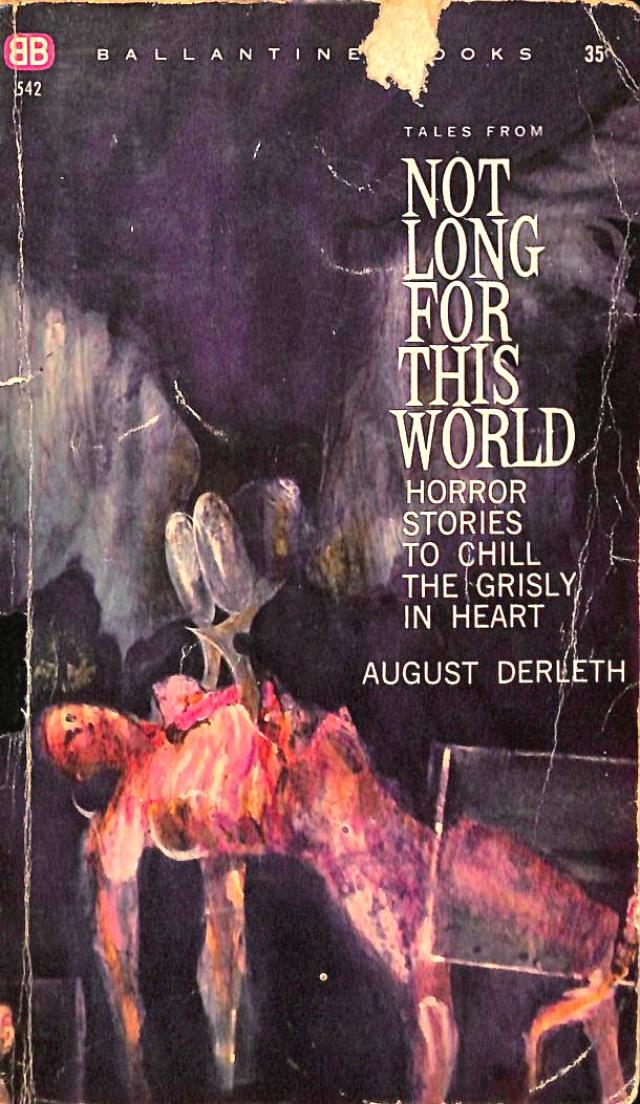
Not ong for this worls.., p.8
Not Ong for This Worls - August Derleth,
p.8


When Moncati reached home, he unpacked the enlarged photograph, found a frame, and hung the picture on the wall squarely over his desk, so that he might remind himself from time to time of his own cleverness in circumventing the evil old man who had been his stepfather. He had already burnt up most of Teddifer’s books and papers, and had begun to rearrange the house to suit his own convenience.
He went whistling up the stairs and left the picture there in the patch of sunlight on the wall: the evil-faced old man with head half turned toward the hidden camera and the flare that had surprised him: Moncati himself in bed, the glare of light that made strikingly clear the huge, cruel old hands and the designing mind behind. The sunlight was additionally merciless, and there the picture hung: Moncati in bed and Hercules Teddifer about to reach for his neck.
For some days the picture comforted Moncati; it gave him a deep-seated feeling of contentment, of satisfaction with himself and the world, and he glanced at it, smiling, once or twice a day. Then he went down to Sussex for a weekend and when he came back, he felt for the first time a disquieting note about the picture. It was something intangible, something upon which he could not put a finger, but it was there.
The photograph gave him the old pleasure and satisfaction, but there was something more, something malevolent about it, and he was irritated to think he did not know what it was. For a brief moment he thought that the old man’s expression had subtly altered, become more calculating, but, being careful about his imagination, he dismissed the thought.
Two evenings later, as he sat at his desk writing a difficult letter, he glanced absently at the photograph and saw a movement there.
Because the indirect light threw a diffused glow over the picture, he thought at first that the movement he had seen was a normal hallucination springing from the slight refocusing of his gaze from paper to photograph, but almost instantly his eyes fixed unconsciously upon the spot where he had thought the movement to have been: Hercules Teddifer’s hands.
With a faint tremor he knew that he had seen the old man’s large, bony hands flex—open and close—and he involuntarily waited, fascinated, for the hands to move again. But only for a second. He recollected himself and turned the light full upon the photograph, a faint feeling of panic guiding his hand.
He looked at it closely, but nothing happened; there was nothing changed about it, and he suffered a brief moment of distaste before he felt the old pleasure creep over him again, the sense of proud security he had made for himself by so fortunately ridding himself of his menacing stepfather.
- He sat down again presently, and resumed the letter, but every little while he caught himself looking expectantly up at the photograph, watching nervously and uncertainly; so that in the end he was obliged to give up the letter; somehow his mind would not return to it, would not concentrate properly on the task before it.
With a faintly derisive smile, half for himself, half for the photograph, he left the desk.
He had no doubt that his eyes had played a trick on him, and he slept well that night, without dreams. He rose in the morning, got at his letter again, and finished it without any trouble.
On his way out of the house to the Victoria and Albert Museum, he gave the photograph a fleeting glance with his customary good humor, and went whistling into the morning’s fog.
Not until he was seated comfortably in the underground did it occur to him that Hercules Teddifer’s face, as he had seen it in the photograph that morning, was no longer turned toward the hidden camera. He had not actually realized it at first, but his eyes had seen, the image had been transmitted, and now suddenly he remembered it with a certain definiteness which he found difficult to escape.
The possibility of any physical change in the photograph was too absurd to entertain seriously; he began to think very clearly around what his eyes had seen in an attempt to find some explanation of it. But the more he thought, the greater his confusion grew, until he knew that he must return to the house and assure himself that such a change had not actually taken place. He made a mental note at the same time to see about his eyes; glasses certainly were indicated.
He let himself in the house with trepidation and went directly to the picture. He looked and looked again; stepped back a little and stared, his mind in outraged tumult There was a change! The old man’s face no longer peered out at him; instead, it had turned ever so slightly, and taken new cognizance of the figure in the bed, the head bent a little, and the eyes lost in contemplation. It was incredible, but it was true.
Moncati took the photograph off its hook and peered closely at it. He rubbed his fingers over it as if he might feel some subtle difference his eyes could not see; but there was nothing. Baffled, he put it back and stood looking at it for a long time, until he became conscious of the fact that he was waiting for change to take place there before his eyes.
Then, angry with himself, he turned away and went grimly out of the house intending to complete the day’s itinerary as he had set it for himself. But somehow, before he knew it, the museum palled on him, and he found himself sitting down to tea with old Wemyss, who eyed him a little askance.
“Investment trouble?” asked the barrister.
Moncati shook his head. “No danger of that. I’ve just developed some curiosity about my late stepfather.”
Wemyss put on his pince-nez and looked at him. “God bless my soul!” he exclaimed. “What’s put you in mind of him now? He’s dead, and the world’s the better for it—you particularly.”
Moncati smiled his most persuasive smile. “Agreed, Mr. Wemyss, but I have a reasonable amount of curiosity and I’d rather like to know something of the nature of those ‘strange stories,’ about which you hinted the last time I called on you.”
Wemyss’ eyes narrowed. “What misguided impulse roused your curiosity?” he asked.
Moncati shrugged. “Is it misguided?”
“I hesitate to talk about things I don’t myself understand and yet must put some belief in,” replied Wemyss, “because I dislike being held up to ridicule even if only in the private opinions of my clients. I don’t suppose you believe in such things as magic and sorcery, eh?”
Moncati smiled pleasantly and said, “Only a fool refuses to keep an open mind.”
“Well said,” answered Wemyss shortly. “Teddifer practiced that sort of thing—squares and circles and spirit rites and such. I don’t hold with it myself, but I understand that some very unusual occurrences took place in that house of his.”
Wemyss shrugged, a little irritated, but went on. “The best I can say is that some people died very oddly—servants. Two that I know of. Both strangled. But of course your stepfather was out of the city at the time. No question about that.”
Wemyss smiled a little oddly, with a kind of menace behind his lips. “He had some queer theories about the projection of psychic doubles and astrals, and the like; for that matter, no one ever found any prints of any kind on those two dead servants.”
Of a sudden Wemyss gulped his tea and was off, saying over his shoulder, “God bless my soul! I’ve forgotten my appointment with Dotson.”
Moncati waved at his back, but he was puzzled; the inference behind Wemyss’ words was clear enough, and somehow Moncati could not get his thoughts away from Hercules Teddifer’s huge, ungainly hands, the tough, clawlike appendages that had so-greedily threatened his own throat. He shook himself presently, paid for the tea, and wandered somewhat reluctantly homeward.
He looked at the picture, but there was no further change. He was conscious of a slight feeling of relief; but this was dissipated at once in the memory of the first change. He took the photograph down again, and examined it anew, but could discover nothing remarkable about it.
For the first time, he began to be aware of something akin to fear; he began to search his memory for some clue to this strange occurance; and at the same time he began to cast around for some manner of escape from the intangible dread akin to that same fear he had known when first he had become aware of his stepfather’s evil design to kill him.
Doggedly he put the picture back on the wall, and went about his small tasks. By evening he had sufficiently recovered his composure to contemplate coolly some means of combatting the subtle dread that lay in the back of his mind. He could not refrain from looking at the picture again, but there was no further change, and he felt a renewal of faith in himself.
He had thought once, fleetingly, of burning the picture, but this seemed to him somehow a reflection upon the resourcefulness and courage that had brought it into being, and he could not contemplate with equanimity the resultant drain upon his self esteem.
Throughout the evening, he sat in the room reading, his desk light thrown upward upon the picture, but nothing happened, nothing whatever. He had come almost to expect some further development, but this absence of anything again set him doubting what he had first seen.
Had there been any change in the first place? Or had his imagination overreached itself? Certain as he was that the old man had first been looking out at him from the photograph, he was equally certain that he was now no longer doing so, but if this change had indeed taken place, it was utterly against natural law.
This thought gave him but little comfort until he realized that he could settle the question of whether or not his imagination had been remiss by taking the negative and having a separate print made for comparison. At once he was flooded with a strange feeling of freedom from dread; he felt that he was about to do the right thing. The possibility that his confidence did not come entirely from within himself did not occur to him.
In the morning, he took the negative and made a second print, enlarged to the same size as the original. He came to his desk with it and stood it up below the framed photograph.
What he saw was so far from reassuring that he caught hold of a chair and eased himself into it. Not only was the second print as he had originally believed the framed photograph to have been, but the latter had again changed in the night: Hercules Teddifer had moved closer to the figure in the bed, and his hands were clenched Moncati began to perspire, coldly. For a moment he sat there at a loss to know what to do, and he thought confusedly of the old man’s strange beliefs. Somehow it had not before occurred to him that by photographing the old man, he had managed, however obscurely to himself, to perpetuate Teddifer and his evil design. But in the height of his misery, hope came to him. He came to his feet and in two strides he had tom the photograph from the wall.
Three minutes later all that was left was a small drift of ashes.
He was utterly relieved at once. How the old man could have managed recourse to his magic sorcery in this way was beyond Moncati, but the knowledge that he had circumvented him a second time was not. His opinion of himself soared.
He went out to celebrate. He made a night of it, hilariously told some acquaintances that he was celebrating his freedom, and congratulated himself upon shaking off the dread he had known so briefly again. He came in late, after midnight, his mind a little sluggish, and threw himself partly dressed on to his bed, where he fell asleep at once.
Not quite an hour later he awoke. The clock had struck two, and he lay drowsily staring into the darkness for some minutes before he heard the sound, like the rattling and rustling of paper. Even at that, he did not come fully awake; he pondered the sound sleepily and was not aware of its approach until it was almost upon his room.
Then he listened carefully, wondering what it might be. It was like nothing he had ever heard before, save for its dry rustling and crackling.
He raised himself tiredly on one elbow just as the door of his room opened. This distracted him momentarily from the sound of movement, and he thought a draft had drawn it open, for at the moment there was nothing but darkness flowing in upon him.
Not until an uncanny chill pervaded his senses did he realize that the darkness he saw was not the shadows in the hall, but that it was something alive, something malignant. Instantly he was caught in a cloud of dread; he saw the darkness resolve itself into a dim, human figure, one side aglow as if a light were falling upon it, and heard a dry chuckling all too familiar.
It was Hercules Teddifer’s grim face that looked down upon him.
Even as an outcry rose to Moncati’s lips, the ungainly hands closed around his neck.
The last thing Moncati remembered was the thing he had unfortunately forgotten: the second print.
Mrs. Elting Does Her Part
The medium came around to it at last, and agreed to Richard Alder’s plan: to put fear into Sanders Hawk, if possible, now that Prother had done his part and talked Sanders Hawk into coming to see her. No easy task, that. She was a little dubious, even though it involved no great violence to her principles.
“He’s retired and living off what he made on those poor suckers,” urged Alder. “And it’s all of five years since my brother Jack killed himself.”
“I don’t know, I’m sure, Mr. Alder,” she hesitated. “The spirits may be angry.”
“I doubt it,” said Alder dryly. “I’ll be in the neighborhood waiting for Hawk; he doesn’t know me, and I look enough like Jack to put the fear of God into him. I’ll come back and pay you afterward.”
That much arranged, he felt considerably better. He left Mrs. Elting’s place and went out into the twilight. There was time now for a little supper, and after that he could take up his vigil nearby, so as not to miss Hawk when he came out. He had an uncanny feeling that he had done the right thing, that he had taken at least a step in the direction of the vengeance coming to Hawk for Jack’s sake—for Jack, who had taken his life after Hawk had mulcted him of his small savings.
As Richard Alder walked to his car, he smiled at the medium’s simple belief in her after-world—“the spirits may be angry—”
Mr. Sanders Hawk, his hair just beginning to gray, but as sauve as ever, arrived with Prother. He left Prother at the door and went into the medium’s rooms for the seance. He was the last to arrive, and was none too eager. A master of skepticism, he. Prother had prevailed upon him, and he had come, but for spiritualism and supernaturalism in general he had a profound contempt.
He sat down, watched the lights dim, joined hands, and smiled derisively to himself. Rigmarole. A kind of magic that depended for its success upon the gullibility of the people who came to see it worked. He told himself that he could foresee each step the medium might take.
In this he was wrong. The medium had hardly gone into her trance when something obviously not scheduled took place. This was Mrs. Elting doing her part, which, of course, Hawk could not have anticipated.
A convincing shudder of terror, a half-voiced cry, the urgent words moaned into the pregnant air from the revoltingly lax body of the medium:
“There’s someone haunted here, someone who is haunted/ I can’t go on—with him here. He is Hawe or Hawk—and there is a malignant spirit with him: a tall man with a mustache. His name is…his name is Alder, John Alder.”
The incident startled Hawk; the long, terrified groan shook him.
“Please go—please go away!” the medium said.
Hawk was astounded and not a little upset. His skepticism was for the moment put from his mind. He got up hastily and drew away, and with unaccustomed speed, he left the house, admitting within himself a certain relief at being again in the city’s refreshing night air. He regretted not having brought his car, and damned Prother briefly for convincing him that the walk would do him good. He considered ’phoning for a taxi, but dismissed the thought; the fact was, he was loath to reenter the house from which he had just taken his hasty departure.
He stepped briskly to the sidewalk and strode away into the night. After the first block, he began to go over the thing that had happened in the seance room. He began to wish Prother had stayed, so that he could relate his incredible experience. Thinking about it, he confessed himself just a bit shaken.
He remembered John Alder, a little dimly, yet well enough. The woman’s description of him was vague, but it was Alder all right, and Hawk began to wonder how she might have got hold of such an idea. Of course, she must have learned something about his past before he came there—but on second thought, he reflected that he and Prother had taken adequate precaution. Still, there must have been means of informing herself.
His confidence and skepticism coming back to him, he half thought of returning to denounce the medium for a fraud, certain that a hoax had been perpetrated upon him. But in a moment he reflected that there was nothing to be gained by such a hoax; the woman had done herself out of her petty pay and had helped herself and her reputation not at all.
Hawks felt a faint, uneasy sense of chill, and had the impulse to turn and look around. But he did not immediately yield to it, because within himself he had admitted to uneasiness, and was loath to signify it so outwardly as to turn and look behind him, like any child in the dark. But presently the impulse became overpowering, and he looked around, certain that he was alone in the shadowed street.
He saw Alder at once, because Alder was at that moment passing under a street light, but, as so often happens, Hawk did not assimilate what he saw immediately; he turned away and had taken four or five steps before the face under the brief glow of lamplight came back to him with the force of a blow, and he glanced over his shoulder again, only to see the figure plodding steadily after him.
Hawk paused grimly, closed his eyes, and looked again.
There was no one there.
Courage returned to him. Impulsively he turned and walked rapidly back down the half block separating him from the man he thought he had seen, confident of finding someone crouched in a doorway. But he found no one, and, turning again to continue on his way home, he went at an increased pace, firmly repressing a growing feeling of fear and a faint sense of helpless anger, this partly at himself for giving way to fear, partly at the nebulous person or persons responsible for this shabby deception.