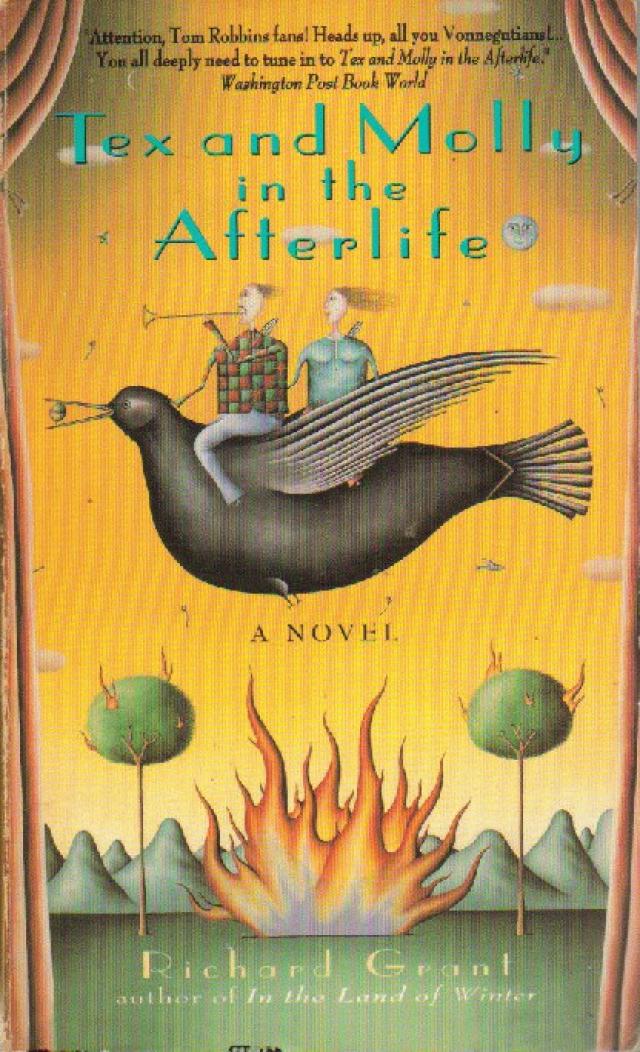
Tex and molly in the aft.., p.12
Tex and Molly in the Afterlife,
p.12


Then she recognized Pippa Rede, sort of sidling along the far wall, creeping up on the food line, and Molly realized that the girl was Winterbelle. How fast she had grown! Or had the years just zipped by that quickly?
Poor Pippa, she thought. So sweet, and very sharp in her own way. And yet at the same time so helpless. So utterly dependent on things falling out of the heavens for her, just when they were desperately needed. As thus far, miraculously, things had seemed with surprising regularity to fall. This free chowder day, just up the hill from Pickup City, being a fairly typical instance.
A stirring of some kind occurred around the entrance. It was as though a strange gust of wind were blowing in, sending dry leaves spinning through the door. Then the knot of people there seemed to unravel, and through the opening she had created stepped Syzygy Prague.
"Pippa!" she called out, in a loud and distinctly Yonkerish voice. "Winterbelle! Ari! What's going on, where does the food line start?"
The room did not exactly become hushed. If anything, it started to buzz with a sudden introjection of energy. Everyone turned to stare at the exotic-looking newcomer—which Syzygy herself did not appear to notice, nor to care about. It happened everywhere. Probably it had happened at the moment of her birth. No doubt it would happen when she passed over to the Summerland.
"Ah," she cried. "There you all are!"
And she advanced through the room toward hapless Pippa, who looked even more inconsequential than before, and toward Ari and Winterbelle, who raced to meet her.
So there they are, Molly thought. The Witches of Glassport. With their wee supernatural children.
Syzygy was some kind of gypsy. Her family had come from Ireland, but they were not Irish. She made no fuss about the way she dressed, wore no makeup, and usually covered her explosive coal-black hair with a cowboy bandana you could buy at Reny's for 99¢. Nonetheless she managed to look like no one else, and to draw attention away from women who ought, objectively, to have left her in their shadow.
She was the neighbor, or co-landowner, or something, of Tex's business partner, Jesse Openhood. The child Ari was supposed to be hers by Jesse, though it was hard to understand how such a thing could have happened.
Molly felt an unusual excitement stirring within her. Something like the way you feel when you've been driving for a long time, and it's dark, and you're a little worried about making it home okay, and suddenly you realize that certain landmarks have begun to appear—that without even being conscious of it, you're driving through familiar territory. Already your shoulders have begun to loosen up; you feel more cheerful, like there's something to look forward to, and it's not even very far off. That kind of excitement.
The thing was, though, this feeling had nothing to do with her.
This feeling, she was sure, belonged to Somebody Else.
And it freaked her out, knowing that. Because it was just like before, when she had been surfing the thought-waves of Eugene Deere: seeing what he saw, thinking what he thought, yet all the while remaining herself, and aware that she was only a spectator.
Only now, the feeling was the same, but like, Who am I this time!
Her awareness, tethered to a person or presence who remained unseen, moved at a deliberate pace across the room, homing in on Syzygy Prague. When there was only a table-width between them, the point of view stopped. Molly stared at Syzygy at close range through a phantom eye. And suddenly
this is really happening
Syzygy turned her head and stared back. Right into Molly. Through her, out the other side. Locking eyes with the invisible Other.
Syzygy raised her spoon. Steam curled around her upper lip, where there was the faintest hint of a moustache. Perversely becoming, on her. Molly felt warmth rising up from her roots.
Syzygy did not smile or frown; but in a very even voice, she said:
"An de bheoaibd no de mhairbh thu?"
Which Molly understood perfectly. It was a sort of joke about Syzygy—not strictly a funny one. It meant, Are you of the living, or of the dead! and it was the way Syzygy answered when you knocked on her door.
«The dead» thought Molly.
But the Other, beside her, silently replied: «Bheoaibd.»
The living. So there you had it: a standoff.
"Here," said Syzygy. She pushed her chowder across the table. "You take the rest."
No hands moved to accept it, but Molly felt gratitude and surprise, partly her own. Syzygy nodded, and then pointedly turned away.
The Reverend Hobart Banebook was making his way to the center of the room, pressing the flesh as he went. People had to scrunch their chairs in to let him by. In his own way, the Rev projected vibes as strong as Syzygy's, only on a frequency closer to the right side of the dial.
"Fellow human sojourners," Banebook said grandly (which Molly thought might be taking a little too much for granted), "I can't tell you how happy it makes me to see you all here. I hope the chowder is to your liking."
He meant it. Molly, or the spirit, maybe both, felt quite certain of this. He actually wanted everyone to like his chowder.
"You know, it's easy to feel invisible nowadays," he went on. "It's easy to feel as though we're just unnoticed faces in the crowd. As though nothing we could possibly say or do would ever matter. Well, I can't say I don't feel that way a lot of the time myself. But I'd like to ask you to consider another possibility. And I'm not saying you have to believe this—only take these thoughts away with you today, and let your minds digest them just the same way that your stomachs are going to digest this meal. And then if you want to forget it, then forget it! You won't hurt old Hoot's feelings, I can tell you."
There was a bit of quiet laughter in the room. Indeed, something kindly and even boylike seemed to unfold in the Rev's face as he went on talking. It was not possible to think that he was less than 100% sincere. Which Molly, confirmed antichurchgoer that she was, found altogether unsettling.
"Now think about this," he resumed. "Think about the days ahead of us—big days, I guarantee you—and think about yourself being here on this earth to witness them, and then ask Why? Why am I right here, right now? Well, let's remember a promise that was made to us a couple thousand years ago. 'And the Kingdom of Heaven shall be thine.' Have you ever thought about what that really means? You might suppose that it's just a fuzzy kind of statement about life after death. But I, for one, do not believe that. I do not believe that the Lord ever speaks in a fuzzy way. The Lord is, if you'll pardon my turn of phrase, very down-to-earth in His dealings with humankind. He sticks to the facts. He names names. So I believe that when the Lord made a promise that the Kingdom of Heaven shall be ours, then what He was talking about was the Kingdom of Heaven. Do you follow me? The Kingdom of the Heavens—the Universe, in other words. All the worlds that lie above us and around us. The sky and the planets and the stars.
"What I'm suggesting is that we, all of us in this room, happen to have been born at the close of this most tumultuous millennium, the tail end of the Age of Pisces and the dawning of the Age of Aquarius. And as you know, Pisces is the Fish, a humble creature destined to remain in the water all his life, unable to rise up into the bright big world that lies above him. Whereas Aquarius is the Water Bearer. He is the master of that very element that has imprisoned the lowly fish. He can partake of that element, but when he has had his fill of it, he can rise up on the legs that the Lord has given him, and he can walk right out of there.
"And I'm suggesting to you that we, also, are about to learn how to rise up and walk. We have been—all of us, humanity—trapped and destined to live our lives down in this low earthly place, unable to rise up into the bright big world that lies above us. But we have been given, here at the end of this millennium, the holy gift of mastery over that very element that has imprisoned us. The means of our mastery is not a pair of legs but the human brain, that mighty organ that sets us above the beasts of the forest. With our brains we've learned the technology of space travel. And out of the raw clay of this planet, we've fashioned for ourselves the vessels—great shining arks, you might say—that can lift us up into the Kingdom that the Lord has vouchsafed to us.
"Now isn't that a wonderful thought! That's what I want to leave with you today, my fellow human sojourners. That thrilling possibility.
"But I want to leave you also with a warning. Pisces the Fish does not want to leap out of the water. He does not recognize it for the prison that it is. And just so, there are people today who do not recognize that this earth is a prison for us. They regard it instead as some kind of holy temple. So remember, when you hear people speak of the earth as something to be venerated—even worshiped!—you remember that the Lord has given us mastery over this place, to use for our own ends until such time as we are ready to leave it, to come into our heavenly inheritance. We need not worship the walls of our prison, as the ancient heathens worshiped rocks and trees and graven idols.
"This story I'm telling you is right there in the Bible, you can read it for yourself. The old Israelis were sent out by the Lord to destroy the Asherim, which were likenesses of the heathen goddess Ashera. Ashera was an old name for the dark spirit that resides in the earth, which has been called by many names through the ages. But of course, the dark spirit herself did not perish when her shrines were destroyed. She was still lurking around during the time of the early Christian fathers—living under the name Diana, who was known also as Dea Paganorum, the goddess of the Pagans. And once again, the righteous were sent out to destroy her shrines. So the grove at Manannan was cut down, where the heathens worshiped the dark spirit who led them to believe that the trees themselves were holy things. Imagine if Noah had believed that! Why, he wouldn't have cut them down to build his ark and we wouldn't even be here to talk about it."
Hoot Banebook took a deep breath and allowed the silence in the room to grow into something that you could feel, a presence in its own right. Then he exhaled, and the relaxed and boyish smile returned to his face.
"Well, that's all the time I'm going to take away from your meals," he said. "I invite any and all of you to come visit with us again here during our regular Sunday services. But that's up to you, of course. Enjoy your food now, and God bless every one of you!"
Molly watched as the Rev made his way out of the room, reopening the channel that had closed in behind him. She glimpsed Syzygy's wild son Ari out of the corner of her eye—standing up on his chair and looking this way & that around the room, as if he had lost something.
Molly had lost something too. The other awareness had vanished from her mind. She felt cast adrift, untethered. There was nothing to hold her here any longer, and by degrees, like a digital brightness control, the scene around her was fading into darkness.
Just before Molly slipped completely away, she heard the boy Ari's voice, as loud and unselfconscious as his mother's, asking: "What was he, Mom? You know, the invisible guy that was right over there."
Which was exactly the question Molly needed.
WILDERNESS
Out through the wall of the church. Among damp trunks of hemlocks, holding up the slope. Ostrich ferns rising head-high and flopping over, like sodden drunks. Tufts of hybrid turf grass whose seeds blew in from the highway, starved for sunlight, lying down in exhaustion. Ground elder, running cedar, Virginia creeper, a statistically implausible seedling of somebody's Rhododendron catawbiense. Lungwort, spleen wort, Bowman's root. Shopping bags, beer cans, a grocery cart. Rusting refrigerators. Everlasting Goodyear radials. Great brown gouges of erosion. Piles of gravel washed downslope. Human excrement. High-gloss faces on the covers of magazines.
A secret world. A hushed brown and green and shadow-black nether region. Cathedral, midden, and boneyard.
Such places are everywhere. They lie between other things, real places: buildings and highways and parking lots. They enclose and conceal sewer plants, residential communities, service entrances, exit ramps, hospitals, zoos. Water runs through them. Steep slopes protect them. Animals hide there. They are neither remembered nor forgotten. Rather, unthought-of.
You see them if you want to see them. You enter them if you are insane or lonely; a fugitive or an investigator; curious, desperate, homeless, or simply strange.
They are the new wilderness. They are Nature, born again. Habitat and breeding ground for new species of wild things.
Such as.
THE HOMELESS
Water gushed through the stream and plunged noisily into a wide-mouthed metal culvert. The thick trunk of a tree whose nearest limb was two heads above stood like a brooding, motionless sentinel. At the base of it lay something wrapped in a dirty sheet or shroud that was indigo blue with gold lame stars. Only when you got quite close could you tell this object was a person. A scrawny sort of person with long, tangled, graying hair.
The wandering Presence or spirit or point of view, to which Molly was still attached like a ballon on a string, drew cautiously nearer. It paused a short distance away, held back by this: a phosphorescent ring of green energy that ran around the person on the ground and around the hemlock trunk, creating a protective energy web. Such artifactures are rare and growing rarer, and their lingering existence made the Presence feel melancholy, as did its own.
Afterlife Factoid #8
You go on and on, whether or not
you're really up for it.
The Presence brushed against the protective web, testing its strength. The web was porous, easily breakable. Even at this light touch, its bindings started to unravel. The spirit drew back, somewhat chagrined. Nobody made things properly anymore.
The person on the ground stirred beneath his starry shroud. His mind worked for a few moments, then his eyes came open. Molly was startled to recognize Tex. He stared into a space that nearly coincided with the place where Molly was, or believed she was. But he was not looking at Molly. Rather, he looked...
«Like he's seen a ghost!» she thought.
"Who are you?" said Tex. "What are you?" Very slowly, the Presence began to take on a material form. The first thing you could really get your eyes onto was a hat: a ball cap twisted approximately backwards, so that Molly could see the logo of a major timber-products company:
GULF ATLANTIC
Growing the Future
Then a full-length, weathered green overcoat took shape. It was dirty and a gash was ripped out of it in back, and bulky things had been jammed into its side pockets. Below that were baggy trousers, rolled up at the ends, and a pair of Doc Martens whose heels were in obvious disrepair.
Only then did the Presence manifest itself: pouchy, unhealthy-looking skin; hair the color of oak leaves turning coppery red in autumn, shot with the sullen gray of rain clouds; limbs long and dangling; flesh slack in the way of a body that was once, a while ago, muscular and well developed. Molly could not see the face, but it must have been a sight. Tex looked like he had just swallowed that brown acid at Woodstock.
"Are you a—" Tex blubbed. "Are you a brownie?"
"A what?" said the Presence. Its voice was phlegmy, with a very peculiar accent: nothing that Molly could pin down.
"You know," said Tex, "a big hairy elf. Or maybe a street person? How come you're dressed like that?"
"Is there something the matter with the way I'm dressed?''
The Presence sounded not quite belligerent, but close.
Tex tried to sit up a little straighter. The effort must have hurt his broken leg, because he winced and grabbed his kneecap. "Wow," he said, "I guess I was asleep for a while."
"You mean a nagumwasuck," said the Presence.
"Say what?"
"A brownie. That's what they're called around here. At least they were, when people still believed in them. No, I'm not that. You'd know a nagumwasuck if you saw one."
"Ah," said Tex.
«Well, at least he's got the sense to go into his good-vibe act» thought Molly. Truth to tell, she was happy to see Tex again, and worried about whether he was all right.
The Presence eased down on his haunches, a pace or two away from Tex's outstretched legs. Through its alien awareness, Molly could sense the dampness of the ground, the smells of mold and decaying leaves. The water in the stream was tainted with oil, bug spray, artificial lemon fragrance, and urine.
"What's your name?" said Tex.
The spirit shrugged. "Beats me." He scratched the ground for a few seconds, then brought a dirty finger up before his face for closer inspection. He said, "I guess you can call me Beale."
"Beale?" Tex was smiling, but his mouth gave a little jerk, betraying nervousness. He was acting the way you might if you were approached by a panhandler in the park. "Is that a, ah, boy's name or a girl's name? Sorry, but I—"
"Ha." Beale enunciated the syllable, as though to distinguish it from genuine laughter. "You can't tell, right? Whether I'm a man or a woman. You can't even decide if I'm real or not. Right?"
Offended again: Molly could feel that, but she had no intimation of violence in the offing. She sensed a great load of bitterness and resentment hanging over the spirit like a cloud.
"You think I'm just some kind of delusion, right?" Beale demanded.
"Easy," Tex said, drawing himself up as best he could. "Take it easy, okay? I'm on your side. At least, I would be if you'd tell me what side you're on."
Beale settled down a bit. The weary head turned away from Tex, glanced up the embankment toward the Church of Mankind's Destiny Among the Stars. More bitterness, more anger. Molly thought:
«This is one fucked-up individual.»
"What?" said Beale.
"What what?" said Tex.
The Presence frowned. "I thought I heard something."
Tex gave him a knowing look. He clearly believed that he was dealing here with a crazy person. Which might (Molly considered) be true. But it was not the whole story.