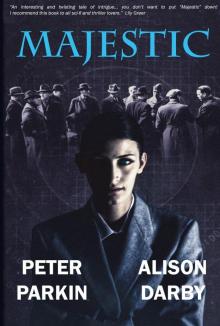
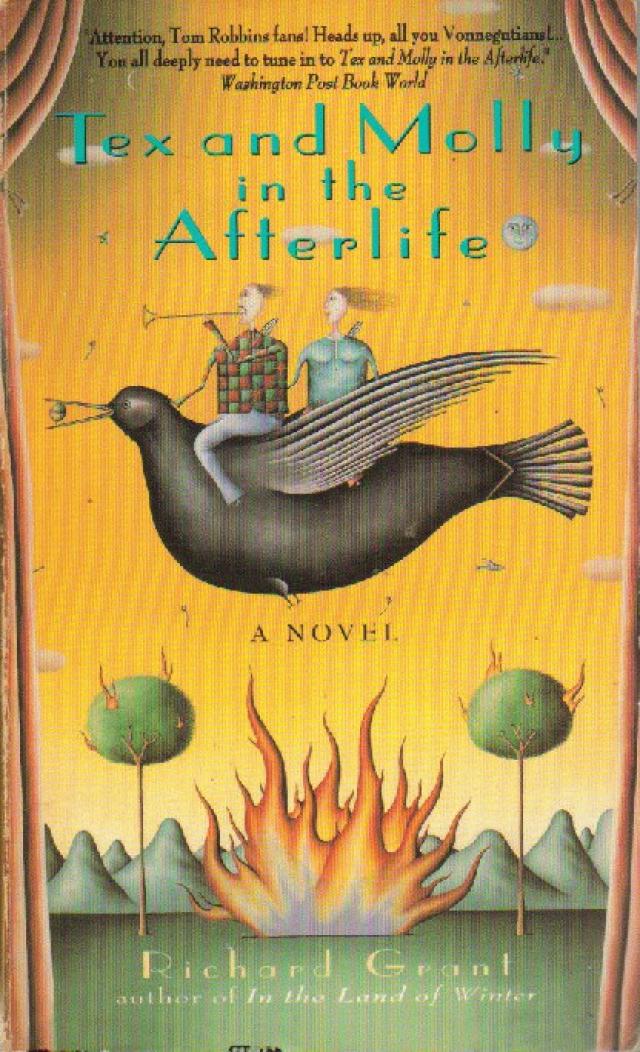
Tex and molly in the aft.., p.44
Tex and Molly in the Afterlife,
p.44


Whoops, said Molly. Sorry.
She extended a paw and snuffed it out again. It was almost too easy.
Now, where in the world, she asked herself, has Tex gotten off to?
The question had barely formed in her mind when the answer (in the person of Tex himself) appeared beneath her. She saw him standing in the midst of a crowd of dryads, thousands of them—flapping his arms, beseeching them. They were for the most part ignoring him, sensibly enough. Still Tex threw himself about, limping badly, as though his injured leg was hurting again. The dryads continued to disregard him. The fires continued to burn. Tex kept railing, not ready even now to give it up.
Molly was touched.
She supposed she ought to help him.
She bent down, meaning to bestow upon him a blessing: the gift of strength and healing, straight from the Bear, divine Keeper of Medicine.
But as she drew near to Tex
Something
—a Power, nearly as great as herself—
rose to stand in her way, blocking her path. Molly saw dark wings unfolding before her, a Blackness deeper than night rising out of the flames. And a Voice said
NO. NOT TONIGHT.
DANCE OF YU
Is this a dream? wondered Burdock Herne. Is it a drama? Could it really, possibly, be happening? Is there such a thing as a dream that is also a drama and yet remains part of actual time, of History—all at once?
Herne stood on a plain of tarmac where once giant bombers had rolled. B-52's: planes as old as Herne himself—scary and Strangelovian, carrying in their bellies the seeds of a new era that had never, mercifully, been brought to germination.
All around him he saw rows and rows of tiny plants. Saplings; evergreens. Spruces, he thought. Plastic tags that dangled from their ... from their necks, Herne almost thought; but no, from their upper branches, of course ... identified them as X 4.3.2. This meant something to Herne, but only distantly. The very fact of trees standing by their thousands in identical pots no longer conveyed much meaning for him. Trees were a commodity; they were the foundation of Herne's empire, the source of his power and wealth. Yet suddenly a Tree—the very idea of such a thing, a living entity rising between Earth and Sun—seemed an unfathomable mystery, something you could spend your whole life thinking about and still never feel that you had grasped.
Herne had a sense of standing at a meeting place, a point of friction or interpenetration between two different worlds. Between this world—the real one, the only one—and Someplace Else. Some place, or dimension, or order of being, that was opaque and vast and utterly unknown; like the Dark Matter thought by physicists to underlie the manifest universe, constituting upwards of 90% of all creation.
This was sheer delusion, of course. There was no other world, as Herne well knew. Dark Matter or no, this was the world where you sank or swam, won or lost, fished or cut bait.
And yet Something—some wholly different reality—seemed to press inward, from everywhere at once, within and without: testing all the weak spots in his weltanshauung, trying to break through. Herne attempted to push the feeling away. But the feeling pushed back. It was stronger than he was. Herne's shoulders sagged.
It would never in a million years—never in the entire remaining life of the universe—have occurred to Herne that what he felt were the eyes of ten thousand dryads, tree spirits, lying heavily upon him. He would never have accepted the notion (assuming it were presented to him for consideration) that the actions of his company might have caused widespread homelessness among discarnate spiritual entities. Herne considered himself a religious man, a Believer; but he was much too sensible to believe a thing like that.
Still, he sensed that he was not alone on this stretch of tarmac. Some Presence that had little to do with the dancers ranged against the fire (though nothing to do with the rows of trees standing cramped in their pots) seemed to him to be waiting or hovering nearby.
Herne looked around. Determined to make sense of things, if sense could still be made. Fully resolved to clear his head, make an accounting, chart a reasonable course.
The scene before him was pure Hieronymus Bosch, only freshly painted. The old Air Force base, recently calm and orderly, was transformed into a maelstrom of fire and destruction, as though at the whim of a particularly wrathful deity. The all-consuming blaze had no center, nor any limit that Herne could see. Turning this way and that, he stared into walls of incandescent horror that rose and fell and moved across the ground too fast to permit even rudimentary mapping. Herne found after several seconds that he was without any sense of direction. Even the most fundamental distinction—up versus down—had grown debatable. The tarmac seemed to lurch and yaw beneath his feet; and the markings painted there years ago, black and yellow lines and stripes and arrows, glared with terrible new portent, like the most hideous sigils of necromancy. Herne turned and stumbled and (with difficulty) caught himself. All of his effort was required simply to remain on his feet. Sweat drenched his clothing; his heart strained against his rib cage, as though trying to wrench itself free. There was nothing he could do. For once in his life, nothing. Only stand and stare for a few minutes longer, until the flames arrived. Then turn and flee like a hunted and helpless animal; like a deer on the run. He had never imagined coming to a place like this. Before him, as if they were demons spawned by his fevered consciousness, two dozen figures danced in the firelight. Herne perceived them first as silhouettes, black-on-orange. Then magically they took the form of ordinary men and women, though misshapen by waves of heat, and pale as spectres. Strangest of all, they wore masks, as though their dance were just one part of a larger, symbol-laden shadow-play. Madly they ran about—whether coming or going, guided by purpose or driven by panic, Herne could not tell—and their arms flew wildly, and their mouths opened wide, then shut. Some of them wrestled with long serpentine things that shuddered as though half-alive, and that threw out steamy jets like a dragon's hot sputum. Others carried tools that might have been weapons or tools or ritual objects, their intended function impossible to know. Others did nothing at all—just stood possessed, like Herne, by the dread, or the riotous fire-spirits, or the living Darkness.
There was about it all—dancers and set pieces and panoramic backdrop—a striking, ceremonial quality. Not like an orderly kind of ceremony (say, a funeral, or a mass). No: an ecstatic, frenzied, moon- and fire-lit, Dionysian riot of murder and mutilation. A ceremony saved from utter chaos only by the will of the shadowy god whose favor the dancers sought.
The scene was irresistibly appalling. And for an indefinite time Herne stood watching it, unable or unwilling to turn away.
Suddenly a great wave of orange light seemed to swell up out of the roiling ocean of fire; and the wave broke over the tarmac, and flecks of flame like sea-foam spewed over Herne and nearly dragged him under.
He fell hard on the pavement. His hip crunched and he sucked in a mouthful of burning air.
"My god," he croaked. To his amazement, and chagrin, the words came out in a gasping sob.
The King was lying on the ground: helpless, crying.
A slap of footsteps came around him, hurrying by. Herne strained to lift his head, to see who it was that was moving past; he would have been little surprised had it proved to be a committee of goblins, wearing Brooks Brothers suits. What he saw instead did surprise him, and he lowered his eyes, wondering whether in fact he had injured his head and was merely delirious, or dying.
Overhead, a figure in a space suit (or something like it) mooned above him. Flames reflected from the shiny helmet, the smoky glass visor. The figure bent low.
Herne understood in that moment that he was insane. He realized at last that the strain of running a giant corporation, the incessant meetings and phone calls, the disintegration of his family, years upon years spent mapping strategy, maneuvering in secret, launching surprise attacks, fending off challenges from without and from within—all these things, topped off most recently by his only daughter's declaring that she hated him and disappearing from their home—had combined to upend his mental balance: to jar him utterly out of the rational world into a completely different world in which he was not a powerful man, a Chairman, a King. Here he was only a tired and sick and possibly injured old man. Beset with demons. Suffering hallucinations. Barely able to hold his head upright, much less stand and walk.
The imaginary figure in the space suit lowered a large gloved hand toward him. From deep in the helmet, a metallic voice uttered words in no language Herne knew.
"What is it you want?" he asked it. "Let me alone here, won't you? I just need a moment to regain my bearings."
The figure spoke again, and the hand in its glove contracted until a single finger pointed toward Herne's chest. He deduced finally that the creature was asking him a question. He followed the finger down to the little placard (he had forgotten he was wearing it) that said
SOMEBODY'S DAD
—which, he gathered, was what the creature was asking him about. "Yes," he said. "Yes, I am. I am Somebody's Dad."
The helmet of the space suit dipped and rose: a nod. The gloved hand reached out again.
Take it, the creature said; or at least Herne thought he heard. Come on. Take it.
Herne could see no reason not to obey. In this different world, where his own will was of no importance, obedience—even abject surrender—was probably the correct course to follow.
"All right," he said, willingly. He took the glove, clutched it firmly: surprised for an instant by how small and delicate-seeming was the hand inside. But what did he know?
The creature in the space suit tugged him upward. Herne allowed himself to be helped to his feet. To his surprise, he stood a head taller than the alien figure in front of him.
"Thank you," he said.
The creature nodded. Herne saw his own face, his staring eyes, in the glass of the visor. He recognized himself without difficulty: an ordinary face, an unexceptional man, his gaze full of emptiness and hunger. That is what I am, he thought. Not the pompous old fool in the Official Portrait.
Hey, the creature addressed him. (He could understand its speech more clearly now.) What's the matter?
The matter? thought Herne, wonderingly. He looked around at the field, the fire, the darkness. On all sides, amid shouts and hissing water and a roar of air being transmuted by combustion, the dance of death went on and on, fast approaching its climactic agony.
Herne said, "I don't ... I—"
Are you hurt?—clearly sympathetic now. Perhaps not alien, after all. Reaching out a gloved hand; touching him. Can I help?
"You—" Herne felt his own words clotting in his throat. He felt some large new thing rising up in him. "Yes"—with surprise he heard his voice say—"You can help."
QUESTS & QUESTIONS (2)
"There," said Tex, pointing as though it were something he was proud of. "See that? What do you think?"
The dryads seemed to confer among themselves. They did so with no sense of urgency, as per custom.
This is no time, thought Tex, for a fucking Ent-moot.
"Think about what?" said Beale, glancing aside at his comrades. You could tell he was temporizing.
Before them, in the long aisle of potted spruces, the figure in the asbestos space suit held the hand of Burdock Herne and led him away. Down the rows of potted trees, toward the vast door of the greenhouse, they receded slowly, into the welcoming dark.
"Right there," said Tex, "you're looking at a little human miracle. You're looking at proof that people can change, if they take it into their heads to. Because see, you've got a screwed-up old guy there—a guy with, you know, something missing inside—who's being healed. The root of heal, you know, is the same as whole. So what you've got is a man who's been wandering in the Wasteland, who's out of touch with his own heart, but now he's being led back toward Whome."
"How do you know that?" said Beale. "How can you be sure what's going to happen? Nobody can foresee the future. Isn't that so?"
Tex leapt up into the air (as best he could) and landed on one foot, like a peg-legged pirate. He crowed: "Aha! So you admit it, sucker. Now let's quit dicking around here and do what you promised."
Beale sighed. He seemed to debate the worth of arguing that, in fact, the dryads had promised nothing. The gleam in Tex's eye dissuaded him. Trees, as a class, have much strength but little willpower. When a strong wind blows, they bend before it.
"All right," said Beale. "We believe you. Humans can change. At least in theory. But what is it that you expect us to do?"
"Be creative," said Tex. "Surprise me."
"Surprise you." Beale shook his head. Then he closed his eyes.
His physical form faded: in a matter of seconds, it was gone. The other dryads vanished as well. There only remained Tex, and the fire, and the thousands of baby trees. But in the next moment, from everywhere—the trees, the Earth, the heavens, the Otherworld, the Dark Mater, the Whome—
a golden Presence appeared or became or was seen to have been immanently close at hand all along.
The Presence might have had something of the likeness of a bear. A Great Bear whose teeth shone white and large as glaciers, whose ears jutted like mountaintops, whose glowing fur was all the waving grass of the plains, whose paws were archipelagos, whose eyes blazed like newborn suns. The Presence growled, and a rumble shuddered through the Earth like a grinding of tectonic strata.
Tex had to take a few steps back to grok all this. These steps moved him out to someplace in the vicinity of the Moon. The poor mortal humans closer at hand probably didn't have quite the same perspective. The Goddess only knows what they thought was happening.
Stately, the Presence turned itself about. Where its paws pressed on the Earth, the blaze was extinguished. Where its breath blew, new flames roared and entire buildings exploded.
Woo, thought Tex, appreciatively. This is one mean-ass teddy dude.
The Presence gave him a look: the sort of look that could shatter a polar ice cap.
WHAT MAKES YOU THINK I'M A DUDE!
the Presence demanded. Uh-oh, thought Tex. That voice sounds strangely familiar.
"Sorry, ma'am," he said. "No offense, okay?"
HMMPH
grunted the Presence. It turned a shoulder to him. Which settled things, for Tex. "Molly?" he said, incredulous. "Is that you, babe?"
The Presence had no time to answer.
Out of the night, a Darkness arose. At first it seemed immaterial, a mere shadow, some kind of visual illusion. But the shadow—whose degree of blackness was more profound than a mere paucity of light—acquired texture and depth; it rippled like heavy fabric; it drained light from the very air nearby; its surface radiated heat, while remaining as blank as the Void.
Then the Darkness took a Shape. And the Shape was that of a monstrous, evil-eyed Raven.
"Damn," said Tex. He recognized this one, too. It was getting to be a regular reunion around here; and not a happy one.
The Raven lifted its wings. It rose into the night sky, blocking out wide swaths of stars.
KEEP ON FLYING
the Bear advised it: YOU'VE GOT NO BUSINESS HERE.
But the Raven said:
OH, YES. MUCH THE SAME BUSINESS AS YOU. I MADE A PACT WITH A MORTAL, AND I MEAN TO SEE IT TO AN END.
GET A LIFE
the Bear rumbled, its deep voice resonant with authority. YOUR ROLE IS PLAYED OUT. YOU'VE MISSED YOUR EXIT. ANYWAY, I'M RUNNING THE SHOW NOW, AND I'M OLDER AND GREATER THAN YOU.
OLDER, PERHAPS,
the Raven conceded. AND EVEN STRONGER. BUT I AM MUCH MORE CLEVER. CHECK THE RECORD. I WAS ODIN, RULER OF THE GODS. HAIDA THE TERRIBLE. BRAN, OF MANY BATTLES. RAVEN THE TRICKSTER.
A BUNCH OF UPSTARTS
sniffed the Bear. I WAS A GODDESS BEFORE THERE WAS A LANGUAGE TO NAME ME. I BECAME ARTIO, AND THEN ARTEMIS, LONG BEFORE ARTH VAWR BUT EVEN HE IS OLDER AND WISER THAN YOUR DARK-EYED SCAMPS.
The Raven laughed: an awful sound, like bones being ground to powder.
NOT WISE ENOUGH. I WAS HIS UNDOING, AS MORRIGAN THE ENCHANTRESS.
I AM THE SEVEN BRIGHT STARS.
declared the Bear, rearing up to score the heavens with its claws.
BUT I,
said the Raven, smugly, AM THE DARK FIRMAMENT THAT SWALLOWS THEM.
And with that, the winged Darkness launched itself high and higher, spreading its wings until all the sky and all the Earth grew black. Even Tex was quaking; while out of the fields far below he could hear people screaming in what must have been a final paroxysm of panic. He could see nothing at all, except for the folds of shadowy death that draped themselves over the head and eyes and massive haunches of the Bear.
And then...
(Tex chuckled: he had sensed there was going to be an and then.) There was a
GIANT SLURPING SOUND
followed by a HIDEOUS BELCH
and the Raven was no more. Where It had filled the sky, there was now only emptiness. Or not just that; but a definitive embodiment of Nothing: vast and round and all-devouring—a veritable black hole among Nothings. Tex peered into it for a while, and as he watched, the black hole contracted. Finally, with a
WET SMACK
it slapped shut. And Tex realized that he had been staring, as it were, eyeball to molar with the Bishop of Worms. But this (though it would have been enough) was not all. Perched up high on the Bishop's slime-green, mucilaginous, ever-spasming body—clutching some kind of tentacular cilium, like a hair growing out of a wart the size of a minivan—sat Beale the dryad. He gave Tex a weary, though not uncompanionable, wave.
Faintly he called out: "Surprise."
DIGESTING
"Well," explained the dryad, "a deal is a deal, after all—even where humans are concerned. I merely reminded the Sublime Excrescence of his arrangement with you, and informed him of the raven-deity's interference. Naturally to a Primary Being like the Worm, a human god-form is not worth making a fuss over. Just a light snack, really."