Tex and molly in the aft.., p.24
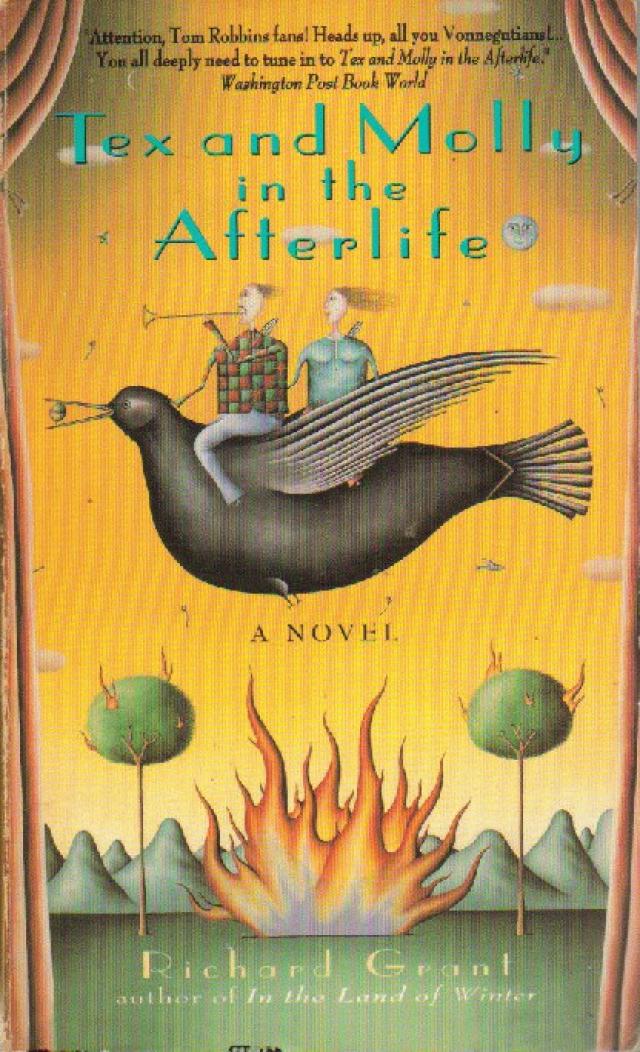
Tex and Molly in the Afterlife,
p.24


"Gin and dry vermouth," said Rainie. "Three to one."
"Thank you," said Ludi. "No."
"Four to one," said Shadow (if that was his name).
"To make a long story short," said Indigo, "we're about to vote on whether to try to disrupt the propagation systems at the Goddin plant. Which we think would seriously impede any kind of gene-splicing experiments they've got going on."
"And these guys," said Sara, indicating the two teenagers, "are going to help us."
"Help us what?" said Ludi. "Get arrested? Why don't you guys just stick to something easy, like tree-spiking? That way at least you get some fresh air." She peered into cabinet doors under the bar, looking for leftover liquor from last year's Unemployment Day bash.
"Anything to one," said Rainie. "As long as it's cold when you serve it."
"We've got some major intelligence," Guillermo confided. He looked from side to side with gravely lowered head: his Jungle Command Post Pre-Strike Briefing mode. "We've learned that they're planning a major powwow in just a few weeks. The C.E.O. himself is coming up from Houston. A guy called Burdock Herne. He apparently runs the company on a tight leash, so his appearance must indicate that they're getting ready for some kind of major push. Therefore the time to strike is now. That's what the vote is about. Because this is something that touches all of us."
Sure it does, thought Ludi. Todos somos Sandinistas, right? She was sick of it.
"You just hold the glass of gin," said Indigo, who had resumed work on his hemp buzz, "and you show it a bottle of vermouth." His round belly rose and fell in a graduated series of chuckles—like one primary laugh followed by a number of aftershocks. This was noiseless, however, as he was holding the smoke in.
"You don't even have to do that," said Shadow, not to Indigo but to Ludi. She wondered if he was flirting with her. ' 'You just swirl the gin around a little and you whisper over the top of it, Vermoooooth."
"Well, here goes nothing," Ludi said from the kitchen. "Cheers, everybody."
"Cheers," most of them said. Only Guillermo looked at her as though full of regret, and Sara Clump glared at everyone.
Ludi took a sip, then a swallow. She did not like the taste of the martini, but she saw immediately what the point of it was.
"Okay," she said. "Good night, everybody. Nice meeting you, Shadow and Saintstephen, whoever you are."
"Wait, wait," said Indigo, looking up helplessly from the sofa. "We haven't voted yet."
"All in favor—" said Guillermo.
"No,'' shouted Ludi. So loud that it surprised her. "Get out of here. Go down and vote in the parking lot. Vote in the middle of the street. Just get out of my home right now.''
COME FLY WITH ME
There was one of those Music of Your Life stations on AM. Ludi found it without much trouble. She liked the way the dial lit up, green and floaty like the numbers were underwater. She lay on her back, entertaining thoughts about the function of music in a pluralistic society. Does it unite, or stratify? Transcend boundaries or codify them?
"If you could use some exotic booze," she sang along, "there's a bar in old Bombay."
In her dreams, she soared like a bird. She floated like the Goodyear Blimp. Then she crashed like the mid-Atlantic phone grid.
HOME (3)
Molly found Tex nodding off in the living quarters of the Bee. The radio was playing the Them version of "Gloria." Just when you think it can't possibly get worse.
"Hey, Bear?" she said, poking him. Her ethereal fingers penetrated slightly into whatever he was composed of. But the touch got his attention anyhow.
"Raven," he said sleepily. "What time is it?"
"What difference does that make?" she asked. Genuinely wondering.
He looked wounded, and immediately she felt bad for having spoken sharply, so she sat down beside him, patting his more or less virtual hand.
Afterlife Factoid #12
The dead have feelings like everybody else.
"I guess I'm just tired," she said.
"Yeah." He stretched and aimed a finger at the radio. "If they're going to crawl that deep in the catacombs, why not play some Pearls Before Swine?"
"Or Love," said Molly.
"Tim Buckley."
"Moby Grape."
"It's a Beautiful Day."
"We should get our own show," said Molly. "We've got time now."
Tex laughed, and she leaned her head on his shoulder, It felt warm. Sort of like a pillow of gentle energy.
"It's good to see you again, Bear," she said.
"You too."
She felt him stir, as his thoughts worked their way through him: a trait he retained from life. Obviously there's a lot to this mind/body conundrum that biology has not yet accounted for.
"I've got stuff to tell you," said Tex. "But I don't know if I've got the energy."
Molly nodded. She cuddled closer to him. Into him. The two of them seemed slightly, here and there, to overlap
"That's weird, isn't it?" she said. "Not having the energy. Because if we're not like, pure energy, then what are we?''
"Mm." He pulled her close. She nuzzled his shoulder. "Do you want to get in bed?" he asked.
"I don't know. Do you suppose pure astral energy can sleep?"
Tex stood and reached out for her. She drifted up into his arms.
He said, "On a night like this,
I'm ready to believe
anything."
O
''It's only a beginning, always.
—RICHARD M. NIXON, resignation speech
or
was it morning again?
* * *
Did the tide move again under the boats in Dublin Harbor? Did the sun flash all the visible colors and then some through the cut-glass prism in the pilot house of the Linear Bee? Yes or no?
If yes, then a stripe of chromium yellow would have splashed across the raven feathers and a couple of rocks and the steer skull from Jerome, Arizona. As the houseboat rose, the colors would have red-shifted, like interstellar light. As it fell, they would have vanished in the ultraviolet. And on WURS, Bad Cathy would have been wrapping up a set.
"Come on, folks. Is it just me? I mean, 'Me muchacho—you muchacha.' Do you wonder why they built a big erection and shot it off at the moon?"
Again.
If no, then maybe Tex just rolled over and felt Molly. More than he felt himself, even, or the bedclothes rumpled beneath him, or the air moving cool and damp across his back, he felt the well-known intricate womanscape of Molly rising and curling and breathing beneath his hand, shifting gently in response to his touch. His fingers moved in response to her shifting, and she rolled nearer to him and he rolled halfway to meet her. Her eyes were still closed, but she murmured—
Bear
—as probably she had done a thousand times, or a million: some definite number but not a number that is known Not even a number that the Universe remembers. A secret number that exists not in Tex's mind or Molly's but in the space they have made between them, in the little akashic alleyway where their private spaces overlap. In that dark infolded place that is neither Tex nor Molly but both of them, things are known that we do not know. Stories are told that we do not hear. We know this, however.
Afterlife Factoid #13
The dead can make love.
It's heaven.
"Are we still here?" said Tex. After a certain indefinite interval.
Molly smiled. She twinkled his little silver earrings. She said: "Would you like some tea?"
Again?
"Yes."
TWININGS
In the galley of the Linear Bee, Molly watched tea leaves drift and settle, forming tiny galaxies at the bottom of the pot.
For all she knew, everything was spelled out there, in the random constellations of darkness within darkness. The comings-together and driftings-apart (and collapses, and annihilations) of the Universe are random like the falling leaves, and yet beneath the randomness is a beautiful order. The molecules of water are separate but they interpenetrate, they flow together and become one thing. The Majolica pot is a bucket of particles, millions of molecule-sized droplets all jumbled up; but it is also a tiny ocean of waves, governed by an orderly and irreducible dynamic. Matter is built of atoms which are built of particles which are built of quarks. But also matter is Mater, the Dark Mother, the foaming firmament of all possibilities, the infinite womb of the unmanifest.
Molly came up for air. This reminded her of the revelation she had experienced once while doing acid, when she realized that her TV remote control contained the same secret code employed by the I Ching. The code derived from this same paradox—the contradictory nature of quantum reality—which in the I Ching is neatly reduced to two symbols, the simplest of all symbols: the solid line of continuity, waves, undivided space, oil paintings and analog hi-fi.
and the broken line of quantum events, particles, separateness, television screens and digital audio.
In that earlier flash of understanding, Molly had taken one look at the little keys that mean stop and pause, and she had grokked that the quantum contradiction is hard-wired into your brain. The first symbol is absolute, whole, and unambiguous; the second is merely a space between Before and After, a separation, fraught with uncertainty.
Two things. Irreconcilable. But eternally twined. And ever so slightly asymmetrical, because the arrow of tirhe (viz, the PLAY button) gets involved.
Which, of course, the I Ching also takes into account. Hexagram 63, Already Done, consists of three pairs of stop and pause lines stacked up in a kind of shaky tower—
—which looks balanced but it is not. The oldest of the many layers of text and commentary that have grown around it like a coral reef warns you, There will be good fortune to begin with, but chaos at the end. And indeed this triple-decker stop & pause sign is associated with upheaval, revolution, and the ancient funerary rite known as the Dance of Yu: an asymmetric, lame-legged movement that is choreographed by the hexagram itself. The good leg takes a step, making a clean break; then the injured leg drags. Brokenness and continuity: the universal dance of the Otherworld. It is the gait of Oedipus (whose name means Swollen Foot) limping to Colonus. Of Cinderella, wearing an Otherworld enchantment and only one shoe, skipping home from the ball. Of Rumpelstiltskin, one foot caught in the floor, hopping in rage, then vanishing into the nether realm from which he came. Of the Crane, emblem of Celtic eternity, perched on a single leg, its long neck twining into a multidimensional knot. All these things are connected; they all lead back around to the same thing; they form a mysterious circle that models the circuits of the human mind.
All of this, Molly divined in her teapot, while the Earl Grey steeped.
Wow, she thought.
Afterlife Factoid #6 (Review)
Death's an absolute mind-scrambler.
She poured the tea and stuck her head into the sleeping cabin. "Bear?" she called.
But Tex had gone back to sleep. He lay half-curled on his left side, the covers pulled unevenly around him, one worn, bony hand resting lightly on his injured leg.
SPIRALS
Tex dreamed of being a bird. A magical bird, with great wings like a condor, a quick retentive mind like a parrot, and X-ray eyes like Superman.
He spread his wings. He rode upon the air.
Below him, a complicated threadwork of roadways stretched outward like protein strands, organizing the living plasm of the countryside. Houses and yards were small and intensely ordered, like mitochondria. Woods lay dark and blobby, like vacuoles. Motor vehicles shunted like metabolites. It was easy to think of the land as a great living thing, an organism, and to imagine human beings simply as parts of it, intelligent organelles working together like a strung-out, slightly paranoid nervous system.
On the other hand, it was just as easy to think of the human presence as an out-of-control, metastasizing cancer. Growing at all costs. .Feeding itself by whatever means necessary, discharging its waste products into the bloodstream, invading all the available territory. In the long run, inevitably, killing its host.
Which vision was correct? Neither, probably. Both. Two things at once, the truth lying in some dimension beyond them.
Tex swooped low over Eben Creek's barn, glimpsing through its cracks the props and costumes of the Cold Bay Street Players. He had conceived the Players, originally, as a kind of crystal, a seed, like a strand of DNA inserted into the chromosomes of Mother Nature. From it would spring forth new structures, new organs of perception, fresh ways of seeing and relating to the other, non-human constituents of the world. Instead, the strand had itself undergone a sort of meiosis: splitting into two separate and irreconcilable parts.
Tex flew south. He followed Route 1 down to Glassport, soaring over the credit-card center, Dan Dan's Pizza Scene, Pickup City, Pippa Rede's magic circle, the Church of Mankind's Destiny Among the Stars. Through a window of the church Tex saw a poster urging parishioners to attend this year's Walk for Life, proceeds to benefit the Dublin County AIDS Coalition. There was no figuring Christians, Tex thought. With Witches, at least, you knew where you stood.
West of Glassport the countryside rumpled into hills and then small mountains, carved by rivers and scooped into ponds. Out here, where real estate was cheaper, Rainie Moss's farmhouse stood amid neat geometric formations of organic herb beds. Sara Clump lived in a mobile home with her older, motherly lover. Indigo Jones raised chickens and goats, which caused problems for his neighbors. Deep Herb moved in and out of group houses where people kept odd hours and did not exhibit recognizable patterns of social interaction.
Tex wondered why he had never seemed to befriend anybody normal. He flew higher, spiraling toward the clouds, hoping to get things in broader perspective.
From up here, the Earth was beautiful. And yet the Earth was sick. You didn't have to be a magical bird to see that.
Everyone felt the sickness; it pervaded the living body of the world; its symptoms afflicted everybody.
The Wal-Mart crowd felt it in the disaffection of their kids, the decline of values, rampant crime, mindless crap on television. The Real Food Co-op crowd felt it in poisoned air and water, a tax system stacked in favor of the rich, a culture whose only creed was unrestrained consumption. For people of Tex's generation it was the small-mindedness, the lack of transcendent values, the pervasive cynicism and apathy that seemed to define Generation X. For the Xers, it was a world in which nothing of value was left for them, in which all belief systems were equivalently vapid.
Tex supposed that for himself, the heart of the sickness lay in the increasing ugliness everywhere—the replacement of woods and fields and unrestricted views with stores and parking lots and a haze of car exhaust that blocked your view of Cadillac Mountain, the first place in America to be touched by the rising sun.
But if the world was sick, like the Waste Land, languishing under some strange curse, then what was the key to breaking the enchantment? Where was the Grail Castle, hidden in changing mists? Who was the Wounded King?
Tex sighed. His dream unrolled, sweeping him northward.
In a blink, like magic, Da Turtle's Hostel lay below him, green and lush and secretive. The tree cover was dense and you could not see much of it, but you could see the bear-trail leading in, and the graveled parking area, and the clearing Syzygy had made to build her house. You could see Leman Pond, but you could only imagine, if you knew they were there, the wolf pens down in their marshy hollow. Tex hovered for a while, remembering it all, but it made him sad and he let it go.
Past the Hostel the land got scruffier, trees younger and rangier, as you passed over the woodlots and penny-ante tree farms and hayfields and abandoned sheep pastures of Applemont. If you knew what to look for, you could spot the tiny marijuana gardens, plots of no more than a quartet acre, usually tucked in among some kind of cover crop. Even before the advent of a locally bred strain, Waldo 44/57 (whose numbers referred to the latitude of Applemont and the estimated days from sowing to harvest, respectively), marijuana had been the #2 cash crop of Dublin County, second to lumber products. Now it unquestionably was #1. To the extent that the family farm survived in this part of the United States, it was due to the persistence and Yankee ingenuity of these small-scale hemp growers.
The northern edge of Applemont coincided with the perimeter of the Goddin base. Tex thought of all the Air Force aviators who, during 5 decades of Cold War, had approached its runways just the way he was now, swooping in low, skimming the treetops. But the analogy between himself and a nuclear bomb-dropper was too weird, even for Tex. He blinked away the runways and hangars and focused instead on the rectangular patches laid out between them, where a million young saplings (by his quick, Superman's-eye count) stretched their limbs up at him, waving in the summer breeze.
So this, thought Tex, is what they mean by "Forest Research Station." Acre upon acre of genetically optimized, cloned and tissue-cultured wood-making machines. It gave him a chill like the one he had felt when he heard the phrase "prescription turf" used to describe the grass on a football field.
Just before he swooped past the northern fence line, more than ready to put the place behind him, Tex's quick corvoid brain flashed onto a perception that ordinary human consciousness would have rejected as too ridiculous to contemplate. In the final series of trial plots—a row of 4-acre rectangles nestled against the chain link and barbed wire—he detected a familiar pattern of dusty green, sharply lobed, pinnate leaves. If he did not recognize it for a several seconds, this might have been because it was too familiar. Then he eased up on the airfoils of the great condor wings and drifted lower, spiraling slowly southward.
Ridiculous, yes—but there it was: a perfect, orderly series of marijuana plots. The plants were huge for this early in the season, their leaves tinged bronze. It must be a pure or nearly pure strain of sativa, the Mexican species that grows too tall for backyard gardens and seldom flowers anyway, this far north. From which Tex deduced