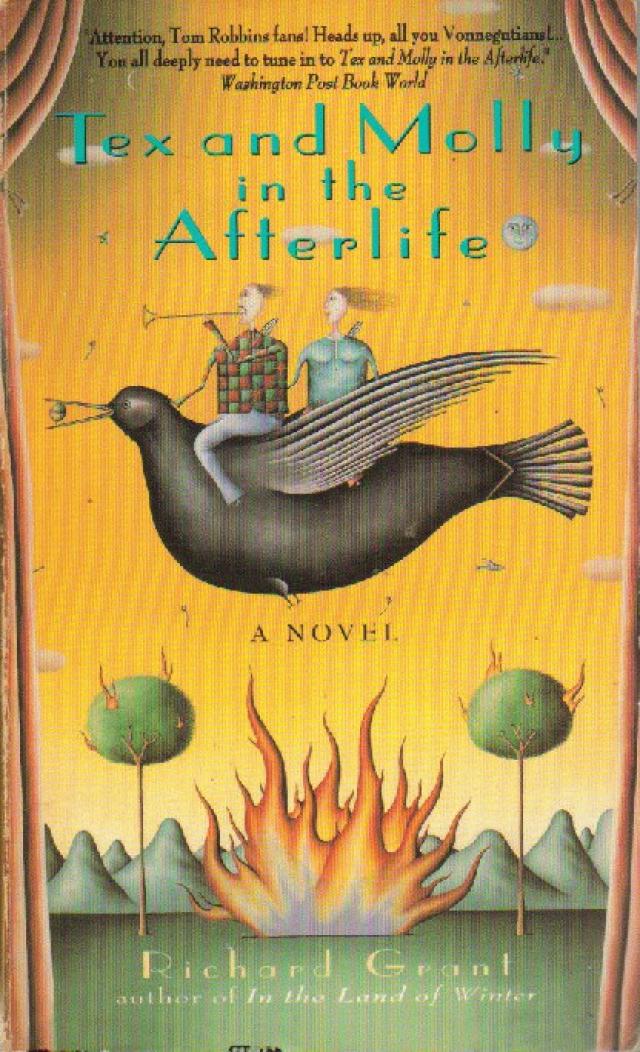
Tex and molly in the aft.., p.30
Tex and Molly in the Afterlife,
p.30


Guillermo pulled the door wide very quickly, so that Gene Deere was caught in a kind of psychic undertow. He stood on the mat with his mouth half-open and a potted plant in his hand. The plant looked a little droopy.
"What is this?" said Guillermo.
Gene took a step forward, which brought him into range of the door, should Guillermo decide to slam it. Ludi thought of warning him. Gene said, "It's a datura."
"That's not what he means," said Ludi. "Guillermo, would you please get out of the way and let poor Gene get through?"
"I'm not in the way," Guillermo said.
"Not physically, maybe. But psychologically you're a major obstacle."
Guillermo and Gene examined one another. Neither seemed to like what he saw. Finally Gene stepped all the way in, holding the plant out toward Ludi.
"I guess this probably ought to get out of the draft," he said.
"Gene, this is Guillermo," said Ludi. "He's an enemy of the state and possibly a criminal. Guillermo, this is Gene. He's a young fogy and defender of the status quo. Could I get you guys some weapons? Would butter knives be okay?"
Guillermo shook his head. "You didn't used to be this way. This ... hardened."
"Things didn't used to be this hard," said Ludi. "I'm sorry, but I was having a really nice morning all to myself and now it's gotten a little confusing. If one of you guys would just leave, then maybe I could figure out how to handle the other one. Two at once is too much."
Gene said, "I guess I came at a bad time." He moved to put the plant down on an end table. "No, it won't get enough light here," he said. He walked to the windows that overlooked the parking area, set the plant down on the floor, fiddled with the Venetian blinds. "Can I make a stack out of these magazines?'' he said.
"They're my Parabolas," Ludi said, in what she thought was a firm and clear voice.
He piled the magazines knee-high and set the plant on top of them. He stood back; checked the angle of insolation; adjusted the trim of the pot. Now it seemed a chair had to go. The whole thing was weirdly absorbing.
"What does he think he's doing?" Guillermo asked.
"Some biological thing," Ludi supposed.
"He's rearranging your living room."
Ludi noted with enjoyment the look of discomfiture on Guillermo's face. "This disturbs you?"
"I would think it might disturb you."
"Are you kidding?" she said. "You should see the number I did on his place."
Guillermo took a little while metabolizing that. Gene augmented the Parabola pile with a couple of months worth of Gnosis.
Abruptly Guillermo stood up. "I don't want to know what's going on here," he said, making for the door. He lowered his eyebrows to deliver a final, Parthian shot, but his sling was empty. Ludi smiled sweetly at him. Exasperated, he stomped out and slammed the door.
"There," said Gene, standing back from his handiwork. "What do you think?"
"It's different," said Ludi.
3 LITTLE WORDS
"Here," said Gene, reaching into his pocket. "I wrote the name of the plant down. Brugmansia inoxia. 'Dr. Seuss'."
"Dr. Seuss?"
"That's correct." He handed her one of his business cards with this horticultural designation recorded in small, meticulous lettering on the back. "It gets very big trumpet-shaped flowers that are yellow with some red inside the throat. Also, it's supposed to be hallucinogenic. But I wouldn't experiment with that because it's highly toxic. You have to extract the active ingredients in a very precise way. Which I, personally, have no knowledge of. So. Anyhow—"
His voice tapered off. Having run through the botanical stuff, he now lost his way. He stood in the middle of the living room as though he was not sure how he had gotten here.
"Well, gosh," said Ludi. "Thanks. I'm sure it'll be very pretty. If I don't kill it first."
"Sefyn said it's quite adaptable," Gene said. "Anyhow, I thought you might like it. 'Dr. Seuss,' I mean. Since you work in a bookstore."
She looked at him in surprise. "How do you know I work in a bookstore?"
"You told me."
"I did?"
"That first night. At the pizza place."
"You remember that night at the pizza place?"
"Of course I remember. You were the one that was drinking. Not me. You didn't give me a chance."
"Oh." It came back to her now. The medium Mex, et cetera. "Sorry about that."
They looked at one another. Then they both decided to smile.
"You want an English muffin?" she said.
"Sure. Thanks."
They walked into the kitchen and she sat him down at the breakfast bar.
"Those are interesting light fixtures," he said.
"I think so too. I might steal them when I move out of this place."
"Take the refrigerator, too," he said. "That's practically a museum piece."
"What museum, though?"
"I don't know. Wherever they keep Bess Meyerson's hairdo."
She shook her head. He had never mentioned this strange sense of humor. She slathered a bunch of butter on his muffins and slid the plate across the Formica, diner-style. The radio was playing "I've Grown Accustomed to Your Face."
"Somehow," he said, with his mouth partly full, "I did not picture you living in a place like this."
"What did you picture—love beads and incense?"
"More like, crystals and New Age music."
"I like some New Age music. Lucia Hwong, for example. Steve Tibbets."
"I wasn't being critical. Just categorizing."
"What's the difference?"
He shrugged, knocked off the muffin. "So," he said. "What was that guy, your boyfriend?"
Ludi let the question pass. "I was just sitting here trying to get some ideas for this play. I haven't made much progress. It's like my mind is playing blank tape." Then, thinking this might be something there was a theory about, she asked him, "Where do ideas come from, anyway?"
Exactly as she hoped (and feared), he lifted his shoulders and lowered his chin, and he said, "Well, there's actually been a lot of work in that area. You know, Darwin called his book The Origin of Species, but what most people don't realize is that he never actually explained where new species come from. What he did was offer a convincing theory of how existing species might adapt to competitive pressures or changing environmental conditions. But not how species themselves—wholly distinct organisms—originate. One of the things the fossil record is not ambiguous about is that species do not arise the way Darwin speculated, as the result of tiny random mutations. There's just no evidence that that's how morphogenesis works. New species just all of a sudden seem to be there. Like, all in one piece."
"Like all in one piece?" said Ludi. "I thought I was the only one who talks like that."
"Everybody talks like that," said Gene. "It's how we think. We think by analogizing. It's quite helpful, especially where difficult problems are involved. We might say, for example, that there's a suspiciously created aspect about the way new forms appear in nature. Which is to say, some form of creativity appears to be involved. And in our own experience we know that creativity is almost never accidental."
"So?" said Ludi.
"So?"
"Where do new ideas come from? That was the question. Remember?"
"Correct. Well, it's fairly straightforward, actually. New ideas come from play."
"Play? As in, The play's the thing?"
"What's that? No, um—as in, unstructured activity. Turmoil. The inherent dynamism of physical reality."
Ludi considered this. Life was full of turmoil, for sure, that seemed to be more the problem than the answer. "I don't think I get it," she said.
"It's my fault," said Gene.
Which were three little words that Guillermo, for one, could not possibly have uttered. Already Ludi detected a New Thing here.
Gene said, "For example, if you look at a slime mold—"
"A what?" said Ludi.
"Or okay—an ant colony. Or wait. A basketball team. You find basically the same type of creativity present. There's always this precarious balance between order and chaos. And see, if the balance tips just the tiniest bit one way or the other, everything changes. And what we're interested in, where creativity is concerned, is a situation where the balance tips in the direction of chaos, or instability. Unstructured activity is the term currently in favor. Because when that happens then the system—the basketball team, let's say—tends to do one of two things. Either it falls totally apart, in which case it loses the game, or else it snaps back into some new order that cannot be predicted beforehand. Therefore it is genuinely creative. Therefore the opposing team cannot have anticipated it. In which case, you score points.
"In a real basketball game, this process happens over and over again. That's why the game is interesting. Because the team retains an organismic integrity—it remains a basketball team, even as it exhibits this continual unfolding of novelty. So in a way, you're watching evolution in progress. And it is evolution, really, because the way the game is played, the way the players interact on court, does change recognizably from one season to the next, in a totally unpredictable way. Yet it remains basketball. It doesn't suddenly turn into a different game. And there's absolutely nothing random or accidental about it."
"I still don't understand," said Ludi. "I mean, I get what you're saying. But I don't get where chaos has to come in. Couldn't everything stay nice and calm and orderly, and you still win the game?"
"Well, actually, there is a biological term for when things stay nice and calm and orderly. The term is Death."
"Ha!" said Ludi. "I thought you were going to say, Employment."
"What's the difference, I guess," said Gene.
"Really."
"But no—if you don't think of chaos as messy—if you just think of it as another word for play, sort of a temporary departure from rules and structure and things like that." Gene spun the butter knife, watching idly as it came to a halt, pointing toward Ludi's left breast. "I could show this to you better than I can explain it."
"Great," said Ludi. "You can write my play for me."
Gene seemed to find this amusing. "Sure. And I guarantee it would be creative. In fact, it wouldn't be like any play you'd ever seen before. Apart from that, all bets are off."
Ludi sighed. "At this point, I don't think any bets are on."
Gene shrugged. "Well, maybe I can help. Sometimes it's good to get a fresh viewpoint. Why don't you show me what you've got?"
"There isn't much to show."
"That's good. I don't have much of an attention span. Generation X, you know?"
Ha, she thought. And she led Gene Deere into her bedroom.
26 CHARACTERS IN SEARCH OF AN AUTHOR
TIME: The Present. One night in Summer.
SETTING: Somewhere at the outer edge of America.
SITUATION: The cultural, ethnic, economic and religious conflicts rending society have spread, like cracks in a sheet of glass, to this small, somewhat isolated community. Until now, whatever differences have existed among the residents have been smoothed over by neighborliness and toleration. A live-and-let-live attitude has prevailed. But lately the divisions have grown sharper, or people's willingness to overlook them has worn thin. The rich are getting richer while those living on the margins—not poor, but lacking the comfort and security of the middle class—grow more numerous. The over-40 crowd does not respect the young, and of course, vice versa. Religious people dislike other religious people who don't agree with them even more than they dislike the totally unreligious. Everyone hates his job, except for the bosses, who hate something else, usually the government. People only feel comfortable around other people exactly like themselves. Everyone clings to something—anything stable, even if it's only nostalgia for a lost golden age, or simplistic political ideas, or end-of-the-millennium fantasies. They're like kids hugging their stuffed animals, scared of strangers, afraid of the dark, crying for help that doesn't come.
OUR STORY begins when a cross section of these people are thrust together under unusual circumstances in a public place on a warm, moonless summer night. DRAMATIS PERSONAE: (Unless specified, characters may be either male or female)
AGING HIPPIE (1)
AGING HIPPIE (2)
ARROGANT YOUNG IDEALIST
AFFLUENT PROFESSIONAL GEN-X TYPE (male)
MINIMUM-WAGE GEN-X TYPE (female)
CREDIT CARD CENTER DRONE
LIPSTICK LESBIAN
TAOIST WAITER (gender-free)
WELFARE WITCH (female)
WILD CHILDREN (assorted)
TV NEWS REPORTER
COMMUNITY RADIO ANNOUNCER
NATIVE AMERICAN
CHAMBER OF COMMERCE TYPE GUY WHO SLINGS PIZZA
CORPORATE EXECUTIVE (may be tourist or summer resident)
RADICAL FAERIE
TOKEN AFRICAN-AMERICAN
GUN-TOTING SURVIVALIST
EVANGELICAL PROTESTANT (does not have to be minister)
SOMEBODY WHO RECENTLY MOVED FROM CONNECTICUT
SOMEBODY'S DAD
A LAW ENFORCEMENT OFFICER
PETS AND OTHER ANIMALS (assorted)
TREES AND OTHER PLANTS (assorted)
ROCK (female)
AMORAL TRICKSTER (supernatural, either gender)
BENEFICENT, HEALING DEITY
ELVES, WOOD-SPRITES, NAIADS, DRYADS, ETC.
"You're kind of losing me here at the end," said Gene.
"Don't worry about it," said Ludi. "I'm kind of losing myself, to tell you the truth."
"It's interesting, though."
"Interesting. I hate that word."
"Yeah." He looked at her with a peculiar smile. "I know what you mean. But some things really are interesting, you know?"
"Yes. And no."
"But, um—" Gene hesitated, lifting the two sheets of paper as though making doubly sure there were no more of them. "I mean, what does the story consist of, exactly?"
"That's kind of the problem," said Ludi. "There kind of isn't a story. I can't think of a plot. But I mean, life doesn't have a plot, does it?"
"No. But it has events. It has changes, developments. Besides, life doesn't have elves and naiads, either, does it?"
"I wouldn't bet on it," said Ludi, quite seriously.
That sobered him up.
"Let's take a complex-systems approach to this," said Gene. "Have you got any scissors?"
MEMES
"My poor play," Ludi lamented, staring down at her bed, where pieces of her manuscript lay spread out on dozens of strips of paper. The bedspread was green nubby cotton. In miniature, you had here the scene in Eben's field, with scraps of Ludi's scenario blowing down toward the bay. Only Gene had made this mess on purpose. In her bedroom. She wondered if this was a wry subtle, nearly symmetrical form of revenge.
"These are memes," Gene explained. "Tiny pieces of information for your actors to remember. They're like genes, only made out of words instead of nucleotides. Get it?"
"Get what?"
He pressed his lips together, impatiently. His eyes were bright; he radiated bustle and energy. "I know I'm not that bad at explaining things," he said. "Look, let's take one of these characters, okay? Here: Lipstick Lesbian. What does that mean? No, stop, I don't need to hear it. Let's assign this character a meme. What would be a good meme?"
Ludi didn't have the faintest idea what he was talking about. "Your call," she said.
"Okay. Let's say:
Meme LL
The only person you can rely on is yourself."
He wrote this in tiny letters on the back of the scrap of paper. "Now we assign this meme to this character, and this governs how this character interacts with the others. Okay?"
"Maybe," said Ludi.
"Fine. Now another character. Corporate Executive. What should we do for him?"
Ludi said, "You get what you pay for?"
Gene shook his head. "Something more dynamic," he said.
"I know," said Ludi.
"Meme CE
The one who dies with the most toys wins."
"We'll go with that," said Gene. "Now, you see what we're doing here? The idea is, you assign a very simple meme to each character, then you put all the characters into play and you observe the ways in which they self-organize. You should see the characters begin to grow in complexity, become more peoplelike. In which case your system is evolving."
Ludi twiddled with the ends of her long hair. "Doesn't sound like all that much fun."
"Then we adjust the memes. Or we tinker with the character mix. If it works, it ought to be fun. It ought to feel like a game. Conversely, if it feels like a game, then you're doing it right. You're pushing into the realm of novelty, of pattern creation. At least, that's how it works in biology. I don't know much about theater."
"That's evident."
He looked at her. There was something different in his expression—an openness, as though some translucent barrier had fallen, and he was adjusting to the new, unobstructed view. Or maybe that's only how Ludi felt, and he was projecting. Anyway he seemed to study her, the way she imagined he might study some unexpected development in a laboratory. After a minute he smiled.
"This is really the way it works," he said. "From the bottom up. Patterns emerge from chaos. Which is the problem with conspiracy theories, and with deterministic theories in general. They assume some kind of hidden program that governs everything. But there's no program because there's no way of controlling a dynamic and creative process. If you succeed in controlling it, the process stops. The system dies. I would think playwrights might have noticed this before now."
"Maybe they have," said Ludi. "I don't know. I'm not a playwright."
"Oh, you will be," said Gene, looking away from Ludi, down at the scraps of paper. "Really. I bet you. You will be."
THE PRESENCE OF THE PAST
"I don't get it," said Molly. "They were getting along great, back then. So why are they here in our galley scrapping at each other?"
"You tell me," said Tex. "You're the know-it-all. Maybe there's some way to do a pause and frame advance on these visions of yours."