Two gentlemen of verona, p.1
Two Gentlemen of Verona,
p.1


NO FEAR SHAKESPEARE
Antony and Cleopatra
As You Like It
The Comedy of Errors
Coriolanus
Hamlet
Henry IV, Parts One and Two
Henry V
Julius Caesar
King Lear
Macbeth
Measure for Measure
The Merchant of Venice
A Midsummer Night’s Dream
Much Ado About Nothing
Othello
Richard II
Richard III
Romeo and Juliet
Sonnets
The Taming of the Shrew
The Tempest
Twelfth Night
Winter’s Tale
NO FEAR SHAKESPEARE
TWO
GENTLEMEN
OF VERONA
SPARKNOTES and NO FEAR SHAKESPEARE are registered trademarks of SparkNotes LLC.
Text © 2017 Sterling Publishing Co., Inc.
Cover © 2017 Sterling Publishing Co., Inc.
All rights reserved. No part of this publication may be reproduced, stored in a retrieval system, or transmitted in any form or by any means (including electronic, mechanical, photocopying, recording, or otherwise) without prior written permission from the publisher.
ISBN 978-1-4549-2878-2
For information about custom editions, special sales, and premium and corporate purchases, please contact Sterling Special Sales at 800-805-5489 or specialsales@sterlingpublishing.com.
sterlingpublishing.com
sparknotes.com
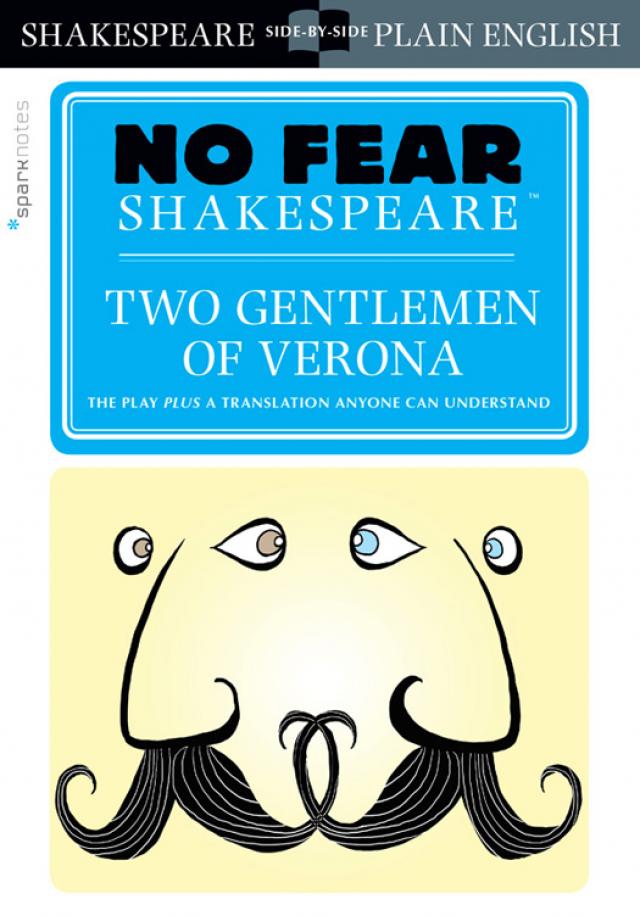
Cover and title page illustration by Richard Amari.
There’s matter in these sighs, these profound heaves. You must translate: ’tis fit we understand them.
(Hamlet, 4.1.1–2)
FEAR NOT.
Have you ever found yourself looking at a Shakespeare play, then down at the footnotes, then back up at the play, and still not understanding? You know what the individual words mean, but they don’t add up. SparkNotes’ No Fear Shakespeare will help you break through all that. Put the pieces together with our easy-to-read translations. Soon you’ll be reading Shakespeare’s own words fearlessly— and actually enjoying it.
No Fear Shakespeare pairs Shakespeare’s language with a translation into modern English—the kind of English people actually speak today. When Shakespeare’s words make your head spin, our translation will help you sort out what’s happening, who’s saying what, and why.
TWO GENTLEMEN OF VERONA
Characters
ACT ONE
Scene 1
Scene 2
Scene 3
ACT TWO
Scene 1
Scene 2
Scene 3
Scene 4
Scene 5
Scene 6
Scene 7
ACT THREE
Scene 1
Scene 2
ACT FOUR
Scene 1
Scene 2
Scene 3
Scene 4
ACT FIVE
Scene 1
Scene 2
Scene 3
Scene 4
CHARACTERS
Proteus—Valentine’s supposed best friend and one of the titular gentlemen of Verona. Proteus is Julia’s sweetheart at the beginning of the play, but when he joins Valentine at the duke’s palace, he falls in love with Silvia and attempts to steal her away from Valentine.
Valentine—Proteus’s best friend and Silvia’s love. Valentine is the other titular gentleman of Verona. Banished to the forest after Proteus betrays to the duke Valentine’s plan to elope with Silvia, he becomes king of the outlaws.
Julia—Proteus’s beloved, Julia, is mistress of the servant Lucetta. Julia disguises herself as Sebastian, an aristocratic male page, when she travels to Milan to visit Proteus. As the page, she does Proteus’s bidding, delivering to his new beloved, Silvia, the very ring she herself had earlier given him as a gift.
Silvia—The duke’s daughter and beloved of Valentine. Proteus and Thurio also vie for her affections. Silvia commiserates with Sebastian over the wrong that Proteus has done to Julia. She escapes her father’s palace with the help of Sir Eglamour, who abandons her at the sight of the outlaws.
Duke of Milan—Silvia’s father. He wants Silvia to marry the boorish but wealthy suitor Thurio. Upon hearing of Valentine’s plot to elope with Silvia, the duke banishes Valentine.
Lucetta—Julia’s servant. She considers love from a practical point of view and helps Julia disguise herself as a man.
Launce—Proteus’ servant and the master of a poorly trained mutt named Crab. His devotion to his dog knows no bounds and gives the play much humor. Launce falls in love with an unattractive but wealthy maid.
Speed—Valentine’s page. At the beginning of the play, Speed does Proteus’s bidding as well. He is friendly with Launce.
Thurio—A foolish rival to Valentine for Silvia’s hand. Thurio is wealthy and unpleasant.
Sir Eglamour—The gentleman Silvia calls upon to help her escape from the duke’s court.
Antonio—Proteus’s father and the master of the servant Panthino.
Host—The person who houses Julia while she searches for Proteus.
Outlaws—A crew of bandits who make Valentine their king when he is banished.
Crab—Launce’s dog.
Panthino—Antonio’s servant.
ACT ONE
SCENE 1
Original Text
Enter VALENTINE and PROTEUS
VALENTINE
Cease to persuade, my loving Proteus;
Home-keeping youth have ever homely wits.
Were’t not affection chains thy tender days
To the sweet glances of thy honored love,
5
I rather would entreat thy company
To see the wonders of the world abroad
Than, living dully sluggardized at home,
Wear out thy youth with shapeless idleness.
But since thou lov’st, love still and thrive therein,
10
Even as I would when I to love begin.
PROTEUS
Wilt thou be gone? Sweet Valentine, adieu!
Think on thy Proteus when thou haply seest
Some rare noteworthy object in thy travel.
Wish me partaker in thy happiness
15
When thou dost meet good hap; and in thy danger,
If ever danger do environ thee,
Commend thy grievance to my holy prayers,
For I will be thy beadsman, Valentine.
VALENTINE
And on a love book pray for my success?
PROTEUS
20
Upon some book I love I’ll pray for thee.
VALENTINE
That’s on some shallow story of deep love,
How young Leander crossed the Hellespont.
PROTEUS
That’s a deep story of a deeper love,
For he was more than over shoes in love.
VALENTINE
25
’Tis true; for you are over boots in love,
And yet you never swam the Hellespont.
PROTEUS
Over the boots? Nay, give me not the boots.
VALENTINE
No, I will not, for it boots thee not.
PROTEUS
What?
VALENTINE
30
To be in love, where scorn is bought with groans,
Coy looks with heartsore sighs, one fading moment’s mirth
With twenty watchful, weary, tedious nights.
If haply won, perhaps a hapless gain;
35
If lost, why then a grievous labour won;
However, but a folly bought with wit,
Or else a wit by folly vanquishèd.
PROTEUS
So, by your circumstance, you call me fool.
VALENTINE
So, by your circumstance, I fear you’ll prove.
PROTEUS
40
’Tis love you cavil at. I am not Love.
VALENTINE
Love is your master, for he masters you;
And he that is so yoked by a fool
Methinks, should not be chronicled for wise.
PROTEUS
Yet writers say, as in the sweetest bud
45
The eating canker dwells, so eating love
Inhabits in the finest wits of all.
VALENTINE
And writers say, as the most forward bud
Is eaten by the canker ere it blow,
Even so by love the young and tender wit
50
Is turned to folly, blasting in the bud,
Losing his verdure even in the prime,
And all the fair effects of future hopes.
But wherefore waste I time to counsel thee
That art a votary to fond desire?
55
Once more adieu! My father at the road
Expects my coming, there to see me shipped.
PROTEUS
And thither will I bring thee, Valentine.
VALENTINE
Sweet Proteus, no. Now let us take our leave.
To Milan let me hear from thee by letters
60
Of thy success in love, and what news else
Betideth here in absence of thy friend;
And I likewise will visit thee with
mine.
PROTEUS
All happiness bechance to thee in Milan!
VALENTINE
As much to you at home! And so, farewell!
Exit VALENTINE
PROTEUS
65
He after honor hunts, I after love.
He leaves his friends to dignify them more;
I leave myself, my friends, and all, for love.
Thou, Julia, thou hast metamorphosed me,
Made me neglect my studies, lose my time,
70
War with good counsel, set the world at naught;
Made wit with musing weak, heart sick with thought.
Enter SPEED
SPEED
Sir Proteus, save you! Saw you my master?
PROTEUS
But now he parted hence, to embark for Milan.
SPEED
Twenty to one, then, he is shipped already,
75
And I have played the sheep in losing him.
PROTEUS
Indeed, a sheep doth very often stray,
An if the shepherd be a while away.
SPEED
You conclude that my master is a shepherd, then, and I a sheep?
PROTEUS
80
I do.
SPEED
Why then, my horns are his horns, whether I wake or sleep.
PROTEUS
A silly answer, and fitting well a sheep.
SPEED
This proves me still a sheep.
PROTEUS
85
True; and thy master a shepherd.
SPEED
Nay, that I can deny by a circumstance.
PROTEUS
It shall go hard, but I’ll prove it by another.
SPEED
The shepherd seeks the sheep, and not the sheep the shepherd; but I seek my master, and my master seeks not me. Therefore I am no sheep.
90
PROTEUS
The sheep for fodder follow the shepherd; the shepherd for food follows not the sheep. Thou for wages followest thy master; thy master for wages follows not thee. Therefore thou art a sheep.
SPEED
95
Such another proof will make me cry “Baa.”
PROTEUS
But dost thou hear? Gavest thou my letter to Julia?
SPEED
Ay, sir. I, a lost mutton, gave your letter to her, a laced mutton, and she, a laced mutton, gave me, a lost mutton, nothing for my labor.
PROTEUS
100
Here’s too small a pasture for such store of muttons.
SPEED
If the ground be overcharged, you were best stick her.
PROTEUS
Nay, in that you are astray: ’twere best pound you.
SPEED
Nay, sir, less than a pound shall serve me for carrying your letter.
PROTEUS
105
You mistake. I mean the pound—a pinfold.
SPEED
From a pound to a pin? Fold it over and over,
’Tis threefold too little for carrying a letter to your lover.
PROTEUS
But what said she?
SPEED
(Nodding) Ay.
PROTEUS
110
Nod-ay—why, that’s “noddy.”
SPEED
You mistook, sir. I say she did nod, and you ask me if she did nod, and I say, “Ay.”
PROTEUS
And that set together is “noddy.”
SPEED
Now you have taken the pains to set it together, take it for your pains.
115
PROTEUS
No, no, you shall have it for bearing the letter.
SPEED
Well, I perceive I must be fain to bear with you.
PROTEUS
Why, sir, how do you bear with me?
SPEED
Marry, sir, the letter, very orderly, having nothing but the word “noddy” for my pains.
120
PROTEUS
Beshrew me, but you have a quick wit.
SPEED
And yet it cannot overtake your slow purse.
PROTEUS
Come, come, open the matter in brief. What said she?
SPEED
Open your purse, that the money and the matter may be both at once delivered.
125
PROTEUS
(Giving him money) Well, sir, here is for your pains. What said she?
SPEED
Truly, sir, I think you’ll hardly win her.
PROTEUS
Why, couldst thou perceive so much from her?
SPEED
130
Sir, I could perceive nothing at all from her, no, not so much as a ducat for delivering your letter. And being so hard to me that brought your mind, I fear she’ll prove as hard to you in telling your mind. Give her no token but stones, for she’s as hard as steel.
PROTEUS
135
What said she? Nothing?
SPEED
No, not so much as “Take this for thy pains.” To testify your bounty, I thank you, you have testerned me; in requital whereof, henceforth carry your letters yourself. And so, sir, I’ll commend you to my master.
PROTEUS
140
Go, go, begone, to save your ship from wreck,
Which cannot perish having thee aboard,
Being destined to a drier death on shore.
Exit SPEED
I must go send some better messenger.
I fear my Julia would not deign my lines,
145
Receiving them from such a worthless post.
Exit
ACT ONE
SCENE 1
Modern Text
VALENTINE and PROTEUS enter.
VALENTINE1
Stop trying to persuade me, Proteus2. Young homebodies have dull minds. If you weren’t so tied to the girl you love, I’d ask you to come with me to see the distant wonders of the world rather than waste your youth living aimlessly as a sluggard at home. But, since you’re in love, keep on loving and thrive in your love. I would do the same were I in love.
PROTEUS
Are you going now? Goodbye, Valentine, my dear friend! Think of me when you happen to see some rare and noteworthy object in your travels. Wish me happiness, too, when you have good fortune. And if you’re ever in danger, trust that my prayers will protect you, for I will pray for you, Valentine.
VALENTINE
And you’ll be praying for me on a book about love3, I suspect?
PROTEUS
I’ll pray for you on a book I love.
VALENTINE
No doubt on some shallow story of “true” love, like the one about young Leander crossing the Hellespont4.
PROTEUS
That’s a deep story of a deeper love—the love was so deep it covered his shoes.
VALENTINE
It’s true. And your love is so deep it covers your boots, and yet you never swam across the Hellespont.
PROTEUS
Covers my boots? Don’t make fun of me.
VALENTINE
No, I won’t, for it doesn’t benefit you any.
PROTEUS
What?
VALENTINE
When you’re in love, your lovesick groans only earn her scorn, your brokenhearted sighs just get you flirtatious glances, and twenty tedious, sleepless nights spent pining for your sweetheart only yield you a brief moment of happiness. If by chance you succeed, it may turn out to be an unlucky win. And if you don’t, then you’ve only managed to waste your time. Either way, you win foolishness by being clever, or your cleverness is killed by foolishness.
PROTEUS
So, by your logic, I’m a fool.
VALENTINE
Because of your logic, I fear you’ll become a fool.
PROTEUS
It’s love you have a problem with. But don’t blame me—I’m not Love.
VALENTINE
Love is your master, because he’s got the better of you. And in my opinion, anyone who’s been taken in by a fool shouldn’t be considered very wise himself.
PROTEUS
Yet writers say that just as the destructive caterpillar dwells within the sweetest flower buds, love inhabits the cleverest minds.
VALENTINE
And writers also say that just as the caterpillar eats the greatest flower bud before it blooms, so too does love make young and fragile minds foolish. It destroys the young lover, who loses his youth while still in his prime, and takes away all his future hopes. But why am I wasting my time giving advice to you, a man who is devoted to foolish love? So, once again, farewell! My father expects to meet me at the harbor to see my ship off.
PROTEUS
I’ll go with you, Valentine.