Attack of the black rect.., p.11
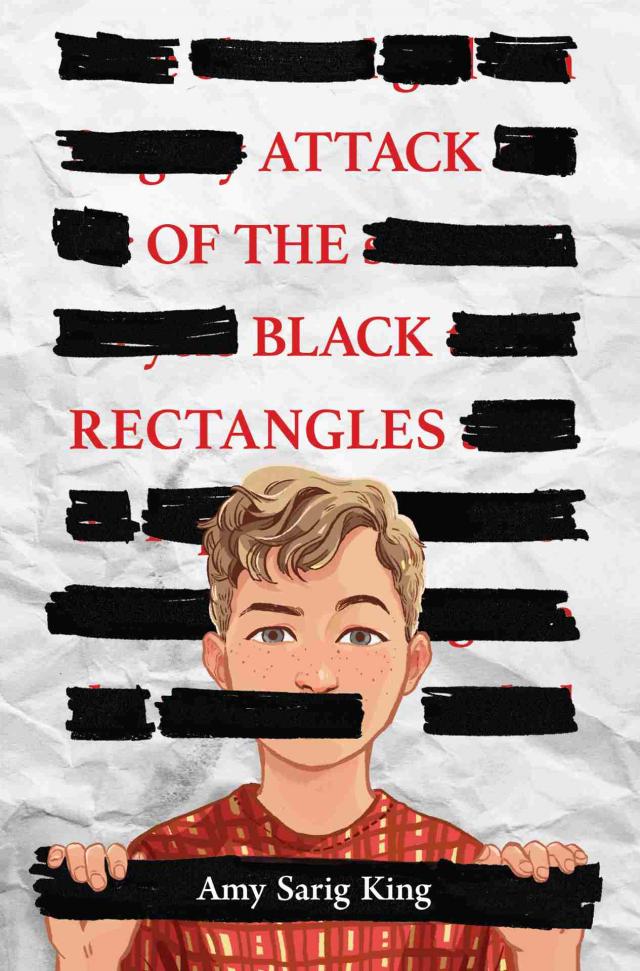
Attack of the Black Rectangles,
p.11


By the time I get home, there’s no way to hide the crying from my face.
As it turns out, nobody notices. I watch the end of a show Mom and Grandad are watching and then go to bed.
The rest of the week crawls by, class by class, math problem by math problem. Every day I feel farther away from Marci and Denis. They’re so normal and happy. They still play BOT DUCK MAN together and I still feel jealous. But then on Friday, at recess, Marci comes up to me and says, “Hey—I can’t make it to the protest this weekend. I have to help my mom do some stuff in the garden. And … Denis told me about what happened with your dad and I’m really sorry it happened.”
Everything in my body wants to be nice and say thank you and all that stuff, but instead, I look around until I find Denis and I fast-walk over to him.
“You told her?” I say.
He doesn’t say anything.
“You’re my best friend! Why would you tell her something I told you in secret?”
“I—uh—I just thought—” he sputters.
Marci is here now, standing behind me. “He thought we might be able to help,” she says.
I look at Denis. “You could have at least asked me first!” I look at Marci and then back at Denis. “There’s nothing you can do to help. I can’t even help myself. I don’t even know why I told you.” Then I walk right to the teacher on duty and ask if I can go to the nurse.
When I get to the nurse’s office, she asks what’s going on and I tell her I have to go home.
“I can’t just send you home,” she says.
“I have to go home. Just call my grandad. He’ll understand.”
So she does. Grandad tells her to have me wait and he’ll be here in a few minutes. After he picks me up, we drive in complete silence. He doesn’t even ask me what happened. When we get home, I go straight to my room, which still smells like baseball glove oil, and I take a nap.
I miss dinner. When I get to the kitchen to eat something, Mom has gone to a yoga class and Grandad gets my plate from the fridge and reheats it for me. I get a glass of water. I feel like crying the whole time and it really bugs me. Even in all the years my dad only came on Saturdays, I didn’t feel like crying this much. I feel like someone put a time bomb in my office filing cabinet. It’s just ticking.
The weather got a little cooler—I need a jacket after dinner to go sit with Grandad in the grass, which he says I have to do, so I do it. He tells me that he’s going to a protest in the city tomorrow—something about teaching real history in America.
“Sounds fun,” I say.
“You can come along if you want,” he says. “It’s right up your alley.”
I don’t have anything else to do, so it seems like a good idea.
Saturday comes, and so does the local paper. The letters to the editor cover a full page. A quarter of them are about us.
Censorship Is Wrong
Our rights as Americans are being silently taken from us by strangers. Our children’s right to read books is a fundamental right and I applaud the kids who came to the school board meeting Tuesday night to fight for the rights of our children. We should support them!
—Nettie Mase, Elm Street
Re: Censorship Is Wrong
When I was young, children listened to their elders. They knew we knew what was good for them. It’s a shame to see kids run loose like this. Their parents clearly have no idea how to raise them.
—Anonymous on Broad Street
That one stings. It makes me think of Dad, because he really didn’t have any clue how to raise me. And it makes me think of Mom, who has enough to worry about without letter writers putting her down.
“Mac? You coming?” Grandad asks. “You and me, taking over the world, kid.”
I put the paper down, put on my sneakers, and walk to the bus stop with him. Something in me wants to hold his hand, which I know I can’t do. Right when I think that, he puts his arm around my shoulder and says, “You’re heavy today.”
Grandad still talks like it’s the 1960s. Heavy means serious.
“Yeah.”
“Heavy is a good way to protest,” he says.
“Sure.”
“It’s the only way things get done around here.”
We play twenty questions on the bus and arrive in the city. Grandad knows the way to the square where the protest is, and I can hear a crowd of people and someone speaking through a microphone. Our kids are our future! I see two teenagers walking in our direction. They both have signs. One says TEACH TRUTH and the other says STOP LYING TO CHILDREN.
“I didn’t bring a sign,” I say.
“Next time, you will. No big deal.”
“What’s the point if I don’t have a sign?”
He looks at me and I can tell he’s done with me being heavy. I’m even done with being heavy myself but I don’t have any other option. I guess some days, or weeks in my case, are just heavy.
We get to the square and the crowd is big. Bigger than I expected. A woman is talking about how young people should learn the truth in school and how Columbus Day is an insult to all of us. Grandad gets a premade sign from a woman who’s handing them out. Actually, he gets two, but when he hands me one, I say no, so he holds a sign up in each hand.
I am too heavy to handle this. The crowd is making me feel like I can’t breathe. There are too many people. Too many strangers. Too many voices talking. Too many thoughts in my head. I don’t belong here.
The woman talks for another five minutes, and I listen and look around and read other signs to keep myself distracted. IF YOU’RE COMFORTABLE LEARNING HISTORY, IT’S THE WRONG HISTORY. CENSORSHIP CAUSES BLINDNESS. FIRST THEY BURN BOOKS; THEN THEY BURN BODIES. The clouds drop rain on us and some people have umbrellas and some start to leave. I turn to Grandad and he’s clapping, signs under his arm, and smiling and he puts his fist in the air.
“I want to go,” I say.
“We just got here,” he answers.
But he sees the look on my face. He puts his arm around me and we walk away from the square.
A block later, he asks, “Did the crowd get to you? Too big? Too loud?”
I nod. We keep walking. The rain falls harder and we’re both soaked.
“I don’t get it,” I say. “Why am I scared of everything now? I thought getting older would make me less scared.”
Grandad nods.
I keep talking. “I don’t want to be this scared going into middle school. The other kids will know and they’ll pick on me.”
“Back up, Mac,” Grandad says. “I need you to understand something important.”
“I’ll get beat up and stuff,” I tell him.
“Hear me out on this.”
We keep walking. Grandad points to a bus shelter that’s empty. We go sit in it.
We don’t sit side by side like usual. He straddles the bench and looks right at me, so I do the same.
“Mac, you’re going to be scared of a lot of things in your life,” he says. “It’s a crazy feeling, being afraid, isn’t it?”
“Okay,” I say.
“Listen to me. Are you listening?”
“Yeah.”
“Okay,” he says. “I need you to hear to this.”
I nod.
“When I got shipped to Vietnam, I didn’t know what to expect. I was only six years older than you are right now. And I was full of fear.” He clears his throat. “I was afraid of my dad because he was strict. I was afraid of my boss at the restaurant where I worked because he was always making me feel small. I was afraid of girls—all of them. I was afraid of everything. I’d just graduated high school and I was afraid of the future. You know?”
“That’s how I feel,” I say. “Like—I’m twelve and I don’t know anything about anything, so I’m scared of all of it.”
“It gets a little worse,” he says. “I don’t want to scare you, but fear is something that gets worse before it gets better. Anyway, the thing is, well—I don’t know what I’m trying to say.”
“I’m scared that school is just a series of lies and people just keep repeating them and then we all have to live inside a big world of lies and I can’t live like that, Grandad.”
“That’s why we fight the lies,” he says. He gestures to his protest sign.
I get the urge to cry again. I wish it would go away.
“I see you,” Grandad says, “holding back tears.” He waits a few moments and adds, “Can I ask you a question?”
“Sure.”
“What are you so ashamed of?”
I didn’t expect this question, this bus shelter, or this feeling of wanting to throw up. If I threw up now, I think it would be all salt water. I suddenly feel like I swallowed the ocean.
“I can’t talk about that here,” I say. “We’re in public.”
“Public? No one can hear us. We’re alone in a bus shelter.”
“Shame is private,” I say.
“Only if you let it wreck your whole life, it’s private,” he says. “Which is what most people do. I aim to bring you into the light, Mac Delaney. Shame is no way to live. And you have nothing to be ashamed about.”
I can tell he wants me to look at him, but I’m still swallowing the ocean and looking at the pavement.
“Listen,” he says. And then he stands up and yells, out toward the street and the building on the other side of it, “I killed two men in the war and every single day I think of their families! One time, I stole food from a grocery store in North Carolina because I was hungry! When my kids were young, I used to spank them even though they were only doing kid stuff! Sometimes I feel like I was a bad husband because I had all this shame!”
By this time, he’s standing on the curb and has his arms out.
“Grandad!” I yell. “Stop!”
He turns around and says, “There was one night I left your gram because I thought she deserved better than me. I will never forget the look on her face.” He starts to cry. I feel so embarrassed and yet—something else. “She looked disappointed, and I realized I was a disappointment. She said, ‘Marcus, you have two choices. You can face all this stuff and stay or you can keep running from it and leave.’ And let me tell you, Mac, I stayed.”
“Wow,” I say.
“Are you hearing me?”
“Did you really kill two men?” I ask.
“It was war. It’s what war is about.”
“Do you really think of their families every day?”
At this, Grandad starts wailing. I mean like a toddler in a grocery store. He’s not quiet, he’s not curled up in bed. He’s on a city street, strangers walking up and down the sidewalks. I stand up and go to him and hug him. We end up back on the bench, straddling it, and he keeps crying.
When he finally gets control of his breath again, he says, “Your turn.”
I don’t know what to say.
He holds my head so I have to look at him. Tears run down his cheeks, but he’s smiling. At me. Nodding a little like he’s cheering me on. I think of Dad. I’ve never seen him cry. And that makes me cry.
“Your turn,” he says again.
“I don’t like myself,” I say. “I think no one else likes me, either. And I think that if someone likes me, they won’t like me for long because I’m probably like Dad, even though I don’t think I’m like Dad. I don’t ever want to get married and I’ll probably be a crappy father like he is.”
Grandad doesn’t move. No hug. No comment. He just waits for more.
“Uh—I am sick of having to fight about dumb stuff like history! Or censored books! I can’t stand people who don’t want to learn new things! Why do they treat kids like we don’t mean anything? I can’t even make a difference. Not in my school or the world. I’ll never make a difference!”
I look up at Grandad and he’s still cheering me on and crying and smiling and it’s kinda weird, so I look back down again.
“I like Marci but I don’t know what to do about it. She’s so cool. I’m not smart enough for her. Denis told Marci about how Dad left and now I don’t know what to do. How am I supposed to know what to do? And he’s probably mad at me because I got all mad and yelled at him. He didn’t even try to fix it. Like I didn’t even matter!”
I take a few deep breaths. I realize I’m crying, too, now.
“And I hate my dad!” I say. “He lied to me and to my mom and to everyone he ever knew and I never want to see him again! Nobody likes me or wants me, and if I ran away tomorrow, no one would even care!”
“Whoa, Mac. That’s a lot,” Grandad says.
“And I think I’ll never grow up to be as cool as my grandad because he fought in a war and he has confidence I’ll never have! My confidence is fake.”
“It is not,” he says.
“The only reason I fight against Columbus Day is because it makes me sound smart,” I say.
“You are smart.”
“I’m smart up here,” I say, pointing to my head. “But the rest of me is a mess!”
“We’re all a mess,” he assures me.
“I don’t like being a mess,” I answer.
“We’re all a mess,” he repeats. “The biggest lie ever told to children is that the adults around them aren’t a mess.”
“All of them?” I ask.
“Most of them, anyway. I don’t know anyone who wasn’t a mess at some point in their lives. Anyone who says they weren’t is lying.”
I don’t know why this makes me cry harder. I think it’s because the truth is beautiful and like rain—it washes everything.
“Let’s go get something to eat,” Grandad says.
I don’t want to get up. I feel like I could do this all day and into the night. “I have more to say!”
“Nothing we can’t talk about over a good sandwich,” he says. And then he hugs me so tight and I wipe my snot on his shirt and he laughs and wipes his snot on my shirt and then the clouds give way to the sun and the whole scene is over.
I don’t know what just happened, but I know everything is different.
Grandad always orders a BLT. I usually order a grilled cheese, but today I order a BLT, too. I don’t even like tomatoes, but the sandwich is the best thing I’ve ever eaten.
“You can use my phone to call Denis on the ride home,” Grandad says.
“Thanks.”
“And how about you let me and your mom help you more with this censorship thing? We won’t take over—but having us behind you will help. Plus, I know a bunch of guys who fought like I did for your right to read whatever the heck word you want. You need to know when to ask for help.”
“I’m sorry you think about those families every day,” I say.
He takes a big bite of his BLT. Chews. Nods. The look on his face is something I can’t describe. “The best I can do is use my life for something good. Not just for other people. For me, too. Your gram taught me that.”
“She was a great lady,” I say.
“She was. She made me care about myself.”
When I think about it, that’s exactly what Grandad just did for me. In public. On a city street. In the rain.
On the way home I call Denis. And I sniffle into the phone like it’s no big deal. I tell him how sorry I am for saying the stuff I did. I tell him I don’t care that he told Marci.
“Just ask her to the dance,” Denis says. “That’ll help with some of your stress, right?”
“I don’t even know how to do that,” I say.
Grandad leans into the phone. “I’ll explain it to him, Denis.”
I swat him away from the phone. “I’ve been putting it off the whole week,” I say.
“I’ll teach him!” Grandad says loudly, tapping his fingertips on his knees.
Denis laughs into the phone. We say goodbye. I say sorry one more time and he says, “We’re best friends, dude. I get it. I’m here for you. Just ask.”
I feel like he’s giving me a free shot because my dad left.
And then I think he’s really cool for giving me the free shot.
I need it.
Grandad teaches me how to ask Marci to the dance. “It’s simple. Just ask.”
Then he says he’s going to dial her number and I ask, “How do you even have her number?”
“We traded at the protest last week.”
“So you have my potential girlfriend’s number but I don’t even have a phone?”
“That’s accurate,” he says. Then he burps. Then I burp. The BLT was worth it.
When Marci picks up, I say, all in one breath, “Hi, Marci, it’s Mac and I want to ask if you’ll go to the dance with me on Friday.”
She says, “Heck yes!”
And then neither of us knows what to say, so I say that I’m on a bus and it’s loud, so I’ll talk to her Monday. She says goodbye, and I can hear that she’s happy. I’m smiling so big that I know I’m happy.
I guess that’s the point.
I look at Grandad and he’s smiling, too.
At dinner, things feel different. It’s weird to not have seen Dad in two whole weeks. Last time I asked Grandad about his stolen car, he said he was leaving it in the hands of the police. I haven’t talked to Mom at all about it. She seems happy, too.
We eat dinner on a Saturday any time we want now.
It’s the longest week of my life. Denis and I play BOT DUCK MAN so much, my elbows are sore. But good things are happening.
On Tuesday after school, Denis and Marci come to my house and we hang out in the now-empty garage. Denis tells me I should fix my bike so we can ride the new bike trails together. Then Marci asks if she can put music on and she puts on Patti Smith, which is punk rock. Grandad comes upstairs and pretends to yell at us for playing the music so loud, but really he came upstairs to dance with us. We thrash around in the space left from Dad’s spaceship … also known as the car he stole.