Attack of the black rect.., p.2
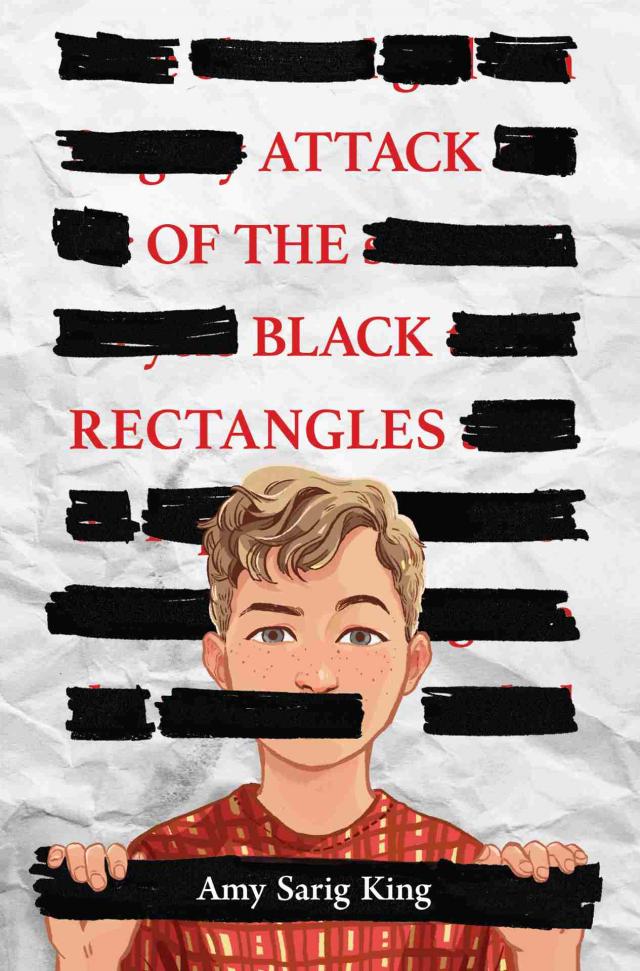
Attack of the Black Rectangles,
p.2


“The way I want you to see this year of your education is like college. You get to choose what you want to learn about, you get to choose the books you read off our class list, and you get to make your own study schedules. If you do poorly, it’s on you. If you do well, your grades will reflect it. Sound good?”
I look around. Everyone is nodding. As I nod with them, I can feel my mouth hanging open. I’m starstruck. This is the kind of teacher I’ve wanted my whole if-it’s-not-interesting-I-don’t-care life.
At lunch, Denis complains about how she split us up—me by the window, him over by the door. Marci says, “And me right in the middle!” But all I can do is dream of sixth-grade college. I’m already writing reports in my head about botflies so I don’t have to learn about boring things like names for types of clouds. And I’m sick of learning half-truths instead of history, so maybe I can do a project on something completely true for once—like why it’s not a cool touristy thing that the pretzel house on Main Street highlights the musket slats in the building and the fact that they could shoot at Native Americans through them. Maybe I can write about how it wasn’t okay to be shooting at the rightful caretakers of the land. For the record, that would be the Susquehannock and Lenni Lenape tribes.
“Are you even listening to us?” Denis asks.
“Sorry,” I tell them. “She’s just not what I expected.”
Marci says, “She certainly acts a lot cooler than people told me.”
“I read her letters in the paper and she seems like a completely different person!” Denis says.
He’s right. The Ms. Sett who complains about everything from candy eating on Main Street to the growing number of local families who do yard work instead of church on Sunday mornings does not seem like this same woman.
“Maybe it’s a different person,” I say. “Like her mom or something.”
Marci shakes her head. “It’s her. She’s just showing us the nice side today. I guarantee you there’s more to this first-day routine than we can see right now.”
Grandad packed me a peanut butter and jelly sandwich and a bag of fluorescent-orange cheese curls for lunch. I get my stuff set up and shake my bottle of chocolate milk.
“You can’t have those!” Marci whispers, pointing at the cheese curls.
“I can have whatever I want.”
“The school doesn’t allow junk food,” Marci says. “Ms. Sett has written about that repeatedly.”
“Junk is a matter of perception,” I say. “If she or anyone else has a problem with what my grandad packs for lunch, then they can take it up with him. I wish them luck. He’s more stubborn than I am.”
Denis says, “Your superpower is your bluntness.”
I say, “Yes, it is.”
Marci sighs. “I just don’t want you to get in trouble.” She’s red in the face … but not from anything we’ve said. The cafeteria has hundreds of students in it and it’s so humid, my cheese curls are going stale.
“I’m not getting in trouble,” I assure Marci.
At the same time, I’ll admit—I’m glad Ms. Sett isn’t in the room as I chomp some Cheetos.
The rest of the day is easy. We have recess and then music before we get back to the classroom, where we all get divided up for math. Ms. Sett gives us homework on the first day of school—forty math problems.
Denis is breathing so deep everyone can hear him. Homework makes him irrationally upset. And being lied to makes him freak out completely.
Ms. Sett notices and smiles at Denis warmly. “I know I said this morning that you’d have very little homework,” she tells him, “but that’s once we get into the year’s work. For now, we have to review and make sure you remember what you learned last year.”
Denis calms down. I’m sure Ms. Sett already read the papers filed with the office about Denis’s problems with homework. And his anxiety. And probably his fear of snakes and water. (And water snakes, which seems obvious.) Also, Denis is afraid of tongues. This sounds weird, but he can’t even look at his own tongue in the mirror without feeling sick. I don’t know if the school knows that.
I honestly don’t mind that I’ve got to watch my tongue when Denis is around. He’s the best friend I’ve ever had. We’re going to be friends until we’re old and sitting on the benches on Main Street, me eating candy and him eating string cheese. Maybe he’ll still be afraid of water snakes and his own tongue. Maybe not. I don’t care as long as he’s still the most loyal person I’ve ever met and he still talks to me.
I’ve been called unlikable.
I blame my parents, one of whom is a normal American mom who is full of grace, and the other who is a rabbit-fearing cranky alien from a planet three galaxies away called BD-134. How this makes me unlikable: Both of them encourage me to say what’s on my mind.
Anyway, this is how it all starts: Me, Denis, and Marci in Ms. Sett’s classroom. BOT DUCK MAN. Record-breaking hot autumn weather with no air-conditioning. Rules about girls wearing shorts. How your history books don’t tell you the whole truth. How my dad says he’s from BD-134. How everything seems so perfect on the first day of school. Too perfect.
Who Makes the Rules?
I moved here a year ago and I don’t think people in this town realize how weird it is to have a rule against junk food. Who can say that a food is junk food? And what kind of person thinks they can rule over a whole town’s eating habits? I also find it interesting that there are three candy stores in town.
—Sam Paris, New Street
Re: Who Makes the Rules?
Our town serves tourists, and candy stores are good business. That said, maybe Sam Paris has not noticed that our country has an obesity problem. Junk food is junk because it has little to no nutritional value and it is often overused as snack food. May I suggest you go to the farmers’ market and note the wide array of fruits and vegetables available there.
—Laura Samuel Sett
On the Friday of our third week of the school year, Ms. Sett looks excited and smiles a lot. We’ve moved our desks into pods again, which feels a lot less like college and a lot more like kindergarten, but it’s what we’re used to and it helps for group work. Denis hasn’t slouched in three whole weeks and Marci has stopped talking about women’s rights during social studies class because we aren’t learning history anymore, only geography.
Yesterday, Ms. Sett said Mexico was part of North America but “not quite the same as North America.” I raised my hand to protest, but in three short weeks, she has learned to ignore my knack for discussing the truth of things.
Fact: Mexico is a bona fide part of North America.
Fact: There are three big, mysterious boxes on Ms. Sett’s desk.
After a half-hour-long lesson on North American topography, which includes having to listen to Aaron James talk about how the Earth is flat for two minutes, arguing that the Rocky Mountains should cast shadows on the clouds above them if the Earth was really round, Ms. Sett finally walks to the boxes on her desk and opens them.
Note: She doesn’t correct Aaron James, who says the Earth is flat.
“It’s our first lit circle day,” she says. “I’ve broken you into groups based on the titles you all chose—we’ll have six novels and six groups!” She points to the board, clicks her remote control, and shows us our names broken up into six groups.
She continues, “The idea is to read the book together, silently, during lit circle time or at home, and discuss with one another after each chapter or section. There will be worksheets to make sure you’re reading, vocabulary lists, and quizzes to make sure you’re understanding what you read. The trick is to not read ahead.” When she says this, she clicks the remote control again and a slide appears, black background and red letters—DON’T READ AHEAD!
Denis, Marci, and I land in the same group, which is awesome. We all rush to the pod of tables that Ms. Sett said was for group six. Aaron is in group six, too. And Hannah Do, who usually stays very quiet on account of her being half the size of the biggest kid in the room, who also happens to be Aaron. Seeing Aaron and Hannah sit next to each other is like seeing a T. rex and a piece of bread sit next to each other.
“I don’t even know what book I picked,” Aaron says.
“I’ve read this book before,” Hannah says. “It’s good. You’ll like it.”
Aaron looks at the four of us and smirks. He thinks we’re all losers for believing that Earth is round. I doubt he’ll like any book.
Marci asks Hannah, “If you already read it, why’d you pick it?”
“I’ve read all of them before.”
Marci nods. Denis sits up straight. I make a nervous cough. Aaron farts and doesn’t say excuse me.
Ms. Sett moves from desk pod to desk pod, handing out books from her boxes. She comes to us last and hands each of us a copy of The Devil’s Arithmetic by Jane Yolen. I’m relieved at how short it is, and the cover intrigues me. It says Winner of the National Jewish Book Award under the title, and under that is a yellow six-pointed star patch—the kind that Nazis made Jewish people wear to mark them during World War Two. I know right away the book is about the Holocaust and I wonder if Denis will feel sick when the Nazis in the book do Nazi things.
I also wonder how Aaron will react. Did he know what the book was about when he chose it, or did he think it was a book about satanic algebra problems? One time when we talked about going to the Air and Space Museum in Washington, DC, Denis said he wanted to see the moon lander, and Aaron told him that the moon landing was fake. I look at him now and wonder if he’ll say the same about the Holocaust.
I try not to judge. Mom always says not to judge, and that no one knows the reality of another person. But looking at Aaron James and his smirk, I feel like something bad is going to happen in group six. I just don’t know what it is yet.
The alarm bell rings for a fire drill, and we all leave our copies of The Devil’s Arithmetic on our desks and march outside single file.
Classic timing.
During club block at the end of the day—Marci is off singing in chorus and Denis is at chess club—I pick up the novel again and start reading the opening pages. There is a word on the first page that I have to look up. Ms. Sett still makes us use old-style dictionaries. The definition of Seder is: a Jewish feast and related ceremony on the first night or nights of Passover. The definition of Passover is: the Jewish festival commemorating the Israelites’ exodus from Egypt.
I write the answers down on the vocabulary worksheet, but have no real idea what they mean. My family doesn’t have a religion, really. Grandad celebrates Easter, but only because of jelly beans and chocolate. We celebrate Christmas, but only the tree-and-Santa-Claus kind. I’ve never been to church, except one time for a spaghetti dinner to support Grandad’s friends who fought in the Korean War. Religion never really interested me before, but for some reason, this book by Jane Yolen has me interested in learning more. In this case, I’m interested in what it was like to be Jewish at a time when it meant you were in serious danger. More danger than I can imagine.
It’s so hard for me to wrap my mind around. The Holocaust was a Nazi Germany–sponsored genocide—mass murder—of Jewish people from 1941 to 1945. Six million European Jewish people died, which was two-thirds of the Jewish people in Europe. The Nazis and their allies also targeted other people—disabled people, gay people, European Roma people, political enemies—and murdered millions of them, too, but most of the people they killed were Jews. The Nazis built enormous camps called extermination or concentration camps—places where they would ship the people they captured by train. The Nazis invented large deadly gas chambers where they would take a group of people to have a shower, but sometimes when they got into the shower rooms, lethal gas came out of the showerheads and killed them. That’s just one way they killed Jewish people and people from the other groups I mentioned. They had a lot of ways, but that way was the one they used on millions and millions of people.
I can’t think of a more horrible thing, really. And the longer time goes on, the less we talk about it. But we can’t pretend it didn’t happen—because when you pretend a thing didn’t happen, that means it can happen again.
Anyway, the rest of the questions on the worksheet are about the book cover and the description on the back. I’m about to start filling it out, but Denis walks back into the classroom and gives me a fist bump on his way to his chair, which means he beat an opponent at chess club. Then Marci comes in and waves at me, and I put the worksheet and the book in my backpack and zip it in.
I don’t read ahead.
Not yet.
When I get home from school, Dad is in the garage working on Grandad’s old car. It’s a bazillion degrees in there because he never opens the garage door and he’s welding. He’s a day early—this is usually what we do on Saturdays. Then, sometimes, if he’s in a good mood, he takes me for flights in it in the middle of the night.
I’m too tired to work on the “spacecraft” today. Mom is at work, so I plop myself on the couch and turn on my favorite anime. The one in my brain.
It’s about a boy with an alien dad and how they fly around in a spacecraft a lot before the boy has to go to middle school. That sounds like a boring anime, but there are secret aliens everywhere and the boy and father have special powers. The boy can change history. The father can melt your whole body just by looking at you a certain way.
That’s the way Dad looks at me when he wakes me up from my accidental nap on the couch an hour later.
“Have you been home long?” he asks.
“I don’t know,” I say.
“Can you help me in the garage?”
“Sure.”
For the next thirty minutes, I help Dad fix the dashboard. I hear the phone ringing in the house, but I’m holding a piece in place while he tightens something underneath with what looks like a weird space wrench. When we’re done, we cover it with a tarp and he leaves right before Mom gets home.
She thinks it’s just a vintage car. Specifically a 1967 Volkswagen Karmann Ghia convertible. I don’t ever tell her what Dad says because he made me promise not to.
Before he catches the bus to his apartment, Dad says, “Maybe we’ll take a ride again soon!”
“But what about tomorrow?”
“Can’t make it tomorrow until late, sport. Something came up.”
“Oh.”
“Doesn’t mean I don’t love ya!” he says, and walks down the sidewalk.
Fact: Aliens lie. All the time. I can’t find grace for that yet, but I’m trying.
When I come inside, Mom tells me, “Marci called and wants you to call her back and have your book with you.” She’s making dinner and has a wooden spoon in one hand and a spatula in the other.
“Which book?” I ask while I wash the grease off my hands.
“Something about a circle?” she says. “Lit circle book. That’s what she called it. Can you set the table?”
I set the table but don’t get the book. I’ll call Marci back after we eat.
Over dinner, Mom asks what book we’re reading, and I tell her. Then I say, “It’s about the Holocaust.”
“Tough topic,” Mom says.
“Damn tough topic,” my grandad says.
Mom scolds him for cursing.
Things get quiet at the table.
Grandad adds, “I’ve been to the camps. You can barely breathe there, even half a century later. Horrible. And I know horrible.” Grandad served two tours in the Vietnam War and has a Purple Heart medal. He knows horrible.
We go on eating and Mom tells us a little about her day. She’s developing a new program for grieving kids and she has her last campfire group next week—they make s’mores and sing songs, and she says she loves every minute of it.
“I’m proud of you,” Grandad says.
“Just doing my job,” Mom replies.
“You help a hundred people every week. Just take the compliment, okay? Your mom would back me up on this,” he says, laughing.
Mom smiles at him and then me, and then the three of us get up and clear the table and load the dishwasher.
When I call Marci back after dinner, I don’t bring the book.
“I left a detailed message to save us time,” she says.
“It’s a Friday night. Who cares about time?”
“When you see what I’m about to tell you, you’ll understand.”
I walk to my backpack in the hallway and get the book. I roll my eyes the whole time. Leave it to Marci to expect efficiency on the weekend. “Got it.”
“Open to page ninety-three.”
I do. And I see it right away. “Oh.”
There is an ugly black rectangle over some words.
“I talked to Hannah an hour ago and her book has the same stuff. Go to page one hundred seventeen,” she says.
I turn the pages. There’s another ugly black rectangle over more words.
“The library opens at ten tomorrow,” Marci says. “Want to meet me there?”
I’m still staring at the black rectangles. I thumb through to see if I can find any more places that are like it, but this is it—two areas of the book that are blacked out so well that the ink bleeds through to the other side. “Why would anyone do this?” I ask Marci.
“I don’t know,” she says.
“It’s even the winner of the National Jewish Book Award!”
“Yeah,” she says. “Whoever did this has some nerve.”
“I mean, it’s not like a kids’ book would have anything that bad in it, you know?”
“Read around the black parts,” she says. “Can you figure it out?”
Page 93 is a really hard page to read. It’s a scene in the showers at a concentration camp. There are girls our age there and they’re naked in the shower room. Surrounding them are Nazi soldiers. When the water turns off, the soldiers yell at the naked girls to move. When they move to the next room, they aren’t given clothes to wear and are freezing. Even with a few words crossed out, it’s a terrifying scene and my stomach hurts.