Attack of the black rect.., p.15
Attack of the Black Rectangles,
p.15


“That was so cool,” Denis says.
“Yeah,” Hoa answers.
We turn and walk back to the entrance. “I wonder if she listens to punk rock,” Marci says.
“She seems too old,” Denis says.
“A lot of those singers are in their eighties now. You never know,” Marci says.
I listen to them talk and know that no matter what happens with the school board or the book or the policy, everything is going to be fine. Middle school will be fine. High school will be fine.
I just need to keep being myself.
Because the paper was getting so many letters, the governing bodies in town, the borough council and the town board, announced two extra meetings for the months of November and December. They would be held in the back room of the Main Street Hotel because the last meeting was so big, it didn’t fit in the tiny room in the town hall anymore. People wanted rules changed. Pizza delivery. Blue houses. Halloween. People wanted to live again the way other towns lived. Many adults around here finally realized, maybe, that they have a say in what happens.
Until we started our protests, people thought they had to follow rules no matter how weird the rules were. We reminded them that just because someone says something is the way it should be, it doesn’t mean that’s the way it should be.
In school, things settled down once lit circle ended. Ms. Sett packed the censored books up in their boxes and put them back in her closet. I don’t know what she’ll do with them; I don’t know if she’ll ever hand them out to other students. She seems not to have changed or opened her mind, and maybe that’s just how some people are.
Mid-November rolled around and pizza delivery was allowed again. Also, the house paint ordinance was changed to include ten other colors.
“I just hope we can buy Cheetos here before I graduate high school,” Denis says at recess a few days after the mid-November meeting.
Marci says, “I predict it will happen a lot faster than that.”
Marci and I decided to be best friends and not be anything more serious because we’re twelve. We both know we like each other. But it’s better to hang out with Denis and be friends. The three of us did a poetry-pottery workshop with Sage Jones last weekend. My haiku saucer reads:
important is truth
even if it hurts sometimes
it is still the truth
The week before Thanksgiving break, we even invent a new way to play BOT DUCK MAN with three players. The school is decorated with handprint turkeys and an occasional Native American and Pilgrim display.
Okay, look. I don’t want to offend anyone, so I’m not even going to talk about Thanksgiving. I know it’s Marci’s favorite holiday because it’s all about family and doesn’t involve gifts. I used to really like it, too, because I love turkey, and Grandad and I always take a walk, even if it’s freezing, and feed the ducks.
But the whole idea and the story they gave us for Thanksgiving is just not something I want to talk about ever again. And the fact that we still all gather on this day and eat and celebrate family while the families whose land we live on are not celebrating Thanksgiving because all we gave them was …
I said I wouldn’t talk about it.
I won’t talk about it.
And I want you to have a really great Thanksgiving.
But I also want you to think about the truth of the whole thing and at least try to figure out why some people don’t really believe in celebrating Thanksgiving because it’s not the real story.
Also, it’s a billion-dollar business now, so the idea of it being a sacred family holiday is sorta lost on me.
Crap. I said I wouldn’t say anything.
Just—make your own mind up.
That’s what happens next.
What happens next is people start making their own minds up about all kinds of things. Based on the truth.
When I sit and talk to Grandad at the end of the day, sitting in lotus position and rolling our beads in our hands, we daydream.
“I wish for a day when all people are truly treated like equals and have the same chances as everyone else,” he says.
“I wish for a day when the truth isn’t hidden in the long grass,” I say.
Mom doesn’t contact Dad anymore, but he’s still in touch with Grandad, who updates him about me. For now, we’re all taking a break from each other. He’s seeing a therapist who is going to help him with being mad all the time and also with the stories he makes up.
I think of Jane Yolen and how she told me to find one thing I like about Dad. I’m still working on it.
What happens next, if we let it happen, is the truth sets us free.
Even if it makes us uncomfortable or sad.
It’s still better to know the truth than it is to be lied to.
What happens next is the adults around here realize that there is no such thing as a perfect town, so they can stop feeling ashamed of the cool little town they already have.
What happens next is: I will go to middle school. Denis will be able to buy Cheetos on Main Street. Marci will be allowed to start an official feminism club. We will all listen to punk rock and dance accordingly. Three best friends take on the world and win.
Anything is possible now.
We just keep being ourselves.
That’s what happens next.
Reader, I have to tell you—this novel was born from a true story.
Jane Yolen’s The Devil’s Arithmetic was censored in my local elementary school in the exact way as it’s described here. After buying an uncensored copy at my local independent bookstore, I went to the principal to fix the problem, but I was shrugged off as if I was crazy to think that censorship is wrong.
Now, four years later, school districts all over the country are seeing a massive rise in book bans—where just a few citizens are removing many books from shelves in a call to “protect” you from the truth … when taking away stories of people different from you, or stories where you might be able to see yourself and your family, or, really, any stories, is the opposite of protection.
I want you to care about intellectual freedom—which is the right to read. I’m pretty sure if you got this far in the book, you do care, and you’re probably sick of being treated like someone who knows less than you know. Good. Keep it up. My side of the deal is that I’ll keep reminding adults that they need to listen to you more.
If your school is facing book challenges and bans, you can find information on how to fight them at: PEN America (https://pen.org/how-to-fight-book-bans-a-tip-sheet-for-students/) and the National Coalition Against Censorship (https://ncac.org/resource/book-censorship-toolkit). I could talk about this topic all day, and during Banned Books Week (yep—that’s a real thing!), I do! But for now, I need to thank a few people.
Huge thanks to everyone at Scholastic, but an extra-big fist bump to David Levithan, my editor and my friend. More huge thanks to Michael Bourret, the best agent in the galaxy.
Enormous thanks to Jane Yolen for writing amazing books and for letting me write about her. Jane, thank you for what you do for young people. My admiration is endless.
Huge props to my kid, who is not Mac Delaney, but who is as fearless, and to my parents, who taught me to seek truth, no matter what, which made me into a writer.
Teachers, Librarians, Booksellers: Thank you for everything. <3
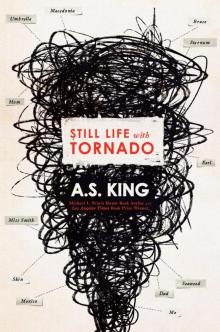
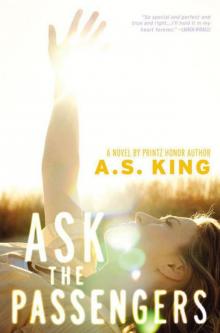
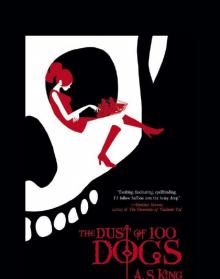
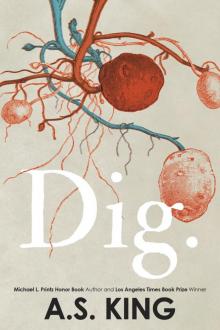
Amy Sarig King is the author of the critically acclaimed novels The Year We Fell From Space and Me and Marvin Gardens. She has also published many award-winning young adult novels under the name A. S. King including Dig, the 2020 Michael L. Printz Award winner; Please Ignore Vera Dietz, a Michael L. Printz Honor book; and Ask the Passengers, which won the Los Angeles Times Book Prize. She is the recipient of the 2022 Margaret A. Edwards Award for a lasting contribution to young adult literature, and lives in Pennsylvania with her epic kid. Visit her website at as-king.com.
Copyright © 2022 by Amy Sarig King
All rights reserved. Published by Scholastic Press, an imprint of Scholastic Inc., Publishers since 1920. SCHOLASTIC, SCHOLASTIC PRESS, and associated logos are trademarks and/or registered trademarks of Scholastic Inc.
The publisher does not have any control over and does not assume any responsibility for author or third-party websites or their content.
This book is a work of fiction. Names, characters, places, and incidents are either the product of the author’s imagination or are used fictitiously, and any resemblance to actual persons, living or dead, business establishments, events, or locales is entirely coincidental.
Library of Congress Cataloging-in-Publication Data available
First edition, September 2022
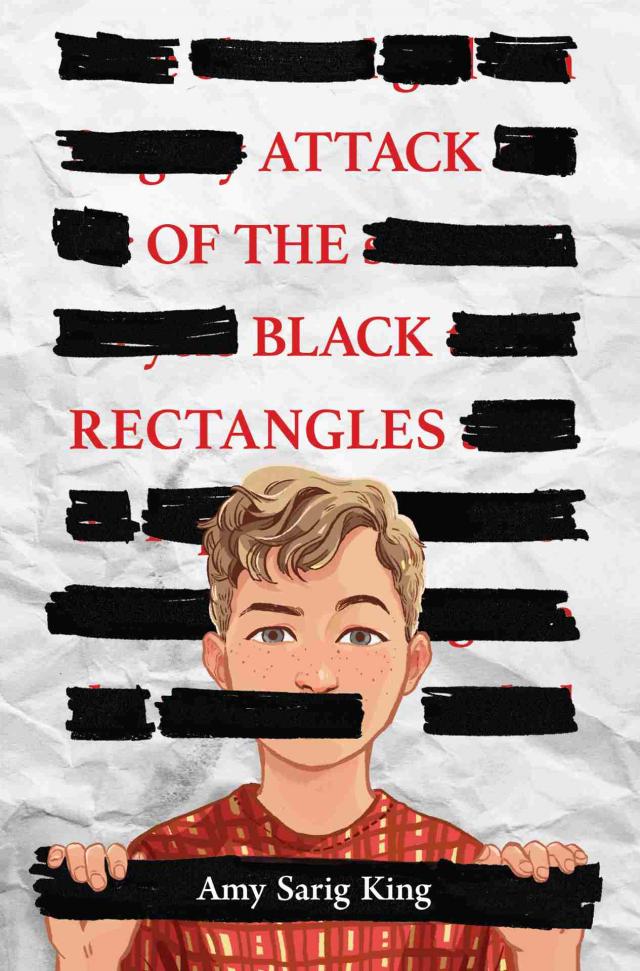
Jacket Illustration © 2022 by J Yang
Jacket design by Elizabeth B. Parisi
e-ISBN 978-1-338-68054-6
All rights reserved under International and Pan-American Copyright Conventions. No part of this publication may be reproduced, transmitted, downloaded, decompiled, reverse engineered, or stored in or introduced into any information storage and retrieval system, in any form or by any means, whether electronic or mechanical, now known or hereafter invented, without the express written permission of the publisher. For information regarding permission, write to Scholastic Inc., Attention: Permissions Department, 557 Broadway, New York, NY 10012.
A. S. King, Attack of the Black Rectangles