Attack of the black rect.., p.8
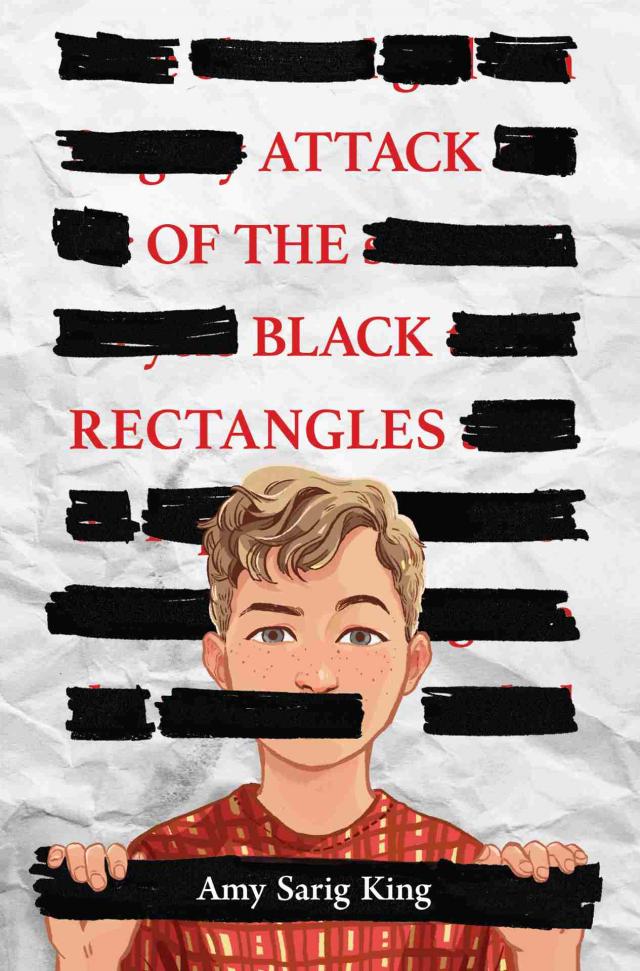
Attack of the Black Rectangles,
p.8


“Yeah,” I say.
“Like I’m some kind of kid!”
Oof. Sometimes, it’s like adults can’t hear what they say when they say it.
As we drive home, Mom tells me what happened in the meeting and then doesn’t say much else because she says she’s still processing. I guess I am, too. When Dr. McKenny said that thing about how we’re still reading the book, she missed the point. I’m sad she keeps missing the point. She’s a principal. She should know how to not miss the point.
But more than that, she should know how to treat my mom. Mom is a tryer. She gives people a lot of chances to do what they say they’ll do and she trusts people—even when she probably shouldn’t.
“How do you feel about it?” Mom asks.
I’m mad, but I’m somehow pretending I’m not. It’s like I’ve inherited long-grass disease from the grown-ups around me. “I don’t know,” I answer. “I think she should care more.”
We park and get out of the car. I get the mail from the mailbox because it’s my favorite thing even though no one ever sends me anything. There’s a magazine and two bills for Mom.
We walk into the house and see the same things at the same time. We both freeze two steps into the living room. Some of our stuff is gone. It looks like we got robbed by a burglar who does interior design. Mom’s favorite chair is still here, and the rocking chair, too, but the rug that was under them is gone. The dining table is here but the centerpiece is missing.
The bookshelves are gap-toothed—random books seem to be gone.
The rug from in front of the kitchen sink—gone.
“Dad?” Mom says. She knocks on his basement apartment door. Opens it. Repeats, “Dad?” Grandad doesn’t answer. It’s Friday. He’s not usually gone on a Friday.
She fast-walks around the house and I follow, finding weird empty spaces where our things once were. One of a set of table lamps. A small pottery vase.
“My knitting bag?” she says.
“My baseball stuff isn’t in the closet,” I point out.
She jogs up the stairs to her bedroom. I go to the garage door and open it.
The spacecraft is gone.
His tools are gone.
“Dad?” I yell.
Mom is upstairs yelling, “Mike?”
I yell, “Grandad?”
She yells, “Dad?”
I go upstairs to my room. Nothing seems to be missing. It’s the same mess I left it as this morning on my way to school. For some reason at this moment, I make a deal with myself to clean up my room every night so Mom doesn’t have to say anything to me about it.
“Dad?” she says.
I go to her room. She’s on her phone, sitting on her bed. All the family pictures she’d framed and put on the walls and the furniture are still there but two paintings are gone, the screws that held them still in the walls.
“Where are you?” she asks him.
All Dad’s dress clothes are gone from the closet where he kept them. It’s like we were robbed but also abandoned at the same time. I’m not stupid. I know what’s happening. I just didn’t think Dad was this mean. Or whatever this is.
“I think Mike cleared out the house and took off,” she says. And in that last part, I can hear her voice buckle under itself. She stays still on the bed. Sighs. I hear Grandad say, “I’ll be right there.”
Mom hangs up the phone and looks at me. I look at her.
Then she offers me a hug and all the mad I was hiding in the car is like a tiny little fish and this huge other fish just ate it and absorbed the mad and now I’m like a huge mad fish that wants to eat all the little mad fish so I can become a fish capable of eating a whole planet. A galaxy. Dad’s galaxy. I want to eat that.
“I am so sorry,” Mom says as we hug.
“You didn’t do anything wrong,” I tell her.
“I don’t even know what to say.”
I can feel her tears seeping through my shirt. I think there’s snot running from my nose and I don’t care.
“You think he just left? Like—forever?” I ask.
“I don’t know,” she says. “I just don’t know.”
“I’m so mad. I don’t understand.”
“Why would he take our things? Those were our things!”
“He took my baseball stuff,” I say. “He doesn’t even like baseball.”
“Oh, Mac, I’m so sorry. We can replace it. I promise.”
I don’t tell her about the lucky rock in my baseball backpack—the one from the game when I hit my first home run. I don’t want to make her feel worse.
We sit like this for a few minutes—hugging and saying things that seem unreal. Asking each other questions we can’t answer. Why did he take a vase? Why did he take the rug?
Before Grandad gets home five minutes later, we breathe a lot and really look around. Dad took some light bulbs and batteries from the light-bulb-and-battery drawer. “And my face cream,” Mom says. “Why would he need my face cream?”
I thought I’d seen Grandad mad before. After he hugs Mom and gives me a hair ruffle at the same time, and after he looks into my mom’s eyes real close-up and says, “We will get through this,” he holds his arms out and breathes a huge breath and then he walks to the garage door and sees how empty the garage is and lets loose a deep howl and curses about ten bad words over and over and over. He walks around the empty space in the garage and then sits down cross-legged on the cement floor and closes his eyes.
I go to the kitchen and get a glass of water for Mom, who is sitting in her chair, now with no rug under it. She thanks me and says, “Get one for yourself, too, bud.”
The garage door is still open and Grandad is still sitting and meditating on the floor.
I get him a glass of water and one for myself, and by the time I’m out in the living room again, Grandad is there and he looks calm.
He says, “I’m calling the police.”
Grandad and Mom let me stay up until midnight. We put on punk rock music and move the furniture around after the police leave. Mom and Grandad take pictures first, of every inch of the house the way it looked when we got home, like the officer suggested, and we start a list of all the missing stuff. By midnight, the list is two pages long. We even leave off the weird stuff. A paper clip holder. Fragrant soap. Toenail clippers.
We move the living room around so it faces the dining table—Grandad says, “That way we can’t ever have our backs turned to each other.” Mom orders a new rug on the internet and reorganizes her books.
I sit in the spot on the cement floor where Grandad sat earlier in the day and I try to meditate the way he does. All I can do is picture Dad flying through space with my baseball stuff poking out the back window.
Mom and Grandad talk pretty loud sometimes. Mom cries a little, but Grandad keeps saying she’s “better off” and then they talk about the mug.
“He knew what he was doing,” Grandad tells her.
“I know,” Mom says.
“He was never gonna change, kiddo,” Grandad says. “He was just getting meaner.”
“I know,” Mom says.
In the morning, as I sit at the dining table munching on a bowl of cereal, I look around and the place feels new. Even with all our old stuff, something about it feels completely refreshed and comfortable.
But when I see Mom at first, she looks like she cried all night. That’s not new at all.
“How you doing?” she asks.
“Good.”
She gives me a hug and kisses me on the head. “I love you like crazy, Mac.”
“Love you, too,” I say.
“It’s all very sudden,” she says. “You’re probably in shock.”
I nod and chew. Cheerios are so delicious.
She starts making herself a cup of tea and Grandad arrives from the basement. “I slept until seven thirty!” he says.
Mom laughs.
He says, “First time in months I managed past five.” He looks around. “The place looks great.”
“I’m not in shock,” I say.
“I didn’t say you were,” Grandad says.
Mom goes quiet while she pours water into her cup, then says, “I did, Dad. Sorry, Mac. I shouldn’t tell you how you’re feeling.”
And now I feel bad because I don’t want Mom to be apologizing to me. Not today. Not ever. I might be in shock. But I’m not as in-shock as she is because I know the truth and she doesn’t.
“I have something I have to talk to you about,” I say.
Mom sits in her usual seat at the table—across from me longways—and she feels too far away for me to talk about this. It feels like it should be whispered. Without Grandad here.
Neither of them says anything.
I look at Grandad and he raises his eyebrows and says, “I’ll be back in ten minutes. Nature calls.”
I rinse my cereal bowl and leave it in the sink and sit down closer to Mom.
“Look,” I say. “This is going to sound really weird, but just listen, okay?”
“Okay,” she says.
I breathe big. Twice. Then: “Dad kept something from you for a long time and he shared it with me and it always felt wrong that I knew this and you didn’t.”
She looks worried.
I continue, “He doesn’t think he’s from Earth. He thinks he’s not human. And the secret we worked on in the garage was his spacecraft.”
The moment hovers. She looks me right in the eye. “Spacecraft,” she says.
“He used to take me for rides in it late at night when you and Grandad were sleeping. Not a lot. Like once a month or so. Usually to eat junk food,” I say. “He’d say he was from two galaxies away and is kind of like an anthropologist, here to learn about us and live a normal human life to be able to report back. It’s probably why he took such weird things when he left.”
Another moment hovers. “Anthropologist,” Mom says.
“I know it sounds like he was just making up a story for me. And sometimes it seemed like it was just a story. But other times, it was like he … meant it. He wanted to fix Grandad’s old car so he could get home. He said he’d been stuck here for—”
“Thirteen years?” Mom interrupts.
“Yeah.”
She sits with this information for a minute and nods and purses her lips. She goes to say a few things but stops herself until she finally says, “You’d go on, like, flights? In space?”
“Not space, really. He couldn’t break the Kármán line,” I say. “That’s sixty-two miles above Earth’s surface. We probably only got up to a mile, maybe. He kept saying he needed elements we didn’t have here. He told me he was probably stuck here for life.”
“I know the feeling,” Mom says.
She seems to be taking this too well. “So you knew?” I ask.
“I knew he was stuck. I didn’t know he was an alien. We’ll keep talking about it.”
“Does Grandad know?” I ask.
“We should tell him,” she says. Then she sends him a text on her phone and he arrives so quickly, I know nature did not call and he was probably waiting on the steps until we were done.
“I’m hungry,” he says. “Anyone want pancakes?”
Grandad laughs when I tell him what Dad said, just like I thought he would. He’s making the best pancakes you’d ever eat. Adding blueberries to his and chocolate chips to mine. He says, “I’m amused, Mac. I’ve waited my whole life to meet an alien and all this time …”
“Dad,” my mom warns.
“I knew he was weird. I mean, I even told you that time he ate peanut butter with his tortilla chips. That’s got to be an alien thing.”
Mom is smiling now, and it’s kinda funny. I think I’m smiling, too.
Grandad says, “Between that and the way he never wiped his shoes off.”
“And he couldn’t really sneeze,” Mom says. “For real—not even if he got dust or pepper up his nose.”
“And he never played catch or did anything I wanted to do,” I say.
I really thought they’d approve of my contribution, but instead, I stop the conversation cold.
I say, “What? He didn’t. He was only interested in his ship. That’s where he’d spend time with me, but he wouldn’t talk to me or anything, besides asking me to hand him a wrench or whatever.”
Mom says, “I’m sorry, Mac.”
“For what?” I say. “You play catch with me all the time.”
Mom and Grandad look at each other in that way that adults do. Mom chews the inside of her cheek like she does when she’s thinking hard about taxes or how to solve a problem.
Grandad says, “I’m sorry, guys. I meant that to be sarcastic. Or funny or something. I guess I make light of things that cause pain. Old habit.”
“Mac,” Mom says. “You have to switch gears for me. I know this will be a bit hard. But, um …”
“I knew you would do this,” I say. “Adults always want to say that weird stuff isn’t weird, but—”
Grandad interrupts me. “I think plenty of stuff is weird, son, but here’s what I think—your dad isn’t an alien; he’s just kind of a jerk. And that wasn’t a spaceship. It was my car.” He takes a deep breath.
“Sometimes our brains make reasons and stories for other people to help them make sense to us.” Mom says this so softly, I can’t even get mad at her. “If he was pulling you out of bed in the middle of the night, while Grandad and I were asleep … I can’t imagine what stories he’d tell you when you were half-awake.”
Grandad says, “With the top down, that car can feel like a spaceship, I guess.”
“It wasn’t just a car,” I say. “Not to him.”
“That’s true. It was a very special car. Your gram and I—uh—well, we did things in that car that were—uh—full of love,” Grandad says.
“That’s not what I meant,” I say.
Mom and Grandad stare at me and I just know they’re going to say something about how I should go talk to my mom’s sister, Aunt Diane, who’s a counselor.
The two of them are looking at me like I’m a rescue kitten in a shelter window. Mom even has tears in her eyes.
“Mac,” she says. “Come here.”
She gives me a really nice hug and her tears end up in my eyes and it’s weird how she did that. “I’m so sorry, buddy,” she says. “It really is a car. I’ve been in it many times. It was our car when I was growing up.”
“The Karmann Ghia,” I say.
“Yep,” Mom says.
Grandad grunts a little, like he’s remembering the car and all the memories in it. It’s a mix of “huh” and “hmph” and “mm.”
I don’t understand myself right now. I don’t know what to say. Because I guess there was always a part of me that went along with everything Dad said, to the point that I could even have memories of flying in space with him. I don’t know how I can have memories of something that didn’t happen. Like—twenty times. I know the difference between the anime I make up in my head and reality. I mean, I think I do. Right?
“Maybe he was really an alien or magic or something and he could make me believe the car could fly,” I say. “Because I really believed I flew in that car.”
“He was magic all right,” Mom says.
“Yep,” Grandad says. He finally sits down to eat after serving me and Mom. He doesn’t use maple syrup—never has. He says that the fruit is sweet enough. This is the town candy freak.
Maybe he’s the alien.
Maybe we’re all aliens.
Marci Thompson is not an alien. I’ve never met a more annoyingly determined and punctual human being in my life.
It’s Mom who answers the door.
“Hi, Ms. Delaney,” Marci says. “Is Mac here?”
When she gets to the kitchen, the table is still covered with syrupy plates and forks and crumbs, empty mugs and half a glass of orange juice that I couldn’t stomach after the syrup and chocolate chips.
“Good morning, Marci,” I say before she even rounds the corner of the hallway. I hear myself say it. I sound forty and like Marci is coming to my office. As if last night I was a sixth-grade boy and this morning I’m some kind of insurance salesman.
“So. Are we ready to go?” Marci asks.
Grandad says he has to get his bucket of candy. I put my shoes on. Marci hands me a sign. It says STOP CENSORSHIP AT INES!
“Do you have anything more snazzy?” I ask.
She holds up her sign. INTELLECTUAL FREEDOM IS A RIGHT.
“We’re going to have to work on some slogans,” I say.
“Yeah. I can’t say it was my most inspiring sign-making night. My cat kept throwing up.”
Grandad arrives with his bucket and a baseball hat so his head doesn’t get sunburned. He grabs three lawn chairs and we say goodbye to Mom. I don’t want to leave her today. Sometimes I think I don’t want to leave her ever.
“Are you sure you don’t want to come with us?” I ask.
“I have errands to run. Don’t worry. I’ll keep myself busy.”
I wish I could tell you that the protest is exciting, but it’s just me and Grandad and Marci sitting outside Tad’s with our signs and eating candy. It isn’t much different from any other Saturday when we eat candy. The same old people stop by to talk to Grandad. They ask me and Marci questions just to be nice.
“What’s going on with those signs?”
“They’re really censoring books?”
“Do you think you can stop them?”
A few tourists stop and ask what the signs mean. Marci shows them the black rectangles in her book. One guy offers to give a donation but Grandad says we don’t have a need for money. Just for action.
The whole time, I think about how I’m treating what Dad did like he’s a guy who works in my office who resigned and is getting a job somewhere else. Not a big deal. Whatever. But on the inside, I know I’m not okay. I’m mad for how he hurt Mom. I’m mad about my baseball stuff. I’m mad he lied to me and made me look like a dumb kid because I believed him. Each thing that makes me mad, I put it in a dull-colored folder and file it in a gray filing cabinet.