The oresteia, p.17
The Oresteia,
p.17


899Here, the only time Orestes hesitates (and the first time he says “mother”), he turns to Pylades, who utters his first and only lines. Since Pylades comes from near Delphi, it is appropriate that he should speak for Apollo.
924This apparently figurative expression for her revenge turns into the actual gathering of the Erinyes, as Orestes will see clearly at lines 1053–54.
935ff.The manuscript of this song also contains many problems of text and interpretation and has been substantially trimmed.
1038ff.Suppliants who threw themselves on the mercy of a god would usually hold a branch of olive or laurel bound round with ribbons of wool. Apollo’s famous shrine at Delphi contained a stone, the omphalos, which was held to be the navel of the earth; there was also a sacred fire that never went out.
1048This epilogue by the Chorus plays a subtle variation on the trilogy structure of the plays. The third episode reflects the shape of this, the second play: what had seemed like a final resolution (“kind of savior”) has turned out to be leading to yet further tribulations (“more a death knell”). The play ends with an unresolved question: What will happen in the fourth episode, viz the third play?
Orestes at Athens
2Gaia (“Earth”) and Themis (“Order,” “Right”) were traditionally said to have been the first gods worshipped at Delphi. The usual story of what happened next told about the dragon Pytho and its violent defeat by Apollo; this is replaced here by what is emphasized as a peaceable succession.
9Delos is the island in the Aegean Sea where Apollo and Artemis were born.
21The temple of Athena Pronaia was below the main sanctuary to the southeast; it was on the road up from the gulf far below.
22The large, numinous Corycian Cave is higher up, not far below the highest parts of Parnassus.
24ff.Dionysus was believed to inhabit Delphi in the winter, while Apollo was away. The myth of how he punished his nephew Pentheus, the king of Thebes, was well known, although it was usually, as in Euripides’ Bacchae, located on Mount Cithaeron rather than Parnassus.
27The river Pleistus flows in the valley far below Delphi.
29The priestess sat on a throne, or in other accounts on a tripod, and then the oracles were delivered through her voice.
40The omphalos stone was oval-shaped and stood about a meter high.
50Phineus was a mythical king who was pestered by the winged Harpies. The Gorgons were characterized by their horribly ugly faces and snaky hair.
140ff.The original staging is uncertain. The opening lines of the Chorus were probably broken up between individual members.
234ff.At this juncture, the setting of the play changes from Delphi to Athens, and a considerable amount of time is understood to have passed, with Orestes on the run and the Erinyes close on his heels. This brings out how long and relentless the pursuit has been.
292ff.The significance of these two locations—the river Triton in Libya and Phlegra in Thrace—is not clear, except that they represent the distant south and north, respectively.
333For Moira (plural Moirai), see p. xxx.
470ff.It takes Athena’s wisdom to see that while humans cannot solve this crisis by themselves, it cannot be resolved simply by divine will, either, since it has such human consequences. Her solution is to set up a jury under her supervision.
After 573There is a major change here from the usual text as it is transmitted in the Greek manuscripts, as is indicated by the marginal line numbers. Athena’s founding speech for the court (lines 681–708) has been moved back from some one hundred lines later to this context, where it makes appreciably better sense.
Before 574A few lines have been added at the end of Athena’s speech to make the arrival of Apollo less abrupt.
685The Amazons were believed to be a tribe of warrior women, located in Thrace or in Asia Minor, who participated in various mythical conflicts. The usual myth was that they invaded Athens in reprisal for a raid mounted against them by Theseus.
641The tradition was that when Zeus overthrew his father, Cronus, along with Cronus’ Titan brothers, he imprisoned them below in Tartarus.
657ff.There is some evidence that this embryological theory had been put forward by some protoscientists around the time of Aeschylus. It can hardly be treated as definitive, however, since, for the whole trilogy so far, it has been taken for granted that the mother is indeed one of the two parents. Apollo’s case is also diminished by his crude language in the next line.
676–80 and 711ff.During this dialogue the jurors come forward, one for each couplet, and deposit their votes. There were two urns, and the procedure was that each juror would put his hands into the top of both but drop the voting pebble into only one.
718The mythical hero Ixion killed his father-in-law and so became the first murderer; he then appealed to Zeus for absolution and became the first suppliant.
723In gratitude for hospitable treatment, Apollo arranged for Admetus, a king in Thessaly, to be spared from imminent death, provided someone else died for him (this is the story in Euripides’ Alcestis). Apollo did this by getting the Moirai drunk.
734In classical Athens, if the votes were tied, it was taken as acquittal, thanks to “the vote of Athena.” Athena makes this declaration after the voting is over, and so does not influence the jurors with it. Her reasons are personal and supernatural; she does not offer her birth as a relevant consideration, as Apollo had done earlier.
858–66Nine strange lines that clearly do not belong in this place have been omitted.
944Pan was a god of the wilds, but he was also a patron of shepherds and their wandering flocks.
1028These purple robes, which are put over the Erinyes’ black ones, may allude to the robes worn by noncitizen settlers (metics) at the annual Panathenaia festival in Athens.
1043and 1047 The call here is to raise the ololygmos, the “triumph-cry,” which was especially associated with women. This has had sinister uses earlier in the trilogy, especially in connection with Clytemnestra, but is now used joyfully.
RECOMMENDED PRONUNCIATIONS OF PROPER NAMES
A verse translation necessarily has to incorporate some assumptions about the pronunciation of names and, especially, which syllable is to carry the most stress. The list below gives a rough phonetic transcription of the pronunciations adopted for the most recurrent names in this translation, with the stressed syllable in bold. Please note that these do not pretend to be the ancient Greek pronunciations, which in many cases were substantially different.
Aegisthus
Ee-giss-thuhss
Agamemnon
Agguh-mem-non
Apollo
Uh-poll-lo
Ares
Air-eez
Argive
Are-guyve
Argos
Are-goss
Artemis
Art-amiss
Athena
Uh-theen-uh
Atreus
At-trooss
Aulis
Owl-liss
Cassandra
Kass-sand-ruh
Clytemnestra
Clite-uhm-nest-ruh
Daimon
Dye-mon
Delphi
Dell-fee
Electra
Ell-leck-truh
Erinyes (plural)
E-reen-new-ezz
Erinys (singular)
E-reen-noose
Hades
Hade-eez
Hermes
Herm-eez
Iphigeneia
Iffy-jen-nigh-yuh
Menelaus
Mennuh-lay-uhss
Moira
Moy-ruh
Orestes
Aw-rest-eez
Priam
Pry-uhm
Pylades
Pill-uh-deez
Pythia
Pithy-yuh
Scamander
Scam-mand-uh
Thyestes
Thigh-est-eez
Zeus
Zyouss
ACKNOWLEDGMENTS
I am especially indebted to Josh Billings, my coeditor for the Norton Critical Edition, who offered much sage advice and encouragement (and even remarked on one passage as “like Emily Dickinson”!). Claire Catenaccio and Arabella Currie also made many helpful observations on the draft version. At Norton, Carol Bemis has been a great champion, and I am also grateful to Marie Pantojan, Rachel Goodman, Bonnie Thompson, and Harry Haskell for their various roles in producing the volume. At home, above all, I have to thank Beaty, as ever, for her love and support, Charis for keeping me alert, and Phoebe and Nat for keeping in touch.
ALSO BY OLIVER TAPLIN
The Stagecraft of Aeschylus
Greek Tragedy in Action
Greek Fire
Homeric Soundings
Comic Angels
Pots and Plays
Copyright © 2018 by Oliver Taplin
All rights reserved
For information about permission to reproduce selections from this book, write to Permissions, Liveright Publishing Corporation, a division of W. W. Norton & Company, Inc., 500 Fifth Avenue, New York, NY 10110
For information about special discounts for bulk purchases, please contact W. W. Norton Special Sales at specialsales@wwnorton.com or 800-233-4830
Book design by Chris Welch
Production manager: Lauren Abbate
JACKET DESIGN BY KATHLEEN LYNCH / BLACK KAT DESIGN
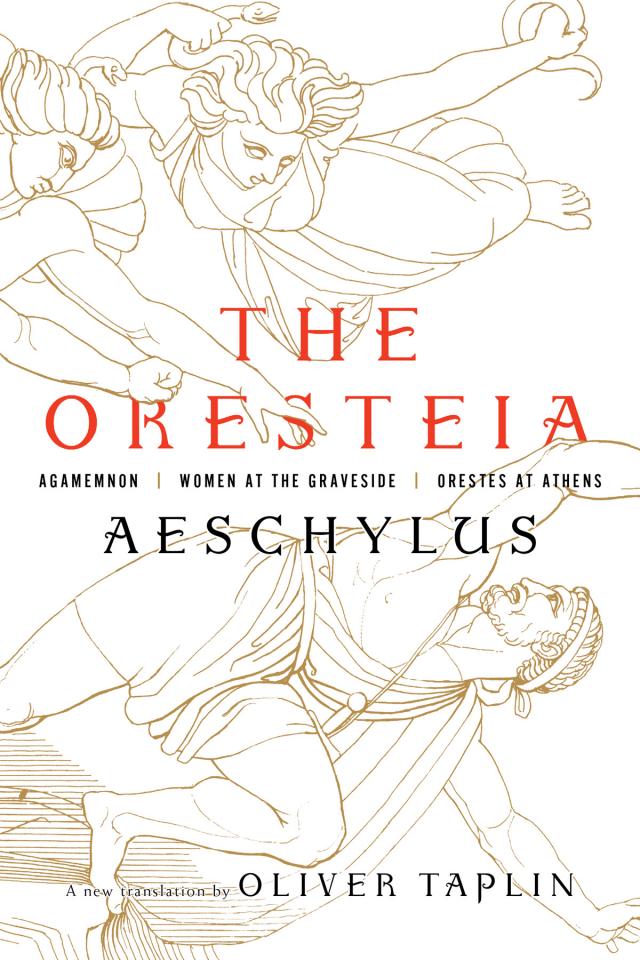
JACKET ILLUSTRATION: ORESTAS PURSUED BY THE FURIES, 1795 (ENGRAVING), FLAXMAN, JOHN (1755–1826) / PRIVATE COLLECTION / BRIDGEMAN IMAGES
ISBN 978-1-63149-466-6
ISBN 978-1-63149-467-3 (e-book)
Liveright Publishing Corporation, 500 Fifth Avenue, New York, N.Y. 10110
www.wwnorton.com
W. W. Norton & Company Ltd., 15 Carlisle Street, London W1D 3BS
Aeschylus, The Oresteia