Straight silver, p.16
Straight Silver,
p.16
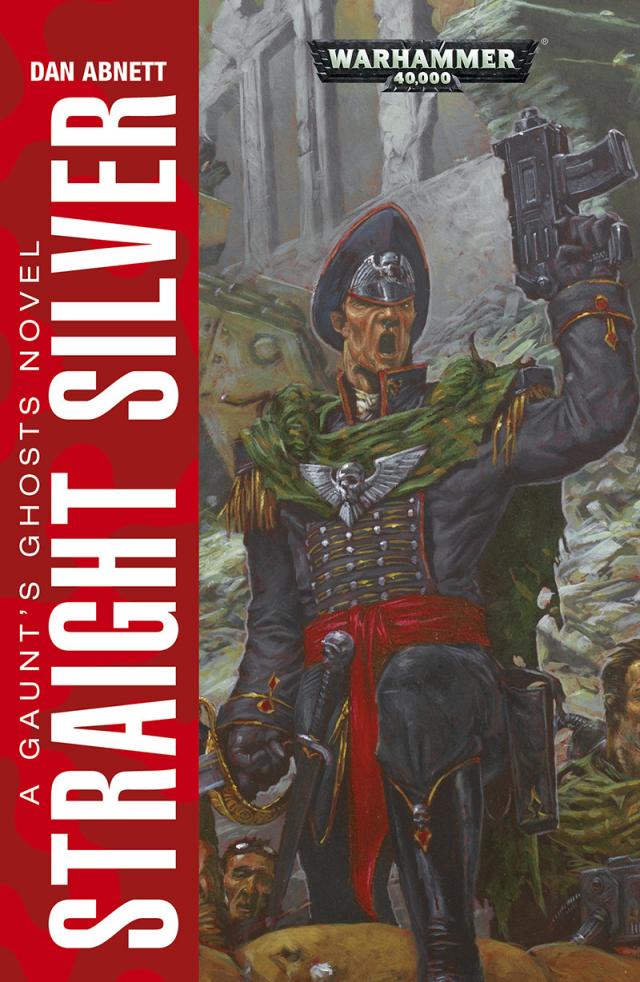


To the north, there were intermittent light attacks and raids all through the night at Loncort and the Salient. Unconfirmed reports were circulating that sectors north of Gibsgatte had endured the biggest offensive of the year, and that battle still raged there.
The morning was damp and fog-bound. With Beltayn his only companion, Gaunt travelled north for Meiseq. Beltayn said little. He could tell Gaunt was in a foul temper, and didn’t want to provoke anything.
A staff car conveyed them as far as Ongche, where they boarded a despatch train bound for the north. The train was half-empty, and rattled along through misty farmland and rain-swept heath.
Prior to departure, just after dawn, Gaunt had made a final inspection of the First’s positions. Daur’s relief squads were at the front by then, though Corbec was to remain as line XO until Gaunt’s return.
At the end of his tour, Gaunt had made a call at the military hospital in Rhonforq, spending time with the injured and looking in on the critical cases. Rawne had survived the night, though he’d required secondary surgery in the small hours to staunch internal bleeding.
Dorden was so fatigued by then he seemed almost asleep on his feet, and the bruises he’d taken in the beating were starting to nag at him. Gaunt had been intending to ask the chief medic to accompany him to Meiseq, but one look at Dorden stifled the idea. Dorden was needed at Rhonforq, if only to get some rest.
Gaunt knew that Dorden was still angry with him about the discipline killings. He had a right to be, in Gaunt’s opinion. Gaunt had been in a dazed rage the afternoon before, weary with the pointless losses he’d witnessed at station 289. He’d just snapped.
As an Imperial commissar, Gaunt was unusual, quite apart from the fact that he held command rank. Commissars were universally feared. They were the Guard’s instruments of discipline and control, the lash that kept the soldiery in line and drove them forward. They were there to drum the tenets of the Imperial creed into the minds of the enlisted men, and then give them stark, regular reminders of that truth. Summary execution, even for minor violations, was acceptable stock-in-trade for a commissar. The great Yarrick himself had once said that it was a commissar’s job to be a figure of greater fear and threat to an Imperial Guardsman than any enemy.
That was not Gaunt’s way. Experience had shown him that morale was better served by encouragement and trust than by an unpredictable temper and a pistol. He’d had a good example in the form of his mentor, the late Delane Oktar. Oktar’s philosophy of morale had been based on trust and tolerance too. There had been times when a firm hand had been called for, a few more when action had worked better than words.
But Gaunt prided himself on his fairness, and knew that he was able to count men like Dorden as friends because of it. At the field hospital, he’d acted just like a typical commissar. Dorden hadn’t said anything, but Gaunt had seen the disappointment in his eyes.
As the train rattled north, he turned the incident over in his mind. There was no point setting the blame on fatigue. Fatigue implied weakness, and a commissar could never be weak. He realised it was more a matter of futility. He’d come into the Aexe war with reservations, and each step of the way to the front had confirmed his fears. War was not senseless of itself. Faced with the immortal obscenity of Chaos, humankind had a true cause to rally around and fight for. There was a greater good, a purpose, even here on Aexe.
It was the manner of this war that was senseless. The dismissive contempt with which the Alliance threw men and materiel at the enemy. The antique thinking that believed brute strength was the main determining factor behind victory. It made Gaunt angry to see this, angrier still to have the First caught up in it. The afternoon before, he’d been smothered by the futility, and it had worked its ministry on him.
Outside, the world went by. One world, just one of thousands, hundreds of thousands, that combined to form the greatest achievement in human history. The Imperium of Mankind. Many believed that the Imperium was so vast in scale, so huge in scope, that the actions of one man could not affect it. That wasn’t true. If everyone thought that way, the Imperium would simply collapse in upon itself overnight. Each and every human soul determined their part of Imperial culture. That was the only thing the Emperor asked of a man. Be true to yourself, and all those myriad tiny contributions would combine to build a culture that could endure until the stars went out.
Beltayn was asleep, his head nodding onto his chest, his bandaged hand cradled in the other. Beyond the window pane, broken woodland flickered by, cut by hillsides dark with rain. A stream flashed like a drawn sword. Meadows lay invisible beneath cloaks of white mist. Uplands broke through fog like the tips of grey reefs. A lone, lightning-scarred tree stood vigil on a bare hill. A village slumbered, derelict. Clouds as thick as ruffled taffeta chased each other across the sky.
Gaunt woke from a recurring dream about Balhaut, and realised the train had stopped. The rain drummed down and gloomy woodlands surrounded the carriage windows. He checked his timepiece: an hour past noon. They should be in Chossene by now.
He got up and walked down the empty carriage to the door. Opening the window, he smelt the damp undergrowth and soil of the wood, and heard birdcalls and the batter of rain on the leaves. Other passengers were peering out. Down at the locomotive, engineers had dismounted.
Gaunt opened the door and jumped down onto the overgrown track side.
The locomotive had broken down, one of the engineers told him. Repairs were beyond them. They were going to have to wait until a relief tender could come out from Chossene.
‘How long will that be?’ Gaunt asked.
‘Three or four hours, sir.’
Gaunt shook Beltayn to wake him up.
‘Come on,’ he said. ‘We’ve some walking to do.’
‘What’s wrong, sir?’ asked Beltayn sleepily.
Gaunt smiled. ‘Something’s awry.’
The mists were beginning to clear as they trudged up through the woods, heading west on a little-used path. Pale sunlight shone down through the branches of the wood. The rain had stopped, but still rainwater fell, dripping down from the canopy. The air smelled of wet, and the scent of some wildflower.
The engineer had given them directions. A village, Veniq, lay half an hour’s walk to the west. Someone there could provide the Imperial officer with transport, the engineer supposed. In his opinion, it was better to stay with the train. Help was coming. Eventually.
Beltayn had been in favour of waiting too. ‘We might walk for hours. Or get lost. Or–’
‘If we wait for the relief tender, we’ll miss my appointment for sure. Meiseq’s still a good way away. We walk.’
The track was muddy and it was slow going. Beltayn insisted on carrying Gaunt’s overnight pack but, with his own kit and his damaged hand, he was over-encumbered and kept stopping to put something down and resettle his load.
The cool air was bracing. Gaunt realised he was raising a sweat, and took off his stormcoat, flopping it over his left shoulder. Behind them, back down through the woods, they heard a train whistle. If that was the relief tender, then they really had made a bad choice and wasted a lot of effort.
‘You want to go back, sir?’ asked Beltayn when he heard the whistle note.
Gaunt shook his head. This brisk walk through the empty calm of the wood was like a balm. His lungs were full of cool, smoke-free air and his nostrils full of flower scent. It was amazingly strong now. He didn’t know what it was. Little bright-blue flowers with odd-shaped petals covered the ground between the trees, showing over the wet moss and ivy. He wondered if it was them.
He turned to Beltayn and took his overnight bag from him. Then he took Beltayn’s pack too.
‘That’s not necessary,’ said Beltayn.
‘Ah, let me carry them a while,’ said Gaunt.
The track wound through the wood, but there was no sign of farmland or the village. They crossed a rushing brook by way of an ancient stone bridge, black with mould. Bird calls and the burr of insects floated eerily through the trees. In one dense thicket, the beythorne was strung with spider webs that glinted with beads of rainwater like quartz.
‘What did the engineer mean about brigands?’ Beltayn asked, pausing to get a stone out of his boot.
‘Deserters, I believe,’ said Gaunt. ‘Over the years, bands of them have run to ground out here in the wooded country. They live by pilfering from farms, poaching…’
‘Brigandry?’ Beltayn added. ‘Being, as it seems, brigands.’
Gaunt shrugged.
‘Well, maybe this was a bad id–’ Beltayn began, but shut up as Gaunt raised a hand.
Across the next clearing, a stand of white birch with gleaming bark, a deer had emerged from the smoke of mist. It stood for a moment, regarding them with its head cocked. Then it turned and darted away.
A heartbeat later, and they saw others, distantly, chasing soundlessly through the woods.
Like ghosts.
A full hour after they had begun their hike, they emerged from the edge of the wood at a point where the land became planted fields. Swaying heads of young, green wheat covered the slopes down the waist of a hill towards a fresh line of woodland in the valley.
It was a decent vantage point, but there was no sign of any village.
‘I’m hungry,’ said Beltayn.
Gaunt looked at him.
‘Just saying,’ he said.
Gaunt put the bags down and mopped his brow. The walk had reinvigorated him, but he was beginning to agree with Beltayn. This had been a bad idea.
He checked the position of the sun, and read his timepiece. He wished he’d brought his compass, or his locator, or even his auspex, but there had seemed no need that morning. His bag contained nothing but his shaving kit, his number one uniform, and his copy of The Spheres of Longing.
He wanted to ask Beltayn which way he favoured, but to do so would be to admit he was lost. He decided they should follow the track down the edge of the field where it curved into the bottom of the valley. Perhaps there’d be a road down there.
They’d gone about a hundred paces, when he stopped again. ‘You see that?’ he asked.
Beltayn squinted. Down in the valley, hidden in the woodland there, was a building. Grey chafstone, the roof made of slate. Some sort of tower poked up through the canopy.
‘You’ve got sharp eyes, sir,’ said Beltayn. ‘I’d never have seen that in a thousand years.’
‘Come on,’ said Gaunt.
It was a chapel, old and rundown, buried in the green twilight of the wood. Trailing ivy and fleece-flower clung to its walls. Bright green lichens gnawed the chafstone. They walked around the partially-collapsed wall, in through the old gate, and up the path to the door. The scent was back, that flower scent. It was so strong, it made Gaunt feel like sneezing. He could see no flowers.
Gaunt pushed open the door and walked into the cold gloom of the chapel. The interior was plain, but well-kept. At the end of the rows of hardwood pews, a taper burned at the Imperial altar. Both men made the sign of the aquila, and Gaunt walked down the aisle towards the graven image of the Emperor. In the stained glass of the lancet windows, he saw the image of Saint Sabbat amongst the worthies.
‘Well,’ murmured a voice from the darkness. ‘There you are at last.’
She was very old, and blind. A strip of black silk was wound around her head across her eyes. Her silver hair had been plaited tightly against the back of her skull. Age had hunched her, but stood erect she would have towered over Gaunt.
There was no mistaking her red and black robes.
‘Sister,’ Gaunt said, and bowed.
‘Welcome here. There is no need for obeisance.’
Gaunt looked up. How had she known he was bowing? For a scant second, he wondered if she was some gifted seer, but then he caught himself. Stupid. Her senses were sharp, and attuned to her blindness. She’d simply noted the direction of his voice. ‘I am Colonel-Commissar Ibram Gaunt,’ he said.
She nodded, as if she didn’t especially care. Or, Gaunt thought, as if she already knew. ‘Welcome to the Chapel of the Holy Light Abundant, Veniq.’
‘We’re near the village then?’
‘Well, the name is a little misleading. Veniq is about four kilometres south of here.’
Beltayn groaned quietly.
‘Your boy is disheartened to hear that,’ she said.
‘My boy? My adjutant?’
‘I hear two of you. Am I mistaken?’
‘No. We’re trying to reach Veniq, to find transport. Our train… well, it doesn’t matter. I need to be in Meiseq tonight.’
She sat down on one of the pews, feeling her way with one hand, leaning on her staff with the other. ‘That’s a long way,’ she said.
‘I know,’ said Gaunt. ‘Can you perhaps set us on the right road?’
‘You’re on the right road already, Ibram, but you won’t reach your destination for a while.’
‘Meiseq?’
‘Oh, you’ll be there tonight. I meant…’
‘What?’
She settled herself against the stiff back of the pew. ‘My name is Elinor Zaker, once of the Adepta Sororitas Militant, the order of Our Martyred Lady. Now warden and keeper of this chapel.’
‘I am honoured to meet you, sister. What… what did you mean about my destination?’
She turned her head towards him. It was the fluid neck-swivel of a human who had been habituated to helmet-display target sensors. For a moment, Gaunt felt like she was aiming at him.
‘I should speak less. There are things that mustn’t be said, not yet. You’ll have to excuse me. I get so few visitors, I feel the urge to gabble.’
‘What things mustn’t be said?’ Gaunt started to say, but Beltayn spoke over him.
‘How long have you been here, lady?’ he asked.
‘Years and years,’ she said. ‘So many, now. I tend the place, as well as I am able. Does it look trim and clean?’
‘Yes,’ said Gaunt, glancing around.
She smiled a little. ‘I can’t tell. I do my best. Some things I see clearly, but not my environment. He doesn’t sound very young.’
Gaunt realised this last comment had been made about Beltayn. ‘My adjutant? He’s… what, thirty-two?’
‘Thirty-one last birthday, sir,’ said Beltayn from the far end of the aisle.
‘Well, he’s no boy, then.’
‘No,’ said Gaunt.
‘I understood it would be a boy. No disrespect, Ibram. You’re important too. But the boy, he’s the crux.’
‘You seem to be speaking in riddles, sister.’
‘I know. It must be very distressing. There are so many things I can’t say. It would ruin everything if I did. And it’s really too important, so that mustn’t happen. Was there a boy? Very young? The youngest of all?’
‘My previous adjutant was a boy,’ said Gaunt, suddenly very unsettled. ‘His name was Milo. He’s a trooper now.’
‘Ah,’ she said, nodding. ‘It gets it wrong sometimes.’
‘What does?’ asked Gaunt.
‘The tarot.’
‘How can you read cards when you can’t see?’ Beltayn asked warily.
She turned her head towards the sound of his voice. Another careful aim. Beltayn stepped back slightly as if he had been target-acquired. ‘I don’t,’ she said. ‘It reads me.’
With her head turned, Gaunt could see the long, pink line of the scar that ran over the top of her skull, seaming her white hair like a plough-furrow through corn, down to the left side base of her neck. He sighed inwardly. He’d almost been taken in by her talk. He’d been on the verge of believing they had stumbled upon – or been fatefully drawn to – a prophetic being. But now everything, even her peculiarly apt references to Milo, took on another meaning.
She was mad. Brain-damaged in some long-ago action. Rambling, talking at shadows, deprived of contact by her lonely vigil.
Gaunt needed to get on. ‘Look, sister… we are heading for Meiseq. I believe lives depend on us getting there. Is there any way you can help us?’
‘Not really. Not in the grand scheme of things. You’re going to have to help yourselves. You and the boy, I mean. As far as Meiseq goes… I wouldn’t want to go there. Ugly place. An affront to the eyes. But you can borrow my car, if you like.’
‘Your car?’
‘No use to me any more. It’s garaged in one of the barns across the lane. You might have to clear undergrowth from the doors, but the car runs. I turn it over every day. The keys are on the doorpost hook.’
Gaunt nodded to Beltayn, and the adjutant hurried out of the chapel.
‘Has he gone?’ she asked.
‘Gone to find the car,’ Gaunt said.
‘Sit with me,’ she whispered.
Gaunt sat beside her on the pew. Rambling though she was, Sister Zaker was doing him a favour, so he could at least humour her for a minute or two.
He could smell the flower-scent again. Where had he smelled that before?
‘It will be hard,’ she confided.
‘What will?’
‘Herodor,’ she replied.
‘Herodor?’ The only Herodor Gaunt knew of was a tactically insignificant colony world some distance to coreward. He shrugged.
‘I’ve been allowed to pass on a few things,’ she said. ‘There is harm throughout. But the greatest harm, ultimately, is within. Within your body.’
‘My body?’ Gaunt echoed. He didn’t really want to get drawn into this. But she deserved civility.
‘Figuratively, Ibram. Your body, as DeMarchese describes the body. Have you read DeMarchese?’
‘No, sister.’ Gaunt wasn’t even sure who DeMarchese was.
‘Well, do so. The harm is in two parts. Two dangers, one truly evil, one misunderstood. The latter holds the key. It’s important you remember that, because you commissars are terribly trigger happy. I think that’s it. Oh, there is something else. Let your sharpest eye show you the truth. That’s it. Your sharpest eye. Well, that about does it. I hope I’ve made myself clear.’