Straight silver, p.23
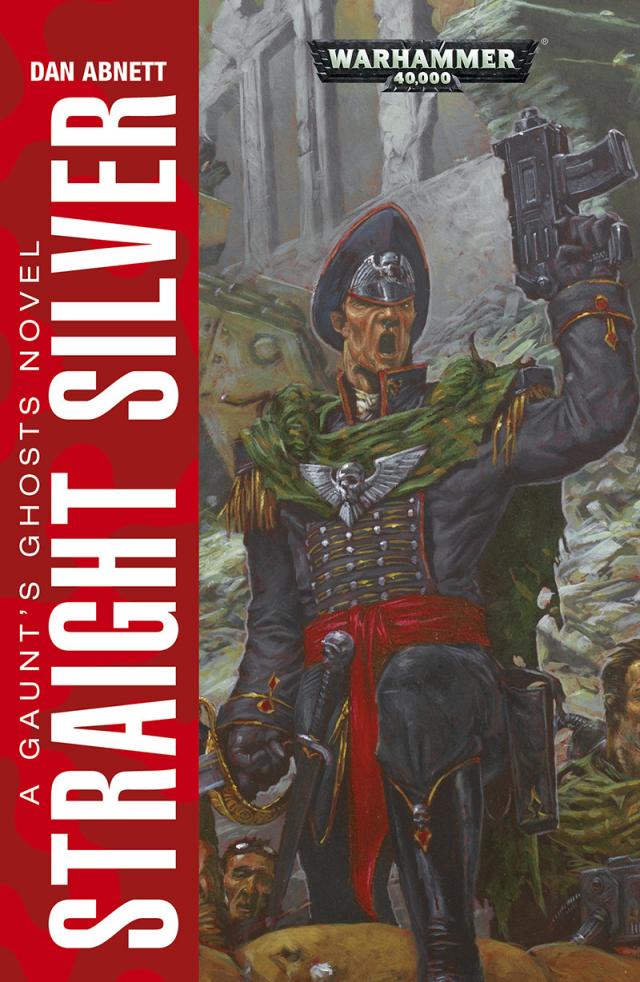
Straight Silver,
p.23


‘Been busy?’ she asked him.
‘There’s not a lot to use, but I managed to raise a barricade across the yard at the back of the kitchen. And I boarded up some of the ground floor windows at the back.
‘Where’s Caffran?’
‘Doing the rounds,’ he said.
Caffran was actually emptying pots. No one had bothered to tip out the pots and pans that had been standing under the drips, and now some of them were overflowing. He opened the front door and slung each one empty into the downpour.
Light bled into the hallway from the drawing room, along with raucous noise and the smell of a decent fire. Caffran could hear Brostin telling a coarse story, and Cuu and Gutes exploding into laughter. A bottle broke. There was another, stranger sound that Caffran realised was Feygor laughing too, choking the noise in and out of his augmetic throat.
Caffran shuddered.
He closed the front door. He hadn’t been able to find Larkin anywhere.
He looked at the coatstand. The raincoat had gone.
The drawing room door burst open and Gutes tumbled out. Light and heat and laughter spilled out around him.
‘More wine!’ he exclaimed.
‘Haven’t you had enough?’ Caffran asked.
‘Don’t be so fething uptight, Caff!’ Gutes replied. ‘Why don’t you join us. We’re having a fine time.’
‘So I heard.’
‘Makes a change from the fething war!’ Gutes slurred.
‘The war’s still going on,’ smiled Caffran.
Gutes looked sad. He pulled the door shut, cutting out the sounds of merrymaking. He leaned against the hall wall and slid down until he was sitting.
‘I know. I know. It never lets up, does it? War. There’s only war. It’s the only future we’ve got. Dark? Yes! Grim? Oh, yes, sir! There’s only ever war!’
‘Don’t worry about it, Piet,’ Caffran reassured.
‘I don’t, Caff, I don’t,’ Gutes mumbled. ‘I’m just so tired, you know? Just so very fething tired of it all. I’m worn out. I’ve had enough.’
Caffran crouched down beside the intoxicated trooper.
‘Get off to bed, Piet. Things’ll seem better in the morning.’
Gutes struggled up to his feet. Caffran had to help him.
‘Things seem better now, Caff! They really do. I gotta get more bottles.’ He lurched away towards the cellar door.
Caffran thought about trying to stop him, but decided not to. Gutes was too far gone.
He heard a creak on the stairs above him, and quickly brought round his lasrifle, switching on the lamp pack under the barrel.
Halfway down the stairs, a little old woman flinched at the sudden, fierce beam of light. She was wearing a raincoat, and it was dripping wet.
Caffran’s light illuminated Larkin beside her. He was smiling as he steadied the old woman’s arm.
‘Hey, Caff,’ he said. ‘Look who I found…’
TEN
Santrebar Mill
‘Blood for land: the commerce of war.’
– Satacus, ‘Of the Great Sezars’
The Republic subjected sectors 57 and 58 of the Peinforq Line to a sustained gas attack during the morning. The wind, a brisk westerly, favoured their enterprise, and carried the gas swiftly into the Alliance fire trenches: so swiftly, in fact, Alliance respirator drill was found wanting. Men died in dreadful numbers. Three hundred and forty-eight in one five-kilometre stretch alone. Hundreds more were brought out of the reeking amber mist, frothing and blistering, screaming and crying.
A fitful barrage responded to the gas attack. Less modest artillery quaked the earth for over an hour to the north, in 59th sector.
The gas took a long time to dissipate, and the Shadik had undoubtedly been planning on that. At a few minutes before 15.00, a considerable portion of the 57th sector fire trench was assaulted by a brigade of raiders who had advanced under cover of the chemical fog. For a period of about twenty-five minutes, savage, blind fighting occurred at the 57th, and there seemed a genuine danger that the line would be penetrated. The timely arrival of a detachment of the Bande Sezari, as well as a company of elite Kottsmark chemtroops, tipped the scales. Then the wind turned, and the poison smog began to drift east off the Peinforq defences. The Shadik raiders beat their retreat.
By then, this possible opportunity had been anticipated, and Alliance Staff Command 57th/58th opted to press. Cavalry and light foot elements were pushed through to overtake the raiders then continue on for a counter-attack. They were supplemented by armour.
Alliance armour was in the main ponderous, primitive, rhomboidal tanks with heavy roof or sponson guns. These sluggish giants rumbled their way out into the Pocket. They were menacing, but had not achieved much success in anything but psychological terms since their first employment twelve years earlier. However, on this day, five Imperial Guard Thunderers, spared from the action at Gibsgatte, led them out. By evening, they had made a memorable dent in the Shadik lines. It was the first demonstration of modern armour superiority witnessed on Aexe Cardinal.
At the time of the first toxin shelling, the First was laid up in a secondary line, awaiting the evening advance to the fire trench. They had decent warning time on their side, but their respirator drill was excellent anyway. They sat tight, until word started to come in of the raid on the 57th sector. Daur went to see Gaunt immediately.
‘We can reinforce,’ he suggested. ‘We’re close enough to do some good.’
Gaunt refused the idea. He’d worked hard to secure a legitimate role in the Alliance for both arms of the First, and he wasn’t about to upset that stability with a show of unilateral bravado. However much he wanted to.
‘Stand three platoons to,’ he conceded to Daur finally. ‘If command requests us, we’ll move at once.’
They waited, tense, for an hour or so. When the wind turned and the counter-assault pushed through, Gaunt and Golke moved down to an observation post on the hem of the secondary line.
Borrowing Gaunt’s magnoculars, Golke watched the steady advance of the tanks, his gaze lingering over the heavy-set, trundling shapes of the Guard armour pieces. The Thunderers were painted mustard drab, and moved forward with their siege-dozers lowered, ripping through piquet lines and thorny barricades of wire. Sprays of liquid mud kicked up from their churning treads.
Golke was seriously impressed. He spoke for a while about armour clashes he’d witnessed, though he was so preoccupied with what he was seeing there was no real thread to his talk. Gaunt understood that Golke had received his injuries during one of these clashes, but he didn’t want to press the count for details. Golke mentioned ‘dreadnoughts’, yet the word did not seem to mean the same thing for him as it did for Gaunt. To an Aexegarian, ‘dreadnought’ was a catch-all word for any armoured war machine.
Whistles were blowing all along the trench system to sound all-clear. The gas had washed out of the line. Gaunt took off his respirator and wiped his sweat-damp face. The afternoon light was good and clear, grey and bright, except for the roiling yellow fume of the departing gas that blanketed no-man’s land.
‘Nightfall’s at 19.40,’ Golke remarked. He produced a data-slate. ‘I have a schedule for tonight’s barrages. When do you want to move out?’
It was a legitimate question. Provided he informed Allied GSC, the timing of the Ghosts’ next raid was down to him.
Gaunt looked at the Aexegarian. ‘Now,’ he said.
The main field infirmary of 58th sector was a large system of bunkers situated amidst the reserve and tiring trenches at the back of the line, west of the main gun-pits and artillery dens. Set well underground, beneath a roof of rockcrete and flak-sacks, it was said to have its own shield umbrella too, but Dorden didn’t believe that.
However, the facilities were decent. Curth had made strenuous efforts, since they’d moved north, to secure fresh supplies from the Munitorium fleet, and Mkoll had taken his own platoon back to escort the supplies and make sure they arrived unmolested. Many of the First, Dorden included, had been surprised that Mkoll had not been part of the regiment’s eastward deployment to the Montorq.
‘Scouts are needed here too,’ Mkoll had told Dorden when the subject came up. ‘I‘m not about to head for the forest and expect the lads I leave here to do something I wouldn’t do myself.’
There was an implication in the master-scout’s remark, Dorden felt. Whatever happened out in the Montorq, good or bad, only bad was going to happen here. The Pocket was going to see action, no matter what. Mkoll’s selfless sense of duty wasn’t going to let him shirk.
When the First had been moved up to the 58th sector, Dorden had packed up his field hospital at Rhonforq and brought it with him, wounded and all, so he could maintain personal care for them and be on hand for the new fighting. That afternoon, gas-attack victims poured into the infirmary’s triage hall. None of them were Ghosts, but Dorden and his medicae staff didn’t hesitate. They sprang up to support the Alliance surgeons, bathing eyes, treating burns, washing poisons out of cloth and bubbling flesh. The respiratory damage was the worst. There was little they could do for the victims with fluid-filled, drowning lungs except try to stabilise them.
Dorden worked urgently. He dearly missed Foskin and Doctor Mtane, who had both gone west with the Montorq mission. He wanted to trust the ministrations of the Alliance surgeons, many of whom were devoted, good men, but their medical practices seemed so terribly outmoded. He took careful note of the treatment deficiencies he saw, and hoped there would be an opportunity for him to advise the sector’s chief of medicine on better, less barbarous techniques. At least three troopers he saved that afternoon were dying as a direct result of treatment rather than gas.
A terrible stench of chemical burns and corrupted blood filled the infirmary. Frothy, discoloured waste matter wept in lakes across the stone floor. Corpsmen turned on the roof vents and hosed with disinfectant, but it didn’t do much good.
‘Feth!’ muttered Rawne. ‘The smell is going to choke me to death!’
‘Will it make you stop talking?’ asked Banda. He looked across the aisle at her cot with a withering stare, but she just grinned. She was pale, and a cut above her right eye was black with stitches. Her mending lungs were having a hard time coping with the wretched air. Still, she found the breath to taunt him.
Rawne got up off his cot, and sat carefully. The ward hall was full of Ghosts, as well as a few Krassians, casualties from that first trench fight at the 55th sector. Many, like Rawne, were healing well, but it would be a long time before they could be pronounced fit for active duty. Rawne wondered how many more Ghosts would come through these halls before the present occupants made their way out.
The days since he had been wounded had passed at a dishearteningly slow crawl. Rawne felt detached and very much out of the loop, even though he’d been brought regular reports. He wanted to get up and out, but not because he was such a dutiful soldier he needed to get back to play his part.
He was distressed at the prospect of what feth-heads like Daur might be doing in his absence.
‘What are you doing?’ asked Banda.
He didn’t reply. He grabbed hold of the back of a wooden chair and slowly dragged himself to his feet. The pain in his stomach, which had been a dormant ache for the last thirty hours, started to throb again.
‘What are you doing?’ Banda repeated. ‘Doc Dorden’ll have your guts.’
‘Feels like he already has,’ Rawne snapped.
He took a deep breath, and let go of the chair back.
God-Emperor, it was hard. It felt like his legs had atrophied. It felt like someone had upturned a live brazier in his belly. It felt like someone was stabbing a bayonet into his spine.
‘What are you doing?’ Banda repeated for the third time. Then added, ‘Major?’
That did it. Rawne hadn’t been addressed by rank for what seemed like an age. Especially by Jessi Banda. If he but admitted it, that had been the best part of this enforced stay in the ward. Jammed together by the proximity of their beds, the comatose nature of their immediate neighbours, and their shared suffering at station 293, they had provided conversational company for one another. It wasn’t a friendship, exactly. Rawne certainly wouldn’t acknowledge anything like that, but they’d talked, and played boredom-defeating word games, and joked occasionally. After the first few hours of them being cooped up together involuntarily, she had stopped calling him major and he’d stopped calling her trooper. They had formed a cordial, sparring companionship as a reaction to their situation.
‘I’m going for a breath of fresh air,’ Rawne said, panting.
‘Oh, what? And leave me here? And I thought we were mates.’
It was too much effort to shoot her another withering stare. It was almost too much effort to remain standing. ‘Just…’ he said. ‘Just…’
‘What?’ Banda asked.
He sighed. ‘Can you get up?’
‘Can I gak.’
‘Oh, for feth’s sake…’ Slowly, very slowly, he plodded round the end of his cot and grabbed hold of a wheelchair that had been folded up against the foot of the next bunk. It took him a moment to force the spring-shot seat back into place, and he almost fell doing it.
‘Careful!’ she said.
‘Like you care…’
He got the chair stable and shuffled it across to her bedside, leaning hard on the handles.
‘Come on,’ he said.
She looked up at him. ‘Gakking well help, then.’
Setting the chair’s brake, he got her by the wrists, and levered her forward to the edge of the cot. He could hear the wheeze in her lungs.
‘Maybe we shouldn’t–’
‘You started this, Rawne,’ she said.
‘On three. You’ll have to help me. One, two…’
She almost missed the seat completely. As it was, she had to wriggle around once she’d got her breath back. Rawne leaned over, doubled up, dizzy from the pain in his gut.
‘Okay?’ she said.
‘Oh, sure…’
He grabbed the handles of the chair, kicked off the brake after a couple of feeble tries, and trundled her up the aisle towards the exit. Pushing really hurt his fethed-up gut.
But at least now he had something to lean on.
Banda was chuckling to herself. Despite the real and growing pain in his stomach, Rawne realised he was smiling too. There was a genuine sense of escape. A comradely feel of fellow prisoners sticking together and making a break for freedom.
And there was an agreeable sensation of flaunting the system that Rawne hadn’t felt since he’d been coining it as part of Tanith Attica’s black market.
The two invalids edged up the infirmary’s exit ramp and out into the firing trench. It was their first sight of daylight in a while. He wheeled Banda along the duckboards as far as a waystation, pausing every few metres to rest, and then got an arm around her and manhandled her up into a vacant obs post. By then, they were both exhausted, and they flopped down onto the sandbags, leaning their backs to the parapet face.
Yet they were both sniggering too.
The pain in Rawne’s belly flared for a while, but slowly it subsided now he was no longer exerting himself. They both took deep breaths, enjoying the fresh air. It wasn’t fresh, exactly. There was a reek of mud, general sweat, wet sacking, fyceline, promethium, fungus, sour food, latrines. But it was light years better than the gas-corrupted waste-stink that permeated the infirmary.
‘We ought to do this more often,’ she quipped, clearly in pain but relishing the escape.
‘Now I know what Corbec meant,’ he replied.
‘What?’
Rawne looked at her. ‘He’s had a tough run, this last while. Wounded, bedridden. He told me the thing he missed worst, what hurt him worst, was missing stuff. The physical pain of injuries didn’t matter so much. It was losing his place in things.’
She nodded.
‘I didn’t appreciate what he meant, really. I thought getting wounded was a vacation. And that you’d be too taken up with your injury to worry about anything else. But he was right. It feels like I’ve been buried and left for dead and the galaxy has moved on without me.’
There was a long pause. A detachment of Fichuan Infantry tramped past along the reserve trench below them. Somewhere, muffled, a field-vox jangled.
‘Why did you order me not to die?’ she asked.
‘What?’
‘In the trench. I heard you. I couldn’t answer, but I heard you. You ordered me not to die.’
He thought about it. ‘Because I didn’t want the bother of finding a new platoon sniper,’ he said.
The trace of a smile crossed her lips and she nodded sagely. ‘That’s what I thought,’ she said.
Rawne got up and looked down over the sandbag wall into the reserve trench. Troops were coming and going. A dirty, black ATV grumbled past, laden with shells for the feldkannones and hessian-bagged rockets for the shargen-launchers.
‘Something’s up,’ he commented.
‘What?’
‘Beltayn just came running up and went into the infirmary.’
‘Ah,’ Banda said, knowingly. ‘You mean something’s awry…’
‘I’m a little occupied, Adjutant Beltayn,’ Dorden remarked as he made yet another attempt to rinse the eyes of a screaming, thrashing Aexe trooper.
‘I can see that, doctor,’ Beltayn said.
‘So it’ll have to wait.’
‘With respect, doctor, the colonel-commissar said you’d say that. He said to tell you that the infiltration unit is moving out in fifteen minutes and–’
‘And?’
‘And you should move your fething arse. His words.’
‘Really?’ said Dorden. ‘I thought he wasn’t mobilising until tonight?’