Straight silver, p.28
Straight Silver,
p.28


Even the most confident Ghosts wanted to be out of this potential grave. They wanted to be taking their chances in the open. It didn’t matter that they were probably at less risk from the shelling and the shrapnel down in the drain.
Indeed, Gaunt felt his own pulse rate rising steeply. Claustrophobia had never been a private fear of his, but down here, like this…
The earth shook with an especially violent jar. Someone back in the line moaned in fear.
‘Quiet!’ Gaunt hissed.
Then he realised how stupid the comment had been. If it was loud down here, it would be deafening above ground. The shelling would cover their noise. They could advance now at double time, not worrying about stealth.
He issued the order and they started to move, almost fleeing down the line of the tunnel. The deluge of explosives continued to roar above them.
‘Hold it!’ Mkoll cried.
They skidded up. ‘What is it?’ Gaunt asked.
‘You hear that?’
Gaunt couldn’t hear anything above the shell blasts and the panting of the men. ‘What?’
‘A scratching noise. A rattling…’
‘Sacred feth!’ Domor suddenly cried out. He could see further than any of them. He could see what was coming.
‘Vermin!’ he said in horror. ‘A swarm of vermin, coming this way! Oh God-Emperor!’
‘Sir?’ urged Lubba, slightly frantic. He had his flamer ready.
‘No,’ said Gaunt. The shelling might be covering their advance, but sustained flamer-bursts would be an insane risk to take. ‘Stand your ground!’ Gaunt said. ‘They’re fleeing the shelling. Just grin and bear it. That’s an order.’
The rats hit them.
A river of squealing, matted bodies, surging in a tide back along the tunnel, filling the floor space to shin-depth, some scampering along the walls. Gaunt felt them collide with his legs, rocking him back, and then pouring around and under him. Men cried out. The noise and stench of the living river was atrocious. The writhing pressure of the rats’ bodies was even worse.
Frantic, seeking cover in the deeper drains, the rats clawed and bit as they swept past. Gaunt had to steady his hands against the tunnel wall to prevent himself being knocked over. He felt sharp needle-bites on his shins and calves.
There was a scream, and frantic activity behind him. Harjeon had been carried over, and had virtually disappeared into the streaming mass of black bodies.
Criid and Livara struggled and swore, trying to get him up again.
We’re probably all dead, Gaunt thought to himself. All of us infected with the multitude of filthy plagues and infections these vile things carry. Golden throne! Of all the things that I imagined might end my service to the Imperium, it was never rats.
As suddenly as it had begun, the vermin tide stopped. A last few squeaking things scuttled by in the gloom. Gaunt heard men stamping at them.
‘Report!’ he said.
There were general moans and comments of loathing. Not a single member of the mission had avoided bites or tears. Harjeon was covered in them, and started shaking and vomiting in loathing.
‘They got on my face… in my mouth–’ he wailed.
‘Shut him up, Criid.’
‘Yes, sir.’
‘Let’s move.’
The sounds of the shelling grew louder, but not because they were closer. There was a faint, cold light ahead, and the noise of the barrage was being carried back along to them from the tunnel mouth.
Just a hundred metres to go.
Gaunt ordered Mkoll, Bonin and Hwlan forward.
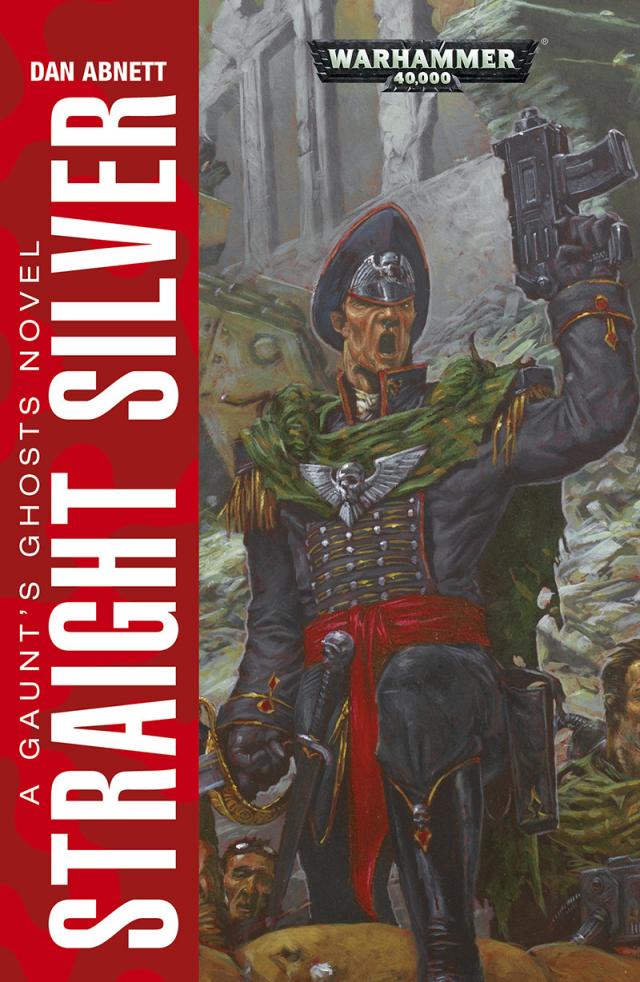
‘Ready order,’ he said to the rest. ‘Straight silver. Let’s keep the surprise on our side as long as possible.’
Two taps.
‘Forward,’ he said.
Up ahead, the three scouts emerged into the open air. It was cold and foggy from the shelling, and the shock-flashes of blasts backlit the misted air. The sound of the barrage was deafening: whooping shell-falls, some high-pitched, some low and basso, others still oddly melodic and expressive. Most detonations were huge and so loud they shook the diaphragm. Others made hotter, flatter sounds. Some made no sound at all, just a flash and a quake of the ground. After every single one there was a surging, pattering hush, like breakers on a shingle beach, as soil and shrapnel rained down.
Finding their way by the strobing flicker of the impacts, Mkoll, Bonin and Hwlan scurried out of the tunnel mouth, heads down. There was a sandbagged revetment and a guard point at the Shadik end of the tunnel, but it was unmanned. The guards had fled for cover.
The scouts found themselves in a deep bay off the main fire trench. They fanned out to the exit, and then ducked back as three Shadik troopers ran past, boots clumping the duckboards. These disappeared, and then two more came by, carrying a screaming man on a stretcher. They too vanished into the glowing smoke.
Mkoll signalled the other two up with him. They emerged into the fire trench proper. It was deeper and better laid than the Alliance trenches, with a wider firestep and a back-slanted parapet of rockcrete blocks. The trench, as far as they could see, which was to the next traverse, was empty.
‘Move up,’ Mkoll said.
A moment later, five Shadik troopers, running hell for leather, appeared round the traverse to their left. They didn’t seem to register the Tanith until the last moment.
The scouts didn’t give them a chance to react. Mkoll brought down the first one, sliding his silver knife through gas-mask and windpipe. Hwlan skewered another in the sternum and then propelled himself and the corpse into a third.
Bonin crashed his rifle-butt into the belly of the enemy soldier nearest him, and sent him tumbling away, winded, then put his weight into a stinging sidekick that snapped the fifth trooper’s neck and dropped him abruptly onto the duckboards. Bonin leapt over him, and quickly killed the winded man with his bare hands.
Hwlan tried to make a clean kill of the last trooper, but the fether was struggling hard. The Tanith man got his lasrifle braced across the man’s neck and wrenched it around, twisting the helmeted skull down hard against the trench floor.
Five men dealt with in just a few seconds.
They were dragging the bodies into cover behind the camo-nets of a funk hole as Gaunt led the first of the main party into the fire trench.
‘Which way?’ Gaunt asked.
Mkoll pointed left.
‘Lead off with Hwlan,’ Gaunt told him. He turned to Bonin. ‘Set here with Oflyn, and take up the rear of the file. Stay in close contact.’
‘Sir,’ nodded Bonin.
The party moved off quickly behind Mkoll and Hwlan. Two scouts at the head and two at the rear was the best insurance Gaunt could muster.
Beyond the second traverse they came to, a Shadik fire-team was trying to set up a pair of autocannons at the parapet. Nine men, all told.
Mkoll and Hwlan came at them from behind, knives out. Gaunt followed them, drawing his power sword, along with Criid, Ezlan and LaSalle. Brutal killing followed. One of the Shadik got a shot off, but Gaunt hoped its sound would be drowned by the barrage. He decapitated a man with his sword, and then impaled another. Nothing stopped his ancient blade, not mail-armour, not battle-plate, not leather and certainly not flesh.
Criid finished off the last man, and looked up at Gaunt.
The shelling had just suddenly ceased.
That meant the ground attack was coming. And it also meant that the Shadik would be streaming back out of their bunkers and shelters to man the step and repel.
THIRTEEN
Corpse light
‘Sometimes, y’know, I really miss my slum. Times like this, for instance.’
– Flame-Trooper Lubba
Fifteen regiments of Alliance troops assaulted the line in the wake of the barrage. A wave attack, welling up from the smoke-skeined darkness of no-man’s-land. The twenty-kilometre stretch of line had been lit up for half an hour by the salvos of the bombardment. After a moment’s eerie silence, it lit up again. Small-arms. Machine guns. Grenades. Flamers. From the air, the wide band of massive light bursts reduced to a thinner, fizzling line of fire.
It was the most significant attack mounted on the Shadik line in eighteen months. An offensive, the officers of the GSC were calling it back in the safety of the rear-line bunkers. Lyntor-Sewq and Martane had been prepping for it since Lyntor-Sewq’s promotion to supreme commander. Lyntor-Sewq had dearly wanted to make his mark early, and prove to the high sezar how lax his predecessor, Count Golke, had been in his accomplishments. It was all part of a greater strategy that incorporated the northern push through Gibsgatte, where the supreme commander had invested the bulk of his Imperial Guard armour. The idea was to sucker punch Shadik by a northern thrust and then take him hard in the belly at the Pocket and Bassin-on-Naeme. Lyntor-Sewq’s overall scheme was to divert the enemy’s strengths to the north and retake the river valley, establishing a new front he called the Frergarten Line before winter set in. If successful, the Peinforq Line would become obsolete for the first time in twenty-six years.
Over winter, the new line could be reinforced using Alliance troops, and be ready by spring not only to hold against the inevitable counter-push, but also to launch an invasion of the Southern Republic, in concerted effort with the Kottmark armies on the Ostlund Line.
It was an over-ambitious scheme, typical of a new commander trying to be emphatic and break the deadlock apparently imposed by his predecessor. If Golke had been privy to the planning meetings, he’d have been able to tell Lyntor-Sewq frankly that the same thing had been tried before, three times, in point of fact. The ‘Oust-and-Out’ strategy was an old one, and it had never worked.
If Ibram Gaunt had been privy to the planning meetings, his comments would have been earthier still. Lyntor-Sewq was playing the war like a game of regicide. The first thing a commander learns that’s of any use at all is that army groups do not behave like playing pieces. They don’t obey set rules, they don’t have preset ‘moves’. Often a strong group signally fails to do what was expected of it. Often, too, a ‘weak’ piece can win the game by being used cleverly.
Unfortunately, neither officer was present at the meetings. By the time it was getting too late to advise Lyntor-Sewq differently, both Gaunt and Golke, the latter by choice, were at the sharp end of things.
Van Voytz was at the meetings, most of them anyway. His counselling efforts were completely eclipsed by the determination of the new supreme commander. When, months later, Van Voytz finally withdrew from Aexe Cardinal, he would come to regard his time there as the most frustrating and impotent of his career.
Most GSC staffers believed that this particular night had been chosen to launch the offensive because of the opening the counter-strike at 57th had provided. Its success had jibed in a timely way with the frontal press at Gibsgatte. This was only partially true.
Though Gaunt never learned the truth, the offensive had been launched because of Redjacq Ankre. Discovering, from logged notes, that the First was infiltrating that night, he’d persuaded Martane to put the call in. Ankre was a proud man. His pride would eventually cost him his life, many years later. He hated the idea that the Tanith could have found an opening, and he used that hate to fuel his persuasive powers. If the stealthers of the First could break the Shadik line, then so could the Alliance ground forces. Ankre was actually afraid that the off-worlders of the Guard might actually achieve something that the Alliance had failed to do. He could not stomach the idea.
He personified the emotion-led failing of the Alliance top brass, a failing that had prolonged this war by decades. As with all efforts of such scale, his failing went unnoticed in the general scheme of things.
Almost three thousand Alliance troops fell casualty on the line assault that night. No figure, not even an estimation, was made for the Shadik forces. At one stretch of the line, one hundred and seventy-eight men of the Genswick Foot, including Lieutenant Fevrierson, became encumbered in lines of wire and were slaughtered by machine guns. At another section, no more than fifty metres long, three hundred Fichuan infantrymen died in the storm charge. The trench filled up, level with the surrounding terrain, packed with bodies so deeply the Shadik were forced to fall back and hold a reserve trench. Trench mortars killed sixty men of the Meuport Fifth as they came towards the parapet and were illuminated by starshells sent up by a nearby Brunsgatte unit who had become disoriented. The surviving men of the Meuport Fifth later took the fire trench, held it for an hour, lost it again and then retook it before dawn. The action entered their regimental legend.
At the northern tip of the assault, a detachment of struthid cavalry overran the held position under cover of autocannons, and stormed the main reserve trench. Then a counter-strike of gas shells and nail grenades broke their sturdy advance and left them dead and dying. Hussars, individually untouched, lay twitching and screaming in the foggy dark, sharing through the mind-links the death-throes of their wounded mounts. Alliance troopers advancing through the area started to mercy kill the birds, and then found themselves, in tearful desperation, mercy killing the hussars too.
They could not bear the screams.
The Kottstadt Wyverns, under Major Benedice, assaulted, took and held a kilometre stretch of fire trench, and then storm-fought their way back down the communication alleys to secure a line of gun-pits. South of them, a brigade of Mittel Aexe dragoons, the Seventh Ghrennes or ‘Steeplers’, did likewise, and then tried to spike the guns and destroy their munitions. Ninety-three men were incinerated when a high explosive dump was enthusiastically flamed, blowing a hole in the earth two hundred metres in diameter. The rest of them, along with a fair number of Wyverns, subsequently died in the clouds of toxic gas that spewed from storage pits ruptured by the main blast.
All the while, set far back, the Shadik super-siege guns continued to bombard. Their immense shells broke shield umbrellas on the Peinforq Line, and obliterated an ammunition dump, a command bunker, nineteen artillery stations – including five heavy howitzer mounts – a sector infirmary and a reserve trench full of young, conscripted Fichuans who thought they’d managed to skip the war for a night.
Some of the massive shells even struck Peinforq itself. The Manorial House was destroyed, and the abattoir, along with the burial chapel, two cafés, and a street of billet-housing full of Krassian troopers.
Despite the monumental losses, the Alliance offensive didn’t lose momentum that night, or the day after. Lyntor-Sewq, determined to press for the victory he saw beckoning, deployed greater and greater numbers into the push until it ran out of steam on the fourth day and he conceded defeat.
But for Gaunt’s mission, that was in the unknowable future. By midnight on that first night of offensive, they were a kilometre inside the Shadik lines, following a supply trench.
All hell was breaking loose behind them at the Shadik front, lighting up the sky and filling the valley with smoke fumes.
But they were pushing forward, silent, relentless, into the depths of the enemy fortifications.
Corpse light broke above them, white and pale. More flares. The roar of the battle was distant and muffled. They’d just slaughtered twelve Shadik infantrymen in their fifth skirmish of the night. The First had suffered no losses so far, but Gaunt wondered how much longer they would be able to work with blades alone.
The sound of the siege guns was deafening now, even though they were still several kilometres away. The ground vibrated, not from impacts but from firing.
‘I’d say there were six guns at least,’ Mkoll told Gaunt. ‘I’ve been counting the flashes and the rhythm.
‘Seven,’ said Bonin. ‘Definitely seven.’
‘If Bonin says seven, seven it is,’ said Mkoll. ‘He’s got an ear for these things.’
‘How far?’ asked Gaunt.
‘Well, it’s not like we can’t find them,’ said Mkoll, pointing to the superheated flashes of discharge lighting up the north-eastern sky.
‘Yes,’ said Gaunt, ‘But there’s no sense of scale. How far?’
‘Two, maybe three kilometres.’
Gaunt sighed and looked around. The supply trench system they were in was dark and quiet. Everything had been pushed towards the front.
Once in a while, Shadik personnel appeared, and were knifed to silence by the Ghosts.
But Gaunt knew they’d been lucky. All it would take was for them to meet an advancing brigade head on.
Then it would come down to firepower. Firepower and numbers.
If only they had a decent fix on the guns. Something concrete to take back with them. He’d told them all that locate was the minimum requirement of the mission.
Two or three kilometres to the north-east wasn’t precise enough.
Round the next traverse of the supply trench, they found themselves in a deep ammunition corridor laid with track. It was twice the width of the infantry burrows, and ran north-east, dead straight.
The feeder roads for the big guns. Wide enough to take the girth of the shells on munition trains.
They were closing on it.
‘Fan out and follow,’ Gaunt ordered, and dropped his team into the bottom of the wide, man-made gulley.
A rifle cracked, twice. Trooper Sekko convulsed and fell.
Gaunt looked back and saw Shadik elements emerging from the gloom, weapons blazing. The Ghosts returned fire, lasguns cracking. Lubba spat fire down the wide space of the ammunition corridor.
The game was up. They’d been rumbled.
FOURTEEN
The first stand
‘This one’s for Try.’
– Hlaine Larkin
‘What does it mean?’ Feygor asked, angry.
‘It means trouble,’ said Caffran.
‘What sort of trouble?’ Feygor snapped.