Straight silver, p.8
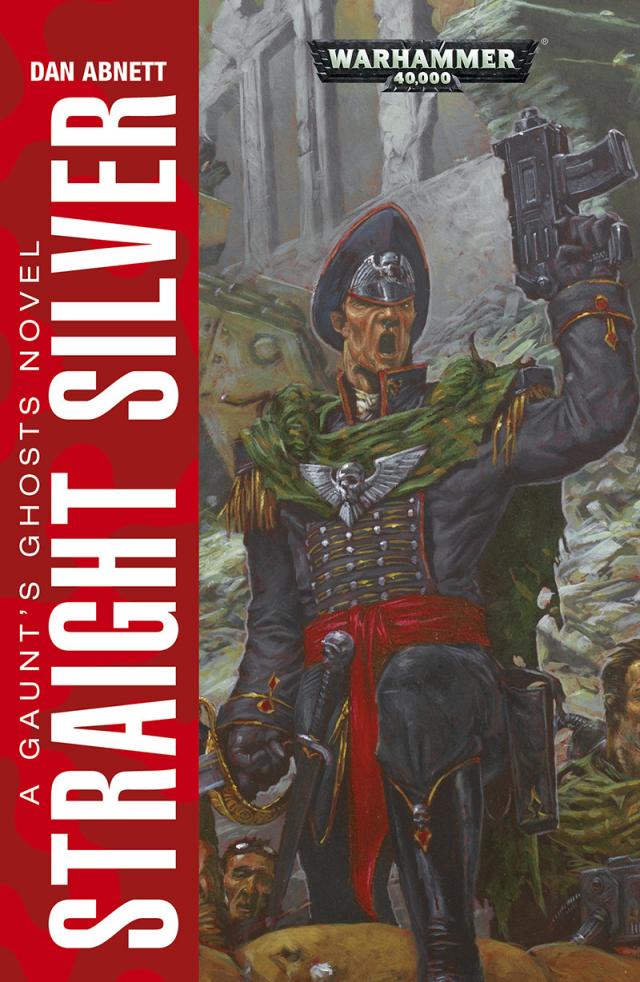
Straight Silver,
p.8


‘There was a fight. Ow! A fight. In the trench. Enemies came in, so we fought them. I – ow! – got my ankle stood on.’ Caober faltered and his voice tailed off. He was a fine scout, but his story-telling ability left everything to be desired.
Dorden continued to wind bandages tightly around Caober’s ankle. ‘Somebody fill me in. Ven?’
Mkvenner looked up, his ear packed with gauze. ‘Pardon?’
Dorden laughed, and so did everyone else – Lesp, washing his hands in a tin bowl, Chayker and Foskin sorting surgical tools. Even Mkoll, sitting on a chair in the corner.
‘What’s funny? I can’t hear,’ growled Mkvenner. The laughter stopped. No one wanted Mkvenner to think they were taking the piss out of him. Mkvenner was one of those Ghosts you respected, every second of the day.
‘When the barrage started, they tested the line with trench raiders,’ Mkoll said as he got up. Dorden could tell at a glance he was holding himself stiffly as he moved. ‘It got very messy. The locals weren’t at all prepared.’
Dorden tied off the bandage and called over to Foskin. ‘Get Caober’s boot back on, loose, and find him a crutch. Stay off it for a few days and you’ll be good to go.’ He wiped his hands and moved over to Mkoll. ‘Let’s take a look,’ he said.
Mkoll started to take off his webbing and jacket, but it clearly hurt him to lift his arms, so Dorden helped him strip down to the waist. The bruise across the pale flesh of his chest was ugly and black.
‘Feth! You been playing smack-stick again?’ asked Dorden.
‘Rifle round. Took it last night. Didn’t notice it at the time. Adrenalin, I suppose. Been hurting like a fether since dawn, though.’
Dorden tutted and sprayed Mkoll’s wound with counter-septic. By his side, Foskin clucked in amazement. He’d been folding Mkoll’s clothes and kit. He held up a mangled large calibre round. ‘Your chest armour stopped this,’ he said. ‘It was buried in your breast-guard. You want me to throw it away?’
Mkoll took it and put in his trouser pocket. He had his own battlefield superstitions.
‘I see the war’s started without me,’ said a voice from behind them. Gaunt had entered the mill. ‘Carry on,’ he added, before they all started throwing salutes. He peered at Mkoll’s hefty bruise. ‘First blood to them, I take it?’
‘We gave a good account,’ said Mkoll.
‘So I hear. I met your fan club. A Colonel Ankre.’
‘Who?’ murmured Mkoll. ‘Oh, him. The red-head. I didn’t think he’d taken to us much.’
‘You’re the heroes of the line, my friend,’ said Gaunt sarcastically. ‘The locals are so impressed, they’ve given us a whole front trench to hold.’
‘Feth,’ Mkoll said.
‘You told them–’ Dorden began.
‘Oh, I told them all right. I don’t think they were listening.’ Gaunt sighed. He handed the flimsy map to Mkoll. ‘This is what we’re taking on, if they have their way.’
Mkoll looked over the slip. ‘Bad place. Took the worst of it last night. The very worst. The river comes in close here, you see? The parapet is low and waterlogged. Ideal for storming. I wasn’t sure they’d even got it clear.’
‘Tell me what you saw up front,’ Gaunt said, sitting down as Dorden dressed Mkoll’s nasty wound.
‘The Alliance soldiers we saw were tired and over-stretched. Ill too, most of them. Low sanitation, low hygiene. What’s worse, they have precious little discipline. They fight well enough when they’re ordered up and controlled, but there’s no sign of initiative.’
‘They panicked when the raid started,’ said Caober.
‘To be fair,’ said Mkvenner, ‘they panicked when the shelling started. They’d never seen that before, not like that. I think they were fairly fit as front-line infantry, but when those new super-guns opened up, they were milling and broken and scared. And the enemy raiders punched right in through them.’
Gaunt nodded. ‘The enemy?’
‘Good, tight, professional. Solid ammo weapons, some body armour. The grenadiers are their strength. Simple explosives, but effective, and in large numbers.’
Gaunt listened to his chief scout and then said, ‘So… what does Lord General Mkoll think?’
It was a private joke. Gaunt trusted Mkoll’s tactical mind absolutely, and often voiced this hypothetical question. If Mkoll was supreme commander here, what would he do?
‘This fight’ll go on till doomsday,’ said Mkoll, once he’d considered things. ‘It’s been going on forty years. A deadlock. You might think that Guard reinforcements like us might overtip the balance in favour of the Alliance, but then so might these new super-guns, in favour of the enemy. What I’m saying is it’ll take something new, something lateral, to break this. Can’t say what with only this fething map to go by.’
‘I’m working on that,’ Gaunt assured him.
Mkoll shrugged, and then winced and wished he hadn’t. ‘I don’t know. Something new. Something different or unexpected. Something from a new angle. We’d better find out what. Before they do.’
‘I know something,’ said Mkvenner quietly. ‘These new super-guns they’ve got. They might have been developing them for years, but don’t you think it’s funny they first use them a day or two after we arrive? They must’ve seen our ships coming in. They must know the Guard is here and that the Alliance has off-world reinforcements at last. They’re afraid the Alliance has got the edge. They want the edge back.’
‘I’ll give ’em the edge back,’ Caober chuckled, testing the sharpness of his straight silver warknife.
‘Hold that thought,’ Gaunt told him with a smile. He looked at Mkoll. ‘Write me up a full report. Everything and anything.’
‘Will do, sir.’
Gaunt was about to say something else when angry voices broke into the mill hall. Ana Curth burst in. ‘Dorden, where the feth are– Oh! My apologies, sir.’
Gaunt stood. ‘As you were, Surgeon Curth. I believe you were about to cuss again.’
‘Fething right,’ she said. ‘I can’t find our fething supplies and the supplies should be there and the Krassians are blaming–’
‘Whoa, whoa!’ said Dorden. ‘From the top and remember to breathe this time.’
Ana Curth took a deep breath. She’d been a well-respected and well-paid civilian medic on Verghast before the Zoican War and, to the amazement of Dorden and Gaunt, had elected to join the Tanith regiment at the Act of Consolation. No one had ever found out why she’d cast aside a comfortable, rewarding lifestyle in favour of the thankless miseries of an Imperial Guard medicae posting. Gaunt believed it was because she had a sense of duty that probably put them all to shame.
They were fething lucky to have her.
‘Our supplies are missing,’ she said. ‘All of them. Everything we shipped in from the Munitorium vessels. I looked for them at embarkation and was told they had been trained ahead. But they’re not here.’
‘No, no,’ said Chayker. ‘I saw them. Piled up in the lean-to behind the mill.’
‘Oh, there are plenty of gakking crates there, Chayks,’ said Curth. ‘And they’re all marked with the Tanith and Krassian symbols. But they’ve got nothing in them except dirty cotton wool and straw. The Krassian medics are trying to give their men field shots, and there’s nothing to use, and they’re claiming we pinched them all–’
‘All right, all right…’ Gaunt said. ‘What have we got?’
‘About thirty cases of one-shot mire-fever doses and about the same in anti-toxin pills,’ said Lesp. ‘Everything we brought up the line ourselves, sir.’
‘Give them to the Krassians.’
‘Gaunt!’ Curth started.
‘Do it. I won’t have bad feeling with good allies like the Krassians. I’ll find our supplies, and the Krassians’ supplies too. We’ll make do until then.’
‘Ever the diplomat, eh, Ibram?’ smiled Dorden.
‘They once invited me to join the Imperial diplomatic officium,’ said Gaunt. ‘I told them to feth off.’
There was laughter ringing from the old wool mill. His driver had told him this was the place set aside for the Imperial Guard medicae units. Laughter seemed a strange sound to hear. He walked in from the car, entering a large hall where eight men and a woman stood around, hooting and chuckling. It seemed like the officer had just told a really good joke. Four of the men and the woman were medics. The others, apart from the officer in his stern cap, were black-tunicked troopers, all of them injured.
He cleared his throat and the laughter stopped. They all looked round.
‘I believe you were asking for me,’ he said. ‘I am Count Iaco Bousar Fep Golke.’
Count Golke was a quiet, silver-haired Aexegarian dressed in a dark green uniform that showed no decoration apart from the insignia of Aexegary on the collar and shoulder boards, and the golden aquila medal pinned at his throat. He walked with a slight limp, and Gaunt could see that his neatly trimmed silver beard had been grown, in part, to disguise old burns on his cheek and throat. He introduced himself as chief of staff/liaison.
They walked together across the yard outside the mill.
‘We’ve met already,’ Gaunt said. ‘In passing. I was one of the Imperial officers presented to you that night at the high sezar’s palace.’
‘I thought so,’ replied Golke. ‘I confess that night I was rather distant. Forgive me if I was distracted. The surprise news of the Imperial arrival, my unexpected decoration…’ He patted the gold eagle medal. Gaunt knew Golke wasn’t mentioning the fact that he had just been stripped of rank too. That night had marked the end of Golke’s four year tenure as supreme commander of the Aexe Alliance forces. A blow to his pride, Gaunt imagined. Another little puffed up aristo general, who’d made his rank by dint of noble blood rather than command merit, now drummed out of office to make way for the newcomers. Gaunt expected bitterness and resentment. He was surprised when he detected none. Golke seemed to be nothing except tired and disenchanted.
‘My new role,’ said Golke, leaning against a gatepost to ease his leg, ‘as I understand it at least, is to facilitate communication between the Alliance and the Imperial expedition. It’s all rather formless and vague, so I have to thank you.’
‘How so?’
‘Giving me something decent to do, colonel-commissar. Something other than the futile round of cocktail welcome parties and handshaking. You’ve quite rattled Redjacq Ankre.’
‘If I may speak freely?’
Golke made an ushering sweep with his hand.
‘Colonel Ankre displayed to me a real ignorance of modern warfare methods. He is blinkered, clinging to outmoded and discredited principles and strategies. Indeed, this whole war–’ Gaunt stopped.
‘Go on, colonel-commissar.’
‘I should not, sir. I barely know you and I don’t feel it is my place to deliver a critique of your nation’s war-making.’
Golke smiled. It was quite a winning smile, even if one corner of his mouth, fused by scar tissue, refused to bend. ‘Colonel-Commissar Gaunt, I was twenty-nine years old when this bloody war began. I served as a front-line infantry officer for twelve years, then joined the Office of Strategy for another fifteen, then some time in the east, then five years as area general in sector 59, then four as supreme commander. Never in that time was I one hundred per cent happy about the way Aexegary prosecuted this war. I criticised, objected, used my rank to try to make changes I thought would be beneficial. It was like pushing water uphill. So let’s make a deal. Speak freely and speak your mind. If I am offended, we’ll agree to disagree.’
Gaunt nodded. ‘Then I’d say this war would have been over thirty years ago if the Alliance had for one moment overhauled their martial philosophies. You’re fighting this like a pre-firearm campaign, like something from the days of antiquity. The use of infantry and cavalry, the dependence on cannon, the expenditure of manpower. And, forgive me, the reliance on the nobility for command personnel.’
Golke chuckled ruefully.
‘There is a concept that we in the Guard hold true. Total war. The prosecution of an enemy that takes no account of national boundaries or political structure. War with a single, unswerving objective, to defeat the foe. War that never stays still but is constantly looking for new opportunities. True to such a concept, the Imperial Guard has triumphed over the enemies of the Emperor in all theatres. We advance, both physically and mentally. You have stagnated, intellectually, as truly and deeply as your front line.’
‘You don’t pull punches, do you, Gaunt?’
‘Not when I’m invited to throw one for free. Look, sir, I know Aexegary has a long and illustrious history of military success, but you’re still fighting wars the way your ancestors did. Shadik is not a bellicose neighbour state to be bested on the field and then invited over for diplomatic reparations. It is a cancer, a spreading evil of Chaos that will not, ever, play by the old rules. It will grind you down, invade you and consume you.’
‘I know that.’
‘Then you seem to be alone. Ankre doesn’t know it. Not at all.’
‘Ankre is old school. He’s a Kottmarker. They’re anxious to prove their worth in the Alliance. What am I saying? We’re all old school.’ Golke looked over at the roofscape of Rhonforq, squinting as if the afternoon light hurt his eyes. ‘Enlighten me, then.’
‘In the first place, the Tanith are stealth experts. They’ll fight like bastards in a front line, but that’d be wasting them. They need to be used, not as cannon fodder, but as the incisive weapons they are.’
‘That makes sense.’
‘Second… dispersal of information. I know that it’s vital to guard dispositional data from enemy eyes, but this is plainly ridiculous.’
Gaunt pulled out the scrappy map Ankre had given him. ‘I think I speak for every Imperial officer when I say that we need an overall perspective. How can I press any advantages I might make if I have no clear idea of the bigger picture?’
‘Ankre told me you were after general charts. The idea appalled him. Our way of warmaking revolves around individual commanders performing their appointed tasks and leaving the concerns of general strategy to the staff chiefs.’
‘That’s like fighting blindfold, or at least fighting with just a narrow view through a little slit.’
Golke put his hand in his jacket pocket and produced a data-slate. ‘Copy everything on this,’ he said. ‘These are the full charts you wanted. But be circumspect. Ankre and the Alliance generals would have me shot if they thought I’d given these to you.’
‘I’ll be careful.’
‘Give me time, and I’ll get the idea accepted by the GSC. If we can prove the advantage, it’ll make it easier for them to swallow. Your commander, Van Voytz, is working on them too. I don’t believe he’s terribly happy with the situation either.’
‘I didn’t expect he would be,’ smiled Gaunt.
‘Now do me a favour. Advance your regiment to the appointed stations. Show willing. I’ll go back to the supreme commander and petition him to act on your advice. A day or two, perhaps three. Then we might see results.’
Gaunt nodded, and shook the count’s hand. ‘You have the chance to win this war, sir,’ he said. ‘Don’t let the Alliance waste it.’
FOUR
287–311
‘Sergeant Tona Criid? Sergeant Tona Criid? I like the sound of that. No other gak-face will, though.’
– Tona Criid, sergeant
It was the Ghosts’ third day on the line. They’d got used to the routines: the patrol circuits, the wire-expeditions, the bilge-pumping, the observations, the manhandling of latrine buckets out up the communication trench, the man-handling of food buckets back down from the cookhouse (‘I swear they get those fething buckets mixed up most times,’ Rawne was heard to say). They’d even got used to what Corbec called the ‘trench walk’ – stooped, head down, so nothing projected above the parapet.
The tension remained. Since the night of Mkoll’s advance party, there’d been no bombardment. On day two, the enemy had assaulted the line twenty-five kilometres north at station 317, but otherwise it had been quiet.
One-third of the regiment had advanced to the line, leaving the other two-thirds in reserve at Rhonforq. At the end of the first week, they were to rotate, and begin a pattern that meant no trooper stayed on the line for more than a week, and every trooper got two weeks’ rest in reserve in every three. Gaunt, of course, hoped the Tanith wouldn’t be staying at the front for anything like that long.
At the line, the Ghosts were caked in mud after the first few hours, and crawling with lice after the first day. They slept, as best they could, curled up under the lip of the parapet, or in hand-scooped dugouts.
Criid had become so muddy she’d decided not to fight it any more. She’d plastered mud across her face and matted it into her hair.
‘What the feth are you doing, sarge?’ Skeen had asked.
‘Camouflage,’ she said.
Fifteen minutes later, all but two of her platoon had followed suit and daubed themselves with mud. Kolea hadn’t, because he hadn’t understood what was going on.
Cuu hadn’t, because, well, he was Cuu.
Still, Criid congratulated herself, I seem to have most of the platoon pulling together. Maybe I can do this.
Ten platoon occupied station 290, with eleven platoon, Obel’s, to their north, and sixteen platoon, Maroy’s, to their south.
Each station represented about a kilometre of fire trench, broken in twenty metre intervals by traverses. They had a dugout bunker with a field telephone and vox, but the Ghosts’ personal vox-links had made that obsolete most of the time.
Three times a day, Criid did her tour, accompanied by Hwlan and DaFelbe. She checked trench integrity, she checked that food was getting through, she checked the obs stations. She individually inspected each trooper’s kit, ammo supply, and feet for trench foot.