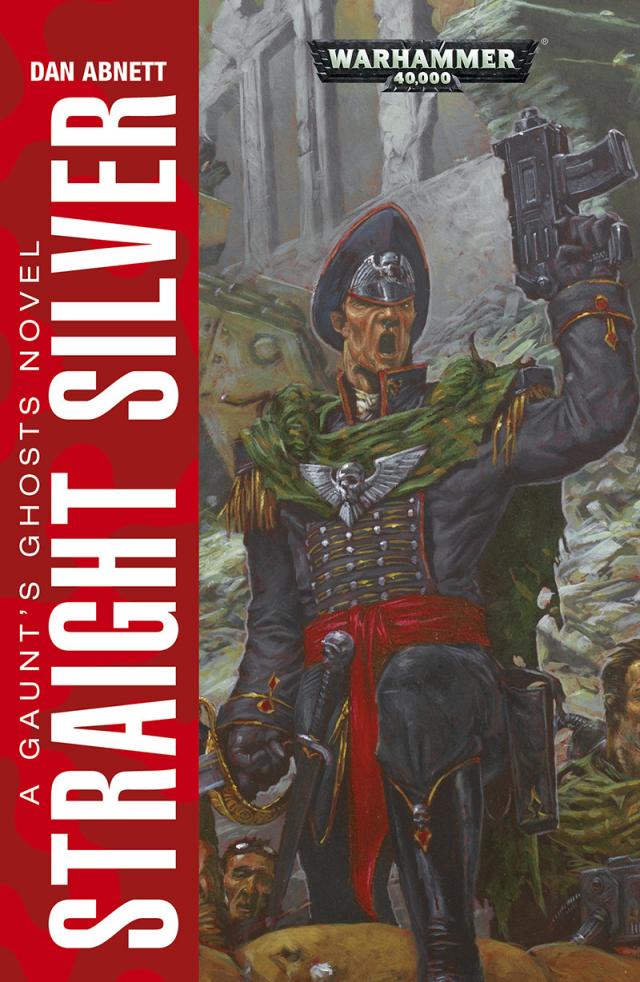
Straight silver, p.9
Straight Silver,
p.9


The third day was dismal. Rain blew in from the west, angled in such a manner that the trench sides offered absolutely no shelter. The rain also tasted of something, something faintly metallic, faintly chemical. Someone said that blister gas had been used the day before up north in the Meiseq Box, and some troopers put on their breather hoods or tied cloth over their mouths. The sky was low and oppressive, churning with fast-moving cloud that was almost black. It sapped the colour from the day. Faces became pale, eye sockets shadowed.
Some of the trench’s previous incumbents – the Seventy-seventh Lunsgatte Rifle Brigade – had stayed behind. A detachment of thirty had been remaindered to man the trench mortars in the pocket dugouts spaced behind the main fire trench. Their fire-officer, a sergeant called Hartwig, joined Criid when she toured the mortar dens. He was tall and humourless, huddled in a mud-flecked grey oilskin, toque and a green kepi with a metal badge that showed some sort of bear-like animal. His men didn’t mix much with the Tanith. They seemed content to live in the cramped hollows of the dens. Criid got the impression Hartwig and his men didn’t think much of a unit that included women, let alone one that was led by one.
The mortars were squat, blue-metal machines called feldwerfers, and used compressed gas to fire the three kilo shells pneumatically. The crews kept the weapons spotlessly clean, they were forever polishing and oiling them. In contrast, the men themselves were filthy and their uniforms piecemeal. Most wore toques or loose hoods, with sleeveless leather jackets or fleeces, and many had flat sheets of armour tied or strung across their chests. Dirt caked their hands and faces black.
Interspersed with the mortars were Favell-pattern spring guns, a heavy little catapult engine that looked to Criid like some kind of pipe organ. It took two men to operate the double windlass and crank back the long throwing arm to the cock-stop. When the trigger lanyard was pulled, the cluster of massive springs in the main body of the weapon slammed the arm up and lobbed grenades or ball bombs out over the fire trench and into the battlefield.
Hartwig assured Criid that the Favell could send a grenade over two hundred and fifty metres. The trick was to set the grenade’s fuse so that it didn’t detonate high in its arc. They needed to blow on the ground, or near it, but if the grenadiers left the fuse too long, there was a risk that the enemy would have time to gather them up and toss them back. One member of each spring gun team had a clay pipe on the go at all times, an ignition source ready and waiting to start fuses that was a lot less fiddly than matches or gun-string.
The Seventy-seventh Lunsgatte weren’t the only prior inhabitants who had stayed in the fire trench. Shrunken, eroded body parts protruded from the trench floor and sometimes the wall, usually where the rain had exposed them. During a heavy period of action three years before, Criid learned, the troops at these stations had been obliged to bury their dead in the trench itself. Water damage was slowly raising them back into the daylight.
During her midday tour on the third day, Criid found Lubba and Vril trying to shore up a section of revetment that was falling in thanks to the rain. Part of the parapet overhang had become a gutter for the rainwater, which was now gushing into the trench in a thick stream. The task was made all the more unpleasant because where the timber had come away, ancient cadavers had been exposed, curled and almost mummified.
‘Gak,’ she said, viewing the scene.
‘We need more planks,’ said Lubba. ‘Even if we get these back in place, they’re rotten through.’
Criid looked at Hartwig. ‘Planking? Flakboard?’
He laughed at her. ‘You’re joking.’
‘Any suggestions, then?’ she said. She was quickly becoming tired with Hartwig’s dreary resignation.
‘There’s sometimes some brushwood at station 282. They bring it forward along the supply trench there when its available.’
‘Brushwood?’
‘Anything will do,’ said Vril.
Criid turned to Hwlan. ‘Go on down to 282 and see if you can get your hands on some.’
‘Yes, sarge.’
‘What about damming that stream?’ DaFelbe suggested, pointing at the liquid mud gushing down over the lip.
‘We’d have to get up over the parapet. So I’d rather be wet than dead,’ said Vril.
‘After dark, then?’ Criid ventured.
‘Sure, sarge. Once it’s dark.’
There was a wet, loose gurgle and another section of the revet slumped into the trench where Lubba was trying to force it back in. Greasy mud slithered out, shedding another vile body with it. The corpse was staring, its jaws open in a scream, but its eyes and mouth were full of mud.
‘Oh gak… Hwlan!’ Criid called after the scout. He stopped and looked back.
‘See if you can find Zweil too.’
Hwlan nodded.
They moved on a little way. Criid checked the next two or three troopers at the firestep: Vulli, Jajjo, Kenfeld, Subeno. Kenfeld’s boots were leaking and he needed foot-powder.
Then they reached Cuu, or at least Cuu’s position. The firestep was empty.
‘Mkhef!’ Criid called to the next man along. ‘Where’s Cuu?’
‘Latrine, sarge!’ the trooper called back.
They waited, and Cuu reappeared. As soon as he saw Criid, he unslung his rifle and held it out for inspection, wordlessly. There was no expression in his eyes. His face still bore the bruise marks where she’d dented it.
‘You left your post, Cuu.’
‘Had to.’
‘You wait until change-over.’
He shook his head. ‘Couldn’t wait. My belly’s a mess. Gakking food round here. An emergency, sure as sure.’
‘How long have you been sick?’
‘A day.’ He did look pale and unwell, now she came to look.
‘You keeping anything in?’
‘Going right through me,’ he said with unnecessary relish.
‘Signal a man up to cover,’ she told DaFelbe, then she looked back at Cuu. ‘Report to Dorden. Get him to fix you up with salts or a shot. Then right back here, you understand me? I want you back before 13.00, no excuses.’
‘Okay,’ said Cuu, picking up his kit. ‘Back by one, sure as sure.’
Criid watched Cuu walk away until he was out of sight round the next traverse.
‘He’s trouble, that one,’ said DaFelbe.
‘Sure as sure,’ she replied.
In the next fire bay, Criid found Pozetine, Mosark and Nessa Bourah huddled in scrapes hulled out under the dripping parapet. They were playing dice, but she could tell their hearts weren’t in it. She ran a quick inspection, though the three were able troopers who didn’t need much steering, and asked if there were any problems.
‘Only the waiting,’ said Pozetine. He was a short, square-set Vervunhiver with a boxer’s splayed nose, ex-Vervun Primary, and a hell of a shot. A shoe-in for sniper specialisation in fact, had it not been for his grievous lack of patience. He worried, he fidgeted. A sniper he was not.
‘Waiting’s always the killer,’ said Criid.
Pozetine nodded. ‘S’why I hate digging in, sarge,’ he said. His fingers were working the dice, making them move in and out between his knuckles. An edgy and all too practiced tick.
‘Bide your time,’ said Criid.
‘What I keep telling him,’ signed Nessa, a model of calm.
It was easy to say. No soldier liked the waiting hours. They had a habit of magnifying fears and gnawing at nerves. But they got to Pozetine worse than most.
‘Do something,’ Criid suggested. ‘I could find you a job. Latrines–’
‘Gak that,’ growled Pozetine. Mosark laughed.
‘Then take a turn on lookout.’
‘I offered, but he’s happy and set.’ The ‘he’ Pozetine referred to was Kolea, down at the end of the bay. He was motionless, peering through a stereoscope rigged to peak out over the parapet.
Criid walked along the duckboards to him. ‘Kolea?’
He didn’t move. She put a hand gently on his arm and he looked up. She could tell it took a moment for him to work out who she was.
‘You okay? You’ve been watching a long time.’
‘Don’ mind it. I can watch.’
He could at that. If Pozetine was the most impatient man in the platoon – gak, the entire regiment – then Kolea had become the most focused and tranquil.
She knew for a fact that he’d been manning the scope for at least two hours, slowly playing it back and forth through a one-eighty arc. He didn’t get bored, he didn’t get tired. She’d have pulled any other man off the duty ages before for fear that fatigue would make him sloppy. Not Kolea.
Criid didn’t know precisely what the loxatl munition had done to Kolea’s brain. Surgeon Curth had tried to explain it to her, but the technical terms had been beyond Criid. Something to do with memory and personality. All of it, ruined. Gol Kolea, the scratch company hero, wise, smart, strong… lost, and only this physical shell of him left with them. His dependability had survived, and expressed itself in an extraordinary attention span.
Or at least, Criid told herself, an ability not to get bored with the most mundane tasks. Kolea could watch the line vigilantly for hours. Pick up a conversation five minutes after it had lapsed and he wouldn’t know what you were talking about.
Criid had admitted it to no one, but Kolea was the biggest problem in her command. Gaunt assumed it would be Cuu, but she knew she could handle that gak-pellet. No, it was Kolea. Ten was Kolea’s platoon, for a start. He’d forged the unit. It was his still. If he’d died, that would have been a different ball game, but he was still here, a constant reminder of his mental absence, of the void where his inspired leadership had been.
Worse still, he’d only ended up this way because of her. She’d been wounded during the fight for Ouranberg. Kolea had carried her to safety and taken his headwound as a consequence. She’d never found out why, really. Varl had said that it was simply Kolea’s way. He’d never leave a trooper down and in danger. Maybe so. But it felt like something else. Like Kolea had needed to save her for some reason, something more than simple loyalty.
Caffran reckoned it was because of the kids. Kolea had sometimes referred to the two orphans Criid had rescued from Vervunhive as a ‘little piece of good’, and Caffran believed Kolea had taken an almost patriarchal interest in looking after Criid and Caffran, the kids’ ersatz parents.
Whatever. She’d never know. She’d never be able to ask Kolea, because Kolea couldn’t even remember Ouranberg, let alone the motives that had once driven his life.
‘You get tired, you sing out,’ she said.
‘Don’ worry, sarge.’
‘You see anything, you sing too.’
His big fingers reached into the neck of his field coat and held out the tin whistle. He beamed. ‘Got my blower.’
‘Good,’ she said. ‘Carry on, Trooper Kolea.’
She got up, but his next words stopped her in her tracks.
‘The kids.’
‘What?’
‘What?’ he echoed.
‘What did you say, Gol? Just then?’
‘Um…’ he thought about it. ‘The kids. They gonna be okay? They all right?’
‘They’re fine,’ she said. Her heart was banging in her ribcage. It was almost like the old Gol Kolea was in arm’s reach.
‘They’re young,’ he said.
‘Yes, they are.’
‘But I guess they’ll manage. If you say they’re all right.’
‘They will.’
He nodded. ‘So young. S’pose war is all they’ve known. But so young, most of them. Boys. Not even shaving yet. Acting like soldiers.’
The Aexe Alliance troopers. That’s what he was talking about. Everyone in the regiment had been shocked to see how terribly young most of the local soldiery was. ‘Kids’ Lubba had said.
Dear God-Emperor. Not her kids at all. She’d seen a spark, just for a second, but it had been false. ‘Carry on,’ she said.
‘You okay there, sarge?’ asked DaFelbe.
‘Yeah. Grit in my eyes,’ said Tona Criid.
The canteen barrow had passed along the fire trench north of station 290 about fifteen minutes before, dishing out pieces of dry rye-bread and a watery gruel made of fish stock and tough root vegetables to the men of eleven platoon. Now Trooper Gutes was coming along through the rain with the wash bin, collecting up the troopers’ mess tins to take them up the supply trench and rinse them at the standpipe tap at rear/290.
It was a rota task, and Gutes had drawn for the day. He didn’t grumble, but it was a scummy job. By the time he’d collected all the mess tins, the wash bin would be slopping and full. Piet Gutes was one of the older Tanith troopers, drawn and tired. It wasn’t physical fatigue he suffered from. It was the wearying attrition of Guard life. The hopeless struggle to get through each day, knowing there was no happy ending waiting for them. No homeworld. No family embrace to return to.
The day Tanith had died, Gutes’s daughter Finra had been twenty-one, and her daughter Foona just four months old. It had been a wrench leaving them, but the Emperor called, and the Emperor was the Emperor.
Piet Gutes woke up some nights, sit-up-straight awake, with the last fire-flash of Tanith fading in his mind’s eye. That final, shuddering cough of flame and light that signalled the death of the world that’d raised him. It had been just a little thing, a wink in the night. He’d witnessed it from the obs ports of the troop ship. Just a tiny, silent flash.
How could that have been Tanith dying, he often wondered. The mantle splitting. The oceans evaporating. The continents sliding into each other and disintegrating. The great nalwood forests licking into cinders in a wall of white heat. The core, cut loose, erupting and boiling out into the vacuum. Piet Gutes supposed that anything, even the most important and profound event in his life or anyone’s life, would seem like nothing more than a tiny, silent flash if you saw it from far enough away.
He wondered about it, sometimes, washing grease off mess tins, sorting power clips, sewing buttons back onto his tunic. The galaxy was big and everything in it was small, and he was small too. The Emperor’s dead! Really? Yeah… that tiny flash just then. Did you see it? The Imperium’s fallen! Sacred feth, you kidding? No… just that little flash. You must’ve noticed.
Far away. That’s where he’d like to be. ‘Far away up in the mountains’, like the old song. It was all he wanted these days. To be so far away that everything looked small and insignificant.
‘Tins! Tins!’ he called, plodding down the fire bay with both hands on the yoke of the big metal pail. Garond tipped his in, then Fenix and Tokar.
‘Thank you kindly,’ Gutes said to each, his voice so rich with sarcasm it made them laugh.
He struggled into the gun-nest, where Caill and Melyr were hunched down beside their support weapon. Caill tossed his tin in, half-finished, but Melyr was still chasing the last drips of gravy with a scrap of Caill’s left over bread.
‘Feth, you like that stuff?’
‘Good eating, if you’ve a hunger,’ said Melyr.
Gutes liked Melyr. Heavy-set, solid, an ace with a fat cannon or a rocket tube. But he hated seeing him there. Bragg had been eleven’s cannon man. Hark had switched Melyr in from twenty-seven when Bragg was killed. It was almost unseemly. Caill, the best ammo humper in the regiment, in Gutes’s opinion, had just about been wedded to Bragg. Now here he was running boxes and feeding belts for someone else.
Times change. Needs must. Get far enough away and none of it looks big enough to be important anyway.
Melyr finished up, smacked his lips appreciatively, and plonked his mess tin into Gutes’s wash bin.
‘My compliments to the chef,’ he said.
‘Melyr, man, you’re a fething lunatic,’ said Gutes.
‘You wanna worry,’ said Caill. ‘I have to sit beside this feth-head.’
‘Sit further back and it won’t seem to matter so much,’ Gutes suggested.
‘What?’
Gutes shook his head. He was glad Caill was settling in with his new partner. That’s what really counted. He knew Caill was still down on himself. He’d left Bragg to run for fresh ammo, and by the time he’d got back, Bragg was done. Three loxatl flechette rounds at close range, that’s what Gutes had heard. Like he’d eaten a tube-charge. So much mess they’d been hard pushed to find enough to bury, and Bragg had been a big guy.
Feth happens, Gutes thought.
He stumbled on, under a reinforced arch, into the next fire bay, wishing he had a hand free to brush away the biter-flies that buzzed around his face. Loglas had told him about a trooper up the line who’d let those things settle and then woke up with his brain eaten out by hatching larvae.
Piet Gutes didn’t fancy that. He did however wonder how someone with his brain eaten out by larvae had managed to wake up at all. An inconsistency in the story. Maybe Loglas had been pulling his leg.
‘Everything all right, Piet?’ called Sergeant Obel, coming the other way down the trench with his runner.
‘Fine, sir.’
‘You got mine already,’ said Obel.
‘I did so,’ said Gutes. Every Ghost’s mess tin was etched with his surname and pin code. The fun part of this job was getting the right tin back to the right body.
Fun part. Yeah, right. There was nothing about the collection, cleaning and redistribution of mess tins that could be considered fun.
‘Carry on, Gutes,’ Obel said.
Gutes stopped at the end of the bay and put his bucket down. Greasy slops rocked out over the lip.
‘Hey, Larks?’
Mad Larkin slowly turned back from the loophole where his long-las was resting. He smiled slightly when he saw Gutes. They’d been good buddies since the Founding Fields. It was nice to see him smile. Larkin seemed edgier than ever these days. He and Bragg had been particularly close.