Rambo iii, p.1
Rambo III,
p.1
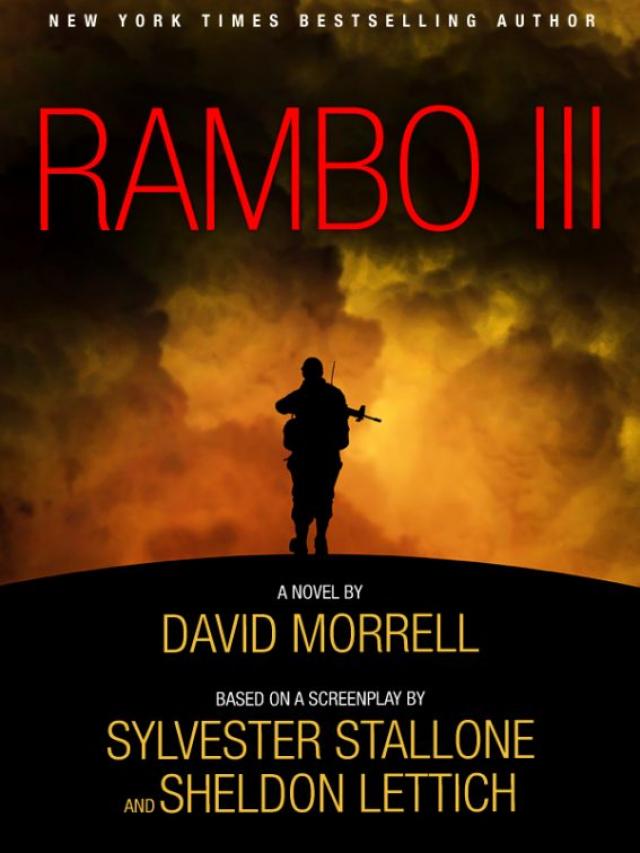


RAMBO III
A novel by DAVID MORRELL
Based on a Screenplay by SYLVESTER STALLONE and SHELDON LETTICH
®
RAMBO III
Originally published as a Jove Book by arrangement with David Morrell and Carolco Pictures, Inc., 1988.
Copyright © 1988 by David Morrell, all rights reserved;
Screenplay Copyright © 1987 by Carolco Pictures, Inc., all rights reserved.
Rambo® is a registered trademark owned by CAROLCO.
MARIO KASSAR and ANDREW VAJNA Present
SYLVESTER STALLONE
RAMBO III
RICHARD CRENNA
Music by JERRY GOLDSMITH
Director of Photography JOHN STANIER, G.B.C.T.
Associate Producer TONY MUNAFO
Executive Producers MARIO KASSAR and ANDREW VAJNA
Based on Characters Created by DAVID MORRELL
Written by SYLVESTER STALLONE and SHELDON LETTICH
Produced by BUZZ FEITSHANS
Directed by PETER MACDONALD
Carolco
A TRI-STAR RELEASE
© 1988 Carolco Pictures, Inc. All Rights Reserved.
To Matthew (1971-1987)—I love you, son.
CONTENTS
INTRODUCTION
1: THE ANVIL
2: THE EMBASSY
3: THE GUNSHOP
4: THE WASTELAND
5: THE SANCTUARY
6: THE VALLEY OF PAIN
7: THE FORTRESS
8: THE CAVE
9: THE MOUNTAINS
ABOUT DAVID MORRELL
INTRODUCTION
If you’re familiar with my introduction to Rambo (First Blood Part II), bear with me for a few paragraphs while I repeat some things I mentioned there. You’ll soon find new material. It’s important to understand the unusual nature of this book.
During the 1970s and 1980s, a hybrid type of fiction, known as a novelization, became popular. Basically, it’s a screenplay that’s expanded into what looks like a novel. In an age before films were widely available on videotape, fans of movies like Star Wars and E.T—the Extraterrestrial could experience them only in a theater or else (if they waited a long time) on network television. DVDs, cable movie channels, and Internet streaming didn’t exist.
Producers decided that fans might be devoted enough to want to re-experience the stories in the form of a book. But if the film was based solely on a screenplay, a book needed to be created. A writer was hired to novelize the screenplay, describing the characters and the settings (there are almost no descriptions in a screenplay) while letting readers know what the characters are thinking.
Some producers demanded that the writer make no changes to the plot and the dialogue. That could be difficult for a novelizer. How much description and how many thoughts could the writer add until the story lost its momentum?
Other producers understood that the writer needed a margin of freedom, and some interesting novelizations resulted, particularly William Kotzwinkle’s 1982 adaptation of E.T., which book critics reviewed favorably and which sold an astonishing million copies. Eric Segal’s bestselling 1970 Love Story was promoted as an original novel, but actually Segal wrote the screenplay first and then novelized the screenplay to promote what became an immensely popular film. John Wayne’s 1953 film, Hondo, was based on a Louis L’Amour short story, “The Gift of Cochise.” L’Amour then combined his short story and the James Edward Grant screenplay into a novelization for the film. With a publicity quote from John Wayne on the cover, it boosted L’Amour’s career.
So there are interesting examples of novelizations, but I don’t think any of them had a history quite like Rambo (First Blood Part II) and Rambo III. In 1972, I sold the film rights of my debut novel, First Blood, to Columbia Pictures for Richard Brooks to write and direct. A year later, Columbia sold the rights to Warner Bros., where Martin Ritt was considered as the director, with Paul Newman perhaps as the police chief. When that production didn’t happen, Sydney Pollack was hired to direct Steve McQueen as Rambo, but that production fell apart, also.
More studios and scriptwriters became involved until finally, in 1982, Carolco Pictures filmed my novel, with Sylvester Stallone as Rambo. The movie was so successful that, two years later, a sequel Rambo (First Blood Part II) went into production, using the countryside outside Acapulco to double for Vietnam. Halfway into filming, the producers decided that a novelization would be useful for promoting the film. But when they studied the contract that I’d signed with Columbia Pictures years earlier, they discovered that a clause stipulated I was the only person who could write books about Rambo.
In my introduction to Rambo (First Blood Part II), I tell the story of the backstage drama behind that book and how it turned out to be the most unusual novelization ever published, but perhaps I spoke too fast. Now that I think of it, my novelization of Rambo III is actually the most unusual of its kind.
Here’s what happened.
Rambo (First Blood Part II) premiered on Memorial Day of 1985 and created an international Rambo frenzy. I do not exaggerate. That summer, Rambo was everywhere around the world. The film broke box office records. Interest in the character was such that my novelization was not only a New York Times bestseller but was even serialized in newspapers such as the New York Post and the Boston Herald.
Carolco Pictures immediately began plans for a third film. In a rare decision, they hired me to write the screenplay (I had nothing to do with the second film; authors of source material are almost never consulted). For two days, I met with Andrew Vajna and Mario Kassar, Carolco’s co-owners, along with their production superviser, Buzz Feitshans. They had specific ideas about the concept (which they wanted to be about hostages) and the setting (which they wanted to be Central America, an unstable region back then). I suggested plot details, and this is the story we agreed on:
Colonel Trautman is assigned to give military advice to a Latin American country that is friendly to the United States but is threatened by revolutionaries. Because things are calm for the moment, Trautman’s wife and daughter accompany him, with assurances from the American embassy that they’ll be safely escorted to various tourist locations. Rebels take over the embassy, however. Trautman’s wife and daughter are held captive while Trautman is wounded in an attempt to stop the takeover.
Cut to Rambo in the United States, where he’s on top of a dizzyingly tall building that’s under construction. In Rambo (First Blood Part II), the screenwriters decided that Rambo was part Native American (my novel First Blood does not suggest this). Some Native Americans are known for their skill at retaining their balance at great heights, and as a result, they’re valued as workers on tall construction projects. I thought that this would be an interesting way to introduce the character, at the top of an immense city, surveying the horizon, amid the solitude he craves.
But after Rambo descends to the ground, he hears a news report about the embassy takeover and learns that Trautman’s wife and daughter are among the hostages. The key to Rambo’s character is that he hates what he is and the violence of which he is capable. Nothing can make him take up arms again, except loyalty to the man he thinks of as his father. In my novel First Blood, we learned that Rambo’s biological father beat his mother. In my novelization for the second film, I added the details that, after his mother died, Rambo joined the Army, volunteered for Special Forces, and attracted Trautman’s attention. Rambo and he developed an extremely complex relationship. Trautman is the father he wishes he had.
The script then dramatized Rambo’s determination to rescue Trautman’s family. After the rebels transfer the hostages from the embassy to their base in the jungle, there’s a dramatic scene in an eerie Mayan ruin as well as an intense action sequence in which Rambo overcomes rugged chasms and raging rivers as he chases the rebels. For me, the main point of the script occurred in the climactic rescue when Trautman’s wife shows that she is indeed the wife of a Special Forces colonel. Trautman taught her how to use automatic weapons, and in one scene, she and Rambo stand side-by-side, firing at the enemy while explosions roar near them. The rebels threatened her daughter, and by God, she wants to get even.
This was an unfamiliar concept in early 1986. True, seven years previously, Ridley Scott’s Alien featured Sigourney Weaver in a strong female action role. But that was an exception. James Cameron’s Aliens and Terminator 2 had not yet appeared, with heroines who demonstrated even stronger action skills. When the Rambo producers read my script, they had major doubts about showing a woman with a submachine gun. In particular, they worried about how the film would be received in Asian countries, where women have a traditional subservient role.
Having delivered the script, I returned to a novel in progress, The League of Night and Fog. Time passed. A lot of it. Writers are at the bottom of a studio’s need-to-be-informed list, so I didn’t think it was unusual not to receive messages from Carolco. Finally, a year later, in 1987, I heard that Rambo III would soon begin filming.
Excellent, I thought
One detail did puzzle me, though. The producers had planned to shoot my script in Jamaica, using it as a double for a volatile Central American country. But the announced location was now Israel.
Strange, I thought. Israel doesn’t have a jungle.
But it does have deserts and mountains that would double for the landscape of Afghanistan, which I was surprised to learn was the subject of the new film. My surprise was tempered by the understanding that it’s common practice for a studio to have different storie
s in development at the same time. Just because Carolco had hired me to write a script, that didn’t mean other writers hadn’t been hired to write scripts, also. One of those, it turned out, was co-written by the film’s star, Sylvester Stallone.
When I asked the producers what was going on, they explained that they now felt a desert picture would provide variety after the forest and jungle in the first two films. Afghanistan was a major war zone, where invading Soviets had battled rebel tribesmen for several years. With considerable media coverage as well as controversy about covert American involvement in that war, this was a hotter topic than revolutionaries in Central America.
As with Rambo (First Blood Part II), the producers wanted a novelization for their marketing campaign, and because I was the only author who could legally write books about Rambo, they again asked me to do it. This time around, I didn’t struggle with the decision. I had enjoyed inventing new facets of Rambo’s character in the prior novelization and was willing to repeat the experience, incorporating further character traits that were in my unused script.
But would the material the producers sent be enough for a book?
The plot went like this:
After the ordeal of again fighting in Vietnam, Rambo takes refuge in a Buddhist monastery in Thailand. Trautman comes to him, asking for help on a mission to Afghanistan’s border. Rambo refuses. Trautman is captured by the Soviets. Racked by guilt, Rambo sets out to rescue him.
So far, that sounds like the released film. But there was more.
Rambo joins forces with an Afghan tribe and meets a forty-year-old Dutch female doctor, who takes care of children wounded in the war. Her name is Michelle. There’s no suggestion of a romance between her and Rambo. Their relationship is that of two war-hardened veterans who respect each other. After Rambo rescues Trautman from a Soviet fortress, the enemy uses every tank and gunship to pursue them, forcing the villagers to flee. In the climax, Rambo, Trautman, Michelle, and the villagers fight their way to safety in Pakistan.
The plot was so big that some members of the production team called it “Rambo of Arabia.” I had plenty to work with, including a chance to develop parallels between the Soviet-Afghan War and the Vietnam War. The script portrayed the Soviet officers as simplistic villains, but I decided to make some of the Soviet officers sympathetic, treating them as counterparts to Rambo, both sides damaged by their respective wars.
After I wrote twenty pages, I received a second script, in which Michelle’s role and that of the children were reduced.
I wrote another twenty pages and then received a third script: Michelle and the children now had even lesser roles.
I kept writing. A fourth script arrived. Michelle and the children were gone. A wonderful sandstorm sequence disappeared. So did a dramatic scene in which rebel horsemen throw ropes around Rambo and ride in opposite directions, trying to pull him apart.
A fifth script arrived. A sixth. A tenth. A twelfth. The stack accumulated on my desk. With each version, the script got simpler until finally this became the story’s essence . . . Trautman is captured. Rambo tries to rescue him and fails. Rambo tries to rescue him and succeeds. The third act was basically the same as the second act, except that the outcome was different.
I phoned the producers and asked how many more scripts they expected to send to me.
“We’re not sure,” they answered. “The budget needs trimming. Sly wants to do more rewriting.”
“But I can’t meet the deadline for the novelization if I keep getting a different script every week. Each new one means I need to start over.”
“You’ve got to meet the deadline. The novelization is part of the marketing campaign.”
“Then let me use the first script. I wrote more pages based on that one. The book and the film won’t be the same, but you’ll recognize the basic plot.”
To my relief, the producers understood my problem and agreed. With more freedom than I imagine any novelizer ever received, I returned to my adaptation. Eventually the book differed from the first script as much as that script differed from the finished film.
A family crisis made it a welcome distraction. A few months earlier, my fifteen-year-old son, Matthew, came home from high school with a severe pain in his right chest. At first, it seemed caused by a strained muscle. But when the pain persisted, my wife and I took him to a doctor, who treated Matthew for pleurisy, an inflammation of the membrane around the lungs. The diagnosis turned out to be mistaken. When the pain got worse, Matthew was given a chest x-ray, which revealed a grapefruit-sized tumor growing from the inside of his ribs.
Midway into the novelization, Matthew was spending every third week in a hospital, where he received chemotherapy for a rare bone cancer known as Ewing’s sarcoma. Each day, after visiting him, I returned to our house to continue writing. When he was allowed to go home, my wife and daughter and I stayed with him while he rested groggily in his bedroom. After he fell asleep, I retreated to Rambo’s adventures in Afghanistan. To stop doing what I’d done every day for years would have been a terrible signal to Matthew that I no longer had hope.
In truth, fear dominated my emotions. Ultimates occupied my mind. Perhaps that’s why I shaped the book as I did. In the prior novelization, I began with Rambo splitting rocks in a prison quarry while meditating about Zen Buddhism, which he had learned from a Montagnard tribesman who helped Rambo’s unit during the Vietnam War. In a similar way, I began Rambo III with Rambo holding the Zen bow while meditating about the four truths of Buddha, the first of which he understands too well: life is suffering. My family—and certainly Matthew, who died shortly after I finished this book—understood that truth, also. (I wrote a memoir about all of this, called Fireflies.)
Life is suffering.
Under these circumstances, it’s not surprising that religion figures prominently in this book. In Rambo (First Blood Part II), the reader learned that Rambo has three faiths that come out of his complicated background: Roman Catholicism (from his Italian father), the Navajo religion (from his Native American mother), and Buddhism. Now, in Afghanistan, a country of Muslims, he learns about Islam. During my research, I became fascinated by the Muslim view of Fate, which I decided would be the book’s theme. How could Rambo, who hates himself, find his destiny?
Rambo III was released on Memorial Day weekend of 1988. Almost at the same time, the Soviets withdrew from Afghanistan. Perhaps they knew Rambo was coming. With a now-dated topic, reaction to the film was not as strong as it might have been if the film had been set (as initially planned) in Central America, where the region remained troubled. Ironically, almost a quarter of a century later, Afghanistan is a war zone again, and the subject is timely once more.
Although its theme was no longer ripped from the headlines, Rambo III attracted enthusiastic crowds. Its gross income was respectable even by today’s standards: $189 million. If that were the only factor, the film would be considered a box-office success. But the budget was $67 million. Preparing a profile for Playboy magazine, I spent a week on the Israel film set, near Eilat, and was amazed by the scope of the production. Hundreds of extras on camels stretched toward bluffs on the horizon as far as I could see. Numerous nationalities with different languages made coordination difficult, requiring lengthy preparations for each shot. Food providers needed to prepare several different sets of meals, paying careful attention to the separate religious/dietary requirements of Jews and Muslims. The desert heat was so strong that some members of the production crew had a full-time job just making sure that everyone always had water.
Considering all this, I’m surprised that the picture didn’t cost more than $67 million. Because theaters, distributors, and advertising expenses need to be paid, the point where profits begin is generally considered to be three or four times the shooting cost. So let’s say that the break-even point was $220 million. But the income was $189 million. Thus Rambo III often appears on lists of expensive films that lost money in spite of its respectable theatrical returns.