Plain bad heroines, p.23
Plain Bad Heroines,
p.23
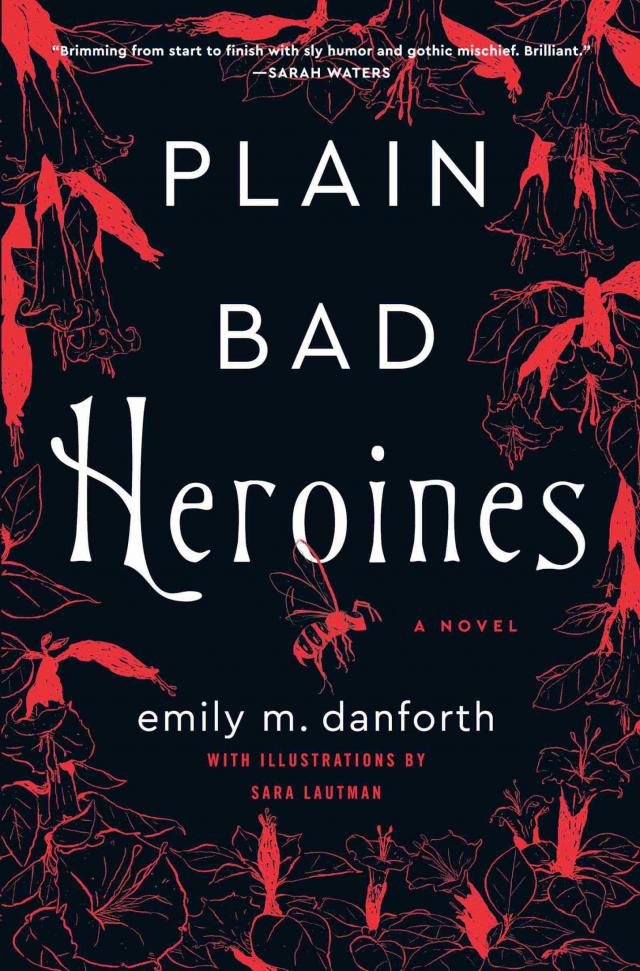


Her whole life (thus far) she’d felt she’d had to find ways to make herself seen. This was because she was the youngest child in a Chicagoan family tree with success at every branch: her father an influential architect; her mother a society maven and (occasional) campaigner for social reform. Not to mention her brothers, one of them only a few years away from being elected to the US Senate. (And there were countless uncles and aunts, cousins and close family friends, all with somehow even shinier shines on their Great American Dreams.) So our Libbie Packard had grown up learning how best to get herself a little attention when she needed it, sea of red-cheeked competitors or not.
She was meticulous in considering her options for approaching Alex: something subtle and clever, or brash and bighearted? Or could she achieve clever and bighearted both—an infinitely trickier pairing?
While she bided her time, Libbie joined a campus club, the Waggish Rogues. They performed skits at assemblies but were better known for their gotcha surprises—think something like early flash mobs—the fifteen or so of them suddenly descending on the library in masks and gowns to stage a scene from A Midsummer Night’s Dream. Or, while their more sensible classmates slept on the eve of Halloween, filling the dormitory hallways with cornstalks and pumpkins to greet them come morning.
All that fall and winter, Libbie kept quiet tabs on Alexandra, who was making her rather loud rounds as Alex the Flirt. She was paired briefly that school year with Jane, and then, for months, with Hazel Two.* Libbie completed an informal polling of several juniors and seniors, Alex’s classmates, to glean the details of the smashes that had come before. And there were so many of them—Evie and Ida, Kitty and Violet—canoodling on the tennis courts, sharing a bag of lemon drops in the library. But so focused was she, so certain of coming success, that these stories inspired not jealousy in young Libbie Packard, but fortitude.
As you’ve no doubt surmised, this quest was less about the particulars of the attraction Libbie had to Alex—whom she did not even know, not really—than it was about the attraction she had to achieving Alex+Libbie status. Soon it would be she who would accept a nectar drop still warm from Alex’s hand, and as it spread its sweetness on her tongue, the two would sit against each other in some conspicuous place on the College Green, tasting sugared peach and being envied by all who were not them.
It wasn’t until May Day—her second year at Wellesley nearly finished—that Libbie Packard felt ready to be seen by Alex Trills. To make certain that she’d be seen by her, that is.
Libbie made her move at that evening’s students-only Follies, an event hosted by the Waggish Rogues. She was adequate in the ensemble skits, but it was really only her solo performance that she cared about, especially once she’d confirmed that Alex was in the audience, pleasantly near to the front and sans Hazel Two.
Libbie was dressed as Nike, the Greek goddess of victory, complete with paper wings strapped uncomfortably to her back and a golden laurel wreath (really just painted branches from campus shrubs) atop her head.
To open the number, two of her fellow Rogues pushed her onstage in a squeaky wheelbarrow. This action, combined with her costume, drew the first giggles. Then the Rogues positioned themselves stage left, where an oversize title card was waiting. They now held it between them to set the scene for the audience:
NIKE, GODDESS OF VICTORY,
RECOUNTS HER ROLE
IN THE VICTORIES OF THE HEART
OF OUR OWN ALEX THE FLIRT.
This drew more giggles and some whoops, too. Libbie watched as Alex straightened in her seat and pretended to be embarrassed by the attention: classic Alex the Flirt head-ducking.
Standing tall in the wheelbarrow, downstage center, Libbie Packard as Nike began her song in just about the sweetest sotto soprano you’ve ever heard. Part of the gag was that, despite ostensibly being the brash goddess of victory, our Nike was a little stage shy. However, as she sang on, listing Alex’s lengthy history of campus crushes—and her own role in bringing them about—she gained confidence:
. . . Sitting pretty with Kitty, all due to my charm.
Then Mary’s heart went pitter-patter when you had her on your arm.
Oh Alex, sweet Alex, that you’re a flirt we know is true—
but you must now give credit to whom the credit’s due.
I’ve been there behind the sunsets
you brought your girls to see.
I’ve been the cause of the red-rose bloom
that sealed your victory.
In all these earthly crushes,
it’s been me at the strings.
Why there have been so many conquests—
you’ve quite worn out my wings!
Libbie had a fairly limited range as a performer, but she’d created this character to maximize her skill set—soft and sweet building to winkingly brash—and she delivered with relish. The audience was hers, but it was Alex’s appreciation she was after, and with the glare of the footlights and rows of grinning faces before her, it was difficult for Libbie to discern what Alex thought of her tribute.
The song reached its crucial final turn, where Nike makes her challenge:
After Evie, after Hazel
and after Violet, too.
At this point, a fellow Rogue delivered a scripted interruption by running onstage to correct Nike with the pun “I think you mean Hazel Two.” She held up a card to the audience that read: Violet, too Hazel Two.
Libbie continued with her song, now amended:
After Evie, after Violet,
and after Hazel Two.
I’m bored with bringing triumph—
I’ve done what I will for you.
Now it’s your turn, Alexandra—
to prove your abilities.
Why not try your hand at Nike?
Can you weaken goddess knees?
No, I won’t be there to aid you—
I won’t assure your victory.
But if you can claim my lofty heart,
you’ll have the best of me.
Come get me, Alexandra—
our dear Alex the Flirt.
Come test your mettle with a god—
if you’re to know your worth.
You can find me in the Pantheon.
That’s where I live, it’s true.
But you’ll need more than disrepute—
to make me fall for you.
Unquestionably, many a heart went pitter-patter, and several cheeks may have even been pinched for Libbie Packard that night. A few students threw flowers onstage and there was one particularly stellar whistle that came from the back of the theater and cut across the applause in its intensity.
But our Nike was after only a single victory, not dozens of them.
She claimed it out on the lawn, at the cast party, which was as much the reason for the popularity of the Follies as were any of its skits. It had rained earlier but now it was clear. The night was drunk on the liquor of late spring, on wet grass and pale moon, on air still warm even after the sunset, air now scented by the rain-smacked lilac bushes planted at the back of the theater, their branches so heavy with blooms and moisture that several were bent against the ground.
The audience was hers, but it was Alex’s appreciation she was after.
Libbie was being served her second glass of punch, something made with too little wine and too much sugar, but she was glad to have it still. Her mouth was rimmed in grape stain, her shrub wreath slipping down her forehead.
“I hadn’t heard they’d moved the Pantheon to Wellesley,” Alex the Flirt said, approaching her from behind. “Fine work by the trustees.”
Hackneyed or not, Readers, Libbie’s heart lit like a match, and she turned, smiling. It was dark out there on the lawn, difficult to see well, so she couldn’t tell if Alex was smiling, too.
“You know you might have sent me a note,” Alex said. “Or come to find me. I would have met you, if you’d asked me to.”
“There wouldn’t have been any applause for me with just a note.” Libbie’s crown was now tilted over one eye.
“How can you be sure?” Alex asked, stepping closer. Now there was almost no distance between them at all. She held out her hand and softly, steadily righted the wreath, gold paint coming off onto her fingers as she did, though she wouldn’t notice that until the next morning. “I might have clapped for you, alone with my private note.”
“It’s not too late for that,” Libbie said. She heard her blood in her ears. It had started a moment before, when Alex had touched her temple, fixing the crown, Alex’s soft fingers against the even softer skin at her hairline in the warm, scented night—the kind of distinct memory that would plant itself in her to be recalled for much longer than she could have guessed right then.
“How do you know me?” Alex asked, her tone more serious. “I mean, do we know each other?”
“I’m trying to know you,” Libbie said. “If you’d let me.”
“After all this effort, seems I have to,” Alex said. She was smiling. “You did borrow a wheelbarrow. Now it’s Miss Nike Packard of Chicago, do I have that right?”
“I’ll let you call me Libbie,” she said, victorious.
Harper and Merritt Go on an Impossible Los Angeles Date
Anybody have money on motorcycle? As in, twenty bucks says Harper Harper was driving a motorcycle that day, and that it would serve as the pumpkin coach for her and Merritt’s Los Angeles dream date?
Because if so, Readers: it’s time to collect.
She had driven some rare model of Moto Guzzi to Bo’s. It’s the kind of bike that people who know about such things, people who care, care about. I am not one of those people, but that bike was a beaut: cream and green, chrome and oil-rubbed leather.
She’d also brought with her a glittery blue helmet for Merritt and a more elaborate black one for herself. She had them propped against the bike’s tires there in Bo’s stuffed driveway. And draped over the seat was a black leather jacket very much like the one Harper wore herself.
“Is this gonna be OK for you?” Harper asked as she bent to retrieve the helmets and hand Merritt hers. “It’s cool if not. I mean it. I’ll get us a car.”
“Oh wow,” Merritt said. “Fuck. OK.” The closest she’d ever been to being on a motorcycle was briefly riding a Vespa as part of a tour group in a hill town in Italy and let’s face it: that wasn’t very close at all. “I should have expected this. Since it’s such a known thing about you.”
“Doesn’t mean it’s your thing,” Harper said.
“Oh, it’s not,” Merritt said. “But today I did sign up for the full Harper Harper experience. Is there even room for us both?”
“There’s room,” Harper said, patting the seat in the back. “This is where you go. But also, we really don’t have to do this. I mean it. I want you to be comfortable.”
“You just need to tell me every single thing I need to know to not get in your way and to keep you alive, by which I mean to keep you keeping me alive. Everything—spare me nothing. Where do my hands go, where do my feet go, how do I sit, how do—”
Harper laughed and said, “I wouldn’t let you get on otherwise. You’re sure?”
“Stop asking,” Merritt said. “Teach me.”
So Harper did.
Once Merritt was seated behind her, but before she had started the engine, Harper leaned back and asked, “Piercing first? Piercing last?”
“It’s your show,” Merritt said. “This is supposed to be your California dream come to life for me.”
“So no pressure, then,” Harper said.
“All the pressure,” Merritt said. “Every ounce of it.” It felt to her like they were escaping, leaving the bungalow of botched auditions in their dust.
And yet somehow, Readers, somehow, taking off with her arms at Harper’s waist, feeling the bike’s whir, its metal churn—feeling it, not just hearing it—latched to their bodies while the wheels roiled beneath them and heat bloomed from the engine, somehow all of that was only the cheese and crackers before dinner, the not-so-memorable opening band before the headliner.
The least of it.
First Harper took Merritt to Metal Mug, a piercing place in West Hollywood. It was bright and modern, its big windows streaming gobs of California sun into the lobby and two fiddle-leaf fig trees in cement pots making the most of that light, their leaves huge and too green to be believed. So while they waited—for no time at all—Merritt dug her sharp thumbnail into a couple of them to be sure. They were not only real, they were now wounded by her: black crescents weeping plant matter.
The place was so smartly designed and sterile that the only vestiges of punk-days-past came from the soundtrack and the staff. When they’d entered The Clash was playing but now, as Sloane, their piercing professional, readied her station, it hopped to Billy Bragg singing “A New England.” Sloane’s own face was an archipelago of metal adornments. You could tell she was pleased Harper had requested her, but she certainly wasn’t gonna go on about it.
“I don’t get to do eyebrows very much anymore,” she said, having selected two so-thin gold hoops from her jewelry case.
“She’s gonna bring them back,” Harper said. “Single-handedly.”
“As close together as you can get them,” Merritt said. She was now seated in a big chair, almost like a dentist’s chair.
“You’ll wear them well,” Sloane said. It felt like the whole thing had just been notarized by that statement: Sloane’s official seal of piercing approval.
“You will,” Harper said, her face closer to Merritt’s ear than it needed to be for her to say it and for Merritt to hear it. Her breath, the soft impact from those words, linked up with the nerves in Merritt’s spine and traveled her length.
Billy Bragg sang, “I saw two shooting stars last night / I wished on them but they were only satellites / It’s wrong to wish on space hardware.”
Soon Harper and Sloane joined him, singing the part about looking for another girl.
And then, because the song was so soon over, Sloane called to someone in some unseen part of the shop, “Ayyy! Mimi! Play that one again.” And hidden Mimi did. And the needle went in above Merritt’s eye with a pressury pinch, not really pain, just sharp pressure releasing a stream of tears but only a couple quick drops of blood, which Sloane didn’t let linger.
She was efficient, in her purple-gloved hands. She was fast. Merritt had barely comprehended the addition of those tiny hoops to her eyebrow, to her face, in her reflection there on the hand mirror they’d given her, when Sloane said, “A few for our Insta,” and she was posing with Harper, their warm cheeks pressed together.
And oh my gawd: Merritt was smiling. Her eyebrow throbbed like she’d been stung there, was being stung there. But she was smiling.
Then Harper took Merritt’s hand, as she had the night previous at Spago—hand in hand with her leading and Merritt following with almost all the willingness to do so that she then possessed—and they were leaving, they were out of there, and as they reached the front of the shop again, up near those fiddle-leaf trees, Merritt said, “I need to pay.” But that wasn’t true, it turned out. Harper had already, or they’d pierced her for free, for the publicity: Harper Harper, valued and frequent patron of Metal Mug. Or perhaps it was a little of both, but whatever it was, there was no money owed by Merritt and no one to pay it to, Sloane and Mimi probably busy hashtagging those pics they’d just taken.
And then they were again outside in the full of that California sun, more of those too-postcard-to-be-true palm trees above them. But in front of them, immediately in front of them, were paparazzi and fans. Some of them were #HARPEOPLE, but others had gathered because they saw other people gathering, something to see. There was a buzzing swarm of humans from Metal Mug’s doorway all the way to the Moto Guzzi and a few squeals, a few gasps—yes, gasps—as they now walked through the swarm. As Harper Harper came into its midst.
Later Merritt learned that Harper had posted their location, likely right as Sloane was swabbing Merritt’s eyebrow with iodine. This meant good attention for the shop, sure, but Harper also knew, had to, what it would do. The chain reaction it would cause. And how fast. Minutes. It had only been minutes since:
Harper Harper @HarperHarper
Getting new hardware for brilliant/gorgeous @SoldOnMerritt @MetalMug so she can be gorgeous X 2.
And people had come to find them, and more would come, still.
“So who’s she, anyway?” one of the paparazzi guys asked, gesturing his ostentatiously oversize camera at Merritt. “Who the fuck’s Merritt Emmons?” He was reading her name from his phone.
“Who the fuck are you?” Harper asked him back.
And he smiled as he said, “I’m the guy who keeps you paying for this sick bike.” She seemed to know this particular jerk, seemed to have an affable thing going with him.
“This the lay of the week?” another guy asked. He was filming them on his phone.
“Of the day,” someone else called, because of course they did.
Now almost all of them, fans and paparazzi alike, had phones and cameras and one iPad too pointed at them.
A woman with endless legs stuffed at their shapely bottoms into black combat boots and sprouting at their shapely tops from denim cutoffs so cut off that their white pocket innards were the lowest hanging fabric on her legs walked toward them. Over the rest of her svelte frame she wore a thin white tank top (no bra) and a green-and-blue flannel shirt, unbuttoned, sleeves rolled. Her brown hair was big and messy, her sunglasses as large as Merritt’s own. She said, as she reached for Harper’s other arm, the arm that didn’t end with a hand in Merritt’s: “Hey, I want a ride on that bike.”
“Only fits two,” Harper said, winking at her. “Next time.”
“Come on,” this stranger said. “Take me instead. I’m better for you. And I love you.”