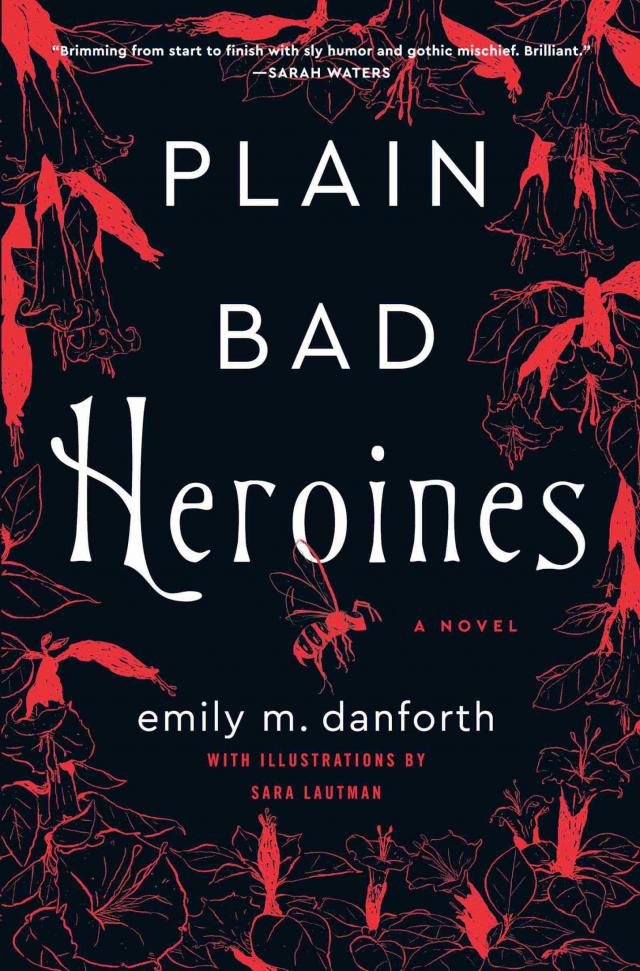
Plain bad heroines, p.61
Plain Bad Heroines,
p.61


* That caption: Just found these in a bag of dirt at Brookhants. Beautiful, but cursed?
* A telling sample of the kinds of advice given in that chapter: “I like a girl to have many girl-friends; I do not like her to have a girl-sweetheart. There are but two people in the world to whom a girl should give her confidence—the first is her mother, the second is her husband. When two girls are very intimate, and count out of this intimacy not only their own sisters but all their other friends, they are apt, unconsciously, to cultivate the faults of selfishness, of meanness, and to cause an undesirable morbidness to spring up.”
* What was there to say, really? The cause was so widely known that two of the less-established and academically rigorous regional prep (finishing) schools for girls—including Mrs. Hutchinson’s (in Newport) and St. Catherine’s (in New Bedford)—had apparently used the recent deaths at Brookhants (and also, of course, the whispered rumors of a curse) to drum up business for themselves. It’s worth noting that while Mrs. Hutchinson’s and St. Catherine’s were maybe rather short, in those years, on academic excellence, they believed that they made up for any deficits in that area with their offerings in the domestic arts, and in their extensive religious requirements, including mandatory classes and church services. These had always been (notable) gaps in the Brookhants curriculum and tradition.
* Even Aimee Benton returned home, leaving her copy of Side Talks with Girls behind.
* Brookhants culled its faculty from the likes of Barnard, Bryn Mawr, Mount Holyoke, Radcliffe, and Wellesley. It’s perhaps no surprise, then, that its curriculum was heavily skewed to best prepare students to pass the entrance exams at those institutions.
* Which is not a slushee, careful Readers, but in this instance, it would have to do.
* “Annie Lisle” is a rather mawkish American ballad about a fair young maiden who dies from some unnamed ailment. It was written in 1857 by New England songwriter H. S. Thompson. A few choice lyrics:
On a bed of pain and anguish / Lay dear Annie Lisle, / Chang’d were the lovely features, / Gone the happy smile.
Even if those lyrics are new to you, I bet many of you are more familiar with this song than you think. In 1870, its tune was borrowed for the Cornell University alma mater, “Far Above Cayuga’s Waters.” (Which, as you might recall, is proudly sung by the character Andrew “Andy” Bernard on the sitcom The Office.)
Since that melodic reincarnation, the tune has also been used as the backing to the alma maters of more than a hundred other schools. Or, if you prefer to dig even deeper into the annals of twentieth-century popular culture, it was used for the Kellerman Resort closing celebration song in the 1987 film Dirty Dancing. (Which is where I first heard it, judging Readers.)
It is catchy. And it certainly has staying power.
* Adelaide/Addled: Was there something to that, Readers?
* Though Libbie still hadn’t decided if she would send for the girl, despite what she’d promised to Harold by pen and by word.
* I know I don’t have to remind you about which city the Boston marriage was named for, Readers.
* Libbie would not confirm this until later, but as she’d suspected, at the time Alex was making her running shove, Caspar and Max hadn’t even reached the doctor’s practice in town, let alone returned with him. To explain her error Hanna had said simply, “I was so sure I’d heard them on the road.”
* Lyrics from the song “Magic,” a chart-climbing, 1984 single from the band The Cars.
* Too much, Readers? I was hoping that we’d come to a place in our relationship where you’d allow it.
* Misha Reditch and Renae Gonzalez were actors with small roles playing fellow Brookhants students. There was good reason to believe that one or both of them had leaked footage they’d shot from their phones of a previous on-set alleged paranormal occurrence involving several crows smashing themselves into the windows of The Orangerie.
* Sometimes, as you know, Readers, quite literally.
* In case you’re not familiar, finsta is a portmanteau of fake Instagram. These are accounts created by celebrities or anyone who wants to lurk or post without feeling the need to perform for fans (or advertising dollars) or who wants to embody a fake persona while using the platform. Generally, the celebrity in question keeps the account set to private, not public, and only allows select people to follow it. Harper’s finsta, at that time, was @RubyBoobyMcLintock (it referenced a private joke). That account had only 149 followers and itself was following only 28 accounts. (Audrey was one of its most recent followers, and she’d finally made her own private Instagram account in order to do so.)
* Photographers call it the golden hour, too. Probably you know this already, especially since you can now use a filter to conjure the same effect. But if you’re gonna be old school about it: you get two magic hours a day, when the sun is low on the horizon and the world appears as if dipped in honey.
* A beautiful short story by Willa Cather. It was first published in 1905 and is now widely considered an examination of a young queer person’s life of longing in a world that doesn’t understand him. You should check it out, Readers.
* Then and still the record length for a single onscreen scene featuring multiple topless women in a slasher film.
* It’s true, Readers, that in her way, young Ava Brookhants was not styled so differently than certain J.Crew models of today.
* One of Lovecraft’s most lasting and influential creations: a mind-controlling entity that appears as a monstrous mash-up of octopus, dragon, and human. Ugh, all those dangling tentacles.
* Even more fucked up than his fictional monsters were Lovecraft’s very real beliefs about white supremacy.
* The inscription on Lovecraft’s gravestone in Swan Point Cemetery: I am Providence.
* The general consensus that night, Readers, at least from the loudest pontificators, was that all this Brookhants nonsense was just that: Bogus. Bullshit. A hoax of the dumbest order intended to froth the dim-witted moviegoing masses.
* The artist had made this necessary distinction clear by painting the words James Baldwin next to the mural’s head with a helpful arrow.
* They used the same recipe as at least one of the cocktails named for MacLane at the height of her popularity.
* Set List for Newportmanteau: October 11, 20—:
“Walking with a Ghost,” Tegan and Sara
“Cry Like a Ghost,” Passion Pit
“It’s a Curse,” Wolf Parade
“Ghost,” Halsey
“I Put a Spell on You,” Screamin’ Jay Hawkins
“The Ghost of Tom Joad,” Bruce Springsteen
“Seven Curses,” Bob Dylan
“Ghost Town,” Kanye West
“In the Fog,” Azure Ray
“Registered Ghost,” Portastatic
* The stanza used most often to end the unofficial ballad of the Brookhants School for Girls.
* It wasn’t a trick of light or a shared hallucination that night in the tower, Readers. It was Hanna Eckhart seated next to Harold in the panoramic séance photo. Hanna might have long been a member of Harold’s house staff, but she was also a person with a keen interest in the afterlife, and Harold was only too delighted to push that interest in the directions he most favored. However, the plain fact that Hanna Eckhart sometimes participated in Harold’s psychic pursuits does not necessarily mean that any of the other terrible things our Alex (and after, at least for a while, our Libbie) believed about her were true. Remember this for what comes next.
* Hanna Eckhart was buried in the Little Compton cemetery. Libbie was certain of this. She had asked to stop and see the headstone on their way to the house. She had touched it, the stone cold even in the sun. And when Sara’s back had been turned, Libbie spit on the grave.
* It was.
* I’m very sorry that I cannot give you the name of this woman, Readers, but it’s been lost to time and mansplaining, while, of course, the names of the Rash brothers have stayed firmly affixed to their dumb tale.
* If you guessed, Readers, that Harold’s interest in Libbie’s child—in other words, his interest in obtaining a child (or vessel) that could be reared in exactly the manner he prescribed—had something to do with these beliefs, you’d be right. I won’t attempt, here, to summarize his complicated thinking about the insignificance of corporeal death when compared to the realms one’s spirit might live on in, but you can read it in Harold’s own words if you can track down copies of the letters he left for Ava.
* OK, OK—so I lied, Readers. I did know her name. But Harold didn’t, and that was the point.
* Readers, as you may know, we do have Ava Brookhants’s own account of this scene from her 1964 memoir, Seer: The Ava Brookhants Story. The book was neither a critical nor a commercial success, but her rendering of these moments is both beautiful and terrifying (a combination favored by our own Bo Dhillon). In the passage, Ava writes that she did not understand, as a child—one who had recently been given a dose of heroin for the pain of her broken arm (yes, you read that correctly)—what she was seeing. She could not fathom what Libbie was doing in the water with all her clothes on at night, or if she should even believe that Libbie was there at all, given her state of mind. And soon, Adelaide came to find her and tuck her back into bed, anyway. Ava accepted her mother’s departure as readily as she had accepted her return: with disinterest.
* Otherwise known as Cannes, the film festival held annually in the spring in Cannes, France. Did you really think, Readers, that this film could premiere anywhere other than France? (Except for maybe Brookhants, but what would be the point of telling this story back to itself?)
* Word was that Harper was seeing her tuxedo’s designer, Annicka Barris, until word was that she was not.
* It was.
* This is true. Harper does really like the movie that Bo made from the Brookhants wreckage. It’s also true that she thinks Audrey is its breakout star. Audrey’s is the performance they’ll be talking about most.
* March 15 entry in I Await the Devil’s Coming. But then you knew that already, didn’t you, Readers?
Emily M. Danforth, Plain Bad Heroines