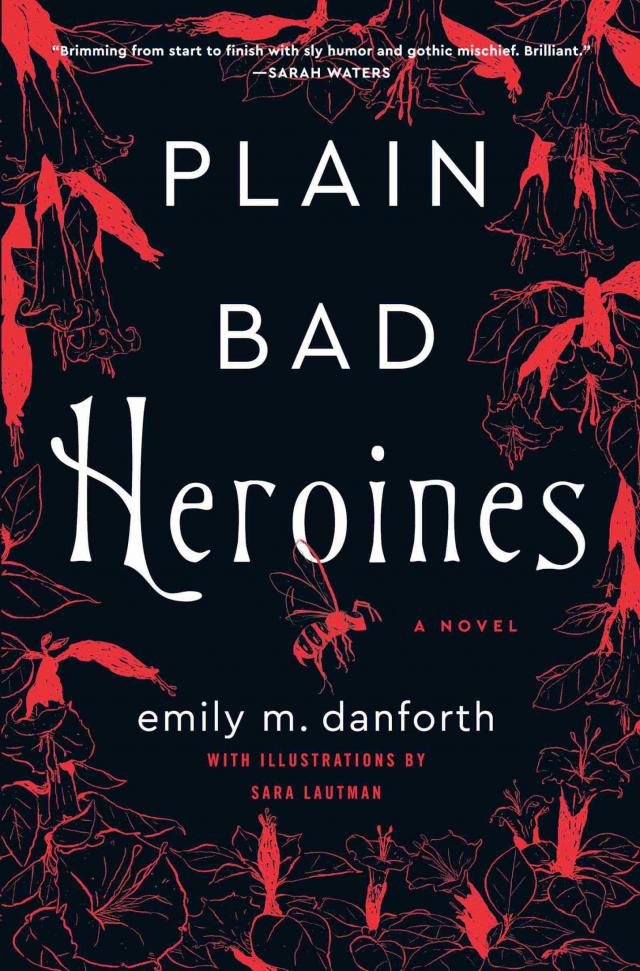
Plain bad heroines, p.51
Plain Bad Heroines,
p.51


And they couldn’t go back anyway. Noel’s band was playing in Providence—Bo had arranged for that to happen, and for some of the footage from that show to make it into the film. And for that to happen they had to go see the band. She had to go.
The crowd booed the action on the screen, the pound of piano keys indicating some lurking threat, some coming violence.
Audrey got out of the car and Harper and Merritt came around to join her, bundling her between them with their arms and bodies; she shivered and did not feel them there the way they wanted her to. Or the way she wanted to.
“Here comes Bo,” Harper said. “He’s smiling. He must’ve had a nap and a bottle.”
“Wait, is that your mom?” Merritt asked.
“No way!” Harper said. “Is it?”
Audrey looked up to see that of course it was. Of course it fucking was. Caroline wasn’t supposed to be here yet, not for another week, but here she was—striding across the lawn with Bo at her side. She was wearing one of those puffy, ankle-length winter coats that made her look like she was sheathed in a flayed caterpillar and was further silhouetted by the projection of her younger self, topless in a pool.
“Honey, were you just driving?” she called to Audrey. “That’s so great!”
And where were the cameras now? Trained on this moment is where. They had to be. Audrey couldn’t quite read Bo’s face at this distance. Was he scowling at her? Was he smiling?
“I can’t be here right now,” Audrey said quietly. “Can we please go to Providence?”
“Now?” Harper asked. “Why, what’s happening?”
“You really didn’t know she was coming?” Merritt asked.
Now Bo and Caroline were there in front of them and Audrey was hugging her mom, because what else, and everyone was saying things that didn’t matter and weren’t real, like What about this crazy snow? It’s unbelievable.
“What are you doing here?” Audrey asked.
“I came early!” Caroline said. “Surprise! This guy convinced me to.” She tilted her head at Bo when she said it.
“Thought she was missing out,” Bo said.
“He said you’d be happy about it,” Caroline said, taking in Audrey’s face. “I wasn’t sure.”
“Of course I am,” Audrey said. “It’s just that we have to go right now. We’re going into Providence to watch Noel’s band play.” She did not look at Bo. She would not.
“I know, Noel told me,” Caroline said. “Isn’t that later, though? I’m going, too—it sounds like everyone’s going.”
“Yeah, the show’s not until later, but I want to see him first. Beforehand.” Until Audrey said it, this had not been the plan.
“You have to go right now?” Bo said with one eyebrow raised outrageously high—not that Audrey saw it. “You sure about that?”
“Yes, right now,” Audrey said to the dark rim of woods over his shoulder.
“OK,” her mom said easily, reaching out to squeeze her shoulder, which made Audrey bristle in a way she didn’t like. “I can’t wait to see your little house on the water! Everybody’s telling me they’re so cute. I really hope it warms up again while I’m here.”
“OK, I love you,” Audrey said. She felt relief turning away from them and handing the keys to Merritt, adding, “I can’t be trusted on the highway yet, obviously.”
Merritt and Harper looked at her, at each other, and then shrugged with semiconfused acceptance and Harper slid back in the passenger side and Audrey squished in beside her, shutting the door as if that was that. They were going. So Merritt put herself behind the wheel.
After Merritt had started the car, but before she began to back up, Caroline called to them, “You’re not gonna put the top up? You’ll freeze!”
“We like it this way,” Merritt said.
“Be safe,” Bo said.
As Merritt pulled the car past the two of them, standing there with puzzled faces in the glow of the film, Audrey said, quietly but not that quietly over her door, “Anything from the orchard’s off-limits. I mean it. It’s out or I walk.”
Ava in the Orchard
Ava Brookhants was up in her favorite tree, watching.
Since she’d first come to Spite Manor the year before, Ava had climbed many trees. Enough to know, anyway, that this one was her favorite.
She almost always went up and up, past the first fork of limbs, reaching her feet out in a bizarre kind of geometry to find the best branches to carry her to a topmost perch where she liked to sit, sometimes for hours. There she had access to a hollow formed when a limb had crashed down during a blizzard.
This had happened, Addie had told her, during the year of the curse, the year that had sent her aunt Libbie away. They’d had a most terrible blizzard that year. (Though Adelaide hadn’t phrased it quite that way. She’d only named the year. It was Ava who had done the calculations to confirm, for herself, that they were one and the same: the year of the terrible blizzard was the year of the curse.)
But now it was 1904 and the curse was no more.
And earlier today, her aunt Libbie had finally come home.
Ava’s perch wasn’t noticeable, especially if the tree was in leaf and you weren’t looking for her, but her hollow was even more hidden than that. Because of this, she stored all kinds of important things within it. Just now she had a few of the pages-long letters her uncle Harold had written to her before he died, and a large moonstone she’d found on the beach, then cut and polished herself (well, with Max’s help she’d done it herself), and the papier-mâché doll she’d made with Addie.
Ava also had a small knife hidden in a bone sheath that she used to cut slices from the apples around her. She often ate so many of these she’d get sick before climbing down. And she had two seashells she liked for no particular reason, and a piece of brown-sugar fudge wrapped in waxed paper, and, today, a book. (But only the one. Usually she had several books up in the tree with her.)
She pulled the knife, still sheathed, from the hollow and pinned it between her bony knees. Then she reached over and back, carefully, carefully, leaning out into the air to test the firmness of a fat purple-black apple she’d been eyeing. She plucked it free, managing to get the whole stem. Ava Brookhants was superstitious about not getting the whole stem. She shined the apple on her shirt, unsheathed the knife, and cut herself a slice. It was crisp and tart. Juice pink with lifted pigment dripped down her face, rolled off her chin, and fell onto the leaves below with the pit-pat of raindrops.
Even then, Ava had a vague sense that some of her interests, like tree climbing and stone polishing, were perhaps unusual compared to those of other girls her age. I say a vague sense because she hadn’t yet spent all that much time with girls her own age. Not back in France, where it was only Ava and her careful caretakers, the Verretts—a family of sisters and their matriarch, the scarily glamorous Odette—expressly chosen by her uncle Harold to raise her, and certainly not here in Rhode Island, where, while waiting for her aunt Libbie’s return, she was tended to by the doting Eckharts.
Only now Hanna Eckhart was dead, too. Ava had learned a new word as the cause: apoplexy. Of course, Aunt Libbie wasn’t really her aunt, just as Uncle Harold had not been her uncle. Ava knew this because the Verretts had told her and Hanna had confirmed it. Harold Brookhants was her father and Libbie Packard Brookhants was her mother. This information made no difference at all to Ava, because at the time the Verretts were telling her this, Libbie and Harold were both only names to her. She did not know them, not as she knew the Verretts. What Ava did know is that her uncle-father Harold was already dead, but he’d written her long letters before his death, and her aunt-mother Libbie lived in America and was content to let the Verretts raise Ava in France. (And she’d never written Ava any letters at all.) So those things she knew.
The very important thing was that, for now: Aunt Libbie did not know that Ava knew any of this.
The other very important thing, at least according to Adelaide, was now that Aunt Libbie was back at Brookhants, she would probably again open her school, the Brookhants School for Girls, and at that time, or at least once she was old enough to do so, Ava could attend.
She’d been thinking a lot about this. What would it be like to attend a school with other girls her age and older too, which was even better—American girls who knew American things? She was both excited by this prospect and also unsure about it, about how she’d fare, how she’d get along, or not, with the other girls.
She cut another slice of apple, careful with the blade, which she always sharpened on the same stone Max used for his knives. Her hands were now so sticky with juice that if she pressed them against the trunk, flecks of bark stuck to her palms. She did not mind this. She liked the idea of wearing tree skin over her own.
The first of the yellow jackets found her then. Her cutting and chewing must have lured it from where it had been: buzzing among the apples rotting below the tree. This was only the first. Ava knew there would be others.
No matter. She cut another slice.
Ava had come to understand that some of Uncle Harold’s ideas about her rearing, as carried out by the Verretts, had been, let’s say, queer. That she was allowed, for instance, from the earliest age, to choose her own clothing. This would help to explain why she was wearing what she was wearing right now: wool knickerbockers and a striped Breton shirt. (When it was cold, she might add to this ensemble a wool fisherman’s sweater and hat.*)
While the many maids Verrett wore diaphanous dresses in vibrant purples and blues, dresses that flowed like their very long hair, Ava was never inspired to follow their examples, and in fact kept her own hair cut quite bluntly (she took the shears to it herself when she deemed it too long). She did glean, however, from the novels she endlessly consumed (she could read in both English and French), that not only her own style, but even that of the Verrett sisters, did not precisely fit the expectations of the era where women and girls were concerned.
Indeed, Ava thought there was little about her that precisely fit those expectations.
For instance, most people would likely find it peculiar that the Verretts had taught her not only geography, spelling, and mathematics, but also philosophies of ontology and mysticism. (As they had been directed by her uncle Harold.)
And she’d learned about various methods of spiritual communication in much more experiential ways, too. All of the Verrett sisters were mediums of different abilities, from channeling to clairvoyance. Germaine painted spirit portraits of the dead. And of course, Odette was one of the most famous trance lecturers of her time.
But as not a single of these subjects had ever before been included in the Brookhants curriculum, Ava sensed—correctly, Readers—that the specifics of her previous education might well set her even further apart from her classmates when and if her aunt Libbie’s school reopened.
And so while she was excited about the pending arrival of so many girls, she was also a little frightened about the many changes afoot here in the only slice of America she’d ever known. A slice that, for a year, had been quiet, secluded, and populated only by the doting Eckharts and Addie and Max. A year during which her aunt Libbie had been merely a rumored phantom shut up nearby in a hospital for the insane. Ava had taken a few excursions into Newport and Providence, and one to bustling Boston, but otherwise, Spite Manor and Brookhants—empty, ghostly, deliciously cursed Brookhants—were America to Ava.
And she wasn’t sure she wanted that to change just yet.
Of course, Ava hadn’t wanted to leave France and the Verrett sisters, either, when the time had come to do so. She knew that Germaine must still wear a shoulder and neck of thick pink scars from the scalding tea Ava had thrown at her as they’d struggled over this mandate, but Ava had done it. Eventually. For here she was in America. And thriving, too.
The wasps were swarming now. In the time it had taken her to eat three-quarters of the apple they’d gone from one to dozens. They moved about her like drifting snowflakes, their hum-buzz the right vibrato to set her song to:
What’s the racket, yel-low jacket?
At Brook-hants you roam!
You took the lives of all those girls—
but now I’m here and home.
So she’d made some lyrical alterations. What of it, Readers?
Ava had found the handwritten sheet of song lyrics folded and placed between the back pages of the book she right then had stuffed in her hollow.
She wasn’t a stupid girl. She knew it was the book: the cursed book that had supposedly caused all the trouble. Ava had known, from the moment her hand touched the red binding, that this was the true copy of The Story of Mary MacLane. It was as if the book’s very paper and ink had become heavy with its history. And, Ava believed, if she held her nose at the correct distance above its open pages—not too close, not too far—and sniffed, it still carried sweet notes of the deathly flowers once pressed inside.
She hadn’t yet finished it, but truth be told, she didn’t think a whole lot of it. She certainly didn’t understand all the fuss over it. Or why girls all across this strange country had called themselves Mary MacLane devotees and formed clubs in her honor. (Why must Americans insist on always thinking they’d invented everything, including sentiment?)
Ava, after all, had already read all but the most recent of the Claudine novels. In French. (And she’d felt a curious pinch of attraction when she’d glimpsed the youngest Verrett sister, Marceline, nude and so fresh from a bath that the beads of water caught the light across her freckled back.)
I mean, if writing a book of this sort was all it took to inspire such devotion, then why didn’t everyone do it? Ava thought she might. One day.
One day she would do so many things.
A mass of yellow jackets had pooled in front of her face. She took great pleasure in forming her lips into a tight O in order to blow out a strong stream of air and skitter them away. Ava was not afraid of the yellow jackets. She had sat, and even moved, in swarms much larger than this one—especially when she went into the woods to the hot springs. Adelaide had shown her the best paths to reach the springs and she had never once been stung. Not yet.
It was Adelaide who had also taught her about the intricate beauty of the yellow jackets’ nests. These nests were, after all, nature’s own elaborate and most literal works of papier-mâché: chewed pulp formed into a structure so spectacular they could live in it. Ava held a reverence for the yellow jackets and what they might manage when they worked together. (But she held even more reverence for their queen.)
She watched as those she’d just sent tumbling through the air tried to reorient themselves. A dizzy few of them headed away from her, in the direction of a large branch that currently held black apples and pink blossoms, both.
It was an old superstition, Ava knew, that an apple tree blooming out of season, especially after it had borne ripe fruit, foretold a death in the family. Germaine Verrett had taught her this when she was only five years old. Ava had been so thrilled to see their neighbor’s apple tree—enclosed in a walled side garden—burst to bloom during a warm October that she’d stolen part of a low branch that hung over the garden wall. She brought it home, propped it in a jar of water. She thought she’d done something pretty and clever. She expected she might even be praised.
But when Germaine came in the door and saw it, she’d gasped. She asked Ava what she’d done and then slapped her before she could explain.
Only once Germaine had given the branch a salt burial beneath that same tree did she explain to Ava that apple blossoms brought indoors were sure to bring sickness on the house. Especially apple blossoms from a tree blooming out of season, which was an even worse predicament.
“You watch now, child,” Germaine had told her. “One in their family will die. You watch.”
She meant the family who owned the tree. So Ava had watched.
And maybe a week later, she was tossing pebbles into the well when she saw the neighbors emerge from their house in stiff mourning clothes and sweep into their carriage, all of them avoiding her eyes. And avoiding too, Ava thought, looking at their apple tree—which still stood defiantly full of out-of-season blooms: a pink cloud on a stick.
She ran to find Germaine then, who was reading cards in her bedroom. She said, without looking up, “I told you. His brother. Only twenty-two and so strong. Much too young for this death, but it came.”
It was not a superstition that young Ava would soon forget.
Ava pulled out the book. Mary’s book. And Clara’s book. Flo’s book. Eleanor’s book. Alex’s book. Aunt Libbie’s book. (Or had it been Libbie’s book? It might have been inscribed to her, given to her—but had it been hers?)
Ava again read the whiny entry from April 2:
How can any one bring a child into the world and not wrap it round with a certain wondrous tenderness that will stay with it always!
There are persons whose souls have never entered into them.
My mother has some fondness for me—for my body because it came of her. That is nothing—nothing.
A hen loves its egg.
A hen!
“Ava!” her aunt-mother Libbie called.
Ava looked in the direction of the voice and saw that Aunt Libbie was only just entering the orchard and did not know where to look for her. She watched her search a wrong tree, then another. She turned back and forth to sweep her eyes over the ground. Ava had all the advantages. She could make her wait, if she wanted to.
“Ava!” Aunt Libbie called again. “Are you here?”
Ava didn’t know what to make of Aunt Libbie. Not yet. She certainly didn’t seem like a madwoman who needed to be locked away in a hospital. She seemed more like an orange squeezed of its juices: the life gone out of her. Anyway, how could Ava tell, after only a few hours spent in her company? She couldn’t. Not really. Even if she did feel certain that she’d have liked Uncle Harold more. And she already did like Adelaide more.