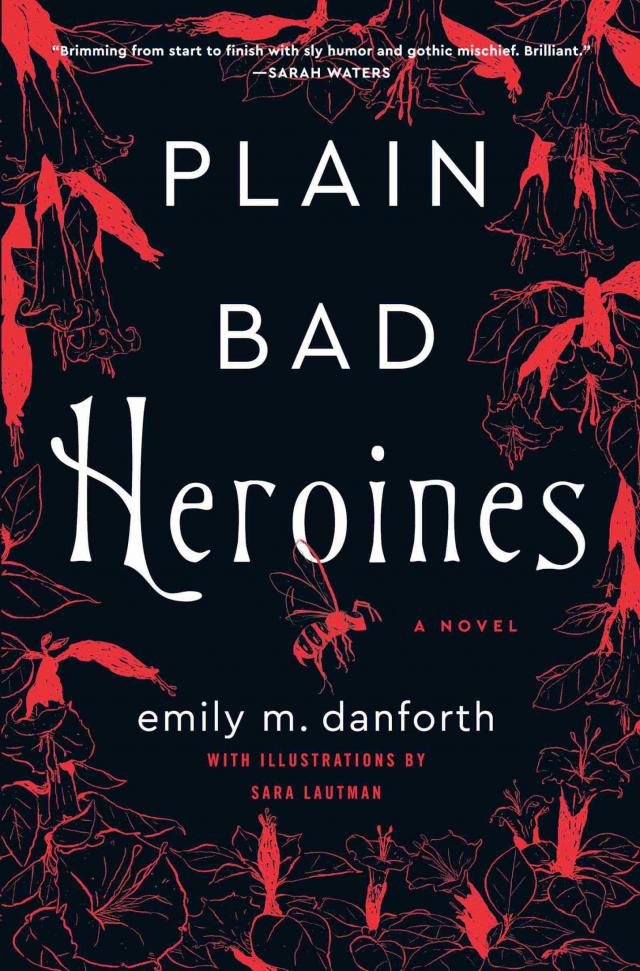
Plain bad heroines, p.54
Plain Bad Heroines,
p.54


“I’m really OK,” Audrey said, taking a deep breath and turning fully around. “I just needed to puke, I think.”
“You’re not OK and you know it,” Merritt said, patting the floor next to her. “Come sit. I thought we were going to do this earlier, but then you didn’t want to, so let’s do it now. I bet Harper will come join us any minute.”
“Do what?” Audrey asked, though even as she said it she thought—
“Seriously, come sit down,” Merritt said again, patting the floor beside her. “Bo’s not gonna rattle all the chains without two of his leads in place. Who’s he gonna drop the chandelier on if we’re not out there?”
“What?” Audrey asked again, though she knew. She did know. The truth scuttling through her like a spider.
“You heard me perfectly,” Merritt said, casting her eyes to the ceiling for cameras. “As I’m certain Bo did, too.”
Audrey steadied herself against the wall; the floor couldn’t be trusted and she couldn’t be trusted to stand on it. She spoke carefully—everything felt like a trap. “Is that what he’s doing tonight? Making a chandelier come down out there?”
Merritt seemed confused. “Oh, I mean—sorry, no. Is there even a chandelier? I just meant whatever it is, he’ll wait for us to do it.”
Audrey couldn’t assemble the right reaction to what she was feeling. Merritt was being so matter-of-fact, so blasé. She was acting like they’d already had a conversation they’d never actually had. This made Audrey speak calmly, too. Even if she didn’t feel calm. “Does Harper know?”
“I mean, what do you think?”
“But you don’t know for sure that she does?”
“Well, I knew about you.”
Why were they talking in riddles when there was so much to say? “How did you know about me?” Audrey asked. “Because Bo told you? Or was this your idea? I mean, to film it this way?”
Merritt rolled her eyes. “Does this seem like my idea? I knew the same way you knew. I guessed. I put it together.”
“I didn’t know,” Audrey said.
“Yes, you did,” Merritt said. “I think you did.”
Audrey sighed. “I mean, I wondered. A bunch of times I wondered—it seemed possible, one of you would say something, but then I thought, No way.”
“You knew,” Merritt said. “You just didn’t want to know. But I can’t really decide: Does it make it cheaper that we all know or less cheap?”
Audrey felt like she might cry. Whether from relief or shame, she wasn’t sure. Both? “God, I feel really fucking stupid.” She leaned her head back against the wall. “When did he tell you this is what he wanted?”
“After you signed on and I’d quit,” Merritt said. “He called me. He said that you and Harper would be in the dark. I was the one who had to keep it all together.”
“I got the same pitch. Like exactly the same.”
Merritt shrugged like this was not a surprise to her. She started to say something, but the door at the end of the hallway opened and they waited to see who would emerge from the long shadow now moving toward them.
It was Harper.
To her credit, she didn’t pretend not to know what was being discussed in this hallway without her. There was no casual approach, no feigned confusion about where they’d gone off to and why. She knew. She wasn’t confused at all.
“Hey, are you OK?” she asked Audrey.
“Not really.”
“Do you think you can make it through the rest of the show, or do we need to take a break with the whole thing?”
“What’s the whole thing, Harper?” Merritt said like Merritt would.
“Listen, if you’re still sick, we should deal with that,” Harper said to Audrey. “But otherwise, we all need to get back out there. If we just get through the concert, we can do this whole part later, when we have time. Back at Brookhants.”
“Well there are more cameras there,” Merritt said. “Better angles.”
“I’m being serious,” Harper said. “Please? We flew in an effects crew from Germany and now they’re waiting on us to do some hologram-smoke thing.”
“God, look at you producing,” Merritt said. “You’re producing so hard right now.”
“They’re really good,” Harper said, ignoring her. “And really expensive. I’m sure it will be worth it, whatever they do.”
“I don’t think I can,” Audrey said. “I don’t have that take in me.” This was true.
“I’m with Audrey on this one,” Merritt said.
Only now, Audrey thought, did Harper seem to realize how much ground she had to make up. Impossible ground. “We can do this part,” she said, “this whole talk-it-out part. I think Bo wants us to. I mean eventually. Can we just not do it right now?”
“Oh my God,” Merritt said, like a puzzle piece had snapped in place for her. “He wants us to have it out over this, right? To what, like, confront each other about it?”
But Audrey was stuck on something else. “Was this your idea?” she asked Harper. “To make the movie this way?”
“No,” Harper said.
“But you knew about it,” Merritt said. “From the start. You helped plan it.”
To this, Harper said nothing.
“She did,” Merritt said to Audrey. “You did,” she said again to Harper. “You’ve been back there pulling the strings with him all along. Is your tattoo even real?”
“What are you talking about?” Harper flipped her arm over, shoved up her sleeve. “It’s real.”
“That doesn’t mean anything, though,” Merritt said, barely glancing at it. “In the scheme of things.”
“It hasn’t just been Bo pulling the strings,” Harper said. She reached for the cigarette at her ear, put it between her lips.
“No, we know that,” Merritt said. “I just said you were back there, too.”
“It was Elaine,” Harper said, matchbook now in hand. “This was Elaine’s idea, this whole found-footage approach.” The spark of the match, the puff of flame as she lit her cigarette: all of it like the flourish at the end of a magic trick.
“That’s not true,” Merritt said. Her face said the opposite.
Harper took a long drag. Then she said, on her exhale, “It is. Ask Bo.”
Merritt snorted. “Why would I trust any answer Bo ever gives to anything?”
“Then ask Elaine,” Harper said, “but it doesn’t matter whose idea it was, anyway. She was right. Something else is happening, something worth getting on camera. Today in the orchard wasn’t anybody pulling our strings.”
“I mean, how wasn’t it?” Audrey asked. “The snow?”
“They didn’t make it snow,” Harper said. “And they didn’t film any of that, anyway.”
Audrey shook her head. This couldn’t be true. “How do you know?”
“Because I told them not to.”
“Forgive me if I don’t put much stock in that,” Merritt said. “Even if it’s not on camera, it was designed to be. This whole thing is designed to be.”
“Nobody was designing the way I felt there but me,” Harper said. She turned to Audrey. “Didn’t you just recite us something about there being more beauty in the artificial than in the natural?”
“Oh don’t,” Merritt said before Audrey could get any words out. “Don’t be cheap, Harper. That story was written in 1905 and its hero kills himself at the end because he’s depressed and alone and his queer ideals have no place in his world.”
“But that’s only part of that story,” Harper said. “That’s what I’m saying—it’s not all one or the other. Even if I sometimes knew more than you did, that doesn’t automatically cancel out everything that’s happened between us or make it fake. Not for me.”
“I don’t know if I can believe that now,” Audrey said.
“You shouldn’t,” Merritt said. “It’s all been smoke and mirrors. And we were plenty happy to dress up and play along.”
Audrey looked at her, there on the floor, smug and cool and trying to act like she was above all of this now even though she was as much a part of it as they were. “Why are you even here, then?” she asked her. “If you figured it all out ahead of time and you think it’s so terrible, why did you come?”
“Because she’s writing about it,” Harper said. “Right? You’re making a book out of this, starring us.”
Readers: if Audrey was surprised by this, and she was, so was Merritt.
“Are you?” Audrey asked.
“It’s fiction,” Merritt said dismissively. “A novel with biographical underpinnings.”
“It’s about this,” Harper said. “Wait for the scene in the creepy hallway backstage at the Columbus.”
But Audrey was disappointed. Again. “Is that really the only reason you came here?”
“Which one would you prefer?” Merritt asked.
“I don’t know,” Audrey said, feeling just so stupid. “I can’t believe how much I wanted this to mean something. It’s embarrassing how much.”
“I consider calmly the question of how much evil I should need to kill off my finer feelings,” Merritt said.
“Please stop fucking quoting Mary MacLane,” Audrey said. “You’re not Mary MacLane, Merritt.”
Merritt seemed a little stunned, but she gathered herself to say, “How about I stop when you stop pointing your finger at us, Audrey.”
“I’m not pointing my finger, I—”
But Merritt was spitting, now. “Oh you are. You are. You keep asking what this is—like you don’t already know and it’s for some reason our job to tell you. We did it because not one of us is a single ounce better or wiser than Mary MacLane, even if we’ve had a hundred and twenty years to be. January fourteenth: I wish to acquire that beautiful, benign, gentle, satisfying thing—Fame. I want it—oh, I want it! I wish to leave all my obscurity, my misery—my weary unhappiness—behind me forever. I am deadly, deadly tired of my unhappiness. March twentieth: Fame, if you please, Devil. One may wander over the face of the earth. But Fame is herself a refuge. Oh, kind Devil, I entreat you, let me have that! That’s why we did it. That’s why I did it. In the hallway with the wrench.”
They looked at each other in that dim hallway with its gold-and-blood wallpaper until Audrey said:
“That makes me really sad.”
“I am sad,” Merritt said. “I’m a sad person who does sad things. And I am deadly, deadly tired of my unhappiness.”
Light shifted at the entrance to the theater, the sound of the band and the crowd swelling and dimming. Someone else was walking toward them, two someone elses, in fact, shadows growing and growing around the corner until Bo and Heather appeared.
“Look at that,” Merritt said. “It’s almost like you could hear what we’re saying.”
“Merritt, I need to talk to you,” Bo said, his face grim and distorted. He looked at Audrey and Harper. “Can you two give us a minute?”
“It’s OK, captain,” Merritt said. “You can just say it to all three of us now. We pulled back the curtain.”
“This isn’t about the movie,” Bo said. He looked, could it be pained? “You should look at your phone.”
“Did I miss my cue?” Merritt said, though her voice had lost some of its edge and she was now reaching into her jacket pocket for the phone, pulling it out, scanning its screen of notifications. “We were discussing our characters’ motivations for this scene.”
Bo seemed to know at least some of what she’d be reading on that phone screen, because now he said, “I don’t know who sent you what, when, but they’ve already got her in the ambulance. I just talked to Carl before I came to get you.”
“What did you do to her?” Merritt asked, fumbling to stand and join them, no longer casual in the least.
“What’s happening right now?” Harper asked. “Who’s in an ambulance?”
“I’m sorry to be the one telling you,” Bo said to Merritt. “We can meet them at the hospital if we go now.”
“What did you do, Bo?” Merritt asked again.
He shook his head like he somehow expected this accusation. He said, “I guess she forgot something on the stove. She went upstairs with it still on and after the fire in The Orangerie, she’d put in those alarms with the strobe lights. She was coming back down when the smoke set them off—it was too much, it startled her.”
“Which stairs?” Merritt asked, though they all knew the answer.
“Spite Tower.”
“Oh my God,” Audrey said. She held the wall to keep standing.
“She told us she never went up there,” Harper said.
“Oh my God,” Audrey said again. She didn’t mean to. How could she be both in shock and not at all surprised? How could something so awful feel so perfectly inevitable?
“She’s still alive?” Merritt asked. “You’re sure?”
“She was, yes,” Heather said quickly. “When they took her in the ambulance she was.”
“Carl was right there,” Bo said like he was happy to have this, at least, to say. “He got to her almost as soon as it happened.”
No one had to ask how they’d gotten to Elaine so quickly, how they’d known just what had happened and where to find her. There were cameras all over Spite Manor.
“Do you want us to come with you?” Harper asked as Merritt followed Bo back down the hallway.
“I don’t see why you would,” she said. “Unless you know something I don’t.”
Elaine Brookhants, Socialite and Philanthropist, Dies at Age 81
Little Compton, RI—American heiress, philanthropist, writer, and late-in-life Hollywood film producer Elaine Brookhants died October 11 at Newport Hospital at the age of eighty-one, a spokesperson for the family told the Providence Journal in a telephone interview. The cause was complications stemming from a fall at home.
Effortlessly elegant and never far from her sharp wit, Elaine Brookhants and her various exploits first captivated New York society pages, and then, for years after, the churning Rhode Island rumor mill. (Which certainly hasn’t been quieted by her death.) She was the most recent Brookhants to occupy the “cursed” family estate: Breakwater, in Little Compton—better known to locals as Spite Manor. The home was built by her eccentric great-grand-uncle, steel tycoon and Spiritualist Harold Brookhants.
She was born Elaine Elizabeth Bishop Brookhants in New York on June 21, 1934, to railroad heir Arthur Ryan Brookhants and his second wife, Valerie Bishop Brookhants. Arthur was a self-styled adventurer who sank much of his inheritance into wild and sometimes unlawful searches for objects of interest around the globe. Largely as a way to legitimize these pursuits, he founded the Brookhants Museum in Providence in 1939. He died of a heart attack in 1948, leaving his daughter with a rumored inheritance of $13.7 million. Valerie Bishop was a jet-setting photographer whose candid shots of her society friends would become some of the most iconic of the era. However, she is perhaps best known now for her series of stark self-portraits, taken while she was hospitalized after a suicide attempt in 1950, while Elaine was away at boarding school. In the coming years, Valerie would spend significant time receiving treatment for depression and neuroses in mental hospitals in New York and California. She died from an overdose of sleeping pills in Los Angeles in 1955.
Elaine was educated at the Wheeler School in Providence, where she was first nicknamed Lainey (a name she continued to use throughout her life) and garnered a reputation as both a gifted writer and a prank-playing troublemaker. However, despite the pranks—or because of them—she was wildly popular with her fellow classmates, occasionally hosting what she called “Spooky Weekends” away for them at her family estate. The caption in the school annual from her junior year describes her thusly: “The only curse our Lainey has to worry about is her mouth and what too often comes out of it.”
In 1951, Elaine entered Vassar, planning to study art history. However, she dropped out to be with her mother after completing only one academic year. Back in Manhattan at age nineteen, Elaine emerged as a youthful new addition to its shifting high society. She forged friendships (and rumored romances) with film stars and her fellow heirs and heiresses alike. Although he typically ran with a crowd closer in age to her mother, Truman Capote wrote this regarding Elaine’s reputation as a desirable match: “Lainey Brookhants might be catch of the day, but unlike a few others of which the same is said, she won’t stink up your kitchen come morning. This particular flounder won’t.”
For a time, Elaine seemed to enjoy mocking social customs as much as she did participating in them. However, after her mother’s suicide and the fervent publicity that followed, she withdrew from the social circuit and developed the reputation for fierce loyalty that she maintained throughout the rest of her life. She also used part of her inheritance to found the Valerie Bishop Clinic in Manhattan, which provided counseling and other psychological services to women of all means. In the 1980s, the endeavor expanded into the Valerie & Eleanor Foundation, with a mission to fund research in mental illness. When she was honored for this work in 2007, Brookhants said, simply, “It’s what my mother would have wanted. And what I wanted for her.”
In 1963, while on vacation in San Francisco, Brookhants met political cartoonist Taylor Behrens, who was then fifty-five to her twenty-nine. The two married just four months later and settled in Little Compton at the family estate. There, Brookhants wrote Mrs. Mittens Invites You to Tea, the first of three macabre (children’s) books of simple rhymes about the strange and guileful Mrs. Emily Mittens and her neighbor (and implied lover) Gladys Glovely. A sample: Mrs. Mittens had five kittens, but then she ate just one. Now Mrs. Mittens has four kittens—but Mrs. Mittens isn’t done. Taylor drew the fearsome pen-and-ink illustrations for the books, which were initially printed as amusing Christmas presents for friends. One of those friends, who was then an editor at Troubadour, convinced Elaine that there was a wider market for the books and published the first the following year. Mrs. Mittens Takes Up Fisticuffs and Gladys Glovely Isn’t Lovely followed. The books sold well for several years, despite often being panned (and banned) by those who felt their messaging wrong for children. (All three are now out of print.)