Plain bad heroines, p.48
Plain Bad Heroines,
p.48
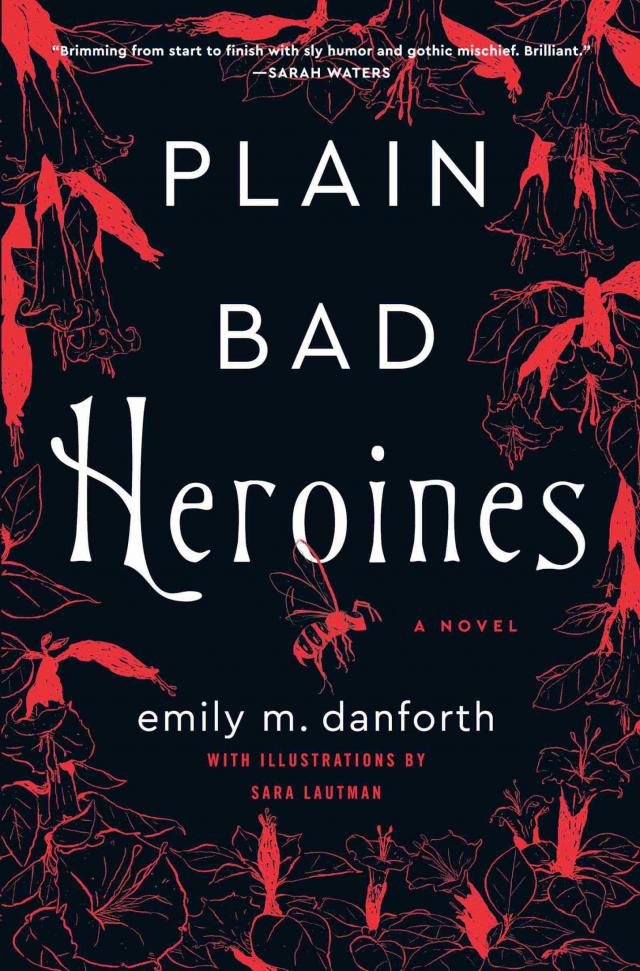


Carefully, slowly, Libbie knelt beside Alex, wincing at her apple bruise as she did. “I’ve been here. I thought we had a plan.”
“We did have a plan! Such a charming plan. But the devil’s in the details, isn’t he, Library?”
“You don’t know what you’re saying, darling.” She was still trying for calm.
“I do know!” Alex said. “I do finally know.” She slid the frame on her lap forward to reveal the book, Libbie’s copy of Mary MacLane’s story, and atop it the missing page, there in the folds of Alex’s skirt.
While they’d been speaking, the buzzing had thinned, but as soon as Libbie saw the book, the page, the proof of what she’d done, it again threaded itself to her veins and thrummed insistently.
“You lied to me, Library,” Alex said. “Again and again. Here we live in a thicket of lies.”
Libbie nodded. She waited for what she deserved, Alex’s listing of her misdeeds. Instead, what she got was:
“And I lied to you,” Alex said. “Harold’s awful bargain—oh how I wanted you to take it. I sold it to you for them, so that I could come here and be with you. So that we could be together.”
“We are together,” Libbie said weakly.
“Oh no. No, not here we aren’t. Here the very trees and soil come between us.”
Alex tapped the book in her lap with her pointer finger—tap-tap. “I wonder, did you forget that Sara had inked her provocations? When you gave this to the girls? Or did you mean for them to see her message to you?”
“Of course I didn’t mean for them to see it. I would have told you—”
“And so did you intend to find a Harold for Flo and Clara, too? Was that your plan? Did you think you might introduce one or the other of them to a man with the correct sum to his name and a parcel of land? Tell me, Library: How would you have continued to advise them as they made their way, these girls in love?”
“Alex,” Libbie started, but it was no use. “You’re so tired and confused, darling—you’re spinning all around.”
“I’m no longer confused,” Alex said. “Not even a touch. Why do you think the few students who remain here gather in the woods to talk of horror? Our whole world’s gone dark and rotten, its belly bloated with worms, and you let the answer hide on a shelf in our home.”
“What you’re saying is madness.”
“I’ll show you the extent of my madness,” Alex said, yanking Libbie’s arm, hard, so she slid closer to Alex in the jerk of the rough movement. Alex then pulled the frame back to her lap, so that it again covered the book and its once-missing page. Libbie could see that the panoramic’s glass looked freshly cleaned. There were no finger smudges, no dust, nothing to hide any of the séance’s participants.
“Look here,” Alex said, pulling until Libbie was bent down over the frame.
“You’re hurting me, Alex,” Libbie said.
Alex did not hear Libbie. Or if she did, she did not care. “Look at their faces,” she said. “Who do you see? I want you to take your time. I won’t show you. I don’t need to because you’ll find her. And then you’ll know how they played us from the start.”
Libbie couldn’t concentrate. The buzzing filled the room, poured in her ears and thickened her thoughts. When she did look down at the photograph, it seemed to hover, almost as if she was viewing it through a stereoscope. The last of the daylight flashed against the glass, charging white spots across her vision. The buzzing was now so intense within her it seemed almost to toggle her vocal cords, as if she was making the hideous sound.
“I can hear it, too,” Alex said.
“You can?” Libbie did not feel at all comforted by this.
“Of course. It’s part of this, but you have to tune it out. Concentrate on the faces and you’ll see. You’ll see what I see.”
From what seemed very far away, Adelaide asked if she should look for Hanna. Libbie had forgotten about her waiting on the stairs. She now looked up to find Addie standing just inside the room. She was rightly afraid to come closer.
“Never mind her,” Alex said. “Look at the photo.”
Libbie did as she was told. She started at Harold, who was easy to spot, his smile wide and proud. This was, after all, his grand gathering. She then worked her way around the table, studying each face as she encountered it. Madame Verrett was next. She was easy too, with her jewels and scarves. Then came a few friends of Harold’s Libbie had met once or twice. A Spiritualist out of Baltimore. More men and women she did not know, at least she didn’t think so—swooped hair and trim moustaches, eyeglasses and drooping jowls, starched lace collars, a thin, bird neck and a round face framed in curls, a man and a woman and a man and a face and a face and a face and no one she knew that surprised her, no one that meant anything at all. This was true all the way around the table until there, seated next to Harold on his other side, his right side, with features part in shadow—though there was no obvious cause for that and it affected no one else in the image—but still, was it, it might be . . .
The buzzing wrapped Libbie’s heart and rattled her spine. She squinted again, shifted even closer to the photograph, which caused her breath to fog the glass, but—
“I’ve brought some water and a bandage!” It was Hanna, finally, there on the last stair with a pitcher and glass in hand. “And I think I heard them coming up the road with the doctor.”
Her voice seemed to enter Alex like the thrust of a knife. “Stay back!” she yelled. “You stay away!”
Hanna, stunned, did not move from that final stair. So Adelaide took the items from her, set them on the edge of the desk, and rushed to the windows to look for the promised carriage.
Alex still gripped the picture frame at both ends and now pressed down on it with too much force as she moved to stand. The glass snapped, first with a crack and then with a scuttling spiderweb. The thin pasteboard backing gave too, snapping the long photograph in half. Alex seemed not to notice. She let go of the frame, took Mary’s book in her right hand, and leveraged it against the ground to help push herself up. Shards of glass spilled from her skirts like salt and Sara’s marked page fluttered to the floor to lie atop the glass.
Alex was now on her feet. “We know your tricks, Hanna Eckhart,” she sang horribly across the room, the desk no longer blocking her view. She turned her good eye toward Hanna. “We see you now. I see you.”
“Did you really hear the carriage?” Adelaide asked. She was still at the windows, scanning the ground below for the promised doctor. “I can’t see it.”
“That’s because she lies,” Alex said, triumphant. “She’s only ever worked for Harold. Even now, she works for him.”
“Are they really here?” Libbie asked Hanna. It seemed impossible that Caspar, Max, and the doctor should have arrived so soon from town.
As the others were speaking, Alex had crept her way along the wall toward the stairwell. Now she seized her chance, taking off, full force, toward Hanna. She had Mary’s book held out before her, each hand gripping a side as if she were carrying a sign in a march. Her intention was clear, clear to Libbie and to Adelaide and especially to Hanna: Alex would shove her, hard, so that she toppled over like a chess piece and fell back down the stairs.
Alexandra Trills was only a blur of hair and flesh and book.
The buzzing had reached an impossible pitch. It was the air itself.
And then, the awful crash of bodies.
Except—
At the final moment, Hanna flattened herself against the stairwell wall, pressing her body into the books that lined it. She had to get the timing exactly right, and even then, it didn’t seem like it should quite work, the stairwell was so narrow.
But it did work, Readers. Hanna made it work.
It was almost as if the books and shelves became something less than solid, something more like flesh, with enough give for her to press her body into their embrace. They let her in.
Alex, with her weeping eye, her skewed perspective, was now at the top of the stairs, but where Hanna should have been was a gap, empty space, humming air. There was nothing for her to collide with, and so instead she dove—outstretched book, then head, then body—down and down, into the twisting darkness.
The buzzing ceased at once, like the popping of a balloon.
Alex did not scream or cry out as she fell, but her body, hitting the walls and knocking loose volumes, careening the corners and bouncing on the stairs, made a terrible kind of gasping, thudding noise that drew quieter the farther it descended.
There was no doctor waiting for our Alexandra Trills when she crumpled into stillness at the bottom of the staircase. This was because the doctor had not yet arrived and would not do so for another hour.*
Alex, smart, strong, devoted Alex, of course did not survive her fall. Her neck had snapped on the first turn of the staircase. Not unlike the glass in the séance photo, first came the solid, murderous break, and then came a spiderweb of smaller cracks throughout her body’s other bones—both wrists, a femur, several ribs.
By the time Spite Manor’s gravity stopped her at the bottom, Alexandra Trills was no longer of our world. She’d drifted from it somewhere in the stairwell, fluttering up over the pages of the many books that lined her fall.
I will not linger here describing all that came next, such as the wailing sob that accompanied Libbie’s harried slipping down the stairs, whereupon she flung her own body over that of her lover and stayed for so long that what they were to each other would never again be denied by anyone who saw.
When, much later, Hanna had tried to help her stand, Libbie screamed at her to get away. Even after Max had pulled his mother from the room, still Libbie screamed, on and on. She was in such a state of rage and terror that the doctor, who had finally arrived, gave her a knockout drop and had her carried to her bed. He hoped that rest would cure her shock.
But in the coming days, whenever she came to, Libbie would not let Hanna Eckhart near her. And even if Hanna stayed away, Libbie would soon grow so agitated at the thought of her somewhere on a floor below that the consulting physicians (for now there were several of them) felt they had no choice but to give her another sedative to quiet her fear. And then the process would begin again. Libbie would rest. Then wake. Then shudder, or scream, or lash about in a hysterical rage over Hanna and her evil machinations. For a week, she did this.
And then—
Adelaide caught our Libbie with a bit of lit kindling she’d pulled from the fireplace. Libbie was trying to light her bed on fire. She did, in fact, light her bed on fire, and the hem of her nightgown too, but they got it put out in time. And so they knocked her out again and sent for her brother, the senator, who was then down the coast in Washington. He arrived with the intention of escorting her back to Chicago, to convalesce with their parents, but when this was explained to Libbie, she again became so violent and unreasonable that the idea of sending her on a cross-country journey now seemed out of the question. (Perhaps it’s worth noting that this was her least favorite brother.) At any rate, soon after she was committed to the Rhode Island State Asylum for the Incurable Insane, where she was further confined for more than a year.
But this ending is not Libbie Brookhants’s ending, Readers. She’ll have to wait for that.
So for the moment, let us leave her wearing a black mourning gown and sitting in a stiff chair, in a drafty room, while she stares at the crack in the plaster wall and tries not to hear the sound of the buzzing, tries not to see the twitching head, and now the cellophane wings and sticky legs, of a yellow jacket as it appears in that crack, tries not to remember all the things she’d prefer to forget. The doctor will be in soon enough and he’ll make her remember, and worse, he’ll make her speak those things aloud. And then he’ll tell her they’re only delusions, only figments of her own invention. He’ll have one of the white-cap nurses with him, the kind who smirk but never smile, who pinch and scratch her when his back is turned. This while the doctor tries to tell her, calmly, so calmly, that these things she remembers are only delusions, only figments of her own invention.
This when she knows, when she finally knows, they are not.
Updates from the Set of
The Happenings at Brookhants
as Told Online
SEPTEMBER 27
ReelSkeeze nabbed these upsetting exclusive photos of costume supervisor Maya Barslonick being loaded into an ambulance at the troubled Happenings at Brookhants set, located at an abandoned boarding school in coastal Rhode Island that has long been rumored to be haunted.
Barslonick was reportedly sorting clothing in a storage container when it caught fire late Wednesday morning. In her own words, she had to “run through a wall of flames” in order to get out the door to safety. Barslonick was treated for second-degree burns at St. Anne’s Hospital in Fall River, Massachusetts. A representative for Barslonick said that she is now “recuperating away from the production with friends.” At this time, the cause of the fire has not been officially determined, but a preliminary investigation seems to point to faulty wiring. A spokesperson for The Happenings at Brookhants told Film Fever that over $65,000 in damage was caused by the blaze and that filming had been significantly delayed. Again.
As ReelSkeeze has already reported, here, here, and here, now only thirty-two days into its scheduled seventy-three-day shoot, the Happenings at Brookhants production has incurred more than its fair share of strange and difficult circumstances, leading online commenters to suggest one of two things: either an elaborate hoax meant to convince us that the film is cursed, or an actual curse. (Much like those said to have tainted films like The Exorcist, Poltergeist, and, the grand-devil of all supposedly cursed films, The Omen.)
While various internet communities are stridently divided on the subject, discussions about a possible curse began in earnest after one of the film’s leads and producers, Harper Harper, posted a short video to her Instagram account on September 2 purporting to show a swarm of wasps that she (and others) claimed looked like a beckoning ghostly figure. Days earlier, Harper had posted a photo to her Instagram that showed several small objects that she claimed she and another crew member had discovered while helping to arrange props on set. Those figures have been reported to link to lore about the school’s troubled past.
In the wake of these posts and rumors, TMZ is reporting that the Brookhants shoot is swarmed with fans and paranormal seekers hoping to get in on the action. The production significantly increased its security forces in order to keep people from the set, and even with these measures, they haven’t been entirely successful.
Casie Fregg, a college student at nearby Roger Williams University, nearly drowned after attempting to swim to the shores of the Brookhants set so that she could meet Harper Harper and, according to an interview Miss Fregg gave with the Providence Journal, “just do a séance with her.” Fregg was rescued by a quick-acting carpenter currently working for the production.
While most people associated with the film have been reluctant to speak to press, ReelSkeeze did manage to interview a camera operator who asked to remain anonymous but offered the following statement regarding the alleged curse: “I’m the definition of a skeptic, but with as many people as we’ve had get hurt already, at some point you have to start asking, Is there something to this? You know? Even if you feel dumb asking it—and I really do. Like, what is it worth to maintain my skepticism, though? For sure not my safety.”
Thus far, veteran horror director Bo Dhillon has not made any on-record comments about the rumored curse, which has only fueled speculation that this is all a hoax intended to increase interest in the film and its story’s supposedly factual basis.
If that’s indeed the case, it seems to be working. Google searches with the film’s title have increased over 1,000 percent since these rumors of a cursed set began making their rounds online.
Uh-Oh, It’s Magic*
Merritt exchanged the word equable for the word placid, read the sentence again, highlighted it because she still didn’t think she’d gotten it quite right, hit Save, and closed her laptop. Then she stretched her arms high overhead and popped her neck. It had already been a six-thousand-plus-word day. I say already because she thought she might take a break now, for several hours, and then start up again when she returned to her cottage later that night.
She was sitting on the pavers in front of the Brookhants Main Hall. They were filming inside. She leaned back against the fountain, slid her legs straight out in front of her in another stretch, this one to ease the cramps that came from sitting cross-legged on the ground and hunched over her keyboard for too long.
Earlier she’d pulled off her chunky-knit sweater—like a blanket, that thing, and too hot. Now she was grateful for the stone side of the fountain’s basin, baking there in the golden sun of that October afternoon, and how it warmed her skin through the thin fabric of her T-shirt. She had it tucked into her mom jeans, high waisted and button front in washed-out denim. Harper had gifted the shirt to her. She’d had one made for each of the three of them. It was black, and on its front, in all caps in a sans-serif white font, it read: Mary MacLane.
“Because we’re with the band,” Harper had said as she’d presented them. Merritt loved hers, but this was her first time wearing it and when she’d put it on that morning, she’d felt a little self-conscious.
At least until an hour later, when Harper surprised her at crafty. Merritt had actually been in the middle of receiving a compliment on the shirt from a lighting crew member. Harper witnessed this as she selected her banana. She smiled at Merritt from behind the compliment giver. And as he walked away, she said, “You look hot in my shirt,” before walking away herself. You could’ve traced a line from those six words to Merritt’s clitoris,* but she did manage to collect herself enough to yell after her, “I know!”