The case of the substitu.., p.1
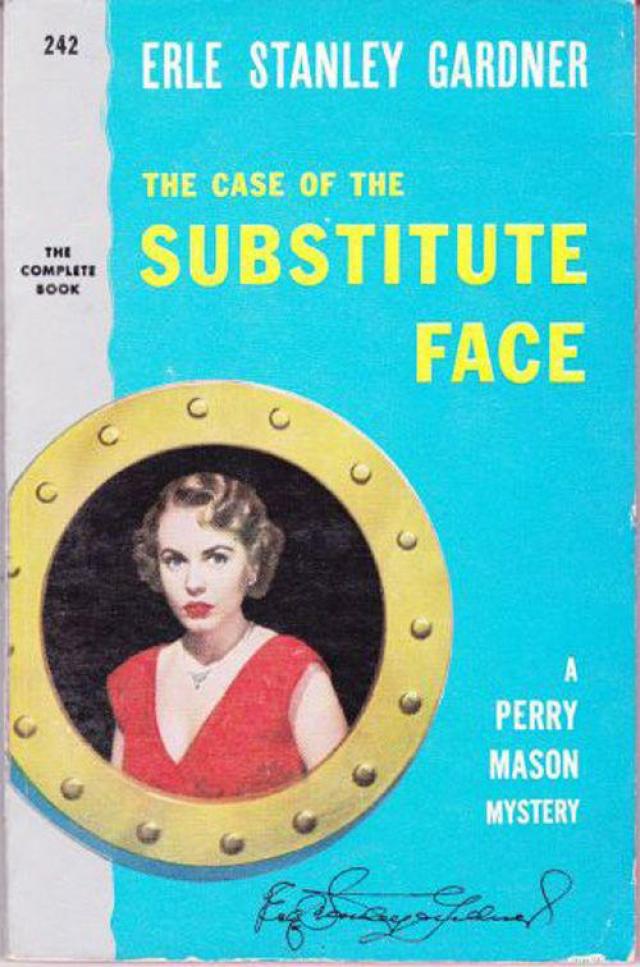
The Case of the Substitute Face,
p.1


Criminal lawyer and bestselling mystery author Erle Stanley Gardner wrote close to 150 novels that have sold 300 million copies worldwide. Today, the great Gardner tradition continues with many of his classics back in print, as well as brand-new additions to the ever-popular series starring the incomparable Perry Mason.
The Case of the
Substitute Face
Erle Stanley Gardner
© 1938, 2011 Erle Stanley Gardner. All rights reserved.
CAST OF CHARACTERS
PERRY MASON—famous criminal lawyer, who is catapulted from a Hawaiian vacation into the mazes of a shipboard murder
DELLA STREET—Mason’s faithful and indispensable secretary, who first turns up a theory … and then turns up missing
MRS. NEWBERRY—“Moms” to Belle … client to Perry Mason … a puzzle to the rest of us
CARL NEWBERRY—“Pops” to Belle … owner of several aliases … and a menace to Morgan Eves
BELLE NEWBERRY—a young modern “as full of bounce as a rubber ball,” who bounces into love outside her social sphere
ROY HUNGERFORD—that rara avis, a sincere socialite, in love with Belle
EVELYN WHITING—auburn-haired nurse whose actions seem mysterious
MR. CARTMAN—a patient with a broken neck, cared for by Nurse Whiting
CHARLES WHITMORE DAIL—president of the Products Refining Company, and a bit of a stuffed shirt
CELINDA DAIL—the daughter, “selfish, spoiled, rich, and ruthless,” especially where Roy Hungerford is concerned
PAUL DRAKE—ubiquitous detective, who runs down clues for Perry Mason
MARJORY TRENTON—blue-eyed blonde with a well-concealed past
CUSTER ROONEY—a smooth customer who developed kinks in his character
MARIAN WHITING—sincere but deluded sister of Evelyn
MORGAN EVES—a bird of a well-known feather
DONALDSON P. SCUDDER—deputy district attorney, who is a little too sure who is guilty
AILEEN FELL—a schoolteacher with off-and-on spectacles and a case of jitters
Contents
Cast of Characters
Chapter 1
Chapter 2
Chapter 3
Chapter 4
Chapter 5
Chapter 6
Chapter 7
Chapter 8
Chapter 9
Chapter 10
Chapter 11
Chapter 12
Chapter 13
Chapter 14
Chapter 15
Chapter 16
Chapter 17
Chapter 18
Chapter 19
About the Author
Chapter 1
Perry Mason stood leaning against the rail as an inky ribbon of black water widened between the side of the ship and the dock. The hoarse whistle bellowed into noise as spectators on the pier waved hats and handkerchiefs in farewell. Propellers churned the water into yeasty foam, then subsided.
The strains of Aloha Oe, snug by the soft voices of Island women, reached the ears of suddenly silent passengers.
Minutes later, as the shore noises drifted astern, Mason, watching the Aloha tower shrinking into the background of city lights, could see the black outlines of the mountains rising in silent sihouette against the stars. The hiss of water streaming past the ship’s side became increasingly audible.
Della Street, his secretary, clasped strong fingers over the back of his hand where it rested on the rail. “I’ll never forget this, Chief. It’s big and quiet and solemn.”
He nodded, fingering the flowered leis which circled his neck with bands of red, white and purple.
“Want to stay?” he asked.
“No—but it’s something I’ll never forget.”
Mason’s voice showed his restlessness. “It’s been a wonderful interlude, but I want to start fighting. Over there—” waving his arm in the general direction of Waikiki Beach—“is something which civilization has commercialized but can’t kill, a friendly people, a gentle warm climate, where time drifts by unnoticed. I’m leaving it to go back to the roar of a city, the jangle of telephones, the blast of automobile horns, the clanging of traffic signals, clients who lie to me and yet expect me to be loyal to them—and I can hardly wait to get there.”
She said sympathetically, “I know, Chief.”
The engines throbbed the big ship into vibrant speed. A breeze of tropical air ruffled the flower petals around their necks. Mason watched the fringe of lights along the dark shoreline, glanced down at the churned white of water where it streamed along the side of the boat.
From the lower deck, leis sped outward, to hang poised for a minute in circular color against the black of the water, then collapse and drop rapidly astern, as passengers sought to comply with the age-old Hawaiian custom.
Mason said, with the tolerance of one who has long since learned to accept human nature as an established fact, “Those are the newcomers, the malihinis. Those leis drift right back into the harbor. Passengers should wait until they’re opposite Diamond Head.”
Elbows on the rail, they looked down on the heads and shoulders of people leaning over the rails on the lower decks.
“There’s the couple we saw last night in the Chinese restaurant,” Mason remarked.
Della Street followed the direction of his gaze. “I’m to have her for a roommate,” she said. “She was in the cabin when my baggage came aboard.”
“Who is she, Della?”
“Her name’s Belle Newberry. Her father and mother are in three twenty-one.”
“Who’s her boy-friend?” Mason asked.
“Roy Amboy Hungerford,” Della Street said, “and he’s not her boy-friend.”
“Don’t fool yourself,” Mason told her. “I saw the expression in his eyes when he was dancing with her last night.”
“You’d be surprised at what men can do with their eyes in the tropics,” she told him, laughing. “Have you noticed the tall, brown-haired girl with blue eyes and the white sharkskin dress, who was weighted down with leis—the one who was standing with her father up there on the …”
“I noticed her,” Mason said. “What about her?”
“I think she has some claim on Hungerford,” Della Street said. “She’s Celinda Dail. Her father’s C. Whitmore Dail—if that means anything. They’re wallowing in wealth, have a big suite on A deck.”
“Well,” Mason said, smiling at her, “you do get around, don’t you? How about dropping our leis, Della?”
She nodded. “I’m going to save one for the night of the captain’s dinner. I’ll have the room steward put it in the ice box.”
They performed the ceremony of consigning their flowers to the dark waters. “Why is it,” Della Street asked, as Mason’s last lei vanished into the darkness, “that all of these things we’d consider superstitions on the Mainland seem so real here?”
“Because so many people believe them,” he told her. “Mass belief is a tangible psychic force. Notice the authenticated stories of persons who have violated Island beliefs and come to grief. Thousands of people have known of the violated tabu. Thousands of minds have believed some evil was going to befall the violator.”
“Like hypnotism?” she asked.
“You might call it that.”
“Here come Belle’s mother and father,” Della Street said. “I suppose they’ll want to be introduced.”
Mason turned to observe a slight, small-boned man of about fifty-five, with high forehead and piercing gray eyes. The woman at his side appeared much younger. She had retained a slender, graceful figure and walked with long, easy strides. Her dark brown eyes studied Mason’s face with interest, then swung to Della Street. She bowed and smiled. The man, hatless, did not so much as shift his eyes.
Mason watched them as they walked past, the man staring with preoccupation at the dark curtain of night beyond the ship, the woman frankly sizing up her fellow passengers.
“You’ve met her?” Mason asked.
“Yes. They were in the cabin for a few minutes.”
Mason once more stared down at the couple on the lower deck. “Celinda Dail,” he said, “had better hurry up and record her location notice or she’ll find someone’s jumped her claim—funny I can’t place that girl. I’ve seen her before somewhere.”
Della Street laughed. “You said that last night, Chief, and after you mentioned it I thought I’d seen her before. So I asked her about it tonight.”
“Has she ever been in the office?” Mason asked. “Or, perhaps, on one of my juries?”
“No,” Della Street told him. “It’s simply a case of a remarkable resemblance to—”
“To Winnie Joyce, the picture actress!” Mason exclaimed.
Della Street nodded. “There’s a natural resemblance,” she said, “and Miss Newberry accentuates it by the way she does her hair. I think she more or less consciously imitates Winnie Joyce in her manner. She’s a bit hypnotized by Hollywood.”
“Everyone is,” Mason grinned, “including Hollywood.”
“Well,” Della told him, “I’m going to hunt up a steward and have him put my lei in the refrigerator. See you in the morning, Chief.”
She walked rapidly forward, leaving Mason standing at the rail, watching the intermittent flashing of signal lights, inhaling the scents of the warm tropical air. The decks became silent and deserted, as passengers, fatigued by a strenuous last day in the Islands, the night sailing, a
nd the strain of farewells, sought their cabins.
Mason turned abruptly as a woman mentioned his name.
“I’m Mrs. Newberry, Mr. Mason,” she said. “My daughter’s sharing the cabin with your secretary, so I know all about you. I saw you standing at the rail as we walked past—I—I want to consult you.”
“Professionally?” Mason asked.
She nodded.
Mason studied her with patient, appraising eyes. “What about?”
“About my daughter, Belle,” she said.
Mason smiled. “I’m afraid you misunderstood, Mrs. Newberry. I don’t handle a general law practice. I specialize in trial work, mostly murder cases. Surely Belle hasn’t done anything which would require my services.”
“Please don’t refuse,” she pleaded. “I feel certain you can help me. It wouldn’t take much of your time and it might make all the difference in the world to Belle.”
Mason noticed a hint of nervous hysteria in her voice and said, “Go ahead. Tell me about it. I’ll at least listen. Perhaps I can make some suggestions. What’s Belle been doing?”
“Nothing,” she said. “It’s my husband who’s been doing things.”
“Well, what’s Belle’s father—”
“He’s not Belle’s father,” she interrupted to explain. “Belle is the child of a former marriage.”
“She goes by the name of Newberry, however?” the lawyer asked, puzzled.
“No,” the woman said, “we do.”
“I don’t understand.”
“It’s this way,” she went on, speaking rapidly; “my husband’s name is Moar. Up until two months ago I was Mrs. Moar. Overnight, my husband changed his name. He ceased to be C. Waker Moar, and became Carl W. Newberry. He simply walked out of his position as bookkeeper in the Products Refining Company. We hurriedly moved to another city, lived under the name of Newberry, then went to Honolulu, and have been there for six weeks. My husband gave strict orders that under no circumstances were any of us ever to mention the name of Moar.”
Mason’s eyes showed his interest. “He left his job rather suddenly?”
“Yes, without even going back to the office.”
“That,” Mason said noncommittally, “is rather peculiar.”
The woman came closer to him. Her hand rested on his wrist, and slowly the fingers tightened until the skin was white across her knuckles. “Belle,” she said, “suspected nothing. She’s a modern young woman, a strange mixture of sentiment and cynical acceptance of life. For more than a year she’d been wanting to take the name of Moar. She said that it was embarrassing to introduce her mother as Mrs. Moar and then explain that Carl was her stepfather. So when my husband said we’d take her name, she was overjoyed.”
“She gets along well with your husband?” Mason asked.
“She’s very, very fond of him,” the woman said. “Sometimes I think she understands him better than I do. Carl has always been something of an enigma to me. He’s Undemonstrative and very self-contained. But he worships the ground Belle walks on. He never started complaining about any lack of opportunities in life until recently. Then he began to grumble. He couldn’t get enough money to give Belle a chance to meet the right sort of people. She didn’t have the clothes he thought she should have. She couldn’t travel. …”
“You’re traveling now,” Mason observed with a smile.
“That’s just the point,” she said. “About two months ago we suddenly became affluent.”
“And that was when he changed his name?”
“Yes.”
“How affluent?” Mason asked.
“I don’t know. He carries his money with him in a money belt. I’ve never seen the inside of that money belt, but occasionally he goes to a bank and gets a thousand-dollar bill changed.”
She continued to clutch at the lawyer’s wrist, and now her hand was trembling with nervousness. “Naturally,” she went on rapidly, “I’m not a fool. I haven’t lived thirty-nine years for nothing.”
“Did you ever ask him any specific questions about the reasons for his actions, about where the money was coming from?” Mason asked.
“Yes, of course.”
“What did he say?”
“He told me he’d won a sweepstakes—some lottery. … But I don’t think he had. The newspapers publish the names of the winners, don’t they?”
Mason nodded. “Only sometimes persons buy tickets under fictitious names.”
“Well, he told me he’d won one of the sweepstakes. He said that environment had made our friendships, rather than natural selection. He said he wanted to begin life all over, take a new name, travel and have Belle meet people of the right sort.”
“You didn’t believe what he told you about winning the lottery?” Mason asked.
“I believed him at the time. Recently I’ve started to doubt him. Over in Honolulu someone from Los Angeles mentioned in my hearing that the Products Refining Company had employed auditors to go over its books. I’m worried … I feel certain … And then Belle …”
“All right,” Mason said gently, “tell me about Belle.”
“She took to this life like a duck takes to water. She’s naturally happy, vivacious, impulsive, and a good mixer. It gave her a great thrill to be thrown in contact with wealthy tourists, the people she calls ritzy. A few days ago she met Roy Hungerford at the Royal Hawaiian. He’s the son of Peter Coleman Hungerford, the oil millionaire. It seems that he’s been dancing constant attendance on a Miss Dail, but since he’s met Belle he’s been putting in more and more time with her.”
“What does Miss Dail have to say to that?” Mason asked.
“She doesn’t say anything,” Mrs. Newberry said. “She’s far too clever for that. She’s apparently taken quite an interest in Belle—you know, some women do that. They become very friendly with their rivals.”
“And you think she considers your daughter a rival?” Mason asked.
“Yes, I think she does, Mr. Mason.”
“And,” Mason went on, “I suppose Miss Dail has been asking your daughter something about her background, where she has lived, and something about her father’s occupation?”
Mrs. Newberry said, “Yes. So far, Belle’s been clever enough to laugh it off. She says she’s only a Cinderella, playing at the party until midnight, and then she’ll disappear.”
“That might get by with young Hungerford,” Mason said, “but I presume it’s merely made Miss Dail more curious.”
“It has,” Mrs. Newberry assured him.
“How does your husband feel about that, now that his background and occupation have attracted so much interest?”
“My husband,” she said, “has almost gone into hiding. I had an awful time dragging him out for a single turn around the deck. He’s gone back to his cabin now and is staying there.”
Mason said, “Now let’s get this straight. You suspect that your husband has embezzled money from the Products Refining Company?”
“Yes.”
“Does your daughter have any suspicions?”
“No, of course not.”
“Where does she think the money came from?”
“She thinks my husband won it in a lottery, but that she must never mention that fact because the lottery was illegal and it might make trouble for him. She’s been too busy having a good time to do very much thinking about financial matters.”
“And,” Mason said, “I presume that nothing would suit Miss Dail better than to do a little amateur detective work and expose Belle as the daughter of an embezzler.”
Mrs. Newberry started to cry.
Mason placed a reassuring hand on her arm. “Take it easy,” he said. “Tears won’t help. After all, nothing’s apt to happen while you’re on shipboard. Why not let this matter wait until you reach the Mainland? By that time your daughter will have had an opportunity to become better acquainted with young Hungerford and …”
“I’m afraid,” she said, “it’s too late for that.”
“What do you mean?”
“Someone stole Belle’s picture.”
Mason raised his eyebrows in silent interrogation.
“Someone stole her picture from my husband’s suitcase sometime after three o’clock this afternoon and before ten o’clock tonight.”
“Well,” Mason said, “what if they did? I don’t see what your daughter’s picture—”