

The case of the long leg.., p.1
The Case of the Long-Legged Models,
p.1
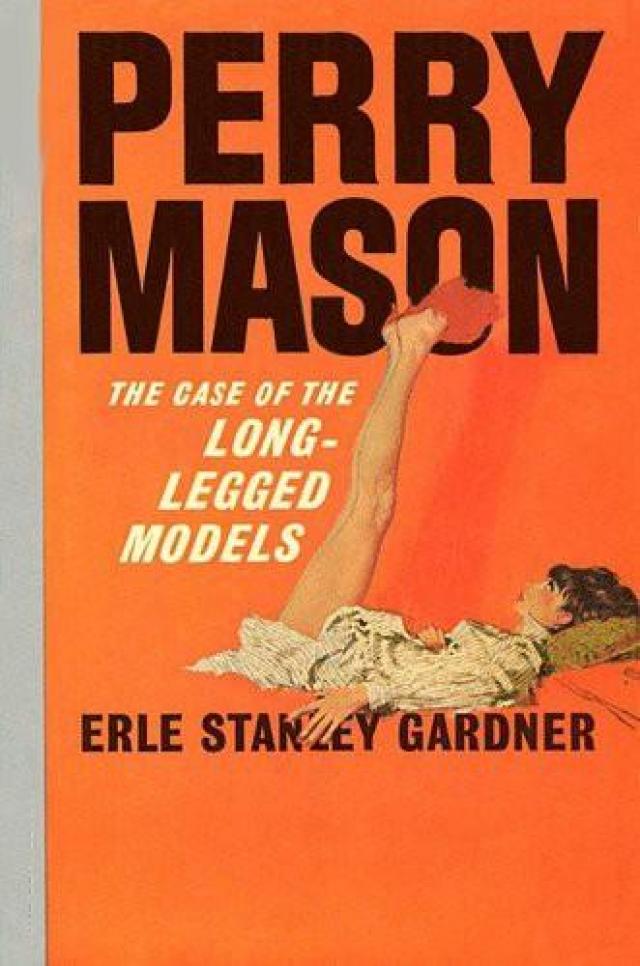


The Case of the
Long-Legged Models
by
Erle Stanley Gardner
Copyright © 1958 by Erle Stanley Gardner. Renewed 1985 by Jean Bethel Gardner and Grace Naso.
Electronic Book: Copyright © 2012 by The Erle Stanley Gardner Literary Trust.
All rights reserved.
Contents
Copyright
Foreword
Chapter 1
Chapter 2
Chapter 3
Chapter 4
Chapter 5
Chapter 6
Chapter 7
Chapter 8
Chapter 9
Chapter 10
Chapter 11
Chapter 12
Chapter 13
Chapter 14
Chapter 15
Chapter 16
Chapter 17
Chapter 18
Chapter 19
Chapter 20
Chapter 21
About the Author
FOREWORD
For some time I have been intending to dedicate a book with a suitable foreword to Michael Anthony Luongo, a quietly competent, exceedingly thorough expert in the field of legal medicine.
I first met Dr. Luongo several years ago when I attended a seminar on homicide investigation given under the auspices of Captain Frances G. Lee, of New Hampshire, at the Harvard Medical School.
At that time I was impressed with Dr. Luongo’s complete intellectual honesty, his sincerity, his self-effacing devotion to his profession.
Dr. Luongo is still a comparatively young man, yet he is a senior member of the Department of Legal Medicine at the Harvard Medical School. For many years he has been a teacher in the Harvard seminars on homicide investigation. He is an associate pathologist for the Massachusetts State Police, and a forensic pathologist certified by the American Board of Pathology.
One of Dr. Luongo’s outstanding traits is his desire for truth and his refusal to be stampeded into jumping to conclusions. It is a well-known fact in police circles that when officers are enthusiastically building up a case against some defendant, Dr. Luongo is quite likely to take the other side of the argument just to make certain the police don’t get off on the wrong foot.
At such times, I am told, he presents the opposing case with a brilliance that would be a credit to any of the skilled defense attorneys who have national reputations.
One thing is certain: By the time Dr. Luongo has permitted himself to reach a conclusion, it is the result of logic, scientific reasoning, keen perception, and honest appraisal of the facts.
For some years I have been watching Dr. Luongo progress in his chosen profession, earning the respect of those who work with him, and building a nationwide reputation for intellectual integrity and fairness.
Men like Dr. Luongo are pioneering a new field of forensic medicine where the expert witness, instead of being a partisan advocate for the side which has called him, appears as an absolutely impartial scientist with high ideals, representing neither the prosecution nor the defense but only Truth and Justice.
And so I dedicate this book to my friend:
MICHAEL ANTHONY LUONGO, M.D.
—Erle Stanley Gardner
Chapter 1
Perry Mason, feeling Della Street’s eyes on him, looked up from his lawbook to regard the trim, efficient figure in the doorway.
“What is it, Della?”
“What is the status of an unmarried woman who is quote, keeping company, unquote, with an unmarried male?”
Mason cocked a quizzical eyebrow. “There is no legal status, Della. Why do you ask?”
“Because,” she said, “a Miss Stephanie Falkner is waiting in the outer office. She says she has been quote, keeping company, unquote, with Homer Garvin.”
“Homer Horatio Garvin?” Mason asked. “Our client?”
“Not with Homer Garvin, Sr.,” she said, “but with Homer Garvin, Jr.”
“Oh yes, Junior,” Mason said. “He is in the automobile business, I believe. And what seems to be Miss Falkner’s trouble?”
“She wants to see you about a personal matter and hopes her Garvin contact will open the door to your interest in her problem.”
“What’s the problem, Della?”
“She inherited a gambling place at Las Vegas, Nevada. Her problem seems to concern that.”
Mason slapped his hand on the desk. “Put a dollar on number twenty-six, Della.”
Della Street made motions of spinning a roulette wheel, then of tossing an ivory ball into the perimeter of the wheel. She leaned forward as though watching the ball with complete fascination.
Mason also leaned forward, eyes intent on the same spot at which Della Street was looking.
Della suddenly straightened with a smile. “I’m sorry, Chief, you lost. Number three came up.”
She reached over to the corner of the desk and picked up Mason’s imaginary dollar.
Mason made a grimace. “I’m a poor loser.”
“What about Miss Falkner?” Della Street asked.
“Let’s call Garvin, Sr. and find out the exact status of this woman. How old is she?”
“Twenty-three or twenty-four.”
“Blonde or brunette?”
“Brunette.”
“Curves?”
“Yes.”
“Looks?”
“Yes.”
“Let’s talk with Garvin before we get our feet wet.”
Della Street moved over to her secretarial desk, asked the switchboard operator for an outside line, dialed the number, waited a moment, then said, “Mr. Garvin, please. Tell him Miss Street is calling.… Yes.… Tell him Della Street.… He’ll recognize the name.… Yes, Della Street.… I’m secretary to Mr. Perry Mason, the lawyer. Will you please put the call through to Mr. Garvin? It’s rather important.”
There was a moment of silence while Della Street listened to the party at the other end of the line.
“Well, where can I reach him on long distance?”
Again there was an interval of silence.
“I see,” Della Street said. “Please tell him that I called, and ask him to call me whenever he gets in touch with you.”
Della Street hung up the telephone. “That was Miss Eva Elliott, his very important secretary. She says that Mr. Garvin is out of town and she can’t give me any number where he can be reached.”
“Eva Elliott!” Mason said. “What’s happened to Marie Arden? Oh, I know. She got married.”
“About a year ago,” Della Street reminded him. “You sent her an electric coffee urn, a waffle iron, and an electric stewpan as a wedding present.”
“A year?” Perry Mason asked.
“I think so,” Della Street said. “I can look up the bill on the wedding presents.”
“No,” Mason said, “never mind. Come to think of it, we haven’t had any business dealings with Garvin since that new secretary came in.”
“Perhaps you aren’t even his attorney any more,” Della Street said.
“Now wouldn’t that be embarrassing,” Mason told her. “I guess I’d better talk with Miss Falkner and see what she has to say. Bring her in, Della.”
Della Street withdrew, returned a few moments later and said, “Miss Falkner, Mr. Mason.”
Stephanie Falkner, a long-legged brunette with gray eyes, walked calmly across the office, gave Perry Mason a cool hand, and murmured, “This is a real pleasure, Mr. Mason.”
The unhurried, well-timed precision of her motions indicated professional training.
“Please be seated,” Mason said.
“Now before you tell me anything, Miss Falkner, please understand that I have done Mr. Garvin’s legal business for years. There isn’t a great deal of it because he’s a shrewd businessman, and he keeps out of trouble. So he rarely has occasion to consult an attorney. But I consider him one of my regular clients and, in addition to that, I am his friend.”
“That’s why I’m here,” she said, leaning back in the overstuffed, comfortable chair and crossing her knees.
“Therefore,” Mason went on, “before I could even consider handling any matter which you might want to consult me about, I would want to take it up with Mr. Garvin, make a complete disclosure to him, and then make certain there would be no possibility of conflicting interests. Would that be satisfactory?”
“Not only would that be entirely satisfactory but I am here because you are Mr. Garvin’s lawyer. I want you to get in touch with him.”
“All right,” Mason said, “with that understanding, go ahead.”
She said, “I inherited an interest in a place at Las Vegas.”
“What sort of a place?”
“A motel and casino.”
“Some of those are fabulously large and …”
“Not this one,” she interrupted. “It’s rather modest, but it has a nice location and I believe it is capable of expansion.”
“How much of an interest did you inherit?” Mason asked.
“There’s a tight little corporation. My father was president. I inherited forty per cent of the stock. The other sixty per cent is divided among four individuals.”
“When did your father die?” Mason asked.
For a moment her face became completely wooden, then she said tonelessly, “Six months ago. He was murdered.”
“Murdered!” Mason exclaimed.
“Yes,” she said. “You may have read about
…”
“Good heavens!” Mason exclaimed. “Was your father Glenn Falkner?”
She nodded.
Mason frowned. “The murder has, I believe, never been solved.”
“Murders don’t solve themselves,” she said bitterly.
Mason said, “I don’t want to ask you to discuss anything that is distasteful to you or …”
“Why not?” she asked. “Life is filled with distasteful tasks. I made up my mind to suppress my feelings before I came in.”
“All right,” Mason said, “go ahead. Tell me about it.”
“My mother died when I was four. That was the beginning of a seven-year cycle of bad luck. At least that’s what Dad thought. He was horribly superstitious. I guess all gamblers are.
“Dad had been well fixed. He was cleaned out in the depression. He was out of money and out of work. He took whatever he could get. He started work in a speakeasy restaurant. The man who owned the place died. Dad bought out the heirs. He had the place built up when Prohibition was repealed.
“However, there’s no use boring you with a story of Dad’s hard luck. He had plenty. He also had some good luck. Dad was a gambler. He wasn’t a bootlegger but he was willing to operate a speakeasy restaurant. He was a plunger by nature, by inclination and by occupation.
“There are some things gamblers are good at, some things gamblers are bad at. Gamblers learn to control their emotions. Gamblers learn to be good losers. Gamblers become poker-faced and undemonstrative, and gamblers can hardly make a good home for girls, either teen-aged or younger. Gambling takes place at night.
“So I didn’t see much of my father. He kept me in boarding schools, and every time it would be the same story. Dad wanted me to have the best, but the best boarding schools don’t cater to the daughters of gamblers. So Dad would pose as an investor. The daughters of persons who gamble on the stock market are very, very eligible. The daughters of men who gamble across a table are very, very ineligible.
“It never occurred to Dad that it would be better and less cruel to put me in a school where I could sail under my true colors, where the standards weren’t so strict. He wanted me to have the best, so I met a lot of social snobs. I would last for a year, then somehow or other it would come out that Dad was a gambler and I’d have to leave.
“I absorbed some of my father’s philosophy. I became undemonstrative. I didn’t dare form friendships because I didn’t want to sail under false colors.
“So, as soon as I was old enough, I finished my education and went out on my own. I became a professional model. I made good money at it.
“Dad drifted into Las Vegas. In the course of time, he acquired some property, put a small motel on it, expanded as much as he could, and then wanted me to come and live with him.
“It was no go. He’d sleep until noon, get in about three o’clock in the morning. Property kept going up in value. A group of people got an option on some adjoining property. They wanted an option on Dad’s property. The idea was they were going to move our small units off the property, consolidate the two, put up a huge, expensive hotel with swimming pool, gambling, night-club entertainment, and all the rest.
“Dad was willing to sell out, but not for the price they offered. Dad learned he was dealing with a syndicate, found out what they had in mind, and held out for a good price.
“The syndicate was furious. When they couldn’t handle things any other way, they began to make threats. Dad laughed at them.
“That’s where Dad made his fatal mistake.”
“The syndicate killed him?” Mason asked.
She shrugged her shoulders. Her face was expressionless. “I don’t know. No one knows. Dad was murdered. That put fear into the hearts of the other stockholders. They wanted to sell for just about anything. From a business point of view, Dad’s murder couldn’t have been improved upon as far as the syndicate was concerned.”
“Go on,” Mason said, “what happened?”
“I inherited forty per cent of the stock. The remaining sixty per cent was owned by four people, each of whom had fifteen per cent. While I was still numbed by the news of Dad’s death, a man got busy buying up stock. Three of the other stockholders were only too willing to sell out for whatever the syndicate wanted to pay them.
“Before Dad’s death I had met Homer Garvin, Jr. We were keeping company. I saw something of his father. Immediately after the murder, Junior’s father asked me to tell him what I knew about my dad’s death. I told him.
“Garvin, Sr. knew even before I did that the other stockholders would be willing to sell for just about anything they could get. He tried to beat this mysterious stock purchaser to it, but was too late. Mr. Garvin got to only one of the other stockholders in time. He bought his holdings.
“That’s the story to date. Mr. Garvin has fifteen per cent of the stock. I have forty per cent. Now a group calling itself a new syndicate wants to buy all the stock.”
“What do you want?” Mason asked.
She said, “I want to sell. However, I’m not going to let them murder Dad and then take my stock for some nominal consideration. Dad gave his life. I’m going to see that these people don’t benefit by his murder.
“Now then, a man whom I will refer to as Mr. X is here in town. I don’t know whether he represents the so-called new syndicate or not. I know the man personally. I met him when I was doing model work in Las Vegas.
“All I know is that someone visited three of the other stockholders when they were frightened stiff, offered cash for their stock, paid the cash, had the certificates endorsed, and then faded from the picture.
“That was all I knew until a few days ago. Then Mr. X sent in the endorsed certificates to be registered in his name.
“Then he phoned me, told me he was interested in buying my holdings as well as those of Mr. Garvin, and asked me to meet him tomorrow night at eight-thirty.
“I’d like to get in touch with Mr. Garvin and see if he wants to pool our interests. I don’t want to sell unless he sells at the same time. Otherwise they’d have control and freeze him out.
“Mr. Garvin is out of town. He left yesterday. I can’t find out where he is. His secretary hates the ground I walk on. She wouldn’t even give me the time of day.”
“How about Junior?” Mason asked. “Can’t he find out where his father is?”
“Junior is East attending a meeting.”
Mason said, “Mr. Garvin might not like the idea of you dealing with this man. He may suggest that I have the personal contact.”
“I know,” she said. “But with me it’s a matter of family pride. I’m going to carry on where Dad left off.”
“You’d like to see your father’s murderer brought to justice?”
“Naturally. That’s the second reason I came to see you.”
“Go on,” Mason said.
“You know what happens with these gangster murders,” she said. “The police huff and they puff, and they mouth great threats to all gangsters. They righteously resolve in great headlines that this city will never tolerate gangsterism, that this murder will be solved.
“They’ve never solved a gangster killing yet that I ever heard of—except once when they convicted the wrong man.”
“So what do you want me to do?” Mason asked.
“After this stock sale goes through, I want to retain you to do something about my father’s murder. I want you to get a private detective to start looking into the case, to unearth clues that can be turned over to the police.
“Then I want you to sort of chaperon the case, to act as liaison man between the private detective and the police, to use your brains to interpret the evidence.”
Mason shook his head. “You don’t need to retain an attorney to see that the police solve a murder case.”
“What have they done so far?”
“I don’t know.”
“Neither does anyone else.”
“Could this Mr. X have been implicated in the murder? He seems to have profited by it.”
“Certainly he could.”
“Then you should let Garvin conduct the negotiations.”
“When Mr. Garvin got this stock,” she said, “he thought he was buying something to give me as a wedding present. He thought I was to be his daughter-in-law. Now that situation has changed … radically.”
“Where can I get in touch with you?” Mason asked.
“You can’t,” she said. “I’ll be in touch with you tomorrow morning. Will ten o’clock be all right?”















