The case of the one eyed.., p.11
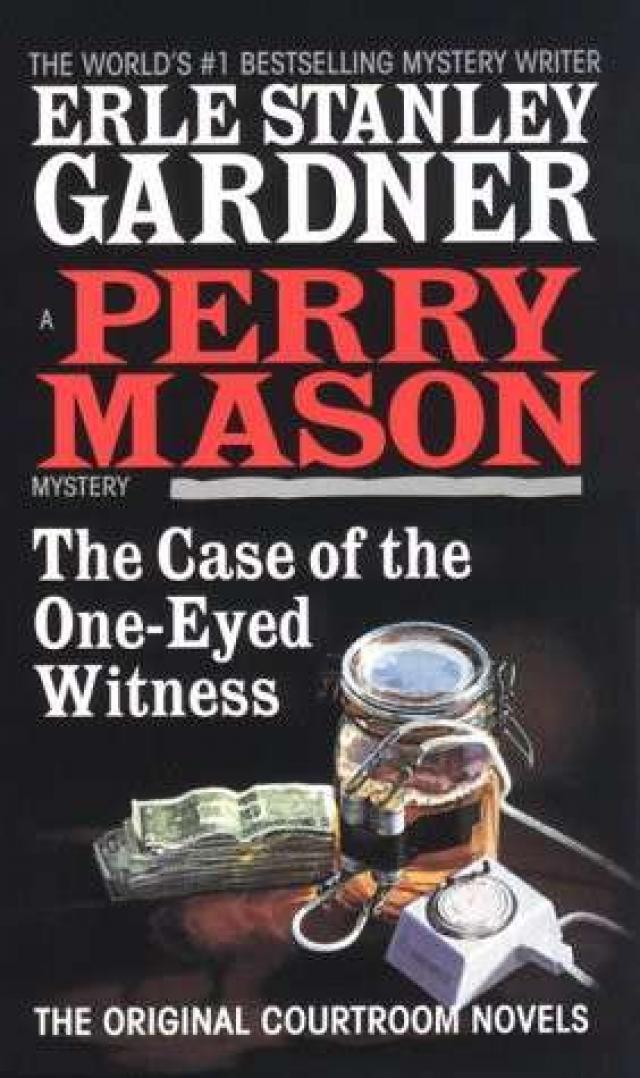
The Case of the One-Eyed Witness,
p.11


“You’ve told me everything?”
“Everything.”
“Then,” Tragg said, suddenly leaning forward, his voice taking on the edge of authority, “will you kindly tell me how, according to this report that was just given me, it happens that your fingerprints are all over the combination of that safe? Will you kindly tell me how it happens that when you tried to open the Carlin safe you turned the combination four times to the right and stopped on fifty-nine as your first move? How it happens that the Fargo safe has a combination which starts with fifty-nine four times to the right?”
Mason took a long drag at the cigarette.
“Well,” Tragg said, “I’m waiting for an answer.”
“I’m afraid,” Mason said, “that I can’t tell you any more than I have.”
“Did you or did you not open Fargo’s safe, either before or after the murder?”
“I did not even look inside the safe,” Mason said.
“Your fingerprints are all over the combination.”
“I can’t help that.”
“You may wish you could,” Tragg told him. “I’m giving you your chance right now, Mason, to come clean. If you’re representing a woman who wanted some documents out of Fargo’s safe, now is the time to say so.”
“That isn’t the case—at least not so far as I know.”
“I think you lifted a paper out of that safe, Mason.”
“I told you I didn’t as much as look inside the safe,” Mason said, his voice cold. “Go ahead and prove the contrary.”
“I think I can,” Tragg told him. “That’s all. You may go now.”
Chapter 12
Within a block of police headquarters, Mason stopped to telephone Paul Drake’s office.
“You familiar with the developments in that Fargo matter, Paul?”
“Sure,” Drake said. “My operative managed to get word through to me before the police sewed him up. I put some other men on the job just in case. Where are you now, Perry?”
“Within about a block of police headquarters. They’ve just finished giving Della and me a going-over.”
“Okay,” Drake said. “Get up here. I have some information for you.”
“All right, you’re going to have to get some more,” Mason said. “I want to find out who Fargo’s girl friend was. I want to find …”
“I have most of the stuff you want,” Drake said. “I’ve found that the investigation I was doing in that other matter led directly to …”
“Who’s his girl?” Mason interrupted.
“Celinda Gilson,” Drake said, “at the Farlowe Apartments. She’s the Golden Goose girl who has the concession for taking flashlight photographs of people who want to have it appear they’re near-celebrities, or who would like to perpetuate the occasion of a darned good binge.”
“The Farlowe Apartments?”
“Yes.”
“Anything else you have will keep,” Mason told him. “I’m sending Della to the office. Make a complete report to her. She’ll get it all classified and tabulated for me. I’m going to try to beat the police to Celinda Gilson.”
“You think the police are looking for her?”
Mason said, “I think she may have killed Fargo when she found out that Fargo had murdered his wife, and had also killed Medford Carlin. I’m mixed in this thing deep enough so I want to find out what it’s all about before the police sew everything up. I inadvertently left a set of fingerprints on Fargo’s safe, and that could prove rather embarrassing.”
“How the devil did you happen to leave prints on his safe?” Drake asked.
“I was trying to check a combination I had, Paul, in order to find out if Mrs. Fargo was really my client.”
“And you did open the safe?”
“Now don’t make the same mistake Lieutenant Tragg did,” Mason said. “He kept asking me if I opened the safe. I didn’t. I did unlock it. That’s something entirely different. Tragg neglected to ask me that question.”
“Okay,” Drake said, “you want me to put a shadow out on this Gilson girl?”
“Good heavens, no,” Mason said. “If you put a shadow on her and the police find it out, you’d never get a license again as long as you lived. We’ve had too many coincidences now, Paul. I’m on my way.”
“Think she’ll be home?” Drake asked dubiously.
“It’s my only chance. If she’s driving around, the police will pick her up. They have broadcast a description of the Fargo car and it should be only a matter of minutes until it’s located. Now, Paul, I want to know all you can find out about Mrs. Fargo. I think she really has a family in Sacramento. I want to find out who they are and where they live. Get busy on that stuff because we’re just one jump ahead of the police and I have to stay that way. There’s some tie-up between Carlin and the Fargos. I’d like to find it.… Okay, Paul, get busy. I’m on my way.”
Mason hung up the telephone, said to Della Street, “You have plenty of money in your purse, Della?”
She nodded.
“Grab a taxi to the office,” Mason said. “Paul Drake’s there. He has some information for you. Get him to run over everything he has. Separate the wheat from the chaff. Get him to find out who Mrs. Fargo’s relatives are in Sacramento. I don’t think there’s one chance in ten thousand she took the six o’clock plane, but check into it and make sure. I’ll be back at the office just as soon as I can get there. And in case this Gilson girl makes a confession I want you to be ready to jump in a cab, join me there and take down what she says. Keep plenty of cash on hand. We may have to go underground for a while.”
“On my way,” Della Street told him. “Where does the Gilson girl live?”
“The Farlowe Apartments.”
“You know where they are?”
“No.”
“I’ll look them up,” Della Street said.
“You get to the office,” Mason told her. “I’ll look them up. Grab yourself a cab. You can get one out front.”
“I’m on my way,” Della Street said, and hurried out of the door. Mason thumbed through the telephone directory, found the address he wanted, all but ran to his car and made time through traffic until he reached the Farlowe Apartments, a medium-sized, unostentatious apartment house which presented a locked door to the street. On the left-hand side of this locked door was a series of cards with the names of the various tenants, with buttons to the left of each card, and individual speaking tubes just to the right.
Mason found a name which had been cut from an engraved visiting card. Celinda Gilson Larue. Two ink lines had been drawn through the last name so that the words Celinda Gilson remained.
Mason held his finger against the button by the Gilson card.
He rang three times before there was a whistle in the speaking tube and then a woman’s sleepy voice said, “Who is it?”
“A friend,” Mason said.
“Oh, yeah.”
“That’s right.”
“What do you want?”
Mason said, “I want to talk with you before the police do.”
“What in the world are you talking about?” the voice asked down the speaking tube.
Mason remained silent.
There was a pause of several seconds, then the buzzer made noise, indicating that the door was being unlatched by a button from above.
Mason noted that the apartment number was 325, pushed the door open, went in, and didn’t bother to wait for the wheezy automatic elevator, but took the stairs two at a time.
The corridor on the third floor was a replica of thousands of other corridors in similar apartment houses. Mason had some trouble adjusting his eyes to the dim light, but finally found the apartment he wanted and tapped on the door.
The young woman who opened the door was knuckling her eyes and yawning as she studied Mason with a certain quizzical humor.
She was attired in a housecoat and slippers. Her face wore no make-up. She said, “So you’re supposed to be a friend. And getting me up at this hour!”
“Oh, come,” Mason said, “this is late.”
“Not for me it isn’t. What do you want?”
“I want to talk with you.”
“Go on and talk.”
“I hardly want to stand here and talk.”
“This is a one-room apartment. I’m in bed. Be your age.”
“I don’t want to talk out in the hall,” Mason said. “Be your age.”
“Just because you want to talk doesn’t mean you’re going to come barging into my place … What do you want to talk about?”
“Fargo,” Mason said.
There was not enough light to show the expression in her eyes. They regarded Mason steadily for a moment, then she stepped back from the door and said, “Come on in.”
Mason entered and she closed the door behind them.
It was a plain, small, furnished apartment with kitchenette and bath. There was a dispiriting lack of individuality about the place and it was singularly uninviting, with the furniture moved to one side of the small room to make way for the wall bed which had been lowered into place. A single electric floor lamp gave a feeble amount of subdued illumination.
“The chairs are all shoved up against the wall,” she said. “That overstuffed chair isn’t too uncomfortable. Swing it around and sit down.”
She kicked off her slippers, jumped up on the bed, curled her feet under her, pulled the covers over her knees, patted the pillows into a pile against the foot of the brass bedstead, said, “All right, go ahead and shoot.”
“You knew Fargo was married?” Mason asked.
She hesitated a moment, then met his eyes, and said, “Yes.”
“When did you see him last?”
“Last night.”
“What time?”
“About ten o’clock. He was at the place where I work.”
“The Golden Goose?”
“Yes. You were there, too. I saw you there with a young woman. I know who you are. You’re Perry Mason. Let’s quit beating around the bush. What do you want? You’re a lawyer. Do you represent the wife?”
“I’m not prepared to state.”
“What does she want?”
“I’m not prepared to state that.”
“What do you want?”
“Information.”
“About what?”
“Mind if I smoke?” Mason asked.
“Not at all,” she said, indicating a brass bowl which did duty as an ash tray and which was about half-filled with cigarette butts.
“Join me?” Mason asked.
“I … Okay.”
Mason took his cigarette case from his pocket, gave her a cigarette, took one for himself and held the match out to her.
She took a quick drag at the cigarette, then put it down, exhaled twin streams of smoke and said, “Let’s get on with the inquisition.”
“You’re friendly with Fargo?” Mason asked.
She hesitated, then met his eyes. “Yes.”
“Quite friendly?”
“Intimate, if that’s what you’re after.”
“How long have you been—intimate?”
“Is that any of your business?”
“I think it is.”
“About six months.”
“Has he talked about marrying you?”
“Don’t be silly. He’s married.”
“What does that make you?”
“You’re a lawyer. You can answer that question.”
“Smart, eh?”
“It doesn’t look like it, does it?”
“Just what did you expect to get out of the companionship?” Mason asked.
“I’ll bite.”
“Surely you expected something?”
“That’s up to him.”
“Did you ever discuss it with him?”
“No.”
“Is he happily married?”
“No.”
Mason said casually, “You knew he was dead?”
She jumped convulsively on the bed as though there had been an explosion near by and she was bracing her nervous system against the shock.
“Did you?” Mason asked.
“Is this a gag? Are you kidding me?”
“He’s dead,” Mason said. “I think he was murdered.”
“Then she did it,” Celinda Gilson said with a note of finality.
“Why do you say that?”
“Because she would do it. He—he expected her to.”
“How do you know?”
“He told me so.”
“Then he’d been having trouble?”
“Yes.”
“What sort of trouble?”
“I don’t know,” she said wearily. “What sort of trouble do you call it when people are married and live together until they get so damn tired of each other they want to break away but there’s no opportunity to break away? You get on each other’s nerves, you start jawing at each other, you probably loved the guy at one time, but that’s all worn off and he irritates the hell out of you just because he’s draped around your neck day and night—and he feels the same way about you.
“You say things that hurt his feelings, he says things that hurt your feelings.
“He’s always jumping on you, and you get to feel you’re never doing anything to suit him. You try to do the best you can, then your self-respect makes you start sticking up for yourself and you fight back. The first thing you know you’re going yah-yah-yah-yah like a cat and a dog shut up in a cage. Then you go pfffft! And get a divorce.”
“That’s what you did once?”
“That’s what I did,” she said. “That’s why you saw the card downstairs, Mr. Mason, with the name Larue crossed out. I put the guy out of my life and crossed his name off the list.”
“How long ago?”
“Eight months.”
“You’re divorced?”
“Not yet. I just crossed the name out.”
“Why aren’t you divorced?”
“Because he won’t pay for it and I’m damned if I’m going to put up my hard-earned dough to buy his freedom. He’s playing around, and sooner or later some little sweetie-pie will sell him a bill of goods and want to get her hooks into his dough. He’ll fall for that line of stuff and then he’ll want his ‘freedom.’ Then he’ll come to me to see about getting a divorce.”
“What’ll you do?”
“Probably hold him up for a little cash,” she said. “After all, I lived with the guy five years. I’m entitled to something. Five years ago I had a lot to offer, now I—well, a lot of the bloom has been rubbed off now.”
“You seem to be rather philosophical.”
“I try to be. Tell me about Arthman. You’re not kidding me, are you? This isn’t a gag?”
“No. He’s dead.”
“Murdered?”
“I think he was murdered.”
“Where’s his wife?”
“Supposedly visiting her mother in Sacramento.”
“When did she leave?”
“This morning.”
“When did Arthman get killed?”
“An hour and a half or two hours ago.”
“You check where his wife was,” she said with finality. “You’ll find she’s the one that did it.”
Mason said, “You didn’t know anything about it?”
“Not a thing.”
“What time did you go to bed?”
“About five o’clock this morning.”
“You live here alone?”
“What does it look like?”
“You were asleep when I rang the bell?”
“That’s right.”
“Had been in bed ever since five o’clock this morning?”
“That’s right.”
“Where were you about ten o’clock this morning?”
“Right here, with my head right on that pillow. Why? Did someone intend to try to pin it on me?”
“What time does the Golden Goose close up?”
“About two o’clock.”
“Where were you between two o’clock and five?”
She shook her head and said, “That’s none of your business. That involves other people. I try not to be a hypocrite. I tell you the things that only concern me and that’s all right, but when they concern somebody else that’s different.”
“You weren’t alone?” Mason asked.
“No,” she said mockingly, “I wasn’t alone. I’ve had lots of things that I’ve paid a price for. I’m having more things that I’m going to have to pay a price for. I’m living my own life and I’ve earned the right to be independent.”
Mason said, “Let’s get down to brass tacks.”
“I thought we were down to them.”
“About ten-thirty this morning weren’t you in a bedroom of Arthman Fargo’s house at 2281 Livingdon Drive with the door closed?”
“No.”
“Where were you?”
“Right here.”
“You drive a car?”
“Sure.”
“Didn’t you drive Arthman Fargo’s Cadillac out of his garage about two hours or so ago and …”
“Don’t be silly.”
“Didn’t you?”
“No.”
“How much do you know about Mrs. Fargo?”
“I’ve never met her. I’ve seen her—at the Golden Goose. He had her with him last night.”
“How much do you know about her?”
“I don’t think that needs to enter into it unless—well, unless that’s true about Arthman having been murdered.”
“It’s true.”
“How do I find it out?”
“You’ll find it out fast enough. Unless I very greatly underestimate the intelligence of Lieutenant Tragg of the homicide detail you’re going to be questioned with some thoroughness.”
She said, “It’s okay by me. I’m free, white and twenty-one and living my own life.”
“How about his wife?”
“If Arthman Fargo is dead, Mr. Mason, he was killed by Myrt.”
“Who’s Myrt?”
“Myrtle, his wife.”
“You seem to be very positive.”
“I am.”
“Mind telling me how you know, what makes you so positive?”
“She’s a vain little twist. She doesn’t want him herself. She would much rather be somewhere else.”
“Where? Do you know?” Mason asked.
“Where what?”