

The case of the one eyed.., p.2
The Case of the One-Eyed Witness,
p.2
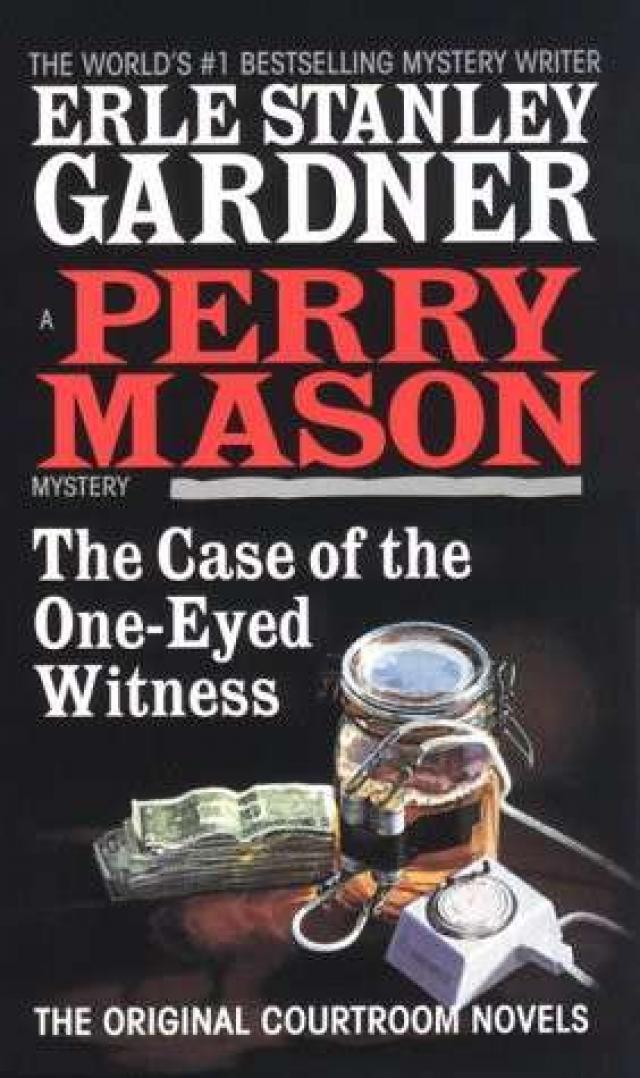


Mason said, “We wait for a few minutes to see if this package that the woman referred to shows up.”
“And in the meantime?”
Mason escorted Della Street back to their table. “We finish our after-dinner coffee, perhaps have a dance and act as though nothing had happened.”
Della Street said, “Don’t look now, Chief, but the telephone call seems to have attracted attention.”
“In what way?”
“We seem to be the subject of a whispered discussion over there in the corner.”
“Who are they?”
“The hat-check girl, the girl who has the photographic concession, and the cigar and cigarette girl. Wait a minute, here comes the cigarette girl now.”
Mason sipped his coffee.
The girl with her cigarette tray made a perfunctory canvass of the people at the adjoining table, then turned to Perry Mason. “Cigars, cigarettes?” she asked, her voice caressing and lingering.
Mason smiled and shook his head.
Della Street nudged him.
“Well, give me a package of Raleighs,” Mason said.
She selected the package, tore off the corner, tapped out a cigarette, handed it to Mason, then bent to hold a light.
She was an olive-complexioned girl with rather high cheekbones, and a good figure. The costume exhibited soft, rounded shoulders from the daring low neckline, and good legs in opera-length nylons.
Mason handed her a dollar. She started to make change.
“That’s all right.” Mason smiled warmly.
“Oh, you are—so generous.”
“That’s all right.”
“It is so good of you to—to give me this….”
“What’s the matter?” Mason broke in, looking at her sharply. “Don’t you ordinarily get tips?”
“Ten cents, fifteen cents, perhaps twenty-five cents,” she said, and suddenly her eyes filled with tears.
“Hey, wait a minute,” Mason said. “What’s the idea?”
“Oh, you will forgive me. I am so upset and on edge that when someone is kind I have no control of myself. I am not myself …”
“Here, sit down,” Della Street said.
“No, no, I will lose my job. I cannot sit with the customers. I …”
Mason watched her face convulse with emotion, saw the tears start trickling down, leaving streaks through the makeup.
“Here,” Mason said, “sit down.”
He arose to hold a chair for the girl, and after a moment’s hesitation she turned the chair so that her tray could balance itself on her lap, and sat down at the table.
“Now then,” Mason said, “what you need is a brandy and …”
“No, no, please. That I cannot do. To drink with the customer is against the rules.”
“What’s the trouble?” Mason asked.
Della Street flashed him a warning glance.
“Something wrong with the job?” Mason prompted.
“No, no. It’s all right Just a private matter and nothing new. But every now and then like a wave it …”
She broke off and almost savagely turned on Della Street. “Your husband would not understand, but you, yes. You can know how a woman feels about her baby.”
“What about your baby?” demanded Mason.
She shook her head. “I am foolish to intrude upon you in this way. Please will you pretend to be selecting something from my tray? It—the headwaiter can be very disagreeable.”
Della Street fingered the various small souvenirs and gadgets.
“Go on,” Mason said.
“It is nothing. After all, it will work out all right. My child is probably in good hands. Only I wish I knew. Oh, how I wish I knew.”
“Knew what?” Mason asked.
“Where my little girl is. You see, it is very difficult and complicated. I am—I am part Japanese.”
“You are?”
“Yes. You probably don’t notice it unless you look sharply, but you can see the eyes, the cheekbones.”
Mason studied her for a moment, then nodded, and said, “Yes, I see now. I thought there was a certain exotic something about you. Now I see what it is. There’s a definite Oriental cast to your features.”
“Only partially Japanese,” she said, “but I’m an American. I’m as good an American as anyone. Only do you think anyone else thinks so? No. To most people I am Japanese, and that makes me taboo, an outcast.”
Mason said, “There was something about your baby.”
“I had a child.”
“You are married?”
“No.”
“Go on.”
“That is it. I had the child, and the child’s father managed to steal her from me. He sold her. When I heard she’d been released for adoption I was frantic. I tried in every way to find out what had happened, to do something, but there was nothing I could do.”
“Was this man who took your baby really the child’s father?” Mason asked.
She hesitated a moment, her eyes lowered, then she raised the lids and looked Mason full in the face.
“No,” she admitted. “The father—died.”
“Why don’t you do something to find your baby?” Della Street asked.
“What can I do? I have Japanese blood, and people do not go out of their way to help the Japanese unless they have much money, and I have none. I do not even know where my child is, but I am sure she was released for adoption. This man who posed as the father of the child and signed papers has disappeared and …”
“How old is your child?” Mason asked.
“She would be four years old now. She was just a baby when …”
Pierre, the headwaiter, glancing around the crowded dining room, suddenly spotted the cigarette girl seated at the table. “Cigarette girl, this way,” he called sharply. “At once!”
“Oh,” she said, “I shouldn’t have done this. Pierre is angry.”
She produced a handkerchief from the V-shaped opening of the strapless costume which hardly seemed adequate to afford sufficient concealment for a postage stamp, hurriedly wiped her eyes, gave her face a quick dab with the powder puff from a make-up compact.
“Cigarettes!” Pierre called, his voice harsh with impatience.
She flashed Della Street a quick smile, for a moment placed her hand on Perry Mason’s arm, gave it a little squeeze, said, “It gets me down once in a while.”
“Don’t let it,” Della Street said. “You should …”
“Cigarette girl. Here, at once,” Pierre called.
“Thanks for the buggy ride,” she said, patting Mason’s shoulder, and was gone.
“Poor kid,” Della Street said.
Mason nodded.
“Babies are worth money,” Della Street pointed out. “I suppose by posing as the father and saying that the mother was dead or had skipped out, he was able to release it for adoption and got probably five hundred or a thousand dollars.”
“A Japanese baby?” Mason asked.
“Who was going to know it was Japanese?” Della Street asked. “You wouldn’t have known that girl was Japanese unless she told you. There’s something about her eyes, just a faint suggestion in the contours of her face. She is a lot more American than Japanese.”
Again Mason nodded.
“You seem rather unimpressed,” Della Street said irritably. “Why don’t you do something about her baby? You could do it, Chief. You could find that child and see that justice was done.”
“To whom?” Mason asked.
“To the mother, to the child.”
“How do you know it would be justice to the child? The child may be in a good home. The mother is working in a night club with just about enough clothing to keep her from being arrested for indecent exposure and …”
“What difference does that make? She loves her child.”
“Maybe she does,” Mason said, “but it’s strange to think that she loves it that much.”
“What do you mean?”
“It must be more than three years since the child disappeared,” Mason pointed out dryly. “She walks up to a couple of total strangers in a night club, suddenly bursts into tears and violates the rules of the place to sit down and pour out her troubles.”
“Well, of course,” Della Street admitted, “when you look at it that way…. But it was so spontaneous! You just had the feeling she had been keeping her troubles to herself until finally they had piled up on her and she just couldn’t contain herself any longer.”
“You overlook the significance of the conference which took place over there in the corner, Della, after I had been called to the telephone.”
“That’s right. Then she must have known who you are.”
Mason nodded.
“And then tried to interest you in coming to her rescue. And yet it was done so convincingly—and those were real tears, Chief.”
Mason glanced at his wrist watch, said, “Well, if there are going to be any further developments they’d better show up. It’s going to be too late to do anything tonight. I can’t forget that note of urgency, of sheer terror in the woman’s voice. I’d like to know what happened at the other end of that telephone to cause her to …”
“Here’s the headwaiter coming this way,” Della Street said.
The headwaiter, a rather short, stocky, middle-aged man, was suavely apologetic with his bow and his voice. His eyes, however, indicated definite purpose.
“You will,” he said, with a shrug of his shoulders, “pardon the interruption, Monsieur.”
“Yes?” Mason asked.
“But is it that you should be Perry Mason, the lawyer—no?”
Mason nodded.
“I am so sorry. I did not recognize you when you entered, but you were pointed out to me. I have seen your pictures in the paper many times, but”—he moved his hands in an expressive gesture—“when I see you, you are younger than I expect.”
“All right,” Mason said, somewhat impatiently. “The food is fine, the service is excellent. Please don’t apologize for not recognizing me and don’t tell anyone I am here.”
The headwaiter glanced just for one fleeting moment at Della Street. His smile indicated that he could be the soul of discretion. “But certainly, Monsieur,” he said. “This is not a place where we point people out. Monsieur’s business is his own—no? The reason I am intruding upon the privacy of Monsieur is that an envelope has been given to me by a messenger for Monsieur Perry Mason, the lawyer. It is of the greatest importance that the envelope is to be delivered only to Monsieur Mason.”
His hands made a swift motion. The envelope was produced with something of a flourish, something of the skill of a magician bringing a live rabbit from a coat tail pocket.
Mason didn’t reach for the envelope immediately. He studied it lying there on the table. It was long, manila, and the “Mr. Perry Mason” had been hastily written. Then his eyes, cold and granite-hard, turned up to the urbane, smiling headwaiter.
“Where did you get this?” he asked.
“It was delivered to the man at the door by a messenger.”
“Who was the messenger?”
“But I do not know. One does not know the names of messengers. The doorman, perhaps. If you wish, shall I send him?”
“Send him.”
For a moment their eyes locked, the lawyer’s probing, insistent, impatient, Pierre’s smiling with what might have been a slight touch of mockery. Then the headwaiter averted his eyes.
“He shall be sent to you at once, Monsieur, and I hope you find everything satisfactory.” The man bowed, turned away and walked toward the door of the night club.
“Somehow,” Mason said, watching the man’s back, “if you’re looking for an explanation of how our whereabouts was discovered by our mysterious would-be client …”
He broke off and tore open the heavy envelope.
“This is it, all right,” Della Street said as she saw the currency, the newspaper clipping.
Mason looked through the assortment. “A collection of everything from five-dollar bills through one-dollar bills, up to a couple of fifties,” he said.
He raised the bills to his nose, then handed the packet to Della Street.
She smelled it, said, “Rather a strong scent.”
“Oh, certainly,” Mason said. “Dollars and scents.”
“I should kill you for that,” Della Street said, smiling. “That would be justifiable homicide in any court in the land.”
“Well, forget the dollars,” Mason said. “Let’s talk about the scents.”
Her eyes became serious. “It’s a nice scent,” she said, “but strong. You know, Chief, it might be that some woman had been saving this money, a dollar or two here and there, then perhaps five dollars, then by a lucky break a fifty-dollar bill, placed in a bureau drawer where she kept her handkerchiefs, the whole thing being saved for an emergency.”
Mason nodded, his face thoughtful. “Only,” he said, “the fifty-dollar bills represent an opportunity she’s had to change a lot of ones and fives. After she scraped that much money together there was a chance to go to a bank and get the lot changed into something that didn’t take so much room and—here comes the headwaiter and the doorman. Della, get the money back in the envelope.”
“There’s no name?” she asked.
“No name,” Mason said. “And no note. Just the money and a newspaper clipping. That’s why she had to call me on the phone to tell me what she wanted me to do.
“Apparently she didn’t have time to write a note. She just put this stuff into the envelope and …” He broke off as the headwaiter escorted the doorman to the table.
“The doorman, Monsieur.” Pierre stood waiting, somewhat expectantly.
Mason handed him a ten-dollar bill. “The service,” he said, “has been excellent.”
Deft fingers folded the bill and palmed it. It was as though the money had been swallowed up into nothing. There was no hint of sardonic amusement in the man’s eyes now. His manner was deferential. “It is a pleasure to serve you, Monsieur. Any time that you wish to come here ask only for Pierre and the table will be waiting.”
He managed to make the message a personal one for Perry Mason but to include Della Street by a swift, almost surreptitious, glance. Then he was bending suavely over another table. “Everything is satisfactory?” he murmured.
The doorman, a big man in an ornate uniform, seemed in a hurry to get back to his post, but his quick eyes had apparently caught the denomination on the bill which had been given Pierre, despite the latter’s swiftness in folding the bill. He seemed properly impressed.
“That envelope,” Mason said. “Can you tell me about it?”
“Not too much,” the doorman said. “The car was just average. Not too new. To tell you the truth I didn’t pay much attention to it. There was a rush on at the time and both of the lads who handle the parking were busy. I stepped up and opened the door and saw there was a lone man in the front seat who didn’t look like he belonged. I knew he wasn’t going to get out as soon as I opened the door. I thought he was a moocher who’d ask for directions. We have a few of them. Fellows pull up to the curb and want to know how to get some place, or where such and such a street is.
“You don’t mind it if you’re not busy and if they’ll just roll the window down and let you know what they want, but when they sit there and wait for you to open the door, it makes you sore. I’ve never had a tip from one of those guys yet.”
“And this one?” Mason asked impatiently.
“Well, like I say, I knew he wasn’t going to get out. I opened the door and he pushed the envelope into my hand and said, ‘Give that to Perry Mason. He’s inside.’ ”
“Yes?” Mason asked.
The doorman said, “I remember handling your car but I didn’t recognize you, Mr. Mason. I’ve heard the name enough but—I guess it’s your first time here, isn’t it?”
Mason nodded. “Go ahead. What about the person with the envelope?”
“Well, that’s all. I stood there sort of dumb, I guess. The man said, ‘Go ahead. Get the lead out of your …’ ”
He stopped abruptly.
“Pants,” Della Street finished.
“Thank you, ma’am,” the doorman said, grinning. “That’s what he said, and then he said, ‘Give it to whoever’s in charge in there and tell him it’s important and it’s for Mr. Mason.’ So I passed it on to Pierre.”
“And what did the man do?”
“Slammed the car door and drove away.”
“You didn’t get the license number or anything?”
“That’s right,” the doorman said. “I didn’t get anything. I’d say it was a Chevvie—about five or six years old. Dark color, a four-door sedan, and that’s just about all I can tell you about it.”
“Can you describe the man?”
“Sort of a grayish suit, his shirt collar was rumpled. He was maybe, oh, six or eight years older than I am, and I’m—let’s see, fifty-three. … He didn’t look like a customer.”
“A working man?”
“Well, not so much a working man. The kind that would have a little business of his own. He looked—well, he was seedy, but he was shrewd. A guy who has some money but doesn’t spend it on clothes and cars, or throw it away in …”
“Night clubs?” Della Street prompted.
Once more the man grinned.
Mason produced a second ten-dollar bill. “Try and remember something else,” he said. “You’re missing tips out at the door and it’s on your mind. You’ll do better later on, if you keep your mind on it. This is Miss Street, my secretary. You can ring my office any time tomorrow and ask for her and let her know in case you think of something else.”
The doorman’s attitude was entirely different from that of Pierre, the headwaiter. In place of swiftly folding the bill and getting it out of sight, the doorman made it a point to look at the denomination, then nodded and beamed approvingly.
“Say,” he said, “don’t worry about me passing up tips outside. Now if there’s anything …”
“Just think it over,” Mason said, “and you might get my car. It’s …”
“I remember your car,” the doorman said, “and I’ll remember you next time, Mr. Mason. Anything you want …”















