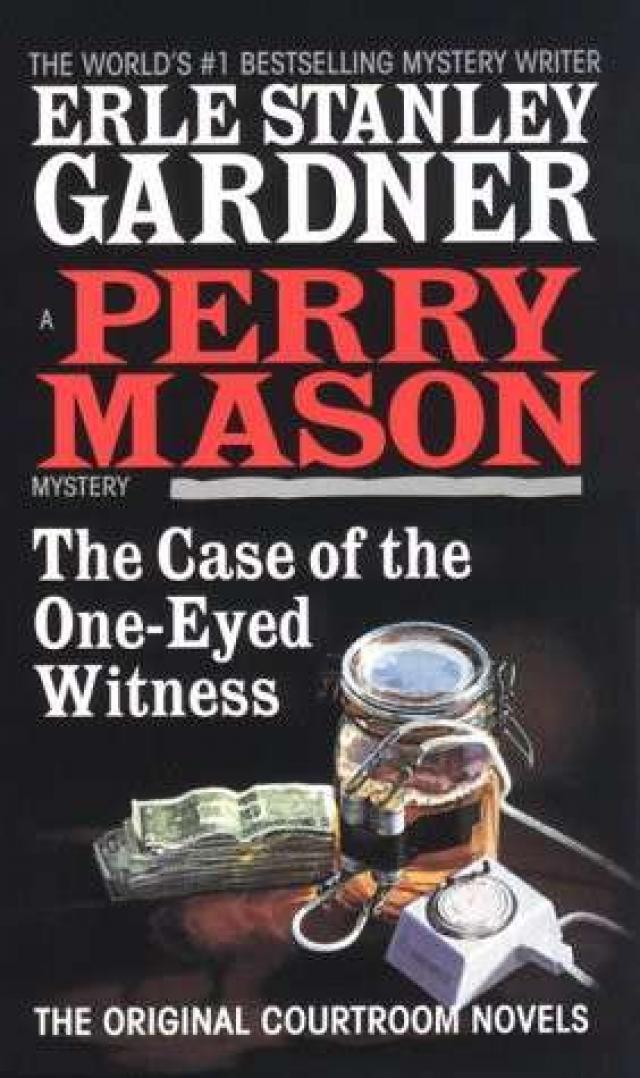
The case of the one eyed.., p.3
The Case of the One-Eyed Witness,
p.3


“That’s fine,” Mason interposed. “Right at the moment all I want is to find out more about the messenger who sent this envelope to me.”
“I’ll keep thinking. If anything comes of it I’ll telephone you tomorrow afternoon. I’m on duty until two o’clock in the morning and I don’t get up until around noon. I may think of something.”
Mason nodded to Della Street, said, “All right, Della, we’ll ring Carlin.”
“If he’s in bed he’ll be mad,” she warned.
“I know,” Mason told her, “but it’s a chance we’ll take.”
“You don’t think it can wait until morning?”
“You didn’t hear that woman’s voice over the phone, Della. Whatever it is, it has to be handled right now. At least I’m going to make a stab at it.”
Mason accompanied Della Street to the telephone. She dropped the coin, dialed the number, glanced inquiringly at Mason. “Do you want to take it from here?”
“No,” Mason told her, grinning. “Use your most seductive voice until he gets over being peeved at the late call, Della. See if you can soothe his feelings.”
“Do I tell him who we are and why we’re calling?”
“Not why, just who. You can …”
Della Street jerked her head back toward the transmitter and said, “Yes, hello. Is this Mr. Carlin?”
She waited a moment, then smiled sweetly and said, “Mr. Carlin, I hope you will pardon the intrusion at this late hour. This is Miss Street talking. I am Mr. Perry Mason’s confidential secretary and it is very important that we see you at the earliest possible moment…. I trust you weren’t in bed…. Oh, that’s fine…. Yes. If possible…. Yes, I know it’s unusual. I’ll put Mr. Mason on the line.”
She cupped her hand over the transmitter and said, “He wasn’t in bed. Sounds polite. I think it’s all right.”
Mason nodded, took the receiver from her hand, placed it to his ear, and said into the telephone, “Hello. This is Perry Mason talking, Mr. Carlin. I’m very sorry to bother you at this late hour.”
“So your secretary told me,” the man’s voice announced over the wire. “However, you don’t need to worry about that. I seldom go to bed before one or two o’clock. I’m quite a reader and very much of a night owl.”
“I want to see you upon a matter of the greatest importance.”
“Tonight?”
“Yes.”
“How long will it take you to get here?”
Mason said, “I’m phoning from the Golden Goose, and I have one other minor matter which I have to see about and it’ll probably take me—oh, perhaps thirty or forty minutes.”
“I’ll be waiting for you, Mr. Mason. Now, let’s see, you’re Mr. Perry Mason, the attorney?”
“That’s right.”
“I’ve heard about you, Mr. Mason. I’ll be very glad to meet you. I’ll make some hot coffee.”
“That’s fine,” Mason said. “I feel that this is something of an imposition, and I certainly appreciate …”
“Not at all, not at all. I’m rather a lonely bachelor here, and I like company. It’s definitely not an imposition, Mr. Mason. I’ll be glad to see you. Are you bringing your secretary with you?”
“Yes. She’ll be with me.”
“That’s fine,” Carlin said. “I’ll be very glad to see you, Mr. Mason, in about half an hour.”
“That’s right,” Mason said. “Thank you,” and hung up.
“Seems to be rather affable,” Della Street said.
“He does indeed.”
“What’s the newspaper clipping, Chief?”
“I’ve only had a chance to glance at it,” Mason said. “It’s just a few paragraphs, evidently from a New York newspaper, mentioning that a certain Helen Hampton had been convicted of blackmail and sentenced to jail for eighteen months. It seems that she and some male accomplice, who was not named, were engaged in a sort of shakedown racket, but it seems to have been rather hush-hush. She pleaded guilty and the judge mentioned in passing sentence that the scheme of extortion was so diabolically ingenious that he did not care to have it made public through the press because of the possibility that others might put the same plan into operation.”
“Nothing else?”
“Nothing else,” Mason said.
“What was the date of the clipping?”
“There’s no date on it,” Mason said. “It’s just a clipping from a paper. It’s begun to turn slightly yellow, which might mean either that it’s old or that it has been left in the sun. Newsprint turns yellow rather quickly under those conditions.”
“Well,” she said, “we’ll probably know more when we talk with Carlin. What was the other matter you said you had in mind, Chief?”
“I want to go out to that pay station,” Mason said. “I presume it’s open until midnight. I want to see if we can find out anything more about the woman who telephoned.”
“Well,” Della Street said, “your friend Carlin sounds casual enough. I rather took a fancy to him.”
“He certainly seemed to be affable and matter-of-fact,” Mason said, “and relatively devoid of curiosity.”
“That’s it,” Della Street remarked. “I was trying to put my finger on what it was that impressed me about him. He seems to have complete poise. The average person would have been burning with curiosity and perhaps a sense of guilt. I can imagine most people would have said, ‘Well, why on earth would Mr. Mason want to see me at this hour? What is it you have in mind?’ and stuff like that. Mr. Carlin wasn’t like that at all.”
Mason thought it over. “Seemed to be affable and devoid of curiosity,” he repeated slowly.
“As though perhaps he’d been expecting the call?” Della Street asked, cocking her head on one side.
“Well,” Mason told her, “I’m not going that far, but he certainly seemed to take it very much in his stride. Come on, Della, let’s get out of here and hunt up that phone booth.”
Chapter 3
Driving out to the drugstore on Vance Avenue and Kramer Boulevard, Mason said, “Della, just how do you suppose this woman knew I was at the Golden Goose?”
“Why,” Della Street said, “a person of your prominence is pointed out everywhere and …”
“Then you have to start with the assumption she had been there at the Golden Goose.”
“Not necessarily. She—wait a minute—yes, I guess you do have to figure it that way.”
“Of course,” Mason went on, “she could have had a friend who rang her up and said, ‘Look, Mr. Mason is here at the Golden Goose. Now’s your chance. All you have to do is get in touch with him.’ Or the headwaiter …”
“Yes, that could have happened.”
“But, somehow,” Mason said, “I don’t think it did. Then there wouldn’t have been that note of urgency or that abject fear in her voice…. No, she must have been someone who was at the night club, who saw us there, and then went out and telephoned.”
“No one could have known you were going to be there?”
“We didn’t even know it ourselves,” Mason said. “You remember we finished interviewing our witness and it was on the way back that you remembered Paul Drake had recommended the Golden Goose. He said there was excellent food and a pretty good floor show and …”
“That’s right,” she said. “We went there on the spur of the moment, and no one knew where we were.”
“With the single exception of the Drake Detective Agency,” Mason said. “You remember we called Paul from the night club and told him we had the statement of that witness and that we’d see him in the morning, and I think I told him we were trying out the night club he’d recommended.”
“That’s right I remember hearing you say that.”
“But,” Mason said, “Paul Drake wouldn’t have told anyone where we were. After all, he’s a detective. He knows how to keep his mouth shut. Oh, well, we’ll probably find out a lot more when we talk with Carlin. It’ll probably turn out to be one of those routine affairs. No reason to get excited about it, and probably no reason to do all this night work.
“However, I can’t get over the idea that this woman had been carefully saving money against an emergency, and when that emergency arose she went to the place where she had been hiding her money and … Well, here we are at the drugstore. Let’s see what we can uncover here. Coming in?” he asked her.
Della Street already had the door open. “Try and stop me.”
The man in charge was just getting ready to close up. Four youths, who were gossiping over gooey concoctions of thick syrups and ice cream, were being courteously but pointedly reminded of the time. The soda clerk was dispiritedly plunging glasses into hot water filled with a detergent, and the cashier was making up totals.
The prescription clerk listened listlessly.
“Can’t remember very much about her,” he said. “They kept ringing the phone in the other booth and we were too busy to answer. Finally I got over there and Central told me someone had left the receiver off the hook in the other booth. I saw they had, and reached in and put the receiver back on the hook. That’s all I know about it. You might ask the cashier.”
Mason crossed to the cashier’s desk.
Yes, she remembered a woman vaguely. She had changed a quarter. Perhaps thirty or thirty-five years old, with a dark coat and a fur collar, and a brown alligator purse. No, she couldn’t describe her more accurately. The receiver had been left off the hook. No, she hadn’t seen the woman leave. They were busy and …
“Which booth did she use?” Mason asked.
“The one on the right, over nearest the magazine stand.”
“I’ll just take a look,” Mason said.
He walked over to the booth, Della Street at his side.
“The prescription clerk is certainly watching you, Chief,” she whispered.
“Probably thinks I’m FBI,” Mason said. “I don’t suppose there’s one chance in a thousand we can find out what frightened her, but we’ll take a look just the same. If she had to leave so suddenly there might be something left behind, a handkerchief, a purse, a …”
“There’s a paper on the shelf and some nickels,” Della Street said, looking through the glass oblong in the door.
Mason pulled the door open. Della Street glided into the telephone booth. “Four nickels stacked here on a piece of paper,” she said.
“What’s the paper?”
Della Street said, “There are just numbers on it, scrawled in pencil. Here’s a number, Main 9–6450.”
“Call it,” Mason said. “See who answers.”
Della Street dropped a nickel and dialed the number, said, “We probably won’t get any answer this time of night. It—oh, yes, hello, hello, yes, oh, thank you—no, never mind, I called the wrong number by mistake.”
She dropped the receiver back into place and smiled at Perry Mason. “That,” she said, “was the number of the Golden Goose!”
“The deuce it is! I’d give a lot to know how she knew we were there. Anything else on that paper?”
“Some numbers on the other side. They’re neatly written, the way a woman who had been a bookkeeper would write them.”
“What are they?”
“It looks like some sort of a complicated license number.”
The numbers were written in a string. 59-4R-38-3L-19-2R-10L.
Mason stood frowning down at the paper.
The prescription clerk moved over rather rapidly. “Find anything?” he asked.
Mason smiled and shook his head. “I was making a note of the number here.”
“Oh,” the clerk said.
Mason slipped the piece of paper in his pocket, yawned ostentatiously and said, “It’s nothing particularly important I have a cousin who has amnesia. For some strange reason she seems able to remember my telephone number even when she can’t remember who she is, or my name, or anything about her family.”
“I see,” the clerk said in a tone of voice which indicated he did not see at all.
Mason piloted Della Street toward the door.
The drizzle had developed into a cold, driving rain. Della Street jumped into the car and slid across the seat to come close to Mason. “Brrrrr,” she said. “I’m cold. The human ankle really needs more than sheer nylon to protect it in weather like this. Did you have some idea about that string of numbers on the paper, Chief?”
“The string of numbers,” Mason said, producing the paper from his pocket, “is the combination to a safe. Four times to the right to fifty-nine, three times left to thirty-eight, twice to the right to nineteen, then turn to the left and stop at ten.”
“The clerk is moving casually toward the door,” she said. “I think he’s interested in your license number just in case …”
Mason stepped on the throttle. The car hissed into motion, the windshield wipers beating a monotonous protest against the pelting rain which drove against the windshield and streamed down in rivulets.
Mason said, “That headwaiter at the night club could know a lot more than he told us.”
Della Street said, “Well, I hope he looks you up and finds out you’re a bachelor with a perfect right to take a secretary to a night club. He may have known who you were but he certainly didn’t know who I was. He took you for a married man out on a surreptitious round of revelry.”
“And you?” Mason asked.
“I,” she said, “was the siren, the voluptuous seducer of virtue.”
Mason said, “I think that Pierre’s reaction to you was because of the way he sized me up.”
“That’s it,” Della Street said bitterly. “Never give the woman any credit. The man always wants to preen himself on being the big bad wolf.”
“Or,” Mason said, “you can look at it the other way. Pierre decided you were the expert vampire and I was the mere plodding businessman suddenly swept off my feet by the glamour …”
“Stop it,” Della Street said, laughing. “As a bookkeeper, how am I going to enter this five hundred and seventy dollars on our books?”
“I guess,” Mason said, “you’ll have to enter it as a credit to Madam X until we find out more about our client.
“However, let’s go see what M. D. Carlin has to say for himself. Perhaps he can enlighten us.”
“What are you going to tell him, Chief—about your client, I mean?”
“Not one single thing,” Mason said. “And I do hope he wasn’t kidding about the hot coffee.”
They were thoughtfully silent until Mason, turning into West Lorendo Street, found himself in the sixty-eight-hundred block.
“Turned too soon, Della,” he said. “This will put us on the wrong side of the street.”
He drove across the intersection, slowed as he studied numbers, then said, “There it is, directly across the street.”
“What an old-fashioned house!” Della Street exclaimed.
Mason nodded. “Probably this was the residence of a man who had a ten-acre tract twenty-five years ago. Then the city started expanding and finally he decided to subdivide, but you can see he kept plenty of elbow room.
“That lot must run thirty or forty feet on each side of the house. Probably tied up in an estate somewhere. You can see the evidence of lack of care. It’s been a long time since it’s been painted, and all that gingerbread trimming certainly is a relic of the dim and distant past. Well, here we go, Della.”
Mason swung the car into a swift U-turn, parking it directly in front of the house. “How are your legs?”
“Still wet.”
“I was hoping the car heater would dry them. Don’t catch cold.”
“I won’t. How are your feet?”
“All right. I have heavy shoes.”
Mason switched off the lights, shut off the motor, walked around the car to open the door for Della Street.
“Okay, Della,” he said. “Here we go on the run.”
They sprinted up the cement walk to the creaky, unpainted porch supported by round wooden pillars, and ornamented by a wooden scroll design.
Mason was groping for the doorbell when the front door swung open. A man’s quiet, calm voice said, “I’m sorry. There’s no porch light. You’re Mr. Mason?”
“That’s right I assume you’re Mr. Carlin?”
“Yes, sir. Won’t you and the young lady come in?”
Carlin pushed the screen door open. Della Street entered, followed by Perry Mason.
“Rather a bad night,” Carlin said. “A cold rain.”
“It is rather disagreeable,” Mason admitted, cautiously noncommittal for the moment, sizing up both the man and the surroundings.
The dim light in the hallway disclosed a man somewhere in the early sixties, a bullet-headed individual, quiet-voiced, with protruding gray eyes behind thick glasses, who regarded his visitors with a certain whimsical patience.
His clothes were as antiquated and as shabby as the outside of the house. A single-breasted coat was cut on a bygone pattern. The trousers were badly in need of pressing. After long months of hard usage, the leather in the shoes had broken down and spread out to conform to the contours of short, broad feet.
He said, “This is a bachelor establishment. I live here by myself. A housekeeper comes in once a week, but I don’t go around picking things up and sweeping and dusting. You’ll have to take things as they are.”
“Quite all right,” Mason assured him. “We owe you an apology for intruding at this late hour. However, the nature of my business is such that it couldn’t wait.”
Carlin adjusted his glasses, peered up at Mason thoughtfully. The left side of his face was long and placid. The right side had a little twist from the upturned corner of the mouth to a quizzical droop at the corner of the eye. The combined effect gave him the appearance of regarding the world with lopsided appraisal.
“My house,” he said, “is at your disposal. I know only too well how crowded your days must be, Mr. Mason. Now please come on in to the living room. I have some hot coffee on the stove.”
“That,” Mason announced, “is going to hit the spot.”
“With cream, with sugar, or black?”
“Both with cream and sugar,” Mason told him.
The living room strongly reflected Carlin’s personality.