

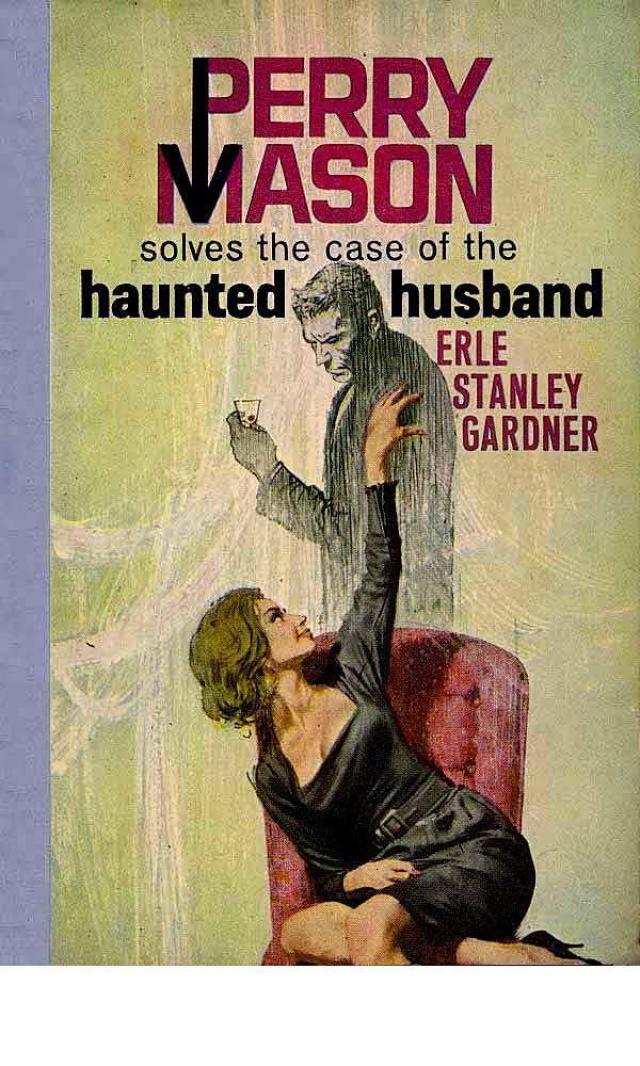
The case of the haunted.., p.12
The Case of the Haunted Husband (Perry Mason Series Book 18),
p.12


"Sustained."
"Did you examine the steering wheel of the car to see whether there were any of lipstick on it?"
"Not then."
"Later?"
"Yes."
"Did you find any?"
"Just a very faint trace of lipstick in one place... You see, if she had been trying to fix her lips at the time of the accident and driving with one hand ..."
"That will do," the judge interrupted sternly. "The court will draw its own conclusions. Simply testify to the facts."
"You looked in the trunk of the car?"
"Yes, of course."
"There was no baggage there?"
"No baggage."
"The ignition on the car was locked?"
The officer lowered his eyes. "I don't know," he said. "It was locked when the car got to the garage. You see, it was moved with a wrecking outfit. There was no reason to start the motor. I looked the car over for liquor and baggage, but I didn't notice the ignition until yesterday when it was called to my attention."
"The ignition was locked?"
"That is right."
"Did you look for fingerprints on the steering wheel of the automobile?"
"No, sir, I didn't. When we see a car go off the road into the ditch and find a person unconscious at the steering wheel with his fingers wrapped around the wheel and no one else in the car, we don't match fingerprints to see who was driving it."
A titter rustled around the courtroom. The judge looked inquiringly at Mason. "You wish a motion to strike out that last statement, Mr. Mason?"
"Oh, let it stay in," Mason said, and turned once more to face the witness.
"Now, the car doors were closed?"
"Yes."
"Both doors?"
"Yes."
"It was rather a cold night, was it not?"
"What is that got to do with it?"
"I am just asking."
"Well, it was cold up there."
"The wind was blowing?"
"Yes."
"And do you know whether the car in which the defendant was seated had a heater?"
"I believe it did. I can remember now... Yes, it did."
"And the heater was on?"
"Yes, the fan was running."
"Now, you say that you lifted the defendant out through the window."
"That is right. The window in the car door."
"On what side?"
"On the right-hand side. The car was lying on its left side."
"I see. And you lifted the defendant through the right window?"
"That is what I said."
"Now, it was impossible for you to lower the glass in the window from the outside, wasn't it?"
"Naturally."
"And you didn't open the door?"
"Not then. I told you we lifted her out through the window. The door was jammed. How many more times do I have to tell you?"
Judge Cortright said sternly, "The witness will confine himself to answering questions. However, counsel should bear in mind that the calendar is crowded with other matters, and this question has been asked and answered in one form or another several different times."
"Exactly," Mason said. "In a moment, I think Your Honor will appreciate the importance of the question. You couldn't roll this window down from the outside of the car, could you, Mr. Corvis?"
"No. I didn't say I rolled the window down. The window was open."
"Rolled all the way down?"
"I ... Yes."
"This car was a four-passenger coupe?"
"Yes."
"There were only two doors?"
"That is right."
"And the windows were rather large – large enough to lift the defendant through?"
"We couldn't have lifted her through," Corvis said, "if they hadn't been big enough to lift her through."
The deputy district attorney let the spectators see his broad grin.
"Then," Mason said, "another person could have made his escape from this car through this window?"
Corvis thought for a moment. "I don't know."
"But if the defendant got through, a man could have crawled through, couldn't he?"
"I don't know."
"That question is argumentative," Hanley said.
Mason smiled. "I shall withdraw it. The facts speak for themselves. Now, Mr. Corvis, you have been a traffic officer for some time?"
"Five years."
"You have had an opportunity to observe quite a bit about the operation of motor cars?"
"Naturally."
"Did you ever," Mason asked, smilingly, "observe a car being operated at night on a mountain road with a cold wind blowing and the window in the door on the right-hand side rolled all the way down – the night being cold enough to necessitate the use of a heater in the car?"
Hanley jumped to his feet. "Your Honor, that is not proper cross-examination. We didn't qualify this man as an expert. It calls for a conclusion of the witness, a matter of opinion, it is argumentative, and ..."
"Objection sustained," Judge Cortright said. "You didn't qualify him. It isn't proper cross-examination."
Mason, having made his point, contented himself with a smile. "That's all."
Corvis left the stand. Other witnesses told of the collision of the four-passenger coupe being operated at a high rate of speed, swerving around a car on a three-lane pavement to find another car already occupying the third lane of the collision of the zigzag course taken by the car. With one exception, none of the witnesses had seen the driver of the car. It had, they explained, happened too quickly.
Edith Lions, however, who had been riding in the car which the four-passenger coupe had tried to pass, told a different story. She was about twenty-two, a red-haired girl with turned-up nose, freckles, and rapid-fire speech. She said, "I was riding with my mother and father in the car. We were sitting three in the front seat. This car was coming along behind us at a terrific rate of speed. All of a sudden it swerved out to pass us, but at that time a car coming from the other direction was passing another car which was also coming toward us."
"What happened?" Hanley asked.
"Just like the other witnesses have said."
"Never mind that. Just tell it in your own words, Miss Lions."
"Well, the person driving the car tried to cut in and scraped our fender. That caused the car to swerve back across the pavement right in front of another car that was coming toward us."
"Then what?"
"Then this other car tried to dodge, and bit a car behind us head-on."
"And what happened to the four-passenger coupe? Could you see?"
"It kept shooting right across the road, and went down the bank. Then I think it rolled over. It sounded like it."
"And what did you do?"
"As soon as my father stopped the car, I jumped out."
"Did you run back toward the cars that had collided?"
"No. I was busy dodging cars for a few minutes. Then I ran over toward the bank where this four-passenger coupe had gone over."
"What did you see?"
"It took me a little while to locate it. Then I looked down and saw the car lying on its side down at the bottom of this steep embankment."
"Did you see anyone – any person?"
"Not then."
"Later on, did you?"
"Yes, sir."
"Who?"
"That woman sitting there," pointing to Stephane Claire.
"Where was she, and how were you able to see her?"
"They turned a flashlight into the car. She was sitting in the driver's seat."
"Now, did you at any time see any other person in the four-passenger coupe?"
"No, sir."
"And could you see who was driving it when the car went past?"
"Yes, sir."
"Who?"
"Well, it was a woman. I could see that, and she was wearing the same kind of a hat the defendant was wearing."
"Cross-examine," Hanley said triumphantly.
"Your father was driving your car?" Mason asked the witness.
"Yes, sir."
"And you were sitting next to your mother?"
"Yes, sir."
"Your mother was in the middle?"
"That's right."
"Then you were on the extreme right-hand side of the car?"
"Yes, sir."
"And this four-passenger coupe passed on your left?"
"Yes."
"And then cut in?"
"Yes."
"It was dark?"
"Naturally."
"And headlights were coming toward you?"
"Yes."
"Did the four-passenger coupe at any time come directly between you and the headlights of an approaching car?"
"How do you mean?"
Mason said, "The court reporter will read the question. Please listen attentively."
The court reporter read the question.
"Do you understand it?" Mason asked.
"Yes."
"Can you answer it?"
"No," she said. "I guess not. There were lots of headlights though. They seemed to be coming from all directions at once."
"How fast was your father driving?"
"Forty miles an hour."
"And how fast was this four-passenger coupe going?"
"At least eighty or ninety miles an hour."
"And when did you first realize there was going to be an accident?"
"When this car sideswiped our fender."
"And as soon as it did that, it immediately swerved to the left?"
"Yes."
"And shot diagonally across the road?"
"Yes."
"Yet with headlights coming at you from several different directions, with your father fighting to keep your car in the road, you, sitting on the extreme right side of the seat, could look across and into the interior of that speeding four-passenger coupe?"
"Yes, sir."
"Your car did skid after the collision, did it not?"
"It was jolted around, yes."
"So that it was headed off toward the right side of the road?"
"Yes."
"And the four-passenger coupe also skidded toward the left?"
"Yes."
"And it was going forty or fifty miles an hour faster than you were?"
"Well ... yes."
"So in order to see the coupe, you had to look across the front seat of your own car?"
"I guess so."
"And because it was going so much faster, you had only a brief glimpse?"
"Yes."
"Your father and mother were both in that front seat, and were both directly in your line of vision, were they not?"
"Well, I sort of craned my neck around."
"You mean so you could see past them?"
"Yes."
"In which direction did you crane your neck? Were you looking forward, in front of your mother and father, or backward?"
"Well, they were moving around quite a bit. Dad was trying to get the car under control, and Mother threw up her bands and screamed, and I guess I sort of looked in between them."
"And at about that time, another car was having a collision with this four-passenger coupe?"
"Yes, sir."
"And you don't think it is possible that your impressions of this brief instant are confused?"
"No, sir. She was driving that car. I saw her."
"Who was?"
"A woman that had a hat just like the one the defendant was wearing when they took her out of the car."
"Was she alone in the car?"
"I ... she was driving."
Mason said, "Can't you do better than that, Miss Lions? If you saw the front seat of that four-passenger coupe clearly enough to see that a woman was at the steering wheel and see the type of hat she was wearing ..."
"I think there was a man in there with her."
"Where was this man seated?"
"Right beside her."
"On her left or right?"
"On her right, of course. If she was at the steering wheel, he couldn't have been on the left," the witness said triumphantly.
"And how was the man dressed?"
"He wasn't wearing any hat."
"And how about the window on the right-hand side of that car-the door window? Was it up or down?"
"It was down. The window was rolled down so the space was open."
"You noticed that?"
"Yes."
"You feel certain this man who was seated beside the defendant had no hat?"
"I don't think he had a hat."
"Wouldn't you see plainly, or can't you remember clearly?"
"Well, I can't remember exactly."
"Then how did it happen you remembered the style and shape of the defendant's hat so clearly?"
"I just did, that's all."
"Yet there was nothing about her to make you notice her head more than the man's head?"
"I couldn't see his head so well."
"Was something in the way – or was it because of the light?"
"The light."
"He was in a shadow?"
"Yes."
"What was casting that shadow?"
"I don't know."
"Now, when the deputy district attorney was asking you questions, didn't you say there was no one in that car except the defendant?"
"Why ... no."
Mason asked, "Will the court reporter please read that question and answer about whether she saw any other person in the car? It was on direct examination," Mason said.
The court reporter thumbed through the pages. "Here is the Question, 'Now, did you at any time see any other person in the four-passenger coupe?' Answer, 'No, sir.'
Mason smiled at her. "Did you say that?"
"Why ... I guess I must have. I hadn't thought about this man until you asked me. Then, when you did, I could remember him. I can see him now sitting there without a hat, a man about middle age – well, maybe thirty."
"How about the cars that were coming toward you? Who was driving them?"
"Well, there was one driven by a man and one driven by a woman."
"You know that because of what someone has told you or because of what you saw?"
"Because I saw them."
"That all took place in a very short time, just a second or so, did it not?"
"I will say so. It was the biggest mix-up you ever saw. One moment we were going along talking about a show, and the next minute we were all mixed up in a mess of smash-ups."
"Yet you saw all these things?" Mason asked.
"That's right."
"That's all," Mason said. "Only don't call thirty as middle age."
"That's our case, Your Honor," Hanley said, as a ripple of laughter in the court subsided.
"May I have a five-minute recess?" Mason asked.
Judge Cortright nodded, motioned to an attorney who had been waiting, and said, "You have something you wanted to take up with me, Mr. Smith?"
Mason leaned across to whisper to Stephane Claire. "I hate to do this to you, but you have got to go on the stand and tell your story."
"Well, why shouldn't I?"
"In the first place," Mason said, "it is poor trial technique. I think that Lions girl has a vivid imagination, and is something of a liar as well, but her testimony will make a case. She probably got so excited at the time she didn't even know what she was doing. Later on, she reconstructed everything in her own mind. She has hypnotized herself. But she is positive and definite. The judge is going to bind you over. Under those circumstances, the wise thing for a lawyer to do is to make the district attorney show his hand – and quit."
"Well, if he is going to bind me over anyway, why not do that?"
"Because," Mason said, "I want to force them to put Homan on the stand. If you tell your story, they won't dare to let it go without some sort of contradiction. They will put Homan on the stand."
Stephane Claire said, "Okay, you are the doctor."
"Don't go into too many details," Mason warned. "Just tell your story in a straightforward manner about how you were picked up by this man, about his drinking, about the accident, and about seeing this man again in the Gateview Hotel."
"You think then they will put Homan on the stand?"
"Yes."
"Will that help us?"
"I hope it will," Mason said. "I have got to solve a murder in order to find out what is back of the association between Homan and Greeley. I have got to find out what Greeley was doing in San Francisco, and if he hadn't gone as far as San Francisco, where he had gone and what he was doing."
"Why?"
"Because Greeley never stole that car. Greeley isn't the sort who would steal a car. If he was using that car, he was using it with Homan's permission and that means Homan is lying in his story about the car having been stolen. Homan sent Greeley on a mission of some sort, and Greeley took Homan's car with Homan's knowledge and consent. The only reason Homan is lying now is because he simply doesn't dare to have the nature of that mission come out."
"And he is willing to sacrifice me in order to keep it from coming out?"
"That's it ... and he saves himself a few thousand dollars as well."
"And you want me to find that key in my purse, just the way ..."
Mason said, "No. I want you to tell it just the way it actually happened, that you found the key in your purse when I asked you about it, there in the hospital."
"And you gave it back to me?"
"Yes."
She said, "Horace Homan, the producer's younger brother, came to see me yesterday. He said he knew I hadn't stolen the car. Seems to be very much – well, interested. He wanted me to go for a moonlight cruise on his brother's yacht and then rang me up and said his brother had changed his mind and wouldn't let him have the yacht."
"Do you like him?"
"Well, he is interesting. He told me about a lot of behind the scenes stuff on Hollywood. He says his brother really doesn't want to see me in any trouble, that if I should be convicted, they would try to get probation for me."
"That is significant. Had he talked that over with his brother?"
"He said his brother was the one who told him. He is a very dynamic young man, isn't he? I can't help contrasting him with Jacks Sterne. Now..."
Judge Cortright finished scribbling his signature across a paper, and looked inquiringly down at Mason. Mason nodded, and the judge said, "Proceed, Mr. Mason."
"I will call the defendant, Stephane Claire," Mason said.
Stephane Claire got to her feet, walked forward, was sworn, and told her story. Hanley gave her only a perfunctory cross-examination, limited for the most part to identification of the body she had been called on to view in the Gateview Hotel as that of the man who had been driving the car.















