

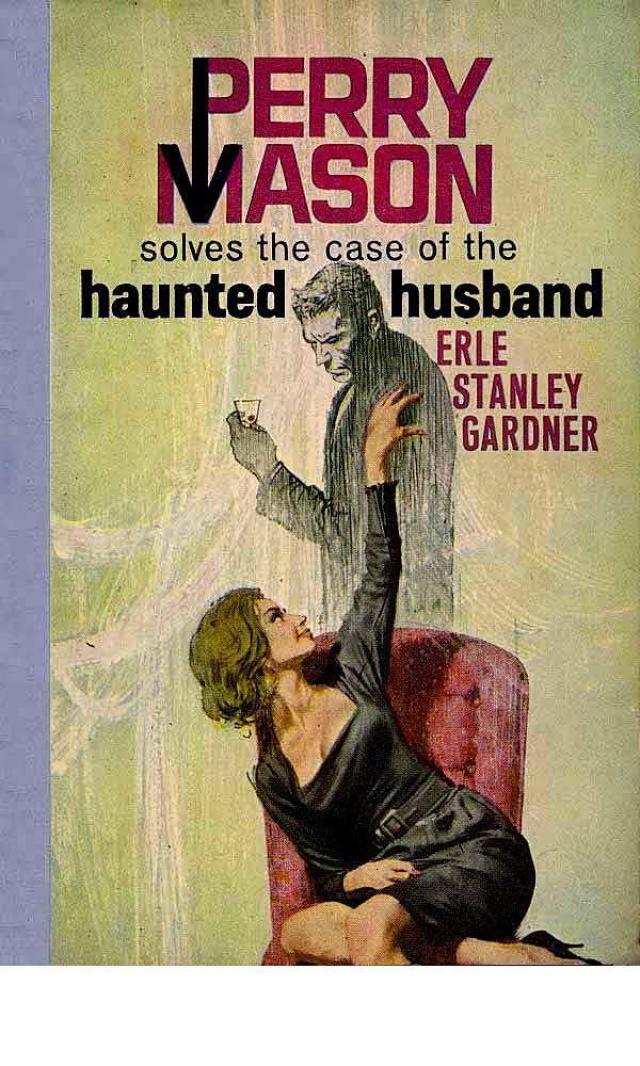
The case of the haunted.., p.13
The Case of the Haunted Husband (Perry Mason Series Book 18),
p.13


"That is our case," Mason said.
Judge Cortright looked at Hanley. "Any rebuttal."
"Yes, Your Honor. I have one witness here in court and one whom I shall have to summon by telephone – man who holds an important position in a Hollywood studio. It will take him a few minutes to get here, but I think this other witness will fill in..."
"Very well, call this witness."
"Mrs. A. P. Greeley," Hanley said.
Mrs. Greeley, attired in black, walked slowly down the aisle of the courtroom, held up a black-gloved hand as she took the oath and settled herself in the witness chair.
"I am going to make this as brief as possible," Hanley said. "Your name is Daphne Greeley. You are the widow of Adler Pace Greeley, a broker?"
"I am."
"On Friday of last week you were called upon by Lieutenant Tragg of the Homicide Squad to identify a body in a room in the Gateview Hotel?"
There was a moment of silence, then Mrs. Greeley said, "Yes," so faintly that the word was all but inaudible.
"And that body was that of your husband?"
"Yes."
"And the same body which Stephane Claire had previously identified as being that of the driver of the car in question?"
"Yes."
"Now, Mrs. Greeley, I want to spare your feelings as much as possible, but it is necessary that I direct your attention to Wednesday, the nineteenth of this month. Do you remember what happened on that day?"
She nodded.
"You will have to speak up, Mrs. Greeley, so that the court reporter can write down your answer. Do you remember the date?"
"Yes."
"Is there anything in particular which fastens it upon your mind?"
"Yes. It was – it was – our wedding anniversary."
"And can you tell us generally what your husband did on that day – as far as you know?"
"Yes. We decided that we would have a quiet day at home. Adler had been very much engrossed in business . . ."
"Now, by Adler, you are referring to your husband, Adler Greeley?"
"Yes."
"And what happened, Mrs. Greeley, on the nineteenth?"
"He said that he wouldn't go to the office at all. Several days before, he told Irma Watkins, his secretary, that he was going to be out of the office that day, and not to
bother him with any matters of business, not to try and reach him, that it was his wedding anniversary, and he was going to forget business."
"And what happened?"
"The same thing which always happens whenever we tried to plan anything. Business intervened, and Adler had to go to San Francisco on the eighteenth. He promised to try and get back on the morning of the nineteenth. Then he phoned he couldn't make it. About noon he phoned again and said he would try to take the four o'clock plane."
"When Mr. Greeley went to San Francisco, what clothes did the take?"
"He threw a few clothes into a suitcase, and jumped in the car and drove off."
"In what car?"
"In his car. He leaves it at the airport. I have my own machine."
"How was he dressed?"
"He was wearing a gray double-breasted suit."
"Any overcoat?"
"There was an overcoat over his arm, but he wasn't wearing it."
"Did he have any evening clothes in that suitcase? That is, did he take his dinner-clothes?"
"As to that I can't say. He packed the suitcase himself, but I don't think he ..."
"The witness will refrain from stating what she thinks," Judge Cortright interrupted.
"Did you have any communication with him after he left?" the deputy district attorney asked.
"Yes, several times. He telephoned and asked me to find some papers for him in his desk."
"But when did you see Mr. Greeley again?"
"He came in Thursday morning, very early in the morning. I don't know just what time it was."
"You say he asked you to find some papers?"
"Yes."
"How?"
"He telephoned me."
"When?"
"About four o'clock."
"From where?"
"From San Francisco."
"How do you know it was from San Francisco?"
"I heard the operator say that San Francisco was calling, and then Adler came on the line, and said he was at San Francisco. He told me to find the papers he wanted and telephone him at a certain number what was in the papers."
"You did that?"
"Yes."
"And telephoned him?"
"That's right."
"How did you telephone him?"
"I said that I wanted to put in a call for the number he had given me."
"You remember what that number was?"
"Unfortunately I don't. I made a note of it at the time on a little pad by the telephone so I could call him back. He didn't tell me where the telephone was located, just the number of it. I have found out since. You told me ..."
"Never mind what anyone told you," Judge Cortright interrupted. "As I understand it, he just gave you a number?"
"That's right."
"Go ahead, Counselor."
"But," Hanley insisted, "you did call long distance, tell the operator you wanted to talk with San Francisco, and give her that San Francisco number."
"That is right."
"And did you reach Mr. Greeley?"
"Almost at once. She told me to hold the line, and the call was put through at once. It was at seventeen minutes past five when he came on the line. We talked two and one-half minutes. I always hold a watch on these long-distance calls."
"Now, did you say you wanted to talk with Mr. Greeley?"
"No. It was just a station-to-station call. He told me to put it in that way."
"Since you have talked with me, you have asked for your long-distance telephone bill?"
"That's right."
"And under the date of the nineteenth, does that call show on your bill?"
"It does."
"And, using that as a reference, you can find out what this number was?"
"Yes."
"And since you have told me about it, have you made any attempt to find out where this number in San Francisco is located?"
"I have."
Hanley said to Mason, "It is a public pay station at the Southern Pacific Depot at Third and Townsend Streets. You can verify it from the telephone company's records."
He turned to Mrs. Greeley.
"Now, Is there any possibility that it was not your husband with whom you talked?"
She smiled. "Absolutely not."
"And this call was put through at approximately five-seventeen o'clock in the afternoon?"
"That is right."
"And when did your husband come home?"
"Sometime after midnight. He told me when I talked with him over the telephone that he would try to catch a night plane. I think he said there was a ten o'clock plane which would get him in shortly after midnight. You see, he had taken his car and left it parked at the airport. ... Oh, I have already told you that."
"You don't know where he had parked his car?" Judge Cortright asked.
"Only from what he told me."
"But you don't know of your own knowledge that the car was at the airport?"
"No, of course not. I didn't go out to look for it, but I do know he was in San Francisco at about four o'clock in the afternoon, and that he was still in San Francisco at quarter past five, because I talked with him on the telephone."
"You heard your husband come in?"
"Oh, yes. He wakened me, but I didn't look at the clock. I don't know just what time it was, but it was... Well, I went to bed at eleven. I hadn't been asleep very long. I would say it was between one and two that he returned."
"Was there anything unusual in his manner or bearing when he returned?"
"No."
"Did you smell liquor on his breath?"
"No."
"Was he wearing a tuxedo when he returned?"
"No."
"Was he injured in any way?"
"No, of course not."
"You may cross-examine," Hanley said to Perry Mason.
"You don't know whether the business which took him to San Francisco was that of Mr. Jules Homan?" Mason asked.
"No. I only know it was something unexpected and important."
"Did the papers which you procured for him have anything to do with Mr. Jules Homan's business?"
"Well… they had to do with Mr. Homan's stock. He wanted me to get the list of Mr. Homan's holdings."
"Did he say why he wanted them?"
"No. He just asked me to get the list and then read off the stocks over the telephone."
"That's all," Mason said.
Hanley looked at his watch. "Your Honor, my next witness is one who . . ."
He turned toward the entrance to the courtroom as a man came bustling in. "Mr. Homan, will you please come forward and take the stand?"
Homan carried an alligator-skin brief case in his right hand, and walked with the quick, nervous strides of a man who is in very much of a hurry. He seemed breathless with haste. His name, he stated to the reporter, was Jules Carne Homan. His residence was in Beverly Hills, and his occupation was that of producer of motion pictures. He adjusted his glasses and frowned down at the deputy district attorney, as much as to say, "Well, well, come on. Let us get it over with."
Hanley said, "Mr. Homan, you are the owner of a certain Buick four-passenger coupe, license number 8V7243, and were such owner on the nineteenth of this month?"
"Yes, sir. That is right."
"Do you know where your automobile was on the evening of the nineteenth?"
"It was involved in a traffic accident on the Ridge Route."
"Were you driving that automobile?"
"No, sir."
"Do you know who was?"
"No, sir."
"Was anyone driving it with your permission, express or implied?"
"No, sir."
"When had you last seen the automobile prior to the time of the collision, Mr. Homan?"
"I don't know about the time of the collision – not of my own knowledge."
"Well, let's put it this way. When did you last see that automobile on the nineteenth of the month?"
"The last I saw of it was about noon on the nineteenth. I ..."
"Where?"
"In front of my house on Maple Grove Street in Beverly Hills."
"Can you fix the time exactly?"
"It was shortly before noon. I don't know the exact time."
"And when did you next see it?"
"On the morning of the twentieth when I was asked to identify it."
"Do you know – or did you know in his lifetime – a broker named Adler Greeley?"
"Yes, sir. Adler Pace Greeley."
"Had you any business dealings with him?"
"He had handled a few transactions for me – stocks and bonds."
"Had you seen Mr. Greeley on the nineteenth?"
"No, sir."
"And had you given him any permission to use your car?"
"No, sir. Certainly not."
"Where is your residence on Maple Grove, Mr. Homan?"
"Twenty-five-nineteen."
"Can you describe that residence – just tell us exactly what it is?"
"It's a Spanish-type house with patio, swimming pool, and the things that go with it. I'm a bachelor. I do much of my work at home. I have this house so that when I wish to get away from the studio and avoid all interruptions, I can work there. I also do quite a bit of entertaining."
"That is what I was getting at. This is a large house?"
"It is, and it isn't. The rooms are rather large. The place is well designed. It's not – well, not what you would call a poor man's house."
"That's the point, Mr. Homan. It's a house which requires a large staff of servants?"
"No, sir, it does not. I have a woman who comes in and does cleaning by the day. I have a combination chauffeur and general handyman who takes care of my wants. I have a Filipino houseboy who mixes drinks, does odd jobs, and keeps the place straight. The woman who does the cleaning comes in twice a week. When I am entertaining, I arrange with a caterer to take charge of everything."
"But I understand, Mr. Homan, that on the nineteenth, you were alone in your house."
"That is right."
"Can you explain how that happened?"
"I was working. I didn't want to be disturbed. I shut myself in my study. When I work, I settle down to work. I concentrate on it. I don't want anything else to disturb me. I don't even eat at regular hours. I work until I realize there's something wrong, then I stop and take stock. Usually I find I am either hungry or tired or both. I shall get something to eat, perhaps snatch a few minutes' sleep, and go back to work. I keep an electric coffee percolator on my desk when I am working and drink hot coffee at frequent intervals."
"But I would like to know specifically about the nineteenth, Mr. Homan. You see, the claim has been made that Mr. Greeley was driving your car at the time of the accident."
"Preposterous."
"Never mind that, Mr. Homan. I have covered Mr. Greeley's movements on that day to place him in San Francisco at five-fifteen in the evening. Now I want to show that your car couldn't have ..."
Mason said, "This conference between counsel and witness is rather unusual, Your Honor."
Hanley said, "I am merely trying to save time."
"No objection," Mason announced. "I only wanted to suggest you proceed in the regular manner."
Hanley said, "Mr. Homan, will you tell us just what you were doing on the nineteenth and where your car was on that day – or over such an interval of time as you know where it was?"
"I was working on a very important production. I didn't want to be disturbed. I had been working on that script almost uninterruptedly for forty-eight hours."
"At your studio or at your residence?"
"At both places. I left the studio on the afternoon of the eighteenth. I came to my house, told both the Filipino and my chauffeur to take time off, that I wanted to be completely and absolutely undisturbed. I locked myself in and went to work."
"And stayed at your bungalow?"
"No, sir. I went out for dinner about midnight on the evening of the eighteenth, and worked until about four o'clock in the morning, then I slept until seven o'clock, got up, took a shower, shaved, had coffee, and went to work. About eleven I drove to a restaurant where I had something to eat. Then I returned and went to work. It was then a little before noon."
"Did you have occasion to look for your automobile?..."
"Objected to as incompetent, irrelevant, and immaterial," Mason said. "It makes no difference as far as the issues in this case are concerned, and it may be an attempt to prejudice the defendant by proving another crime."
"I will stipulate that the purpose of the testimony will be limited solely for the purpose of showing the whereabouts of the car," Hanley said.
"On the strength of that stipulation, I will permit the question to be answered," Judge Cortright ruled.
"Answer the question."
"Yes, sir. About four o'clock in the afternoon I wanted to take a short drive to get some air. I had been working straight through and suddenly realized I was fatigued. I went out to get my car and drive up around Mulholland, Drive. My car was gone."
"And what did you do with reference to trying to locate your car?"
"Objected to as incompetent, irrelevant, and immaterial," Mason said.
"Objection sustained."
"I think you may inquire," Hanley said with a little nod to Mason.
Homan got up and started to leave the stand.
"Just a minute," Judge Cortright said.
"Aren't you finished with me?"
"Mr. Mason has the right to cross-examine."
"Oh," Homan said and turned inpatient eyes toward Mason.
"Just a few questions," Mason said, "in regard to the nature of your work, Mr. Homan. When you are concentrating, I take it that you are very irritated at interruptions."
"Very."
"You answer the telephone?"
"No. I disconnect it."
"How?"
"I have a little switch at the telephone. It was especially installed to cover my needs."
"You do, however, occasionally put through a call?"
"Very, very occasionally. The nature of my work is something that the ordinary man can hardly appreciate. It represents the very essence of concentration," and Homan glanced up at the judge.
"Now you can't recall any single instance, any isolated facts which would account for Mr. Greeley taking your car."
"Absolutely not. I am satisfied Mr. Greeley did not take my car."
"And during this period that you were concentrating, can you recall having made any telephone calls?"
"No, sir. I made none."
"Now," Mason asked casually, "what was your business with L. C. Spinney in San Francisco?"
Homan stared at him.
"Can't you answer the question?" Mason asked.
"I don't understand it. I haven't any business with Mr. – what was the name?"
"Spinney, L. C. Spinney."
"I haven't any business with Mr. Spinney in San Francisco. I have never heard of the man. I remember now, you mentioned his name to me once before."
"You didn't call him on long distance on Tuesday and again on Wednesday?"
"Certainly not."
"And he didn't call you?"
"No."
Mason said, "Now, Mr. Homan, this may be exceedingly important. Please bear in mind that the records of the telephone company can be consulted and ..."
Homan snapped his fingers, the quick gesture of a nervous man who has an idea pop into his head.
"What is it?" Mason asked.
Homan said, "Mr. Mason, I don't know what you're getting at, but I can tell you this. If you can show that any long-distance call went over my telephone on either Tuesday or Wednesday, you'll be doing me a great favour, a very great favour indeed."
"Why, may I ask?" Mason said.
Homan cleared his throat, shook his head, said, "I would prefer to tell you privately, Mr. Mason."















