Into the darkness d 1, p.28
Into the Darkness d-1,
p.28
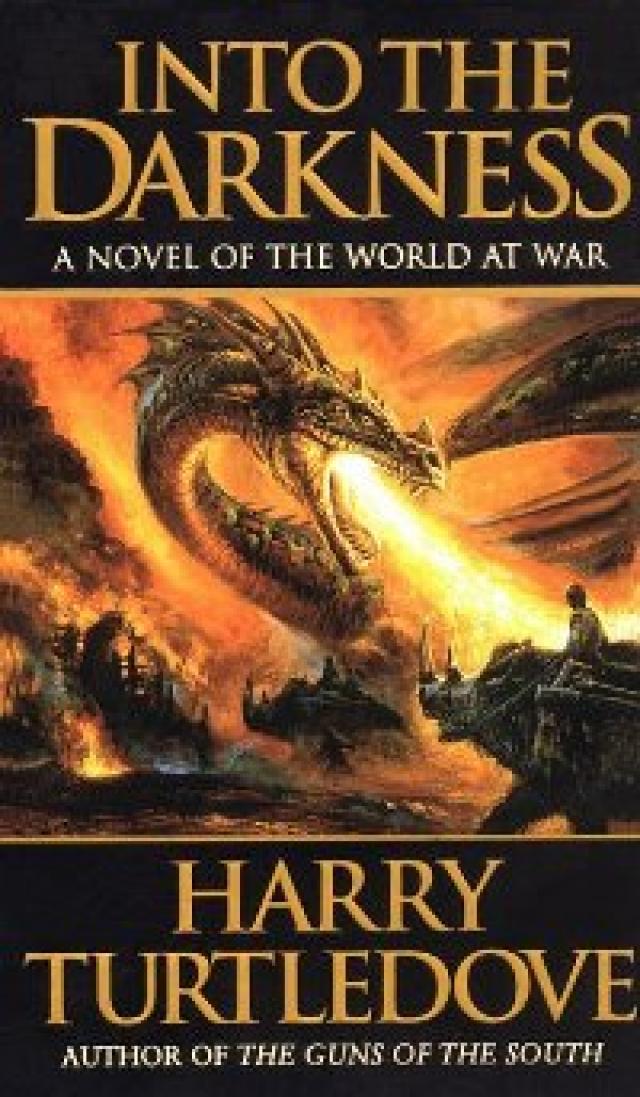


Not that even magecraft could annul what had already happened. As Eforiel drew Cornelu ever nearer the harbor of Facaceni, he saw for himself that King Mezentio’s men were there before him. Sailing ships had emptied soldiers out on to the quays, as they had at Tirgoviste—as they had, probably, at every Sibian port.
And, just as Cornelu had guessed, the rest of the Algarvian navy had followed the invasion fleet south. Algarvian and Sibian ships were tossing eggs at each other outside the harbor, and blazing with powerful sticks. Every time a beam went low, a great cloud of steam rose from the ocean.
Eforiel shuddered beneath Cornelu. She paid no attention to the beams, but eggs bursting in the water frightened her. She had reason to fear, too; a burst too near might kill her. Cornelu dared approach Facaceni no closer.
A puff of steam rising only a couple of hundred yards away warned that he might already have come too close. It came not from a stick but from another leviathan spouting. A moment later, leviathan and rider broke the surface. “Who are you?” the rider called to Cornelu.
Was he speaking Algarvian or Sibian? With only three words to go on, Cornelu had trouble being sure. “Who are you?” he called back. “Give me the signal.” He did not know what the signal was, but hoped to learn more by the way the other leviathan rider responded.
Learn he did, for the fellow said, “Mezentio!”
“Mezentio!” Cornelu answered, as if he too were an Algarvian, and delighted to find another one in this part of the world. But, while his mouth spoke the name with every sign of gladness, his hand delivered a different message to Eforiel: attack!
The leviathan’s muscles surged smoothly beneath him as she arrowed through the water toward the other rider and his mount. Calling Mezentio’s name must have lulled the Algarvian, for he let Cornelu and Eforiel approach without taking any precautions against them.
He learned his mistake too late. Eforiel’s pointed snout rammed his leviathan’s side, not far behind the creature’s left flipper. The impact almost pitched Cornelu off Eforiel’s back, though he was as well strapped and braced as he could have been. The Algarvian leviathan twisted and jerked in startled agony, much as a man might have done if unexpectedly hit in the pit of the stomach.
After delivering that first blow with her jaws closed, Eforiel opened them and bit the other leviathan several times. Blood turned seawater crimson. Cornelu laughed to see the Algarvian rider splashing in the ocean, separated from his mount. Eforiel did the Algarvian no harm. She had not been trained to hunt men in the water—too much likelihood of her turning on her own rider, should some mischance have separated the two of them.
Had circumstances differed, Cornelu might have captured the other rider. But he doubted he had any place on Sibiu to which he could bring the Algarvian for interrogation. And he spied other spouts not far away. He had to assume they came from Algarvian leviathans.
When he ordered Eforiel to break off the attack, he thought for a moment she would refuse to obey him. But training triumphed over instinct. She allowed the leviathan she’d wounded to flee into the depths of the sea. Cornelu did not think a Sibian-trained animal would have abandoned its rider like that—but the Algarvians, as he’d seen to his sorrow, had tricks of their own up their sleeves.
And they had these leviathans. “Mezentio!” their riders called, hurrying toward the commotion at least one of them had spotted.
Cornelu did not think he could fool them as he had the first Algarvian he’d encountered; few tricks worked twice. Nor, being outnumbered, was he ashamed to flee. He hoped to escape them and then go on looking for Sibians still resisting the invaders.
In war, though, what one hopes and what one gets are often far removed from each other. The Algarvians pursuing Eforiel were better riders than most of their countrymen, and mounted on sturdier leviathans. They chased Cornelu far to the south of Facaceni, and seemed intent on driving him from Sibian waters altogether.
To make matters worse, a dragon flew high over Eforiel, helping the Algarvians and their leviathans keep track of her. The dragonflier was sure to be speaking into a crystal. If one of the riders was likewise equipped… If that was so, the Algarvians had devoted a great deal of effort to tying their forces together in ways no one had thought of before.
Another dragon came flapping up behind the first. This one carried a couple of eggs slung under its belly, and did its best to drop them on Eforiel. The flier’s aim, though, was not so good as it might have been. Both eggs fell well short of their intended target; one, in fact, came closer to hitting the Algarvian leviathan riders than it did to Cornelu.
He hoped that would make the enemy lose him, but it didn’t. Cursing the Algarvians, he kept Eforiel headed southeast, the only direction in which they permitted him to travel. He shook his fist at them. “Force me to Lagoas, will you?” he shouted.
Lagoas was neutral. If he came ashore there, he would be interned, and out of the fighting till the war was over: a better fate than surrendering, but not much. He cursed the Lagoans even more bitterly than he did the Algarvians. In the Six Years’ War, Lagoas had fought alongside Sibiu, but this time around her merchants had loved their profits too well to feel like shedding any blood.
And then, as if thinking of Lagoans had conjured them up, a patrol boat came speeding along a. ley line from out of the south. He could have escaped it. The ocean was wide, and the ship could not leave the line of energy from which it drew its power. But, if he was going to be interned, sooner struck him as being as good as later. This way, as opposed to his coming ashore on their soil, the Lagoans might heed his wishes about Eforiel. And so he waved and had the leviathan rear in the water and generally made himself as conspicuous as he could.
The Algarvian leviathan riders turned and headed back toward Sibiu. Cornelu shook his fist at them again, then waited for the Lagoan warship to approach. “Who might you be?” an officer called from the deck in what might have been intended for either Sibian or Algarvian.
Cornelu gave his name, his rank, and his kingdom. To his surprise, the Lagoans burst into cheers. “Well met, friend!” several of them said.
“Friend?” he echoed in surprise.
“Friend, aye,” the officer answered in his accented Sibian. “Lagoas wars with Algarve now. Had you no heard? When Mezentio your country invaded, King Vitor declares war. We all friends together now, aye?”
“Aye,” Cornelu said wearily.
Skarnu stood up before his company and said the words that had to be said: “Men, the redheads have gone and invaded Sibiu. You’ll have heard that already, I suppose.” He waited for nods, and got them. “You ask me,” he went on, “they were fools. Lagoas is a bigger danger to them than Sibiu ever could have been. But if the Algarvians weren’t fools, they wouldn’t be Algarvians, eh?”
He got more nods, and even a couple of smiles. He would have been gladder of those smiles had they come from the best soldiers in the company, not the happy-go-lucky handful who in the morning refused to worry about the afternoon, let alone tomorrow.
“We can’t swim over to Sibiu to help the islanders,” he said, “so we have to do the next best thing. King Mezentio must have pulled a lot of his soldiers out of the line here when he invaded Sibiu. That means there won’t be enough men left in the redheads’ works to hold us back when we hit them. We are going to break through, and we are going to go rampaging right into the Algarvian rear.”
Some of the men who’d smiled before clapped their hands and cheered. So did a few others—youngsters, mostly. Most of the soldiers just stood silently. Skarnu had studied the Algarvian fortifications himself, studied them till he knew the ones in front of him like the lines on his palm. As long as they held any men at all, they would be hard to break through. He knew it. Most of the men knew it, too. But he had his orders about what to tell them.
He also had his pride. He said, “Remember, men, you won’t be going anywhere I haven’t gone myself, because I’ll be out in front of you every step of the way. We’ll do all we can for our king and kingdom.” He raised his voice to a shout: “King Gainibu and victory!”
“King Gainibu!” the men echoed. “Victory!” They cheered enthusiastically. Why not? Cheering cost them nothing and exposed them to no danger.
Seeing that Skarnu had finished, Sergeant Raunu strode out in front of the company. He glanced at Skarnu for permission to speak. Skarnu nodded. The company would have got on fine without him, but he couldn’t have run it without Raunu. The veteran underofficer affected not to know that. Skarnu understood perfectly well that the pose was an affectation. He wondered how many company officers really believed their sergeants thought them indispensable. Too many, odds were.
Raunu said, “Boys, we’re lucky. You know it, and I know it. A lot of officers would send us forward but stay in a hole themselves. If we won, they’d take the credit. If we lost, we’d get the blame—only we’d be dead and they’d try again with another company. The captain’s not like that. We’ve all seen as much. Let’s give him a cheer now, and let’s fight like madmen for him tomorrow.”
“Captain Skarnu!” the men shouted. Skarnu waved to them, feeling foolish. He was used to accepting the deference of commoners because of his blood. Like his sister Krasta, he’d taken it for granted. The deference he got here in the field was different. He’d earned it. It made him proud and embarrassed at the same time.
“Whatever we can do, sir, we’ll do tomorrow,” Raunu said.
“I’m sure of it,” Skarnu said. That was a polite commonplace. He started to add something to it, then stopped. Sometimes Raunu, if given the chance to talk, came out with things he wouldn’t have otherwise, things an officer would have had trouble learning any other way.
This proved to be one of those times. “Do you really think we’ll break the Algarvian line tomorrow, sir?” the sergeant said.
“We’ve been ordered to do it,” Skarnu said. “I hope we can do it.” He went no further than that.
“Mm.” Raunu’s wrinkles refolded themselves into an expression less forbidding than the one he usually wore. “Sir, I hope we can do it, too. But if there’s not much chance… Sir, I saw a lot of officers with a lot of courage get themselves killed for nothing during the Six Years’ War. It’d be a shame if that happened to you before you figured out what was what.”
“I see.” Skarnu nodded brightly. “After I figure out what’s what, it will be all right for me to get myself killed for nothing.”
“No, sir.” Raunu shook his head. “After you know what’s what, you’ll know better than to go rushing ahead and get yourself killed for nothing.”
Skarnu quoted doctrine: “The only way to make an attack succeed is to go into it confident of success.”
“Aye, sir.” Raunu frowned again. “The only trouble is, sometimes that doesn’t help, either.”
Skarnu shrugged. Raunu looked at him, shook his head, and walked off. Skarnu understood what the veteran was trying to tell him. Understanding didn’t matter. He had his orders. His company would break through the Algarvian line ahead or die trying.
All through the night, egg-tossers hurled destruction at the Algarvian positions. Dragons flew overhead, dropping more eggs on the redheads. Skarnu had mixed feelings about all that. On the one hand, slain enemy soldiers and wrecked enemy works would make the attack easier. On the other, the Valmierans couldn’t have done a better job of announcing where that attack would go in if they’d hung out a sign.
The Algarvians made little reply to the eggs raining down. Maybe they’re all dead, Skarnu thought hopefully. He couldn’t make himself believe it, try as he would.
He led his men to the ends of the approach trenches they’d dug over the previous couple of days. That new digging might also have warned the Algarvians an attack was coming. But Skarnu and his men would not have to cross so much open ground to close with the enemy when the assault began, and so he reluctantly decided it was likely to be worthwhile.
“This is how we did it in the Six Years’ War,” Raunu said as the soldiers huddled in the trenches, waiting for the whistles that would order them forward. “We licked the redheads then, so we know we can do it again, right?”
Some of the youngsters under Skarnu’s command grinned and nodded at the veteran sergeant. They were too young to know about the gruesome casualties Valmiera had endured in that victory. Raunu deliberately didn’t mention those. The men hadn’t suffered badly in this war, not yet, not least because their leaders did remember the slaughters of the Six Years’ War and had avoided repeating them. Now the risk seemed acceptable … to men who weren’t facing it themselves.
Off in the west, behind Skarnu, the sky went from black to gray to pink. Peering over the dirt heaped up in front of the approach trenches, he saw the enemy’s field fortifications had taken a fearful battering. He dared hope that no Algarvian position during the Six Years’ War had been so thoroughly smashed up.
He said as much to Raunu, who also stuck his head up to examine the ground ahead. The sergeant answered, “Just where it looks like there couldn’t be even one of the bastards left alive, that’s where you’ll find whole caravans full of’em, and they’ll all be doing their best to blaze you down.”
Raunu had been loud and enthusiastic while heartening the common soldiers in the company. He spoke quietly to his superior, not wanting to dilute the effect he’d had on the men.
More eggs and still more eggs fell on the Algarvian entrenchments and forts. And then, without warning, they stopped falling. Skarnu pulled a brass whistle from his trouser pocket and blew a long, echoing blast, one of hundreds ringing out along several miles of battle line. “For Valmiera!” he cried. “For King Gainibu!” He scrambled out of the approach trench and trotted toward the Algarvians’ works.
“Valmiera!” his men shouted, and followed him out into the open. “Gainibu!” He looked to either side. Thousands of Valmierans, thousands upon thousands, stormed west. It was a sight to make any soldier proud of his countrymen.
Only a few hundred more yards, Skarnu thought. Then we’ll be in among the redheads, and then they’ll be ours. But already flashes ahead warned that some Algarvians had survived the pounding the Valmierans had given them. More and more enemy soldiers began blazing at Skarnu and his comrades. Men started falling, some without a sound, others shrieking as they were wounded.
The Algarvians had endured all the eggs the Valmierans tossed at them without responding—till this moment, when the men attacking them were most vulnerable. And now they rained eggs down on the Valmierans. Skarnu found himself on the ground without any clear memory of how he’d got there. One moment, he’d been upright. The next—
He scrambled to his feet. His trousers were torn. His tunic was out at the elbow. He wasn’t bleeding, or didn’t think he was. Lucky, he thought.
He waved to show his men he was all right, arid looked back over his shoulder to see how they were doing. Even as he did so, a couple of them went down. They hadn’t come very far—surely not halfway—but he’d lost a lot of them. If he kept losing them at that rate, he wouldn’t have any men left by the time he got to the forwardmost Algarvian trenches. He probably wouldn’t live to get to those trenches himself, an unpleasant afterthought to have.
The headlong charge was simply too expensive to be borne. “By squads!” he shouted. “Blaze and move by squads!”
Half his men—half the men he had left—dove into such cover as they could find—mostly the holes burst eggs had dug in the ground. The rest raced by them. Then they flattened out and blazed at the Algarvians while the others rose and dashed past. Little by little, they worked their way toward the trenches from which the redheads were blazing at them.
Skarnu took shelter in a hole himself, waiting for his next chance to advance. He looked around, hoping the order he’d had to give hadn’t slowed his company too badly. What he saw left him wide-eyed with dismay. As many Valmierans were running back toward their own lines as were still going forward against the enemy. Of the ones still advancing, most paid no attention to tactics that might have cut their losses. They kept moving up till they went down. When they could bear no more, they broke and fled.
“You see, sir?” Raunu shouted from a hole not far away. “This is how I feared it would be.”
“What can we do?” Skarnu asked.
“We aren’t going to break through their lines,” Raunu answered. “We aren’t even going to get into their lines—or if we do, we won’t come out again. Best we can do now is hang tight here, hurt ’em a bit, and get back to where we started from after nightfall. If you order me forward, though, sir, I’ll go.”
“No,” Skarnu said. “What point to that but getting us killed to no purpose?” He assumed that, if he ordered Raunu forward, he would have to try to advance, too. “This is what you warned me about before the attack began, isn’t it?”
“Aye, sir. Good to see you can recognize it,” Raunu said. “I only wish our commanders could.” Skarnu started to reproach the sergeant for speaking too freely. He stopped with the words unspoken. How could Raunu have spoken too freely when all he did was tell the truth?
Leofsig still retained the tin mess kit he’d been issued when mustered into King Penda’s levy. As captives went, that made him relatively lucky. Forthwegian soldiers who’d lost their kits had to make do with bowls that held less. The Algarvians might have issued their own kits to men who lacked them, but that didn’t seem to have entered their minds.
What had crossed their minds was carefully counting the captives in each barracks in the encampment before those captives got anything in their mess kits or bowls. Leofsig would not have bet that the Algarvian guards could count to ten, even using their fingers. The endless recounts to which the captives had to submit argued against it, at any rate.
Every so often, a captive or two really did turn up missing. That meant the redheads tore the encampment apart till they found out how the men had disappeared. It also meant a week of half rations for the escapees’ barracksmates. No one got fat on full rations. Half rations were slow starvation. Half rations were also an argument for betraying anyone thinking of getting away.