Into the darkness d 1, p.9
Into the Darkness d-1,
p.9


The old woman nodded. “That appears to be enough to have left you a profoundly cynical man.”
“Thank you,” he said. She laughed out loud. For the life of him, he couldn’t figure out why.
With the dawn, Talsu peered down from the Bratanu Mountains into Algarve. Smoke rose from the burning town of Tricarico. He smiled. His officers had assured him that Jelgava was doing far more damage to Algarve than the cowardly Algarvian air pirates were inflicting on his own kingdom.
His officers had also assured him that soon, very soon, Jelgava’s ever-victorious forces would sweep out of the mountains and across the plains of Algarve. The Jelgavan army had visited fire and devastation on those plains in the last months of the Six Years’ War. He saw no reason why Jelgava should not do the same thing again.
He saw no reason why Jelgava should not already have done it again, in fact. All of Algarve’s neighbors hated her. All of them that mattered were at “war against her. They were many. She was one, and beset from east and west and south. Why, then, were his countrymen not yet out of the mountains and racing to join hands with the Forthwegians? He scratched at his almost invisibly pale mustache, which he wore close-trimmed, not in any wild Algarvian style. It was a puzzlement.
A delicious smell distracted him. Turning his head, he saw Colonel Dzirnavu’s servant carrying a covered silver tray toward the regimental commander’s tent. “Ha, Vartu, what have you got there?” he asked.
“His lordship’s breakfast—what else?” the servant answered.
Talsu made an exasperated noise. “I didn’t think it was the chamber pot,” he said. “What I meant was, what will the illustrious count enjoy for his breakfast?”
“Not much, if I’m any judge,” Vartu said, rolling his eyes. “But if you mean, What is he having for breakfast?—I’ve got fresh-baked blueberry tarts here, and poached eggs and bacon on toasted bread with butter sauce poured over them, and some nice ripe cheese, and a muskmelon from by the seashore. And in the pot—not a chamber pot, mind you—is tea flavored with bergamot leaves.”
“Stop!” Talsu held up a hand. “You’re breaking my heart.” His belly rumbled. “You’re breaking my stomach, too,” he added.
“See what you miss because the blood in your veins isn’t blue enough?” Vartu said. “Red blood’s good enough to spill for our dear Jelgava, so it is, but it won’t get you a breakfast like this at the front, no indeed. And now I’ve got to get moving. If the hot stuff gets cold or the cold stuff warms up, the other thing his lordship will bite off is my head.”
Neither soldier had spoken loudly; the colonel’s tent lay only fifteen or twenty feet away. Vartu ducked inside. “Curse you, what took you so long?” Dzirnavu shouted. “Are you trying to starve me to death?”
“I humbly crave pardon, your lordship,” Vartu answered, abject as a servant had to be in the face of a noble’s wrath. Talsu jammed his own face against the brownish green sleeve of his uniform tunic so no one would hear him giggle. Dzirnavu was as round as a kickball. He looked as if he’d take years without food to starve to death.
With the regimental commander’s breakfast attended to, the cooks could get around to feeding the rest of the soldiers. Talsu lined up with the other men in tunics and trousers of the same horse-dung color as his. When he finally got up to the kettles, he held out a tin plate and a wooden cup. One bored-looking cook plopped a ladleful of barley mush and a length of grayish sausage on the plate. Another poured sour beer into the cup.
“My favorites,” Talsu said: “dead man’s cock and what he pissed through it.”
“Listen to the funny man,” said one of the cooks, who’d probably heard the stale joke two or three times already. “Get out of here, funny man, before you end up wearing this pot.”
“Your sweetheart’s the one who knows about dead man’s cock,” the other cook put in.
“Your wife, you mean.” Laughing, Talsu sat down on a rock, took the knife from his belt, and cut off a bite-sized chunk of sausage. It was greasy, and would have been flavorless except that it was heading toward stale. Along with the porridge, it filled his belly. That was the most he would say for it. He wondered if Colonel Dzirnavu had ever tasted what his men ate. He doubted it. If Dzirnavu tasted sausage like that, the Algarvians in Tricarico would hear him screaming.
Presently, the regimental commander deigned to emerge from the tent. With green-brown tunic and trousers stretched tight to cover his globular frame, with bejeweled medallions of nobility glittering on his chest, with rank badges shining from his shoulder straps, he resembled nothing so much as a heroic coconut. “My men!” he said, and the sagging flesh under his chin wobbled. “My men, you have not advanced far enough or fast enough to satisfy our most magnificent sovereign, his Radiant Splendor, King Donalitu V. Press ahead more bravely henceforward, that he may be more pleased with you.”
One of Talsu’s friends, a tall, skinny chap named Smilsu, murmured, “You don’t suppose it’s ever crossed the king’s mind that one of the reasons we haven’t gone farther and faster is that we’ve got Colonel Dzirnavu commanding, do you?”
“He’s Count Dzirnavu, too, so what can you do?” Talsu answered. “The only thing that would happen if we moved fast against the Algarvians is that we’d leave him behind.” He paused for a moment. “Might be the best thing that could happen to the regiment.”
Smilsu snickered, hard enough to draw a glare from a sergeant. Talsu loathed sergeants and pitied them at the same time. They made themselves as hateful as possible to the men of their own estate under them, knowing all the while that the officers above them despised them for their low birth, and that, however heroically they might serve, they could not hope to become officers themselves.
Colonel Dzirnavu, perhaps exhausted at having addressed his soldiers, retreated behind canvas once more. Smilsu said, “You notice the king is displeased with us, not even with us and the colonel?”
“So it goes,” Talsu said resignedly. “When we win the war, though, he’ll be pleased with the colonel and then, if he happens to recollect, with us, too.”
From inside the tent, Dzirnavu let out a bellow. Vartu hurried in to see what his master required. Then he hurried out again. When he returned, he was carrying a small, square bottle of dark green glass.
“What have you got there?” Talsu asked. He knew the answer, but wanted to see what Dzirnavu’s servant would say.
Sure enough, Vartu had a word for it: “Restorative.”
Talsu laughed. “Make sure he’s good and restored, then. If he’s back here snoring while the rest of us fight the Algarvians up ahead, we’ll all be better off.”
“No, no, no.” Smilsu shook his head. “Just restore him enough to get him fighting mad, Vartu. I want to see him go charging between the rocks, straight at the Algarvians. They’ll run like rabbits—like little fluffy bunnies they’ll run. They won’t have figured we’d be able to bring a behemoth through the mountains.”
Vartu snickered. He almost dropped the dark green bottle, and had to make a desperate lunge for it. Fortunately for him, he caught it. Unfortunately for him, Colonel Dzirnavu chose that moment to bellow again: “Confound it, Vartu, you worthless turd, what are you doing out there, fiddling with yourself?”
“If you were fiddling with yourself, you’d be having more- fun than you are now,” Talsu told the servant. With a sigh, Vartu went off to deliver the therapeutic dose to his master.
“If he liked the illustrious count better, we couldn’t talk to him the way we do,” Smilsu said.
“If he liked the illustrious count better, we’d probably like the illustrious count better, too, and we wouldn’t have to talk to him the way we do,” Talsu said.
His friend chewed on that, then slowly nodded. “Some nobles do make good officers,” Smilsu admitted. “If they didn’t, we never would have won the Six Years’ War, I don’t suppose.”
“I don’t know about that,” Talsu said. “I don’t know about that at all. The Algarvians have noble officers, too.”
“Heh.” Smilsu shook a fist at Talsu. “Now look what you’ve gone and done, you lousy traitor.”
“What are you talking about?” Talsu demanded.
“You’ve made me feel sorry for the stinking enemy, that’s what.” Smilsu paused, as if considering. “Not too sorry to blaze away at him and put him out of his misery, I guess. Maybe I won’t have to report you after all.”
Talsu started to say it would be softer back of the front than at it, but held his tongue. The dungeon cell waiting for anyone reported as a traitor would make the front feel like a palace. Worse things would happen to a traitor back there than to a soldier at the front, too.
By midafternoon, the regiment had taken possession of a little valley, in which nestled a village whose Algarvian inhabitants had fled, taking their sheep and goats and mules with them. Colonel Dzirnavu promptly established himself in the largest and most impressive house there.
His men, meanwhile, fanned out through the valley to make sure the Algarvians had not yielded it to set up an ambush. Talsu looked up at the higher ground to either side of the valley. “Hope they haven’t got an egg-tosser or two stashed away up there,” he remarked. “That sort of thing could ruin a night’s sleep.”
“That’s not in our orders,” one of his comrades said.
“Getting myself killed for no good reason isn’t in my orders, either,” Talsu retorted.
In the end, a couple of platoons did sweep the mountainside. Talsu made sure he got part of that duty, thinking, If you want something done right, do it yourself. But he soon discovered even the whole regiment couldn’t have done the job right, not without working on it for a week. Near the valley floor, the mountainsides were covered with scrubby bushes. He might have walked past an Algarvian company and never known it. Farther up, tumbled rocks offered concealment almost equally good. The sweep found no one, but none of the Jelgavans—save possibly their captain, a pompous marquis—had any illusions about what that proved.
When Talsu got back to the village, he set out his bedroll as far from the handful of buildings as he could. He noted that Smilsu was doing the same thing not far away. The two men shared a wry look, shook their heads, and went on about the business of getting ready for the night.
Talsu woke up at every small noise, grabbing for his stick. No soldier who wanted to live to get old could afford to be a heavy sleeper. But he did not wake for the egg flying past till it slammed into the farming village. Three more followed in quick succession: not big, heavy, immensely potent ones, but the sort a crew might hurl with a light tosser a couple of men could break out and carry in and out with them on their backs.
They knocked down three houses and set several others afire. Talsu and his company went out into the fields to keep the Algarvians from getting close enough to blaze at their comrades, who labored to rescue the men trapped in the building the egg had wrecked. Looking back, Talsu saw the house Colonel Dzirnavu had taken as his own now burning merrily. He wondered whether or not he should hope the illustrious colonel had escaped.
Leofsig trudged east along a dirt road in northern Algarve, in the direction of the town of Gozzo. That was what his officers said, at any rate, and he was willing to take their word for it. The countryside looked much as it did back in Forthweg: ripening wheatfields, groves of almonds and olives and oranges and limes, villages full of houses built from whitewashed sun-dried brick with red tile roofs.
But the stench of war was in his nostrils, as it had not been around Gromheort. Smoke blew in little thin wisps, like dying fog: some of the wheatfields behind him were no longer worth admiring. And dead horses and cows and unicorns lay bloating by the roadside and scattered through the fields, adding their sickly-sweet reek to the sour sharpness of the smoke. Forthwegians and Algarvians lay bloating in the fields and by the roadside, too. Leofsig did his best not to think about that.
When he’d found himself included in King Penda’s levy, he’d been proud, eager, to serve the king and the kingdom. Ealstan, his little brother, had been sick with jealousy at being too young to go off and smash the Algarvians himself. Having seen what went into smashing a foe—and how the foe could smash back—Leofsig would have been just as well pleased to return to Gromheort and help his father cast accounts the rest of his days.
What would please a soldier and what he got were not one and the same.
A trooper mounted on a brown-painted unicorn came trotting back toward the column of which Leofsig was a tiny part. He pointed over his shoulder, gesturing and shouting something Leofsig couldn’t understand. The gestures were plain enough, though. Turning to the soldier on his left, Leofsig said, “Looks like the Algarvians are going to try to hold us in front of Gozzo.”
“Aye, so it does,” answered his squadmate, whose name was Beocca. Leofsig envied him his fine, thick beard. His own still had almost hairless patches on his cheeks and under his lower lip. When Beocca scratched his chin, as he did now, the hairs rustled under his fingers. “We’ve pushed ’em back before—otherwise, we wouldn’t be here. We can do it again.”
Before long, officers started shouting orders. The column deployed into skirmish lines. Along with his comrades, Leofsig tramped through the fields instead of between them. The grain went down under the feet of thousands of men almost as if cut by a reaper.
“One way or another, we’ll make the redheads go hungry,” Beocca said, stamping down the ripening grain with great relish. Leofsig, sweating in the hot sun, hadn’t the energy to stamp. He just nodded and kept marching.
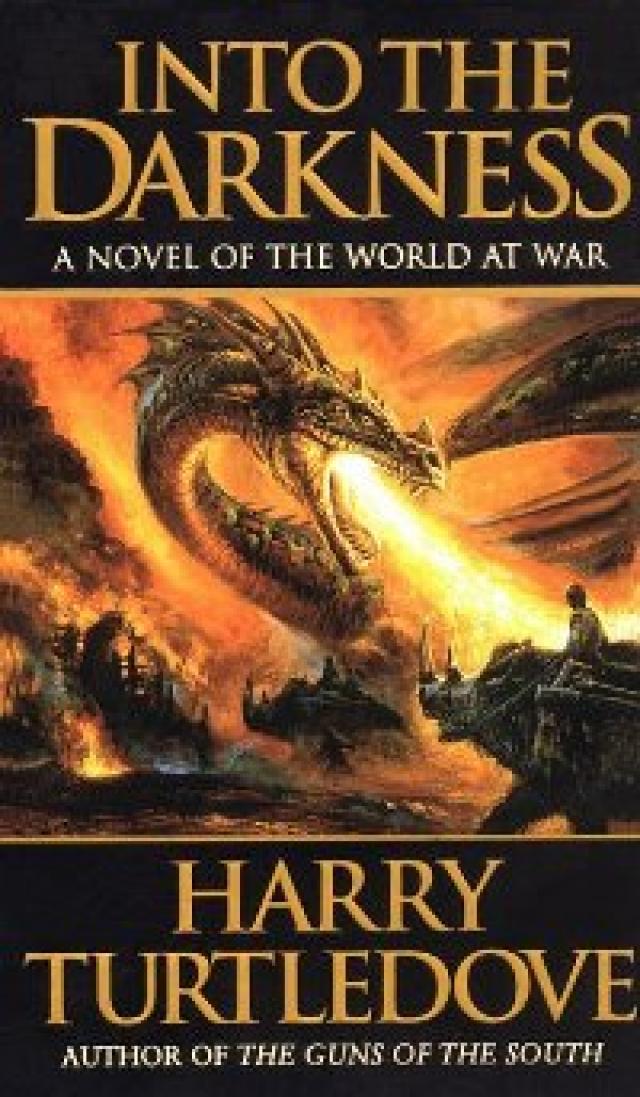
More shouts produced lanes between blocks of men. Unicorn and horse cavalry trotted forward to screen the footsoldiers who would do the bulk of the fighting. Forthwegian dragons flew overhead, some so high as to be only specks, others low enough to let Leofsig hear their shrill screeches.
“I hope they drop plenty of eggs on Gozzo,” Beocca said.
“I hope they keep the Algarvians from dropping eggs on us,” Leofsig added. After a moment, Beocca grunted agreement.
As the Forthwegians drew nearer to Gozzo, Leofsig kept cocking his head and looking up into the sky every so often. Even so, he was cautiously skirting a hedgerow when the Algarvian dragons came racing out of the east to challenge those of his kingdom.
The first he knew of the battle overhead was when a dragon fell out of the sky and smashed to earth a hundred yards or so in front of him. The great beast writhed in its death agony, throwing now its silvered belly, now its back—painted Forthwegian blue and white—uppermost. Its flier lay motionless, a small, crumpled heap, a few feet away. Flame spurted from the dragon’s jaw, cremating the man who had taken it into action.
Leofsig looked up again: looked up and gasped in horror. He had seen very few Algarvian dragons till now. That had led him to believe the enemy had very few, or very few they could commit against the Forthwegians, at any rate. Since they were also fighting Jelgava and Valmiera and Sibiu, that made sense to him.
It might have made sense, but it proved untrue. Suddenly, two or three times the Forthwegians’ numbers beset them. Dragons tumbled to earth, burned or even clawed by their foes. Most were marked in blue and white, not Algarvian green, red, and white. Other dragons, their fliers killed by an enemy’s stick, either flew off at random or, mad with battle, struck out at friends and foes alike.
In what seemed the twinkling of an eye, the Forthwegian dragon-swarm was shattered. The remnant not sent spinning to their doom or flying wild without a man to guide them fled back toward Forthweg. They might fight another day. Against overwhelming odds, they would not fight above this field. Inside half an hour, Algarve, not Forthweg, ruled the skies.
Beocca made a rumbling noise, deep in his throat. “Now we’re in for it,” he said. Leofsig could only nod. The same thought, in the same words, had gone through his mind, too.
Most of the dragons that had driven off the Forthwegian swarm had flown without eggs, making them faster and more maneuverable in the air. Now still more flew in from the direction of Gozzo. Some of their fliers released their eggs from on high, as was the usual Forthwegian practice—the usual practice everywhere, so far as Leofsig knew.
But the enemy, with Algarvian panache, had also found a new way. Some of the Algarvian fliers made their dragons stoop on the Forthwegian forces below like a falcon stooping on a mouse. They loosed the eggs the dragons carried at what seemed hardly more than treetop height, then pulled out of their dives and flew away, no doubt laughing at their foes’ discomfiture.
One of them, off to Leofsig’s right, misjudged his dive and smashed into the ground. The egg he carried erupted, searing flier and dragon both in its burst of flame. “Serves you right!” Leofsig shouted, though the flier was far beyond hearing. But the Algarvian’s swooping comrades kept on, placing their eggs far more precisely than did those who did not dive; they tore terrible holes in the Forthwegians’ ranks.
“Forward!” an officer shouted. Leofsig heard him through stunned and battered ears. “We must go forward, for the honor of King Penda and of Forthweg!”
Forward Leofsig stumbled. Around him, men raised a cheer. After a moment, he joined it. Turning to Beocca, he said, “Once we close with the Algarvians, we’ll crush them.”
“Aye, belike,” Beocca answered, “if there are any of us left to do the closing.”
As if to underscore that, more eggs started falling among the advancing Forthwegians. Not all of them—not even most of them—came from the dragons overhead. The army had come into range of the egg-tossers outside Gozzo. Dragons carried larger eggs than the tossers flung, but could not carry nearly so many; Leofsig, head down and hunched forward as if walking into a windstorm, trudged past a broken-backed unicorn, one side of its body all over burns, that dragged itself along on its forelegs and screamed like a woman.
Forthwegian egg-tossers answered the rain of fire as best they could. But they’d had trouble keeping up with the rest of the army: horse-drawn wheeled tossers clogged roads and moved slowly going crosscountry, while the retreating Algarvians had sabotaged ley lines as they fell back. Forthwegian mages had reenergized some, but far from all. And, to make matters worse, the diving dragons paid special attention to the egg-tossers that were on the field.