Into the darkness d 1, p.52
Into the Darkness d-1,
p.52
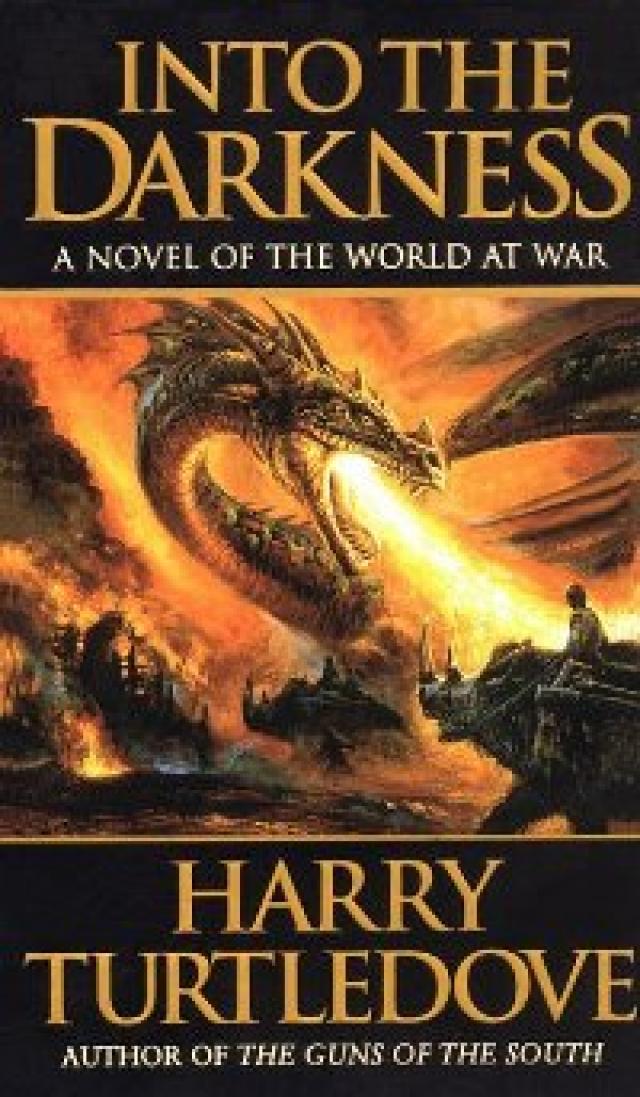


And then, before the Gyongyosians had got off the wooded slopes of Mt. Sorong, eggs began falling around them. “The stinking slanteyes have brought another dragon transport with them,” somebody yelled.
When Istvan came out from under the trees for a moment, he looked up into the heavens. It was still too dark for him to see much, but he did spy a couple of spurts of fire. That meant Gyongyosian dragons had got into the air, too, and were contesting the sky above Obuda with the Kuusamans.
He came down on to the flatlands that led to the Bothnian Ocean. He knew exactly which trenches his company had to occupy. Serving Borsos had got him out of a lot of exercises, but not all of them. He discovered he still remembered such basics as taking cover and making sure no dirt fouled the business end of his stick.
“By the stars!” said one of his comrades, a burly youngster named Szonyi. “Will you look at all the ships!”
Istvan did look, and then cursed some more. “The Kuusamans brought everything they’ve got this time, didn’t they?” he said. He couldn’t begin to guess how many ships were silhouetted against the brightening sky, but he was certain of one thing: that fleet was larger than the one the Gyongyosians had in local waters.
“Don’t despair!” an officer down the trench shouted. “Never despair! Are we not men? Are we not warriors?” In more practical tones, he went on, “Have we not got our great garrison on this island as well as our ships?”
That did help steady Istvan. He stopped feeling as if he were alone and facing the Kuusaman fleet without anyone to aid him. Egg-tossers on and near the beach began flinging their deadly cargo at the foe. Plumes of water mounting high in the air told of near misses. A burst of fire and a plume of smoke told of a hit. Istvan yelled himself hoarse.
But the Kuusamans had brought heavy warships east along the ley lines to Obuda. They carried egg-tossers that matched any the Gyongyosians had mounted on the island. Eggs came whistling in, some aimed at the tossers opposing the Kuusamans, others at the trenches where Istvan and his comrades crouched. He felt trapped in an earthquake that would not end. Not far away, wounded men wailed.
Like any others, Kuusaman cruisers also mounted sticks far heavier than a soldier or even a behemoth could bear. Where their mighty beams smote, smoke sprang skyward. A soldier caught in one of them burned like a moth flying through a torch flame. Istvan hoped the poor fellow hadn’t had time to realize he was dead.
“Look!” Szonyi pointed. “Some of our dragons have broken through!”
Sure enough, several dragons were diving on the Kuusaman fleet. Szonyi wasn’t the only one to have spotted them. But those great sticks could point to the sky as well as toward Obuda. Dragons could not withstand their beams, as they could the ones from the common soldiers’ sticks. One after another, Gyongyosian dragons plunged burning into the sea.
Yet the dragons were fast and agile. Their fliers were fearless, they themselves too stupid to be afraid. Not all were struck before the fliers could release their eggs and even pass low above the warships’ decks. The dragons flamed, enveloping Kuusaman sailors in fire, then flapped away.
“For all the good we’re doing here, we might as well have stayed asleep in the barracks,” Istvan said. “It was like that the last time the Kuusamans tried to take Obuda away from us, too.”
“I don’t think it will stay that way this time,” Sergeant Jokai said. “I wish it would, but I don’t think it will. Those sons of goats have brought a lot more ships and a lot more dragons than they did last time.”
The offshore battle went on for most of the morning. The Gyongyosian admiral in command at Obuda threw in his ships a few at a time, which meant they were defeated a few at a time. Had he hurled the whole fleet at the Kuusamans, he might have accomplished more. As things were, the would-be invaders slowly beat down the Gyongyosian defenses.
Somewhere around noon, a new cry arose, one in which Istvan joined: “Here come the boats!”
Not all the Gyongyosian egg-tossers had been wrecked. Indeed, some had not taken part in the earlier fight against the Kuusaman naval expedition, and so had given the foe no clue about their position. Istvan shouted with glee as eggs fell among the boats carrying Kuusaman soldiers, wrecking some and overturning others.
Gyongyos painted her dragons in gaudy stripes of red and blue, black and yellow. They dove on the invaders. The small boats carried no sticks strong enough to slay them as they dove, and some of those boats began to burn.
But most kept on coming toward the beaches of Obuda. A few, the larger ones, glided swiftly along the ley lines whose convergence at the island made it a bone of contention between Gyongyos and Kuusamo. The rest advanced as they might have in the ancient days of the world, pushed by the wind or pulled by oars.
Small, stocky, dark-haired soldiers crowded the boats. “They don’t look so tough,” said Szonyi, who hadn’t been on Obuda long enough to have seen Kuusamans before. “I could break one of them in half.”
He was on the weedy side as Gyongyosians went, but that didn’t mean he was wrong. It also didn’t mean being right would do him any good, which he didn’t seem to realize. Istvan made things as plain as he could: “As long as the slanteyes have sticks and know what to do with them—and they do, curse ’em, they do—you won’t get close enough to break ’em in half.”
“That’s the truth.” Sergeant Jokai sounded surprised to be agreeing with Istvan instead of harassing him, but he did. “Don’t think for even a minute that those ugly little bastards can’t fight, because they cursed well can. And don’t think they can’t take this stinking island away from us, because they’ve done that, too. The thing is, we’d better not let ’em do it again, not if we want to go on looking up at the stars.”
The Kuusaman captives the Gyongyosians had taken when they last seized Obuda were slave laborers back on the mainland of Derlavai or on the other islands Ekrekek Arpad ruled. Something similarly unpleasant no doubt befell captured Gyongyosians in Kuusaman hands. An enslaved captive might still look up at the stars, but how much joy could he take in doing it?
Istvan hoped he would not have to find out. Kuusaman boats began beaching. Soldiers jumped out of them and ran for what cover they could find. Istvan and his comrades blazed away at them, and knocked down a good many. But not all the Kuusamans came ashore in front of positions that hadn’t been too badly knocked about. Cries of alarm warned that some of the invaders were outflanking the Gyongyosian defenders.
“Fall back!” an officer shouted. “We’ll make a stand on Mt. Sorong.”
Retreat was galling to any troops, and more galling to the Gyongyosians, who fancied themselves a warrior race, than to most. If the choice was retreating or being attacked from the front and flanks at the same time, though, even the fiercest fighters saw where sense lay.
Eggs burst not far from Istvan and his comrades as they fell back. “Curse the Kuusamans all over again,” Jokai snarled. “They’ve gone and fetched light tossers along with ’em.”
“We did the same thing when we took Obuda back,” Istvan said.
“Curse ’em anyway,” his sergeant replied, a sentiment with which he could hardly disagree.
More eggs burst ahead of them, these large, throwing up great columns of riven earth. High in the sky, a dragon screeched harshly. Jokai had been right; the Kuusamans were indeed far better prepared for this attack than they had been for the one the year before.
Kuusaman eggs had already wrecked some of the defensive positions on the lower slopes of Mt. Sorong. As Istvan wearily stumbled into an undamaged trench, he asked the question surely uppermost in his comrades’ minds as well: “Will we be able to hold out here?”
Whatever else Sergeant Jokai was, he was forthright. He answered, “It doesn’t really depend on us. If the stinking slanteyes can hold the sea around this miserable island, they’ll be able to bring in enough soldiers to swarm over us and enough dragons to flame all of ours out of the sky. If our ships drive theirs away, we’ll be the ones who can reinforce and they’ll be out of luck.”
That made sense, even if Istvan didn’t care for the notion that his fate rested in hands other than his own. Now that he wasn’t on the move any more, he realized he was hungry. He had a couple of small rounds of flat-bread in his belt pouch, and wolfed them down. His belly stopped growling. Some of his comrades had already eaten everything they’d brought from the barracks. No one from higher up on Mt. Sorong showed up with more in the way of supplies.
Istvan wondered if Borsos was safe, and if the dowser had given the Gyongyosians such warning as they’d had. Maybe Borsos was having to fight as a real captain would. Maybe, too, he was dead or captive by this time. Many Gyongyosians surely were.
“Nothing I can do about it now,” Istvan muttered. It was getting dark. Where, he wondered, had the day gone? Unlike most on Obuda, it hadn’t evaporated in boredom. He wrapped his blanket around himself and did his best to sleep.
By the way Skarnu swung a hoe, anyone who knew anything about farming and looked closely would have known he hadn’t spent much time working in a field. Some of the Algarvian soldiers trudging along the dirt road surely came from farms themselves. But they didn’t expect to sec anything but farmers in the Valmieran fields, and so they didn’t look closely.
After the soldiers had vanished behind some walnut trees, Skarnu leaned the hoe against his hip and looked at his hands. They too would have shown he was no farmer. The calluses on his palms weren’t years old and yellowed and hard as horn; he still got blisters at their edges and sometimes even under them.
His back ached. So did his shoulders and the backs of his thighs. He sighed and spoke in a low voice: “Maybe we should have surrendered after all, Sergeant. It would have been easier.”
Raunu spread his own hands. They were as raw as Skarnu’s. He was a commoner and a longtime veteran, but he’d never done work like this, either. “Easier on the body—oh, aye, no doubt about it,” he said. “But if it were easier on the spirit, we would have done it when most of the army gave up.”
“I couldn’t stomach it,” Skarnu said, “so I suppose that proves your point.”
His coarse wool tunic and trousers itched. Back when he was living the life of a marquis, he would never have let such rough cloth touch his skin. But he could not have kept up the fight against the Algarvians from a captives’ camp, and they would never have let him out of one unless they were sure he had no fight left in him. He didn’t think he could have fooled them into releasing him—and so here he was, pretending to be a peasant instead of pretending to be a collaborator.
In a matter-of-fact way, Raunu said, “If they catch us now, they’ll blaze us, of course.”
“I know. They did that in the parts of Valmiera they occupied during the Six Years’ War,” Skarnu said. “I learned about it in school.”
“Aye, so they did,” Raunu answered. “And afterwards, when we were holding some of the marquisates east of the Soretto, we paid ’em back in the same coin. Anybody even looked at us sideways, we figured the son of a whore was a soldier who hadn’t had enough, and we gave it to him.”
Skarnu hadn’t learned about that in school. In his lessons, Valmiera had always had right and justice on her side. He’d believed that for a long time. He still wanted to believe it.
He stretched and twisted, trying to make his sore muscles relax. He hadn’t learned farm work in school, though. Only a noble addled far past mere eccentricity would have thought learning to till the soil in the least worthwhile.
He swung the hoe again, and did manage to uproot weed rather than wheat. “Good to know there are some folk besides us who stay loyal to king and kingdom,” he said, and knocked down another weed.
“Oh, aye, there are always some,” Raunu said. “What’s really lucky is that we found one. If we’d asked for help from half the peasants around these parts—more than half, I shouldn’t wonder—they’d have turned us in to the redheads faster than you can spit.”
“So it seems,” Skarnu said grimly. “That’s not the way it should be, you know.”
Raunu grunted and went back to weeding for a while, attacking the dandelions and other plants that didn’t belong in the field with the same concentrated ferocity he’d shown the Algarvians. At last, at the end of a row, he asked, “Sir—my lord—do I have your leave to speak what’s in my mind?”
He hadn’t called Skarnu my lord in a long time. The title, in his mouth, carried more reproach than respect. Skarnu said, “You’d better, Raunu. I don’t suppose I’ll last long if you don’t.”
“Longer than you think, maybe, but never mind that,” Raunu said. “From everything I’ve been able to piece together, though, Count Enkuru, the local lord, is a right nasty piece of work.”
“Aye, I think there’s a deal of truth to that,” Skarnu agreed. “But what has it got to do with—?” He broke off, feeling foolish. “The peasants would sooner have the Algarvians for overlords than Count Enkuru—is that what you’re saying?”
Raunu nodded. “That’s what I’m saying. Some of the nobles I’ve known, they never would have figured out what I meant.” He took a deep breath. “And that’s part of the trouble Valmiera’s been having, too, don’t you see?”
“Peasants should be loyal to the nobles, as nobles should be loyal to the king,” Skarnu said.
“No doubt you’re right, sir,” Raunu said politely. “But the nobles should deserve loyalty, don’t you think?”
Skarnu’s sister would have said no in a heartbeat. Krasta would have thought—did think—her blood alone was plenty to command loyalty. She would have wanted Raunu flogged for presuming to think otherwise. Skarnu’s attitude had differed only in degree, not in essence, till he took command of his company.
Slowly, he said, “That does make a difference, doesn’t it? Men will go as far as their leaders take them, and not a step farther.” He’d seen that throughout the recent disastrous campaign.
“Aye, sir.” Raunu nodded. “And they’ll go as far in the other direction if their leaders push ’em to it—which is why we’ve got our little game laid on for tonight. We have to show ’em what we’re against along with what we’re for.”
Toward evening, the farmer who’d given them shelter came out to look over the work they’d done. Gedominu hobbled on a cane, and had ever since the Six Years’ War. Maybe that was what made him dislike the Algarvians enough to keep working against them. Skarnu couldn’t have proved it, though; Gedominu said little about himself.
He looked over the field now, rubbed his chin, and said, “Well, it’s not too much worse than if you hadn’t done anything at all.” With that praise, such as it was, ringing in their ears, he led them back to the farmhouse.
His wife served up a supper of blood sausage and sauerkraut, bread and home-brewed ale. Merkela, a second wife, might have been half Gedominu’s age, which put her not far from Skarnu’s. Skarnu wondered how the half-lame farmer had wooed and won her. He also wondered certain other things, which he hoped he was gentleman enough to keep Gedominu from noticing.
After full darkness, Gedominu slowly climbed the stairs and as slowly came down again, his cane in his right hand a stick in his left. It wasn’t so potent a weapon as the ones Skarnu and Raunu had brought to the farm, being intended more for blazing vermin and small game for the pot than for men. But a man who met that beam would go down, and might not get up again.
Gedominu tucked the stick under his arm to blow Merkela a kiss, then led Skarnu and Raunu out into the night. They got their own sticks from the barn. Gedominu moved well enough when he needed to, and took them along winding paths they couldn’t have followed themselves at night. Skarnu doubted he could have done it in broad daylight.
At a crossroads, someone softly called out, “King Gainibu!”
“Valmiera!” Gedominu answered. Skarnu would have come up with a more imaginative challenge and countersign; those would the first ones to cross the Algarvians’ minds. But that could wait for another time. Now, four or five men joined his comrades and him. Moving as quietly as they could, they hurried on toward the village of Pavilosta.
“Pity we can’t pay this kind of call on Count Enkuru himself,” Skarnu said. Seven or eight men were not enough to storm a noble’s keep, not if his guards were alert—and Enkuru’s, by all accounts, were.
“His factor will do well enough,” one of the locals answered. “His factor will do better than well enough, as a matter of fact. He’s the one who collects the taxes Enkuru screws out of us, and as much more besides to make him near as rich as the count. And you can hear for yourself that he’s in bed with the redheads. Everybody for miles around’ll be glad to see the bastard dead.”
Before the war, such talk about a noble and his factor would have been treason. Technically, Skarnu supposed it still was. But it was also a chance to strike a blow at Algarve. That counted for more.
Gedominu underlined the point, saying, “Folks have got to learn they don’t just go ahead and do whatever some turd in a kilt tells ’em to—not without they pay the price for doin’ it.”
“Let’s be at it, then,” Raunu said. He pointed to positions that covered the factor’s house—much the largest and finest in the village—but remained in shadow. “There and there, and over there, too. Move!” The locals hurried to obey. Skarnu let his sergeant give orders. Raunu had proved he knew what he was doing. Nodding to Skarnu, he said, “Now we’ll give ’em what-for.” He pried a cobblestone out of the ground and flung it through one of those invitingly large windows.
Furious shouts followed the crash of broken glass. The door flew open. A man in velvet tunic and trousers—surely the factor—and a couple of Algarvians ran out on to the street, as ants might run out of their nest if a boy stirred it with a twig. They probably thought some brat was bothering them.
They soon discovered how wrong they were, but kept the knowledge only momentarily. The raiders blazed them down. They fell without a sound: so quickly and quietly, in fact, that no one else came out to investigate. Raunu solved that by pitching another stone through a different window.